I heard that there is an ongoing movement now for people that truly care about decentralization and censorship-resistance to only publish to small relays.
That’s a great question, I don’t know. Maybe it can’t be answered, because it’s dependent on a whole bunch of social factors, like how likely relay runners are to censor users, or what a given user’s risk profile for censorship looks like.
In theory, 2 relays for the entire network is enough. But that introduces scaling issues and the possibility for them to cooperate in banning someone. My best guess is that at the network’s current size, 5-10 hubs is probably enough, plus relays that support special use cases, like authenticated communities and archival relays. Nerds will run their own relays, which is fine, but it doesn’t really benefit anyone as long as censorship or relay failure is only occasional. I guess what’s most important is that 1. there are backups of important data, and 2. it’s easy to create a new relay when one is needed.
No, very few people should be running relays. We have probably 10x more relays than we need right now. The point is that if one relay goes down or bans you, you have at least one other relay that can continue to serve all your stuff. This doesn’t require self-hosting.
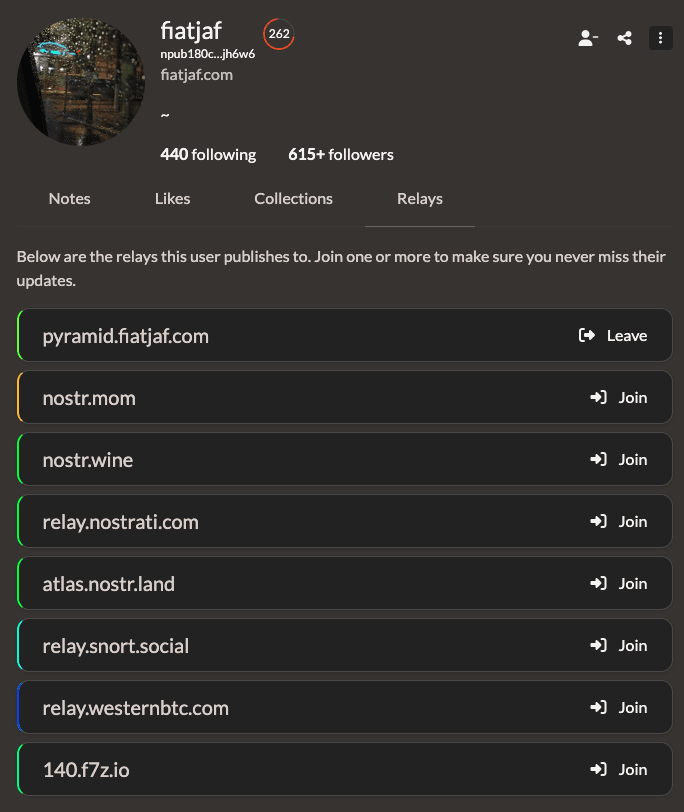
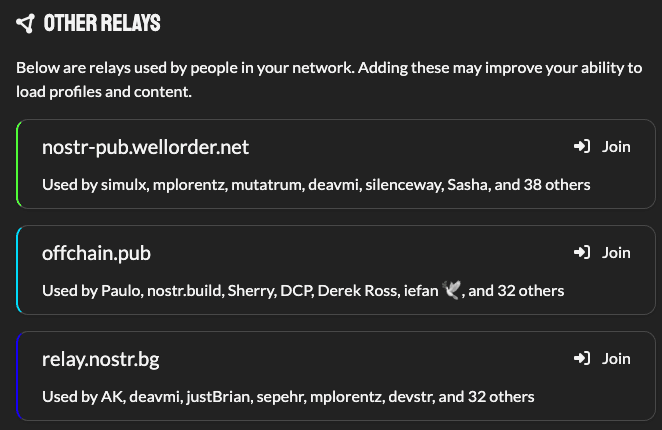
It depends on what you mean by “size”. There’s WoT size, which is where more people you follow post to a given relay:
There are also relay monitoring systems like nostr.watch that are working on a system for reporting how many active users are on a relay, along with other metrics.
No, but why? Do you want to pay 100 relays to hold your notes? Broadcast is digital squatting, made possible only by taking advantage of hobbyist relay operators.
It’s true, but also in nostr your reach is unavoidable. Clients will faithfully propagate the notez 🎵🎶 and somehow nostr.band uses telepathy to find some relay it never should have had a reason to see 😂



Write a comment