The Predator's Pedestal
The state is not society's protector but its predator, surviving through ideology and intellectual capture, growing through war, vulnerable to withdrawn consent.

The state is not society's protector but its predator, surviving through ideology and intellectual capture, growing through war, vulnerable to withdrawn consent.
The article argues that dormant Bitcoin, including Satoshi’s coins, remains legally owned, not abandoned, because inactivity alone does not extinguish property rights. It critiques proposals like eCash and BIP-361 as attempts to override ownership through protocol changes, emphasizing that such interventions conflict with both established legal principles and Bitcoin’s core design, where control--and thus ownership--is defined solely by possession of private keys.

From MySpace to Terra/LUNA, most platforms and tokens are disposable. They promise ownership but vanish with the hype, leaving creators and workers with nothing. Bitcoin is different. It is cathedral-building: slow, covenantal, sovereign, built to last for centuries. This article contrasts disposability with endurance, calling readers to build cathedrals, not art deco houses.
A clear, near-future reflection on how rent-seeking—not production—became the hidden operating system of modern economies. This article examines property taxes, 50-year mortgages, debt spirals, artificial scarcity, and the illusion of ownership, then contrasts it with the emerging Bitcoin paradigm where extraction breaks down and sovereignty returns to individuals.

Most altcoins, tokens, and NFTs are **securities** under the Howey Test. The crypto industry blurs this line to ride Bitcoin’s credibility without earning it.
Explores how centralized land and registry systems undermine true ownership and how sovereignty begins by reclaiming stewardship beyond bureaucratic permission.
While governments spend like there's no tomorrow and devalue their currencies to the limit a silent network continues to grow. It needs no approval. It doesn't ask permission. It just works. It's called Bitcoin. And it's not just money. It's a perfect republic. A real republic, without ballot boxes or parties, without licenses or favors. A system of rules that cannot be corrupted or rewritten. A space where private property is protected with mathematics and energy, not promises. Where no one rules over anyone, and everyone is equal before the code, its constitution. Bitcoin has its own division of powers, like any well-designed republic: - The code is the legislative branch. It defines the rules: twenty-one million, scheduled reduction, adjustable difficulty. They do not change by majority. They are not negotiated. They are clear, predictable and visible to all. - The miners are the executive branch. They execute those rules, validate transactions, secure the network. They do not govern. They do not legislate. They only comply with technical precision. - Nodes are the judiciary. They verify. They confirm. They reject what does not conform to protocol law. They do not buy. They don't shut down. Here's how it works. Simply, elegantly and resiliently. In a world where trust is in crisis, Bitcoin offers certainty. In an era of inflation and surveillance, it offers ownership and privacy. Its architecture is underpinned by something firmer than laws: by mathematics, energy and a network of shared principles. It doesn't need to be defended. It needs to be understood. Bitcoin does not impose. It invites. It does not demand faith. It offers verification. It is an open network that operates around the clock. A republic without borders where anyone can participate. Here, no one gives you rights: you already have them. All you need is a private key to exercise them. Bitcoin is evidence that as the old system runs out of steam, this digital republic becomes the only sensible option.

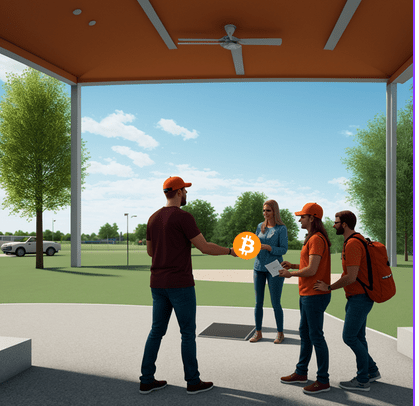
Bitcoin is not peer to peer property. Bitcoin is peer to peer electronic cash. In this blog I show you how to buy coffee using bitcoin as peer to peer electronic cash even took a vow to never spend your bitcoin. The merchant doesn't even need to know you spent any of your precious sats on your brown energy juice.