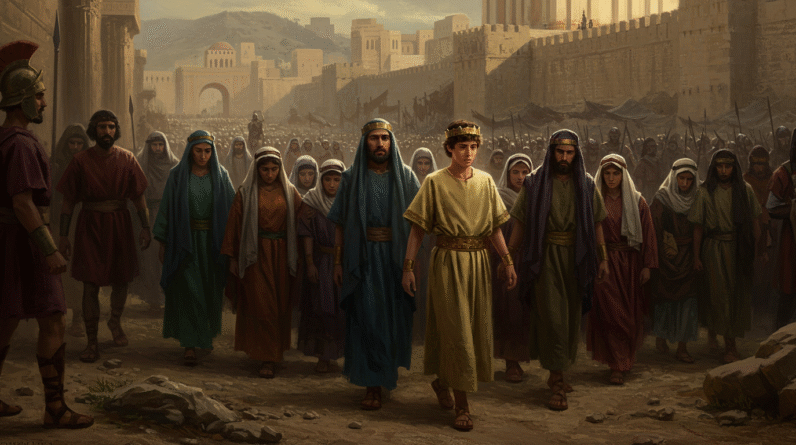
The Lord sends Jeremiah running through Jerusalem to find one righteous man so the city may be pardoned—and finds none. The foe gathers from the north and Jeremiah’s vision unmakes creation itself over a people wise to do evil. The one Just Man is found at last outside the walls, and for His sake the city is spared.
Jeremi Suri is a historian at UT Austin. Please support this podcast by checking out our sponsors:
- LMNT: https://drinkLMNT.com/lex to get free sample pack
- Munk Pack: https://munkpack.com and
Jeremi Suri is a historian at UT Austin. Please support this podcast by checking out our sponsors:
- Eight Sleep: https://www.eightsleep.com/lex to get special savings
- BetterHelp:
In the context of the provided sources, Jeremiah 50:1–51:64 is identified as a section detailing God’s use of Babylonia and his subsequent judgment upon it.
This week's class takes up Jeremiah 9, where the prophet names the root sickness twice — **"they do not know Me"** (Jer. 9:3, 9:6) — and hands us the one boast that survives it: **"that he understands and knows Me"** (Jer. 9:24). Paul later routes the whole Gospel through that verse: no flesh may boast, unless it boasts in the Lord (1 Cor. 1:31).
Jeremiah 8 is a chapter of missed chances. Judah will not turn back — the stork in the sky knows her seasons, but God's people do not know the time of the LORD's judgment — and the prophets cry 'Peace, peace' where there is no peace. 'The harvest is past, the summer is ended, and we are not saved.' And then the ache that gives the chapter its name: 'Is there no balm in Gilead? Is there no physician there?' — a question the whole Gospel rises up to answer.
Serbian boxer Miloš Stojanović Tigar, who is also the boyfriend of popular Serbian presenter Jovana Jeremić, achieved his tenth jubilee victory in his professional career by knocking out Bela Aduašvili from Georgia in the second round.
God made His people to cling to Him the way a sash clings to a man's waist (Jer. 13:11). A sash that stops clinging rots in a hole by the river and is good for nothing. Then the prophet who preached that ends up praying his people's own words back to God — they say they are called by Your name, and so does he; they say there is no healing for us, and he says my wound is incurable (Jer. 14:9, 19; 15:16, 18) — and he accuses God of being a stream that runs dry. God doesn't defend Himself. He answers with the very thing Jeremiah has been preaching: "If you return, then I will bring you back" (Jer. 15:19). Our Confessions file that line under the Gospel.