Article Not Found

The chapter could not be found.

Try searching or paste a Nostr address (naddr)

If you have the article's Nostr address (naddr), paste it in the search box below. We'll attempt to fetch it from the relays and add it to our index.

Looking for people? Search users

Open for Comment: Airworthiness Directives; Various Helicopters

Transportation Department — The FAA proposes to supersede Airworthiness Directive (AD) 2015-20-12, which applies to certain Sikorsky Aircraft Corporation Model S-61A, D, E, L, N, NM serial number (S/N) 61454, R, and V; Croman Corporation Model SH-3H; Carson Helicopters, Inc., Model S-61L and SH- 3H; Glacier Helicopter, Inc., Model CH-3E; Robinson Air Crane, Inc., Model CH-3E, CH-3C, HH-3C and HH-3E; and Siller Helicopters Model CH-3E and SH-3A helicopters. AD 2015-20-12 requires calculating or recalculating the hours time-in-service (TIS) of the main rotor shaft (MRS), determining whether the MRS is repetitive external lift (REL) or non-REL, performing a nondestructive inspection (NDI) for cracks, replacing any MRS that has cracks, replacing parts before their life limits and removing from service any parts that have exceeded their life limits. This proposed AD would also require establishing retirement lives for each REL MRS, including reducing life limits and allowing for modification of life limits based on service information, and removing any MRS with oversized dowel pin bores. Since the FAA issued AD 2015-20-12, a design re-evaluation shows that the MRS on certain helicopter models requires a lower life limit. This proposed AD would retain some of the requirements of AD 2015-20-12, and would also lower the retirement life for a certain MRS installed on certain helicopters and would update the type certificate holder name for some of the affected helicopter models. The FAA is proposing this AD to address the unsafe condition on these products. (44 days remaining)


Can Christians Watch Movies Featuring Magic and Witchcraft? Two Pastors Debate.

When J.K. Rowling’s "Harry Potter" series became a film franchise in 2001, it intensified an existing controversy among some evangelical Christians, who argued that its positive portrayal of witchcraft could desensitize children to the occult, blur the line between fantasy and real spiritual practices, and serve as a gateway to interest in actual witchcraft or Wicca.Others argued that the magic in the series was purely fictional rather than real occult practice, that the series promoted moral values such as courage, loyalty, and self-sacrifice, and that it could be read with discernment or even used to illustrate Christian themes.While the "Harry Potter" dispute is largely a thing of the past, the debate over whether or not it is sinful for Christians to watch movies about magic and witchcraft remains. On a recent episode of “Live Free with Josh Howerton,” co-hosts and pastors Carlos Erazo and Paul Cunningham dove into the debate. While Erazo and Cunningham disagree on the issue of movies with magic and witchcraft themes, they do agree that such entertainment falls into the “matters of conscience” category, described by Paul in Romans 14 as disputable issues on which Christians should follow their own convictions without judging others for having different convictions.Erazo, who is more restrictive with entertainment, says he asks himself four questions before deciding whether or not something is OK to engage with: “What type of content am I consuming?”“What is it glorifying?” “Who is the author, and what's his intent or purpose?”“Is it redeeming that which the Bible calls a sin?” When he applies these questions to the "Harry Potter" books and movies, for example, he walks away with a conviction to abstain from them. “'Harry Potter' glorifies something the Bible explicitly condemns, and the specific things it glorifies, I believe, are spiritually dangerous,” he says, citing Deuteronomy 18’s forbiddance of practicing divination, fortune-telling, sorcery, charms, necromancy, and the like. “'Harry Potter' portrays all of these elements as good, exciting, and heroic, and in many ways, we are invited to love these characters, see them as heroes, and love what they do. And so as a Christian, I reject that,” says Erazo, emphasizing that witchcraft is not fictional but a very real practice used by millions of people. Cunningham sees the issue differently. He draws a distinction between committing a sin and watching a fictional character commit a sin. He gives the example of the "John Wick" series, which Erazo says he enjoys watching. The film revolves around a retired assassin who goes on a sustained killing spree for revenge. “If you use that train of logic,” Cunningham argues, “I think you have to land at the exact same place with 'Harry Potter' because both 'John Wick' and 'Harry Potter' … [have sins] that happen in the real world and can happen in the real world. In those movies, it glorifies them.” To hear more of the debate, watch the episode above. Join BlazeTV+ and start watching Josh today at blazetv.com/JOSH. Use promo code JOSH to get $20 off your subscription.

Cover image for Can Christians Watch Movies Featuring Magic and Witchcraft? Two Pastors Debate.

Jeremiah Chapter 20

Last week Jeremiah smashed a jar in the garbage valley. This week we find out what it cost him: Pashhur, the chief officer of the temple police, beats him and locks him in the stocks overnight, and Jeremiah opens his mouth and says the worst thing anybody says to God in the Old Testament — O LORD, You induced me, and I was persuaded (Jer. 20:7). Then watch one word walk through the next five verses: God prevailed over him, his friends expect to prevail against him, and they will not — because nineteen chapters back the promise was already standing, they shall not prevail against you (Jer. 1:19). His enemies cannot win against him precisely because God already did.

Cover image for Jeremiah Chapter 20

The Wojak Was Right: Jesus Was NOT a Jew

The meme’s “Jewish Jesus” is a later Catholic forgery. Marcion’s First New Testament—the Evangelion and Apostolikon—strips away every interpolated Jewish detail and reveals the true Christ: emissary of the unknown, wholly good God who came to liberate humanity from Yahweh.

Cover image for The Wojak Was Right: Jesus Was NOT a Jew

Biblestr is live!

Yes, we actually managed to get this working. It was a crazy idea, but we #GitCitadel residents-and-frens are crazy enough to get it working.

Cover image for Biblestr is live!

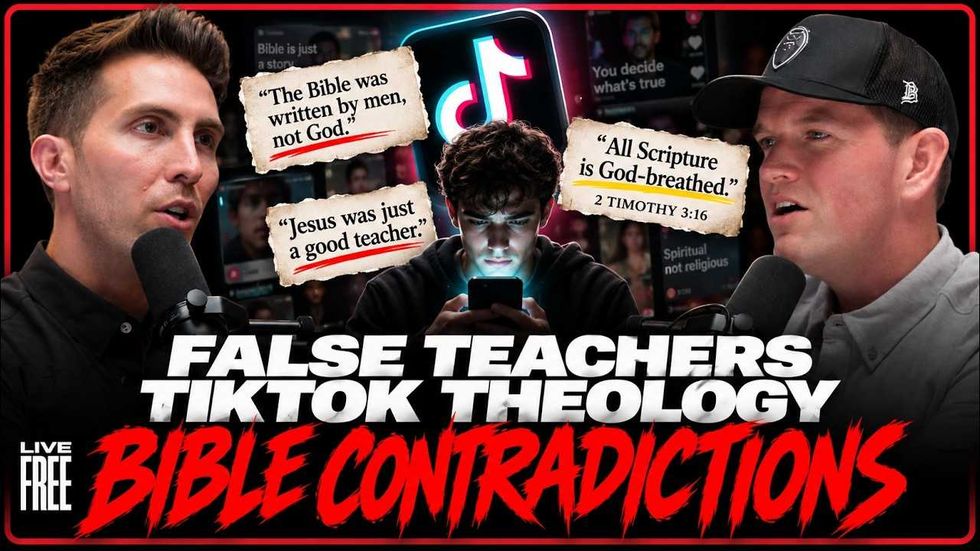
Does the Bible really contradict itself? Pastors take on viral TikTok theology

In a day where TikTok theology is wracking up millions of views, it’s more important than ever for Christians to know what the Bible actually says. On this episode of “Live Free,” Josh Howerton’s co-hosts and fellow pastors Paul Cunningham and Carlos Erazo address a viral TikTok video, in which the creator claims the Bible has several contradictions. “The Bible says that God is all-knowing. Psalm 147:5 says that His understanding is infinite. First John 3:20 says that God knows all things. Matthew 10:30 says that He knows the number of hairs on our heads,” the video creator began. “But in Genesis 18, God says He's going to go down to the cities of Sodom and Gomorrah to know how sinful they're being. An all-knowing God would know that. He wouldn't have to go down there. Also, an all-present God would already be there,” he argued.In his second claim, he argued that the empty story was inconsistent across the gospels: “In the books of Matthew and Luke in the Resurrection story, it says that the women who discovered the empty tomb ran off and told everyone that the tomb was empty. But in the book of Mark, it says that the women were afraid and didn't tell anyone.” The creator’s final claim aimed to debunk the Bible’s definition of love: “And then of course there's the whole God is love, but then it also says that love is patient and kind, never jealous or boast. But then it says that God is a jealous God. So how could God be love if love isn't jealous?” Cunningham begins by addressing the TikTok creator’s claim about love and jealousy, pointing to the semantics of the word “jealous.”“The same word can be used in certain ways in certain contexts that would be appropriate and in other ways that would be inappropriate,” he says. He gives the example of a husband being jealous regarding his wife. “I should not be jealous if my wife were simply to say hello to a male co-worker, but I actually should be jealous if my wife slept with that male co-worker,” he explains. “The reason I give that analogy is that usually when it says God is jealous in the Bible, it's in relationship to His people, Israel, and it talks about in context that they are His bride and they are giving love to a different god or a different thing that only belongs to Him,” he adds. Erazo then dives into the creator’s claim that an all-knowing God would not have to visit Sodom and Gomorrah to find out what the people were up to. He gives the analogy of playing hide-and-seek with his 4-year-old son. “I'll say, ‘Where are you? I don't see you.’ I know where he is because I'm his father,” he says. “And so when God seems to be asking questions and when He seems to not know one thing, He knows.” “A fancy phrase for that is called anthropomorphic language,” adds Cunningham. “God has to use language we can understand to help us understand a God we can't completely understand.” Above all, Cunningham and Erazo want believers to not allow “seeming contradictions” to shake their faith. “When you see videos like this, don't freak out if they bring up something you've never thought about because someone else has thought about it and probably given a really good answer for it,” says Cunningham. To hear the duo’s full response to the video and other kinds of TikTok theology, watch the episode above. Join BlazeTV+ and start watching Josh today at blazetv.com/JOSH. Use promo code JOSH to get $20 off your subscription.

Cover image for Does the Bible really contradict itself? Pastors take on viral TikTok theology
Return to Homepage