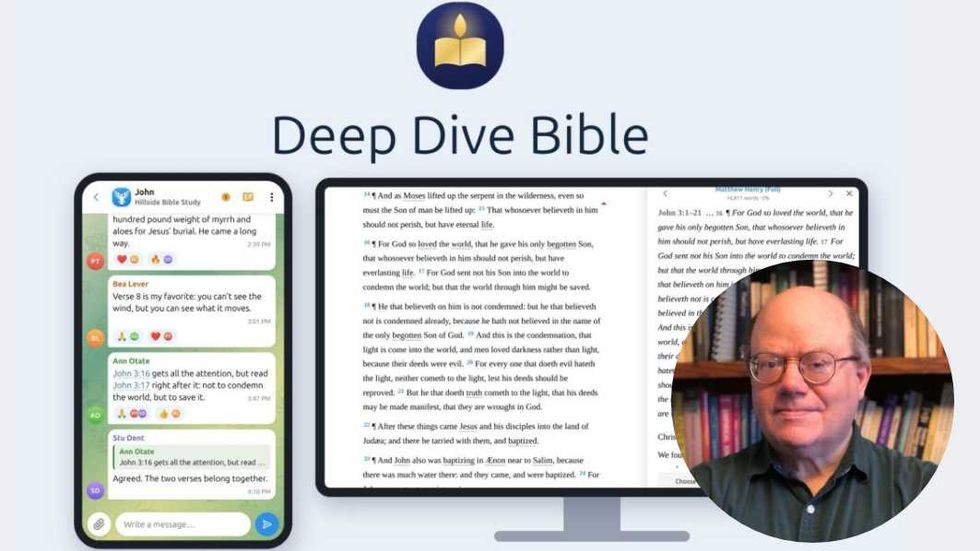
Wikipedia co-founder Larry Sanger has a new project. This time, he's helping people navigate the Bible.His Deep Dive Bible, officially launched November 2, puts Scripture, commentaries, reference materials, and group discussion in one place. It's free, and you don't even need an account to start reading.'The Bible could sustain interrogation; who knew?'"If you read the Bible with an app, you probably switch between the text, references, and maybe a group study," Sanger wrote on X."What if all three worked together?"Sanger calls the project "free, forever: a gift to the whole Church."Plenty to exploreThe site's welcome page lists 15 English Bible translations, including the King James Version, English Standard Version, New International Version, and New American Standard Bible. You can read translations side by side or consult commentaries on individual verses without leaving the reader.There are 55 commentaries, 15 reference works, and 220 maps, according to the site. For more ambitious students, there are Hebrew and Greek study tools, interlinear texts, and cross-references. Audio readings are also available.You can read without registering; a free account lets you save your progress, make notes, highlight passages, and join group studies organized around particular readings and discussion topics.The site is still labeled beta, but Sanger says it will remain free, supported by donations.RELATED: To raise Christian children who become Christian adults, one simple habit matters most Eric Thayer/Getty ImagesFrom skeptic to believerSanger has good reason to take Bible study seriously. Raised Lutheran, he lost his faith as a teenager and spent more than 35 years as an agnostic. He went on to earn a doctorate in philosophy, co-found Wikipedia, and build a career devoted to organizing information online.In December 2019, he decided to read the Bible cover to cover. He wasn't looking for a conversion. He wanted to understand a book he had long dismissed without, by his own admission, having studied it properly.Armed with study Bibles, maps, dictionaries, and commentaries, Sanger began working through Scripture. What he found surprised him."The Bible could sustain interrogation; who knew?" he recalled in his 2025 conversion testimony.By late February 2020, he had privately acknowledged his belief in God. He didn't make a full public declaration of his Christian faith until five years later."I never had a mind-blowing conversion experience," he wrote. His faith came slowly through reading, questioning, and reconsidering arguments he had once found unpersuasive.Questions welcomeHe never stopped studying. In April 2020, Sanger started an online Bible-study group on YouVersion, later moving it to Telegram. This September, he gave the group its own website, bringing along the archive of earlier discussions.The software behind Deep Dive Bible, called Chatiferous, was built using Anthropic's Claude AI, with Sanger directing the project. It's released under a free-software license, and the site is being opened to other Bible-study groups.In a 2023 guide to reading the Bible, Sanger urged readers to make use of commentaries, maps, encyclopedias, and study groups. He was especially insistent that readers shouldn't be afraid to ask questions."It is not only OK to ask questions," he wrote, "it is essential that you both ask your questions and get them answered."