Where do web of trust score calculations come from? Some say they should be based on follows. Others say no, we should replace follows with explicit attestations of trust. The article synthesizes these viewpoints to propose that web of trust must incorporate ANY AND EVERY PIECE OF DATA that is available and relevant to the question at hand. For this to work, we propose a process called INTERPRETATION that converts raw data of any format into an internally standardized "ratings format" that can be recognized by our web of trust algorithm of choice.
Bad actors can easily fool personalized PageRank using the link farm attack. Well-placed NIP-56 reports can pick off bad actors like a sniper rifle, effectively cleaving away an entire link farm with only a small handful of well placed reports.
Personalized, portable trust metrics on Nostr require standardized protocols to communicate trust metrics from Web of Trust Service Providers to Nostr clients. Open, shared protocols will empower users, prevent vendor lock-in and accelerate adoption, just as they did for email and Lightning.
Key rotation is an existential problem that cries out for an answer. This article outlines a simple, workable solution that uses personalized web of trust to keep track of key rotation events. We propose no new NIPs or event kinds, instead relying on the Decentralized Lists NIP to establish a simple protocol that can be expanded upon later. A Key Rotation Manager client would make an excellent entry into the upcoming web of trust hackathon!
Web of Trust systems in nostr need to generate trust metrics that are contextual, personalized to the end user, and portable throughout the ecosystem. These requirements, in particular the portability requirement, can only be realized when trust metrics are calculated independently of the nostr clients that consume them. This article explores how innovative solutions like Trusted Assertions can make this a reality.
This article outlines a simple system to delegate curation of nostr NIPs to your personalized web of trust. Custom NIPs (kind 30817) at NostrHub.io will be enhanced using kind 7 reactions (+/−) for up/downvotes. Reactions will be filtered using personalized GrapeRank metrics communicated via Trusted Assertions. Additional features can be added in the future to ensure a rich, robust and truly decentralized system of NIP management.
Nostr should have a marketplace of third party service providers that calculate personalized trust metrics for consumption by nostr clients. This will enable the development of more sophisticated trust metrics, promote consistency of the user experience across nostr, and free up client resources to focus on their core missions.
This is a high level overview of the GrapeRank algorithm for personalized trust metrics. The baseline GrapeRank metric functions as a method of nostr pubkey verification: kind 3 follows are favorable indicators, with mutes and reports being disfavorable. A well defined pathway exists to incorporate additional indicators and to create additional, contextual GrapeRank metrics for a variety of applications.
I discuss how to integrate personalized trust metrics generated by independent service providers into your nostr client using NIP-85: Trusted Assertions.
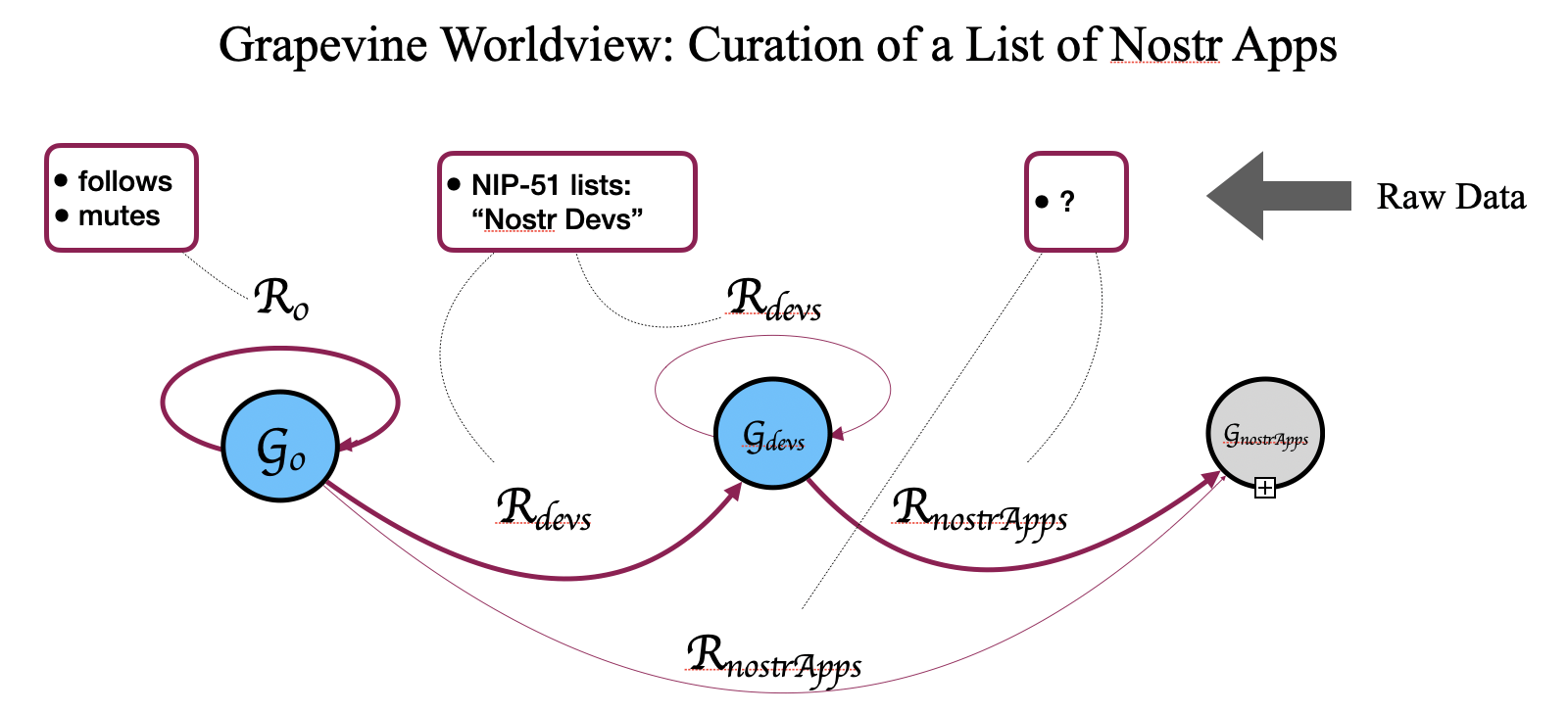
The Grapevine Worldview is a control panel and visualization tool for the curation of content, facts, and information by your grapevine. This article presents an example worldview, one that corresponds to the dynamic, decentralized curation of a list of nostr apps.
To make web of trust work, we need to think more deeply about how exactly trust scores are calculated, and we need to expand our dataset to include explicit trust attestations in addition to proxy trust indicators.