Free Poison — 2. Pharaoh's House
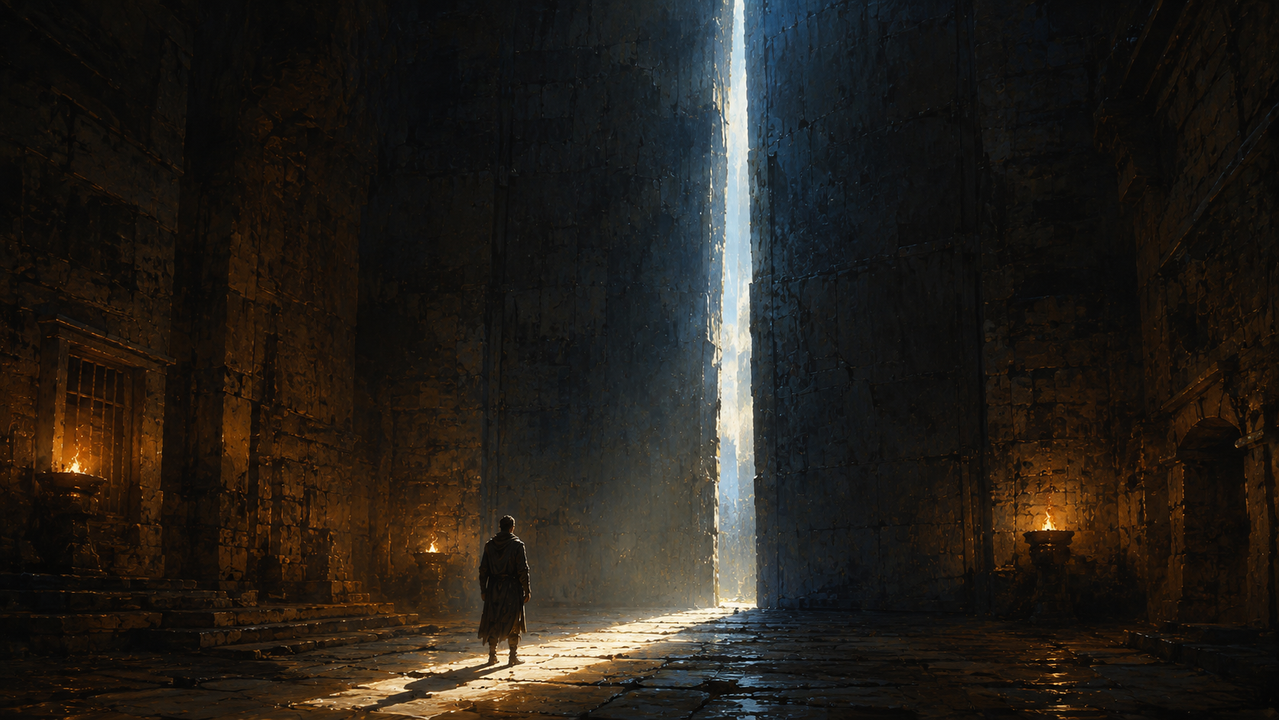
There are these two young fish swimming along and they happen to meet an older fish swimming the other way, who nods at them and says ‘Morning, boys. How’s the water?’ And the two young fish swim on for a bit, and then eventually one of them looks over at the other and goes ’What the hell is water?
— David Foster Wallace, This Is Water, 2005
A slave born in the house does not dream of freedom. He can’t. You can only want a thing you’re able to picture, and he has no picture. His father was born here and his father before that, the walls of the compound are the edge of the known world, and the overseer is simply how mornings happen. Ask him if he’s free and the question won’t land. Free from what. This is just the shape of being alive.
He isn’t lying when he says he’s content. He genuinely is. Contentment doesn’t require freedom, it only requires the absence of a visible alternative, and the house has made very sure there isn’t one. The man is not suffering under his condition, he’s at peace inside it, and that peace is the most secure lock on the whole compound. A miserable slave might run. A content one never will. The house worked out long ago that the cheapest way to hold a man is to make sure he can’t imagine the outside.
You know something he doesn’t, and you know it in your body instead of your head, because it already happened to you once. There was a version of you that looked at the balance in your account and felt nothing remarkable. The number was just a number, the currency was just the currency, the slow bleed of it was just the cost of things going up, which is what things do, the way rain is what the sky does. You had no picture of an outside either.
And then somebody, or something, cracked the wall an inch, and light came through that shouldn’t have been there. Once you’d seen it you could not go back to not seeing it. The thing that had been invisible your entire life was suddenly the most obvious feature of the room, and you wondered how you’d missed it, how anyone misses it. You probably got a little unbearable about it, the way the recently sighted always do around the still-blind.
That is the most important thing that has ever happened to you, and it isn’t important for the reason you think. It isn’t important because you fixed your money. Fixing your money is good, but that’s not the earthquake. The earthquake is that you now have proof, burned in at a level deeper than argument, that a wall can look exactly like the edge of reality and turn out to be a wall with a door in it.
You’ve felt the specific vertigo of watching solid ground reveal itself as a floor you could walk through. Most men live and die without that feeling even once, and you’ve had it. A man who has had it even once can never again fully trust the sentence this is just how things are, because he has caught that sentence lying to his face and he knows what it feels like from the inside right before it breaks.
You were handed the one tool that matters and you used it exactly once. You took the most disorienting and liberating thing available to a modern person, the discovery that the water is water, and you applied it to a single wall and set it down. You found out the ground can be a floor, checked one board, and pronounced the whole house solid.
Every other wall you live inside, you still read as the edge of the world. You extend to your food and your children and the formation of your own soul the exact benefit of the doubt you learned the hard way not to extend to your money. You know the sentence lies. You’ve simply decided it only lies about the one thing.
It doesn’t only lie about the one thing. It lies structurally, because that is what it is for. It isn’t a conspiracy, and I said that already and I’m not taking it back. Nobody convened to build the house.
The house is what piles up when a thousand generations each reach for the nearest comfort and hand the hard parts of living to whoever will take them off their hands. It grows the way coral grows, blind and slow and enormous, until it looks so much like nature that fighting it feels like fighting the tide. But grown is not permanent, and invisible is not absent, and the fact that nobody raised the walls on purpose changes nothing about the walls being walls and you being inside them.
The invisibility is not a detail. It’s the mechanism. The house does not mainly hold you with force. Force is expensive, it makes people angry, and angry people are dangerous. The house holds you by quietly editing the range of what you’re able to want. It never has to forbid the exit as long as it can keep the exit from occurring to you as a thought. A door you can’t see beats a door that’s locked, because the locked door at least admits you’re contained, while the invisible one lets you believe you’re already standing in open air.
You are not standing in open air. You cracked one wall and mistook the crack for the horizon.
But look hard at what that crack actually was, because you’ve been reading it as your failure and it’s the opposite. Cracking the money wall was not luck and it was not a gift somebody handed you. You did it. You thought against every person around you, held a conviction that cost you something to hold, and acted on it while it was still strange and still expensive. That is a specific and rare thing a person can do, and you have already done it once with your own hands.
Most men go their whole lives and never find out they’re capable of it. They never once break with the room they were raised in. You did, and the doing of it left something in you that doesn’t leave, the same way the first heavy thing you ever lifted told you what your body was for. You are not a man who stopped at one wall. You are a man who has proof, in his own history, that he can walk through a wall at all. Almost nobody has that.
So the other rooms are not standing there to shame you with how far you have left to go. They’re standing there because you’re one of the few people alive who has demonstrated he can do the one thing they require. The work ahead of you is not a punishment for stopping early. It’s the most alive a person gets to feel, the thing you already tasted once and called the best decision you ever made, waiting for you in four more rooms. You are not behind. You are early, and you are qualified, and the house has no idea what to do with a man who knows both.
I won’t march you through the house room by room here. That’s the rest of the book, and each room gets its own reckoning, the money and the bread and the children and the thing you’d call your faith if you were honest about how little of it you hold in your own two hands. For now I want one thing lodged where you can’t shake it loose.
The peace you feel in the rooms you’ve never questioned is not evidence that those rooms are fine. It’s the same peace the man in the compound feels, the identical thing, chemically the same. The content slave and the comfortable modern both mistake the absence of a visible alternative for the absence of a cage. The only difference between him and you is that you already know, from one hard instance, that the peace can be a lie and the wall can be a door.
He never got to find that out. You did. So don’t spend it on one wall.
Write a comment