Yayoi Kusama’s Outsider Vision Became a Global Spectacle After Her Death at 97
Yayoi Kusama’s Outsider Vision Became a Global Spectacle After Her Death at 97
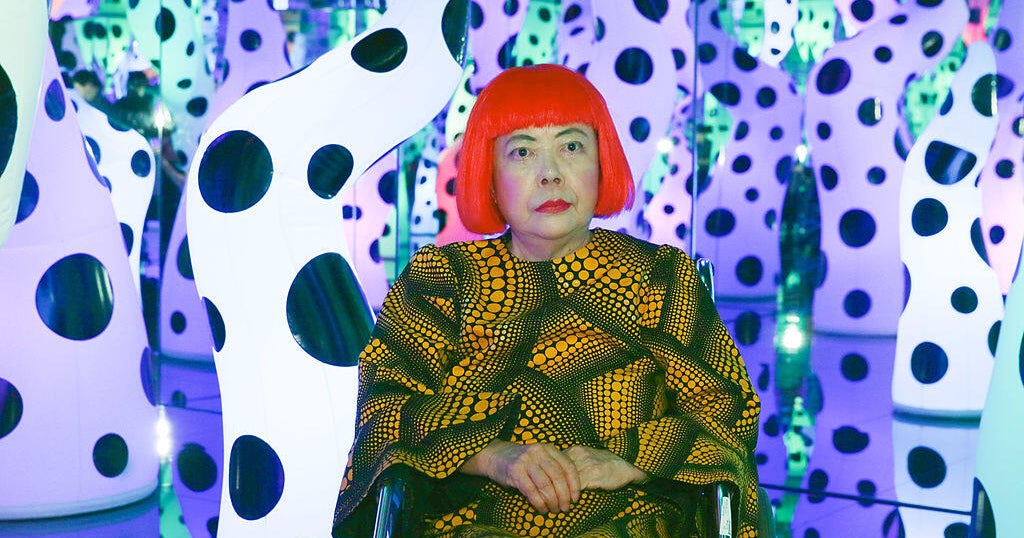
Yayoi Kusama, whose vivid dots and mirrored installations transformed private visions into a worldwide artistic language, has died at 97. Her career carried a striking tension: she was long treated as an outsider, yet ultimately became one of the most recognisable and commercially successful artists of her generation.
Her studio said Kusama died on Aug. 14 at a Tokyo hospital and continued painting “until her final days.” That image of relentless production is central to both accounts of her life: one presents a pioneering avant-garde artist whose work encompassed painting, performance, fiction and poetry; the other emphasises her determination to make art accessible to mass audiences.
The broader interpretation, however, differs in emphasis. One account foregrounds Kusama’s marginalisation, arguing that her ideas were appropriated by white male artists and that the art establishment wrote her out of history. It places her provocative 1960s performances, anti-war interventions and experiments with sexuality within a political and feminist tradition, even as critics dismissed some of the work as shock material.
The other stresses the contradiction between vulnerability and defiance. Kusama described herself as “an artistic revolutionary” while also admitting, “I am so afraid, all the time, of everything.” Her hallucinations and decades living in psychiatric institutions were not treated simply as biographical detail; they became part of the explanation for her recurring motifs of infinity, repetition and self-obliteration.
Recognition arrived late but decisively. Museum retrospectives, record auction prices, fashion collaborations and selfie-friendly installations turned the once-overlooked artist into a global phenomenon. Yet Kusama remained wary of fixed categories and once said, “It feels good to be an outsider.” Her final legacy may lie precisely in that unresolved contrast: radical experiment and commercial spectacle, personal survival and worldwide celebrity.
Write a comment