Two Survivors Offer Hope as Nepal’s Tunnel Rescue Exposes the Disaster’s Vast Human Toll
Two Survivors Offer Hope as Nepal’s Tunnel Rescue Exposes the Disaster’s Vast Human Toll
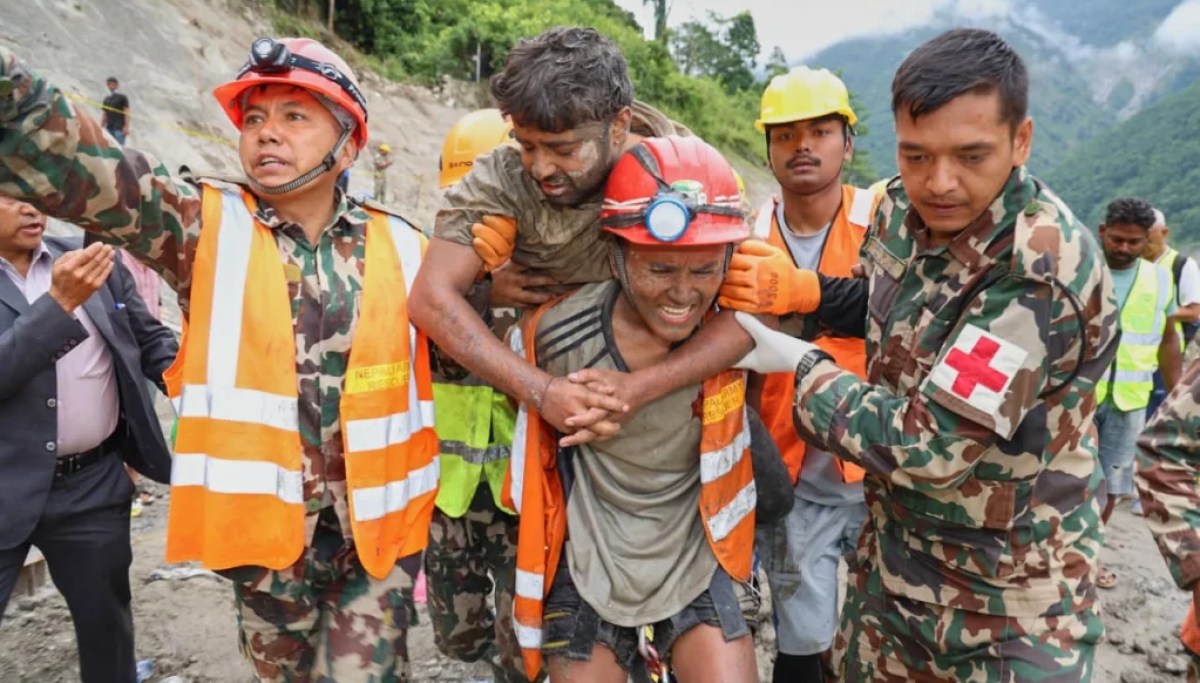
The rescue of two workers from a flooded hydropower tunnel has transformed Nepal’s disaster story from one of near-total devastation into a fragile contest between hope and exhaustion. Nine days after a glacier-related collapse sent mud, water and rock through Himalayan valleys, emergency crews are still searching for survivors—and confronting the limits of what they know.
Sanjay Shah, identified in one account as a foreman, and Kabir Maharajan, a supervisor, were pulled alive from the Upper Trishuli 3A project after rescuers reached a tunnel roughly 170 metres underground. Another report gives Shah’s surname as “Sah,” an inconsistency that reflects the chaotic flow of information during the operation.
The workers’ survival has encouraged officials and rescue specialists to keep digging. Communication Minister Bikram Timilsina wrote, “We are waiting for the rescue of more and more people,” while reports say voices were heard inside the tunnel after rescuers broke through. Families, meanwhile, have gathered at hospitals and government offices, waiting for news of relatives among the hundreds missing from hydropower sites.
The more expansive accounts stress both the human drama and the technical danger. Engineer Arnold Dix called the rescue “a real triumph for humans and humanity,” but warned that rescuers themselves could be drowned by unstable rock and rising water. At least 40 workers may remain inside Trishuli 3A, while authorities estimate that roughly 900 workers are missing across 12 projects.
The narrower official-style reports focus on the confirmed breakthrough: two men rescued, medical teams monitoring them, and operations continuing. Yet even these accounts convey the scale of the crisis, citing at least 557 workers missing from the Trishuli 3A project alone. Across the coverage, the central contrast is stark: two lives recovered offer proof that survival is possible, but the disaster’s death toll, missing-person figures and damaged infrastructure remain deeply uncertain.
Write a comment