Miloš Vučević Meets with Balint Pastor in Vrbas
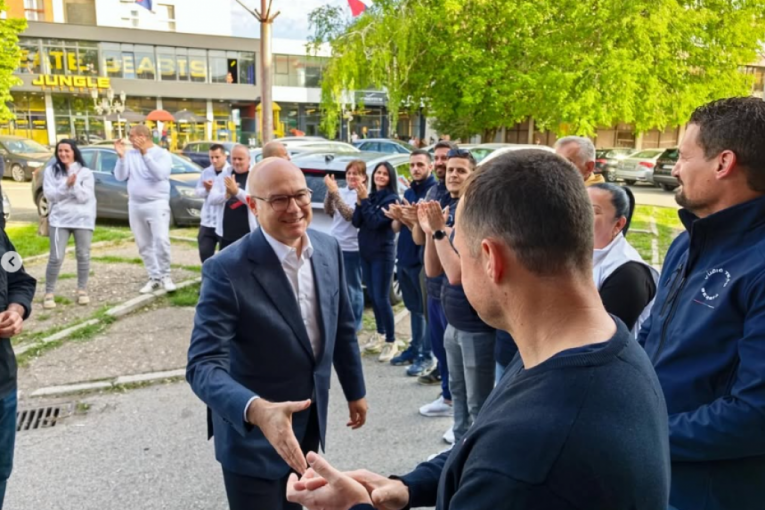
Miloš Vučević Meets with Balint Pastor in Vrbas pro-government Pro-government coverage presents the Vučević–Pastor meeting in Vrbas as a successful and widely supported reaffirmation of SNS–SVM cooperation that guarantees stability, responsibility, and concrete results for citizens. It downplays a small group of protesters as an unsuccessful disruption attempt and highlights both leaders’ shared backing of Aleksandar Vučić’s policies and Vučević’s firm pushback against opposition criticism. @Republika Miloš Vučević, leader of the Serbian Progressive Party (SNS), met with Balint Pastor, president of the Alliance of Vojvodina Hungarians (SVM), during a visit to Vrbas, where they discussed the continuation of cooperation between their parties and the implementation of an existing coalition agreement. Both sides publicly reaffirmed that their shared objectives are political and institutional stability, a sense of responsibility in governance, and delivering tangible results, and they again voiced joint support for the policies of Aleksandar Vučić at the national level. Media on both sides acknowledge that the meeting took place in Vrbas, that a small group of protesters attempted to disrupt or at least mark the visit, and that Vučević was also greeted by a larger number of supporters who applauded his arrival and speech.
Across outlets, the encounter is situated within the broader framework of long-term coalition cooperation between SNS and SVM, which has been central to power-sharing in Vojvodina and to securing parliamentary majorities at the national level. There is agreement that this meeting served to signal continuity of that partnership ahead of further political decisions and to underscore SVM’s ongoing alignment with Vučić’s governing bloc. Coverage on both sides frames the event as part of the current phase of Serbian politics marked by debates over institutional stability, scrutiny of projects built under SNS, and the management of tensions between the ruling coalition and opposition forces, especially in local contexts like Vrbas.
Areas of disagreement
Significance of the meeting. Pro-government outlets portray the Vučević–Pastor meeting as a high-level, constructive reaffirmation of a successful coalition that guarantees stability and effective governance in Vojvodina and Serbia. Opposition-aligned sources, where they cover it, tend to downplay its importance, depicting it as a routine or symbolic photo-op meant to project unity rather than announce substantive policy changes. While loyal media emphasize continuity and strategic planning, critical outlets suggest the real motive is to shore up the ruling bloc’s image amid political pressure.
Public mood and protests. Pro-government coverage stresses that Vučević was greeted by loud applause and a supportive crowd, framing the small group of protesters as a marginal, frustrated minority whose attempt to block or disrupt the visit was a “complete failure.” Opposition sources invert this emphasis, highlighting the very existence of protests in Vrbas as evidence of growing dissatisfaction with SNS rule and arguing that security controls and media choreography suppressed broader dissent. The former narrative centers on popular legitimacy and calm order, while the latter underscores tension, intimidation, and managed public space.
Characterization of opponents. Pro-government media depict opposition figures such as Dragan Đilas and local activists as irresponsible, obstructionist, and even hostile to checks on safety of projects built under SNS, presenting Vučević’s sharp reaction as principled defense of accountability. Opposition outlets, by contrast, frame Đilas and other critics as raising legitimate concerns about corruption, public safety, and misuse of state resources, and they describe Vučević’s rhetoric as aggressive deflection meant to avoid scrutiny. Thus, loyal coverage personalizes blame toward opposition leaders, whereas critical coverage personalizes it toward SNS leadership and Vučić’s circle.
Narrative about stability and responsibility. In pro-government reporting, the repeated slogans of stability, responsibility, and results are taken at face value, used to illustrate that SNS–SVM cooperation delivers concrete benefits and continuity in governance, especially for minority communities. Opposition-aligned outlets tend to treat these same terms as empty catchphrases masking authoritarian tendencies, clientelism, and exclusion of dissenting voices from decision-making processes. For the former, the meeting in Vrbas is proof that responsible actors are safeguarding institutions, while for the latter it is another step in consolidating an already dominant power structure.
In summary, opposition coverage tends to see the Vrbas meeting as an image-management exercise that glosses over popular discontent and governance problems, while pro-government coverage tends to present it as a strong, popular reaffirmation of a responsible coalition that guarantees stability and supports Aleksandar Vučić’s policy line. Story coverage
Write a comment