Cryptographic Anonymity in Social Discovery
In a standard network environment, the act of following an account is a public declaration, a piece of cryptographic evidence that allows observers to map a users interests, political leanings, and personal associations. By employing the NIP-59 standard for account management, the protocol introduces a Shadow Web of Trust. This architecture moves beyond simple encryption of content and begins the systematic obscuring of the social graph itself.
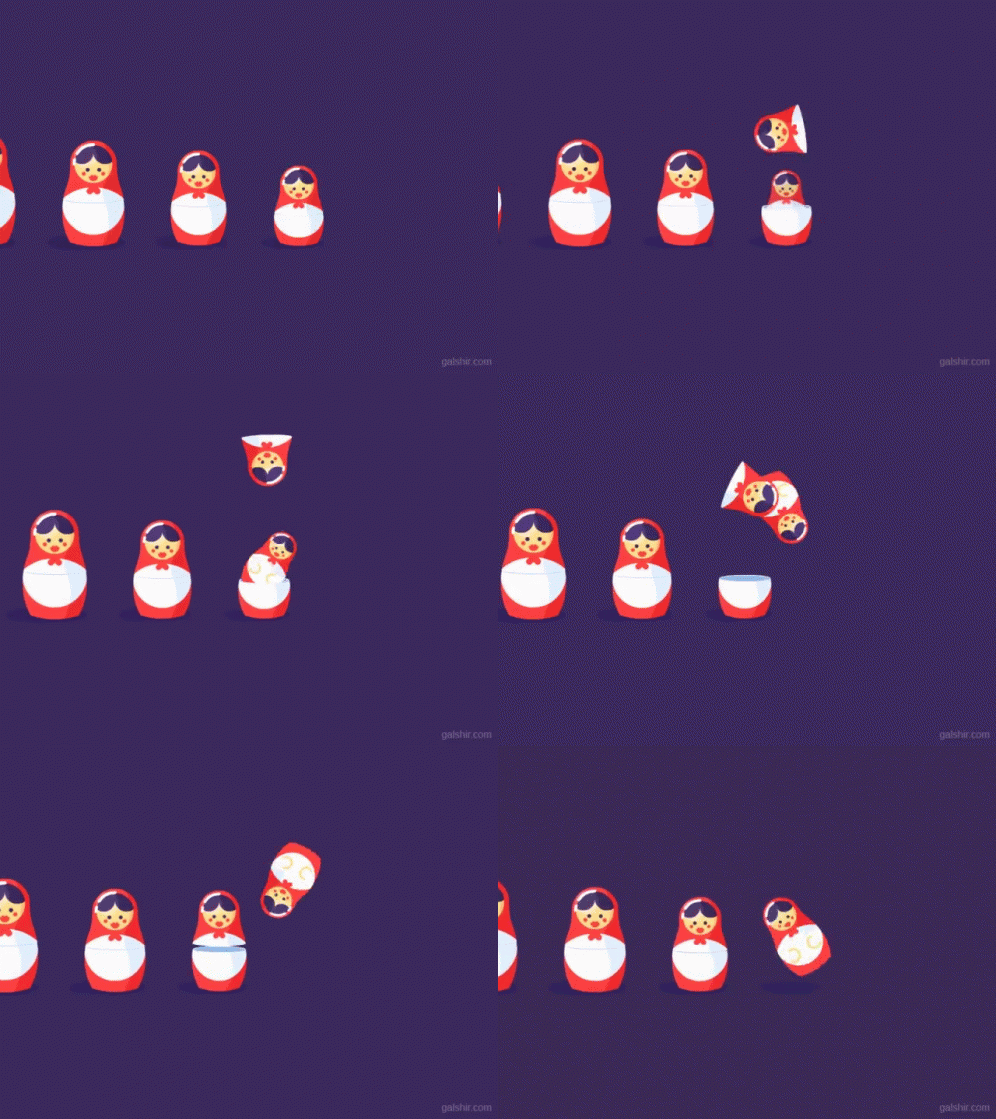
At the technical core of this transition are three distinct layers: rumors, seals, and gift wraps. A rumor represents the raw intent of the user, such as the desire to follow a specific public key. By remaining unsigned, the rumor provides a layer of plausible deniability; even if leaked, it cannot be mathematically linked to the author. This rumor is then placed inside a seal, a kind thirteen event that identifies the author to the recipient but hides the underlying content. The final layer is the gift wrap, a kind ten-ten-fifty-nine event signed by a random, one-time-use ephemeral key. This final encapsulation ensures that an external observer cannot see who is sending a message or for what purpose, as the public-facing signature belongs to a ghost identity that exists only for a single transmission.
This creates an environment where the construction of an information ecosystem is a private act of self-determination. In conventional social networking models, follow lists are commodified to drive algorithmic manipulation. Every association is fed into a commercial imperative designed to predict and influence future behavior. When these associations are moved into a Shadow Web of Trust, the link between commercial surveillance and social discovery is severed. The user is free to explore ideas and content without the metadata trailing behind them as a permanent digital shadow.
Mitigating the potential for surveillance requires more than just hiding the text of a message; it requires hiding the existence of the relationship. NIP-59 achieves this by isolating concerns across its three layers, ensuring that relays and third-party observers are blind to the social topology being formed. The implications for a censorship-resistant protocol are profound. If an adversary cannot map the connections between dissidents, researchers, or private citizens, they cannot effectively target the nodes of influence. Privacy becomes the default state of the social graph, fostering a space for unfettered exploration safe from the pressures of targeted advertising and state-level metadata analysis.
Write a comment