MBS26: Why Muslims Must Embrace Nostr

Full prepared text from the second Muslim Bitcoin Summit Nostr lecture.
04.19.26 Dallas, TX
The question is never only whether the tech just works. The more important question is what kind of human being the tech expects, and what kind of human being the tech produces. ~ @Mbitcoiner
Why Muslims Must Embrace Nostr
At the inaugural summit last year I was given the honor of hosting the Nostr workshop. To my knowledge this was the first time Nostr was presented at any formal Muslim event. The fact that this year MBS26 has dedicated space for a talk as well as a workshop[^1] I think speaks to how easy it is for us to understand and embrace liberating technologies since it is what we are already doing when we sell our fiat and start stacking sats, set up our own nodes, and withdrawn our coins from exchanges to embrace the full beauty of the bitcoin standard. Muslim Bitcoiners have been constant champions of sovereign tech and Nostr is really just a social protocol that elegantly integrates with bitcoin lightning payments to instantly and permissionlessly economize.
At last years’ workshop I framed my presentation of Nostr around this quote from @Ibn Maghreb who is a key figure in the muslim cypherpunk space[^2]. He wrote in his essay Notes on Digital Sovereignty that:
The first step towards establishing any type of Digital Sovereignty is to consider migration away from infrastructure and networks that are saturated with malevolent surveillance… there must be a simple recognition that anything sustainable from an Islamic perspective cannot be built on the platforms of Meta, Google or Amazon.
Today I’m not here to give you a state of the art on Nostr[^3]. What I want to do is discuss the idea of Digital Hijra.
I. Beyond the Technicals of Onboarding — Why Migrate to Nostr At All?
There is an essay that I think deserves more serious engagement than it’s gotten so far.
A brief manifesto on why Muslims should stop treating digital life as neutral, reject captive and extractive platforms, and begin rebuilding their technological, social, and monetary lives on sovereign foundations in service of Allah.
Understanding Digital Hijra

I believe this diagnosis of the problem of legacy social media (LSM) is correct and the theological argument needs serious consideration, but the full weight of what it is arguing for has not yet gone as hard as it needs to go. Today I want to push this argument a little further and show you what we mean when we talk about Digital Hijra and Nostr.
Reframing structural dependency as a theological problem is a stronger case than most people make when they talk about freedom tech. Discussions around convenience and security are still important but they become secondary concerns. A degradation of the moral agency that Islamic obligation presupposes is a fundamental priority to address. It shifts the conversation out of classical fiqh register, away from the halal-haram question, and into akhlaq. What kind of person and what kind of community the Islamic tradition is trying to form. That is the correct frame, and most people are not using it.
This is an area that we have not spent nearly enough time developing. What is the user or community supposed to do once they have migrated? We genuinely assume that the act of moving to sovereign tools is itself a liberating thing — that by leaving the panopticon [^4] you start to become free. We treat the infrastructure change and inner transformation as more continuous than I think they actually are. There is something to that. But I think it is imprecise in a way that we need to unpack. The person who arrives on Nostr after years inside algorithmic systems of desire-production doesn’t arrive free. They arrive carrying the formation of everything they just left. The habits of attention, the patterns of desire, the particular relationship to their own identity that those systems spent years engineering. None of that is addressed by a change of protocol.
Some would say this makes the entire project naive. I want to argue something different: that the Digital Hijra movement is right about the necessity for migration but has not yet given a full account of what migration is for. And that when it does, the objection turns out to rest on an anthropology that Islamic theology has pretty good reasons to reject.
The second objection I see is somewhat harder and something we need to sit with rather than wave off. It is the critique that Digital Hijra is strategically irrelevant. Their argument is simple. Technological acceleration is a planetary process, inhuman in scale, indifferent to what any community decides to do about it. Nobody’s migration to decentralized protocols changes the material conditions of that process. Those of us on Nostr with our relays, zapping from our lightning wallets are not founding an alternative civilization. They are building an enclave. A comfortable one, perhaps. But calling it something more than that is a kind of consolation.
That critique has real teeth. And I want to deal with it directly, because I think the answer to what’s true in it is also the answer to what’s most consequential about what the Digital Hijra movement is actually proposing.
That answer starts with getting our own history right — the Muhajirun did not retreat.
II. Hijra Is Not Retreat
Most people here have probably encountered some form of Wael Hallaq’s argument from The Impossible State. His core thesis is that the modern nation-state is not a neutral tool that Islamic political projects can simply capture and redirect. It is a metaphysically loaded organism with assumptions that produce a specific kind of subject, the citizen, whose formation is structurally incompatible with the Muslim moral subject our tradition is trying to cultivate. The Hallaqian problem[^5] is thus a problem of pyrrhic victory: you capture the machinery of the state and find that the machinery has been quietly capturing you.
This cybernetic critique extends that diagnosis into the digital domain. Accelerating techno-capital is evolving in ways that are faster than any community’s ability to route around them and fundamentally indifferent to what any group of people decides to do about it. From outside the protocol, Digital Hijra to Nostr, Bitcoin, the broader stack of freedom tech, looks like a reaction formation — a nice story about sovereignty while not meaningfully different in kind from the infrastructure we are proposing to migrate from. Our hardware is manufactured abroad in conditions of labor extraction. That supply chain isn’t something you can opt out of. As decentralized as the protocol is most internet infrastructure is still owned by the same concentrated capital we claim to escape. And it is a product of the same civilization, running on the same material base, built by developers whose cognitive and moral formation happened inside the same technological epoch. The open source cypherpunk and the surveillance capitalist are operating within the same fundamental disclosure of the world. Hallaq’s insight about the state — that it is not an inert tool but a living philosophical project — applies with equal force to digital infrastructure. You do not escape the Matrix by choosing better tools within it.
While I obviously do not agree with this argument I do think it is important to understand, as it reveals that where things have gone wrong is in our framing of hijra and a misreading of accelerationism. With Bitcoin our aim hasn’t been to re-create the western financial industry with an Islamic wrapper. So why should our approach to Nostr be any different?
The Accelerationist framework does not equate technological progress with going along with the currents of hypermodernity. The whole point is that hypermodernity is already losing coherence, having produced the conditions of its own supersession. What matters is not whether you are moving with the flows of cyberspace but whether you are moving along lines that go further and faster than civilization can accommodate or capture. This is not a question of speed. It is about direction and depth of engagement.
The Hallaqian insight — that you cannot capture or reform a metaphysically loaded system without being formed by it in return — does not lead to paralysis. It leads precisely to our founding move. If the state cannot be captured, if the platforms cannot be reformed, if the system cannot be redirected from within — then you do not try. You build outside. You found something new on different metaphysical ground, with a different account of what the human subject is and what community is for. The Hallaqian problem is not an argument against Digital Hijra. Properly understood, it is the argument for it.
And this is where the correction of the historical record becomes important. The Muhajirun were not slower than Mecca. They were more radical. The Quraysh had wealth, infrastructure, established trade networks, social legitimacy, institutional inertia — everything that looks like power from the outside. The community that left for Medina had none of that. What the Muhajirun had was a different anthropology, a different account of what human beings are for, and the willingness to build something on that account rather than negotiate endlessly with a system that was never going to accommodate them. Mecca did not evolve into Medina. Mecca became historically irrelevant. The strategic act in founding Medina was not a defensive maneuver — it was the act that made the old configuration of power obsolete.
So when someone says Digital Hijra is a retreat from the actually consequential terrain of technological development — I would suggest they have the geometry backwards. Building sovereign infrastructure, forming communities of genuine accountability and spiritual depth outside the attention economy, developing economic relationships that don’t run on surveillance and debt — this is not slower than what the mainstream is doing. It is operating on an entirely different axis. And different paradigms have a tendency, over time, to redefine what the main axis is.
This is what I mean when I say Digital Hijra is not the reactionary position but a more radical path. Our religion teaches us what human beings are, what communities are for, and what civilization is supposed to produce — and that theory is not compatible with the endpoint that instrumental rationality is accelerating toward. That incompatibility is not a weakness. It is precisely the source of whatever genuine transformative potential this movement has.
Muslim Bitcoiner’s original essay gestures toward this. What it doesn’t fully develop is the structure of what gets built after the migration. And that’s where I think the most interesting work is. The Medina model is the primary frame we need to focus on even if it makes some people uncomfortable. The Hijra was not a meditation retreat. It was the founding of a polity — with governance, economic relationships, mutual obligations built on trust, and a vision of justice it was willing to organize collective life around. The brotherhood pacts between Muhajirun and Ansar, were not warm feelings. They were new institutional forms, built deliberately from available materials, reoriented toward a different goal.
That is the ambition Digital Hijra either has, or doesn’t. I think it does. The question is whether the community forming around it is willing to take that ambition seriously rather than staying comfortable in the enclave register.
There are second-order models worth developing alongside this — the Sufi tariqa as a structure for elite formation and transmission of spiritual authority within a network, the classical rihla tradition as a model for distributed knowledge and attestation across geography. These are not alternatives to the Medina frame. They are what the Medina frame makes possible once the founding act has been taken seriously. You need the polity before the tariqa can flourish within it. You need the institutional ground before the knowledge networks have somewhere to root.
But the founding precedes all of that. And you cannot create something half-heartedly. The intention must be clearly followed through. The Muhajirun knew what they were doing. The question the Digital Hijra movement needs to answer is whether we do too.
III. Fitra and the Protocol
When we declare Digital Hijra and prescribe: migrate, change your infrastructure, move to sovereign tools — the first response is: migrate to where, exactly? And before I move on to Nostr I want to address a real issue and strategic failure that I’ve seen all too often with folks joining Nostr for the first time.
I’ll begin with a proposition that will infuriate most software developers: infrastructure change alone is not sufficient. The current systems are theologically problematic so it is right that migration becomes necessary. Where we move too fast is in implying that migration is transformative in itself — that the act of arriving somewhere new begins the work of becoming new. That conflation needs to be carefully parsed out, because the work of inner formation is not the same as the work of changing your tools. Pretending otherwise produces a community that may have excellent operational security but suffers from the same fractured attention it started with.
Machinic Desire doesn’t operate on its subjects from the outside. It operates through them. People accustomed to the attention of the algorithm don’t just become visible to it — they internalize its gaze, they regulate themselves, they conform themselves into the product, becoming the subject the system needs them to be. The observation here is not about surveillance in the crude sense of Big Brother watching you — which we already know is happening[^6] — it’s about the way extended participation in a system of such power shapes desire, attention, and the relationship to one’s own self. A person who has spent years inside the attention economy hasn’t just been watched. They’ve been formed. Their habits of reading, their tolerance for depth, their capacity for the kind of sustained contemplative study that Islamic practice actually requires — all of this has been manipulated, quietly, at the level of the nervous system, by systems that were engineered specifically to capture and redirect it.
What Nostr provides that is distinct from legacy social media platforms is a space that is a neutral environment. It is not actively engineering your desires. The algorithmic systems of LSM are desiring machines, optimized at scale to capture attention and redirect it toward engagement, outrage, and compulsive return. Nostr is not that. It does not have an algorithm selecting what you see based on what will keep you on the platform longest. It does not have an engagement metric that rewards the most inflammatory content. And it does not have an advertising infrastructure that requires your psychological vulnerability as its product.
All of that is quite significant. But it is not transformational. It is the precondition for transformation to occur. The work that happens in that space is what our tradition calls tarbiya — the formation of character, the cultivation of virtue, the slow and often uncomfortable process of becoming the kind of person Islamic moral obligation assumes you are capable of being. That work is communal, relational, somatic in the sense that it happens in the body, in practice, in repeated action over time. It is not primarily intellectual. You do not think your way through tarbiya. You are formed through it, by a community that holds you accountable, by practices that reshape attention and desire at the level where the algorithmic formation previously operated.
The deepest problem with purely secular accounts of human potentiality is not that they are wrong about the power of formation. They’re largely right about that. The problem is that they have no account of what formation is operating on. They map the substrate layers but not the transcendent. And anyone who has done serious inner work — in any spiritual tradition — knows that the psychological and the spiritual are not the same thing.
What accumulates through years inside the attention economy is sediment. Real, thick, genuinely difficult to move through. But sediment deposited on something. The residue is not the soul. Tarbiya then is not a reconstruction project. It is excavation. It is clearing. Moving through the sediment toward something that was always already there, that the system worked on but could not reach, and so buried it in mud.
Islamic theology starts somewhere different with the concept of fitra. It affirms that the human being arrives in the world already oriented. Not by social formation, nor by cultural inheritance, but by something primordial. The hadith of the Prophet ﷺ are unambiguous on this: every child is born on fitra — an innate disposition toward recognition of the divine, toward tawhid, that precedes and underlies everything that social formation subsequently builds over it.
This changes the function of digital environments entirely. To categorize Nostr as simply another reterritorialization project, where we just end up reproducing the logic of the old system, assumes that tarbiya is a technological reconstruction process — that the algorithm is the only power that brings about internal formation. This is not what Islam teaches us, and I would go so far as to say that our tradition holds is view as closer to that of shirk.
What Nostr becomes is not the site of reconstruction, but the site of unveiling. Because without the mask of the algorithm the layer at which the fitra operates once again becomes exposed. Tarbiya, on this account, is not building a new human from scratch. It is remembering. It is the gradual reassertion of an orientation that the fiat system has worked very hard to bury but could not erase.
This is why the community dynamics of Nostr matter in a way that goes beyond the practical. A community engaged in genuine tarbiya — in practices of muhasaba and muraqaba, self-accounting and vigilance, in the kind of sustained relationships that the attention economy systematically prevented — is not just doing good Islamic practice in a new location. It is creating the specific conditions under which the fitra can surface. The neutral space of the protocol and the active work of the community together constitute something the protocol alone cannot and the community alone, inside the old system, could not sustain.
The Naqshbandi Sufis have a concept in their spiritual tradition that maps well onto this — khalwat dar anjuman, solitude in the crowd. The maintenance of inner connection to Allah while being fully engaged in the world. It was developed as a description of the mature spiritual practitioner, but it names something structural that our Nostr community can embody collectively: a mode of presence in digital life that is attentive rather than compulsive, grounded rather than uploaded, and capable of the kind of depth that the attention economy was specifically designed to make impossible.
That is what Digital Hijra is for. Not escape. Not performative sovereignty. The creation of conditions in which the work of becoming what you already fundamentally are can actually proceed.
IV. The Beautiful Resistance
Linux, Nostr, Bitcoin — these are products of the same civilization that produced Google, Facebook and Apple, running on the same material infrastructure, built by people whose cognitive formation happened within the same technological epoch. The open source developer and the surveillance-state capitalist are operating within the same fundamental disclosure of the world. The question is not whether your tools are sovereign. It is whether your relationship to tools as such has been transformed. And changing which tools you use does not, by itself, answer that question because there is a metaphysical orientation that shapes the entire field of modern technological practice.
The administered world of late capitalism is not a corruption of Enlightenment rationality — it is its logical culmination. Reason, made purely instrumental, produces systems of total algorithmic control as naturally as water runs downhill. Hypermodern culture is not an aberration. It is what happens when every domain of human experience gets liquified in the logic of calculation and exchange. Digital Hijra does not solve the problems of instrumental rationality by deploying more sophisticated instrumental rationality. In certain respects it is not the negation of Enlightenment instrumental reason — it is closer to its apotheosis. Saying it is Islamic does not change what it is structurally. The infrastructural program — sovereign tools, decentralized protocols, censorship-resistant money — does not by itself escape. It relocates within the same space.
Our Islamic resistance must be an aesthetic experience. It must be an embodiment in cyber of doing that which is beautiful — ihsan. Beauty is an experience that refuses to be reduced to a simple definition. It maintains a form of negative freedom precisely by being purposeless on the administered world’s terms. Beauty doesn’t argue with constraints. It simply exists in a register that cannot be fully colonized. Art is the last defensible form of genuine resistance available within hypermodernity.
Islam’s cultivation of beauty was never ornamental. The adhan is not a notification system that happens to be aesthetically pleasing. The geometry of Islamic architecture is not decorative pattern applied to a functional structure. Arabic calligraphy is not a pretty way to transmit information. These practices cultivate a specific mode of attention — one that receives the world as meaningful, as layered with significance that exceeds its utility, as oriented toward something that cannot be calculated. The beautiful, in our Islamic tradition, is not outside the world. It is the register in which the world cannot be entirely administered. It is how our tradition has always maintained, against every form of reductive pressure, the experience of the real is not a commodity.
This is where what our Nostr community is already doing becomes significant[^7]. When a picture circulates on Nostr without an engagement metric determining its reach, something is happening that is structurally different from what happens on platforms organized around attention capture. When an article gets shared in a space that doesn’t reward the most inflammatory framing, the relationship between writer and reader is different — quieter, more demanding, more genuinely reciprocal. When art gets made and shared in a community not organized around virality, the art becomes accountable to different pressures. These are not just nice features of a better platform. They are the maintenance of non-instrumental experience within an infrastructure that is itself instrumentally structured.
The protocol doesn’t produce this. The community does. But the community can only sustain it because the protocol isn’t manufacturing the conditions under which non-instrumental experience becomes impossible by design.
This is the principle I’m advocating: that the Islamic aesthetic tradition is not a supplement to the Digital Hijra movement. It is not something you add once the infrastructure is in place. It is one of the primary mechanisms by which we must navigate through cyberspace in what our community actually produces and circulates. A Digital Hijra community that is generating genuine aesthetic practice is doing something that a purely infrastructural account of the movement cannot explain and cannot substitute for.
Art is the last refuge of non-instrumental experience in hypermodernity. Our Islamic tradition would go so far as to say it was never only a refuge — it was always a practice of formation, a resistance, a way of training attention toward what exceeds calculation. In the neutral space that the Nostr protocol provides, this practice is necessary and it becomes an integral part of the answer to the deepest critique the movement faces, especially with the dawn of artificial super intelligence.
You cannot out-rationalize an algorithmic world. But you can inhabit it differently. And Islam has always known how.
V. Islamic Hyperstitions and the Possibility of Tajdid
The Digital Hijra movement is not an Islamic digital polity that already exists somewhere waiting to be joined. It is one being enacted. This Summit, the conversations, the economic relationships running on Lightning, the aesthetic practices circulating without algorithmic mediation, the accountability structures forming between people who have chosen to trust each other in this space — these are not preparations for something that will happen later. These are all elements of Digital Hijra. Embryonic, sure. Still in formative stages. But the polity is not a future state the community is moving toward. It is what the community is in the act of becoming, right now, through the act of taking itself seriously enough to actually do something.
Consider what tajdid actually is when you look at it carefully. The concept of civilizational renewal is not a description of someone who finds an unchanged original and makes a faithful copy of it. Every act of renewal is a different act of production. The renewal constitutes what is renewed. Al-Ghazali’s revival was not a return to something that existed independently of his efforts — it was a creative act that produced a particular configuration of the tradition as authoritative, and the tradition became what he said it was through the collective enactment of his vision by subsequent generations. Ibn Taymiyya’s renewal was also produced under such fashion. Khomeini, Salahuddin, Mehmed, Tipu Sultan — all were figures who produced types of renewals that echo into our current age. They were not new religious discoveries. They were, in the precise sense I’m using, hyperstitional[^8] acts: visions of Islamic civilization that became real through the commitment of communities to living as if they were already real.
The hyperstitional claim is that this matters beyond its current scale. That a community enacting a coherent vision of Islamic digital life — with genuine spiritual depth, aesthetic practice, economic relationships outside the debt and surveillance based economy, decentralized infrastructure — that community is not just building something for itself. It is producing a proof of concept that has effects beyond itself, in ways that are not fully predictable and not fully controllable by anyone inside it. This is how Islamic civilization has always propagated. Not through central coordination but through the multiplication of communities each taking the tradition seriously in their particular location and moment, each renewal generating the conditions for the next.
And here is where the decentralized architecture of Nostr becomes theologically significant rather than just technically convenient. There is no single Digital Hijra. There cannot be, on this protocol, and that is a feature rather than a limitation. Different communities are enacting different visions of what Islamic digital life looks like — different aesthetic sensibilities, different scholarly emphases, different political orientations, different relationships to the broader questions of technology and civilization. These are not in competition in a way that requires resolution. They are in the kind of productive tension that the Islamic tradition has historically navigated through ikhtilaf — legitimate scholarly disagreement that generates depth rather than fracture.
What this means practically is that the hyperstitional potential of Digital Hijra is not dependent on any single vision winning. It is distributed across the network. Multiple relays, multiple clients, development happening in parallel, each accountable to the Islamic tradition and to each other but none requiring the others’ permission. This is structurally closer to how Islamic civilization actually functioned at its most generative — the Abbasid translation movement, the flowering of Andalusian thought, the Timbuktu scholarly networks — all more meaningful than any centralized institutional model could be.
What is immediately at stake — and I want to be precise about the scope here because the further implications exist and can be pursued elsewhere — is the possibility of a Muslim cultural and intellectual life that is not mediated through Western hegemonic infrastructure. Not as a rejection. Not as a retreat into separatism. But as the reassertion of a civilizational voice that has its own sources, its own aesthetic forms, its own modes of knowledge transmission, its own account of what human beings are and what communities are for. That voice has been present throughout modernity — often suppressed, co-opted, occasionally caricatured into forms that served other agendas — but never extinguished. The fitra, again, is not the system’s to erase.
The cultural work is foundational. It has to precede the larger questions, or those larger questions get answered in someone else’s language with someone else’s assumptions built into their grammar. What Nostr makes possible — what this community is already doing — is the development of that grammar. A space in which Islamic thought, Islamic aesthetic sensibility, Islamic accounts of human good can develop on their own terms, in conversation with the broader world but not subordinated to it.
That is real sovereignty!
The Digital Hijra movement has not yet been fully tested against the weight of what it is proposing. This is the gravity of the situation we find ourselves in. Not one of better tools for individual Muslims to protect their privacy. The founding of a space in which Islamic civilization can think, make, transmit, argue, and renew itself without asking permission.
Whether the community currently forming around this project is prepared to take that seriously is the open question I leave you all with today. And I don’t think it is likely to be answered from anywhere outside this intellectual space that we are working in as Muslim Bitcoiners. It can only be answered by what the community does next.
VI. Selective Appropriation
So, can the Islamic tradition’s historical precedent of selective appropriation hold for something as structurally formative as digital infrastructure? Yes, absolutely!
Islamic tradition absorbed Greek philosophy, Persian statecraft, Indian mathematics, Chinese technology — took them in, worked on them, and produced something that was neither the source material nor a simple addition of Islamic content to foreign form. It was a new configuration. Al-Kindi doing Greek logic birthed the hikmat siences. Al-Biruni doing Indian mathematics produced a revolution of applied and advancement mathematics not matched in the West for centuries. These tools were taken seriously on their own terms and then reoriented toward ends their originators didn’t intend and couldn’t fully anticipate.
This precedent holds significant weight today. Nostr and Bitcoin and the broader stack of freedom technology can be taken the same way and reoriented toward Islamic ends in ways that actually transforms them rather than just adding Islamic content to a foreign structure.
The Islamic intellectual tradition didn’t appropriate Greek philosophy by taking the conclusions and discarding the method. It engaged the method seriously enough to argue with it, extend it, and in some cases break it open from the inside. Ibn Rushd worked through Aristotle with sufficient depth that the encounter produced something neither tradition had contained before. The appropriation was genuinely transformative because the engagement was genuinely serious. Superficial appropriation — taking the vocabulary, performing the moves, without the depth of engagement — does not produces good Islamic thought and risks isolationism in an echo-chamber.
The same standard applies here. The Digital Hijra community’s engagement with freedom technology has to be serious enough to argue with it, extend it, break it open where it needs breaking. Bitcoin’s monetary philosophy carries embedded assumptions about value, scarcity, and exchange that are not theologically neutral — they need to be engaged, not just accepted as infrastructure. Nostr’s account of identity and attestation raises questions about community, trust, and authority that have Islamic answers worth developing. The cryptographic imagination of radical individual sovereignty sits in genuine tension with Islamic accounts of the self as inherently relational and communally constituted — that tension is not a problem to be resolved by ignoring one side, it is a productive site of genuine intellectual work that we need to engage.
This is where the tariqa and rihla models I flagged earlier become practically important as they become what the Medina frame makes possible once it’s been taken seriously.
- The tariqa model** — chains of transmission, relationships of mentorship and accountability, the formation of something like an initiated community within the broader network. This is the model for how depth gets maintained and transmitted inside the Digital Hijra community as it grows. Decentralized networks have a known failure mode: they produce breadth without depth, connection without formation, reach without roots. The structural logic of transmission through relationship rather than through broadcast is the corrective to that failure mode. It is how the community avoids becoming a very sovereign version of the same superficiality it left.
- The rihla model** — scholarly travel in pursuit of knowledge, the building of trust networks through direct encounter across geography. This is the model for how the knowledge dimension of the network develops its integrity. The classical Islamic scholarly tradition built its authority not through institutional credential but through chains of attestation, through the isnad — who heard what from whom, traceable back through living relationships. In our distributed network that is trying to develop genuine scholarly and intellectual life, that model of attestation-through-relationship rather than credential-through-institution is not only historically resonant, it is architecturally suited to what Nostr actually is.
Both of these second-order models depend on the founding having been taken seriously. You cannot have genuine chains of transmission without a community that has committed to being somewhere long enough for transmission to happen. You cannot build nodes of a network state without them being stable and deep enough to be worth traveling to. The enclave mentality that treats Digital Hijra as a personal sovereignty project, and simply a way of protecting individual Muslims from a hostile system, produces neither tariqa nor rihla and so fails to formulate tarbiya. It produces isolation with better tools.
Nostr is not an Islamic protocol. Bitcoin is not an Islamic monetary system. GrapheneOS is not an Islamic operating system. They are the structural forms through which decentralized digital life is currently the most coherently organized. The task is not to build from nothing — only Allah does that. Digital Hijra is about migrating to inhabit and sustain these tools with sufficient depth, spiritual seriousness, aesthetic practice, and intellectual integrity that what emerges become more that just niche Islamic cypherpunk culture.
What it is instead gets determined by the quality of the community doing the inhabiting. That is not a question with a predetermined answer. It is the genuinely open question that our founding act has initiated, and the subsequent acts of tajdid will later answer in their time.
Nostr, Bitcoin, the sovereign infrastructure we are pursuing — these tools build the door. But our tradition has never confused the door with what opens it. Tarbiya, community, beauty, the fitra finally given room to breathe — these are the keys opening something Muslims have never stopped believing is possible, never stopped working toward, and never needed anyone’s permission to pursue. These are what actually unlock the civilizational potential this movement is either serious about or it isn’t. The question is whether we are willing to use them and build.
[^1]:For Muslims, Nostr is our digital marketplace. Markets exchange things. Publicly and privately. Physical items, digital products — these @alp has strategically woven together in NoorNote along with the social marketplace of ideas. Considering our spotlight on developing a grounding cyber language, I think it is important to note that communication is naturally an exchange like market. Similar marginal analysis should be applied to how the value of our dialogue engages people to that of price action. If human action is the driver of cost then we should be more observant of this in the quality of the conversations we engage with online.
[^2]:Based on the principles outlined by @BTC/Zero in his review of the Cypherpunk Manifesto, a Muslim Cypherpunk is an individual who views privacy-enhancing technologies (specifically cryptography and decentralized systems like Bitcoin) as essential tools for fulfilling Islamic ethical and legal obligations. Privacy is understood not just a personal preference but a religious necessity to protect one’s dignity, wealth, and family from unauthorized surveillance or state overreach. A Muslim Cypherpunk believes that by “writing code” to create anonymous transaction systems, they are establishing a digital environment that aligns with the goals of sharia, such as protection of property and prevention of injustice. Essentially, they merge the cypherpunk ethos of radical transparency for the powerful and radical privacy for the individual with Islamic principles of autonomy and resistance to usury and oppression. For more on Islamic cypherpunk ethos see the siminal text from SAIF — Spiritual OPSEC Guide.
[^3]:An annual report card is due. Sadly many Nostr clients did not pass. Seeing less than a 30% success rate in the developer space has been depressing. But it is important to remember that basically no one is profiting here. These are all passion projects with people who genuinely believe they are doing something important. Those who have survived should be commended for that effort. Without going into detail I would highlight two trends I’ve observed this past year the first of which is that of vibe-coding clients. This is a reality we have to content with now. Both seasoned developer and untrained explorer have relatively equal access to the ability to deliver a functioning client. Whether all of these unique creations will exist a year from now likely will be due to passion retention from their user/dev relationships and with AI in the game I think what will be interesting to watch will be the interplay between human passion and algorithmic utility. The second observation I want to note is a clear utility preference among those that use Nostr for note vs those that use it for other stuff. While personally in the other stuff camp as I don’t see notes alone as the most exciting feature of the protocol, what it is that distinguishes our notes is the identity verification element. This is something I haven’t really seen either side take too seriously yet and absolutely needs solved if we want to win the digital ID race. Why are we still allowing users to “raw dog” their nsec to login? This is no different than the “get your bitcoin off exchanges” and “not your keys not your coins” talk and it will become an attack vector very soon if not taken seriously by nostr developers. While the excuse that this is a user responsibility is true, it does not hold up to the pressure caused by data leak. The moral weight of governance in a decentralized space will likely hit us sooner than we expect, and in current state that exposes iOS users to be most effected in such an event. Personally, as a user, this has lead me to pivot to root cause solutions such as GrapheneOS and Linux and until Nostr devs clearly define a solution to the problem of Apple’s walled garden (truly a high ask) then this segment of Nostr appears to be a decaying space. Anyhow, these are just some of my own observation and this is in no way meant to be an actual state of the art which should be done but by someone other than myself or at least in a separate context.
[^4]:All extensions of the Global American Empire (GAE) from the MIC to the FIC to all the silicon tech bros embedding themselves within the Pentagon. All are fingers of the hand of dajjalic systems with Palantir being perhaps the most notorious of these recently.
[^5]:Building off the caution in Hallaq’s warning about the corrupting nature of state craft and recent geopolitical events, it should be a key observation that the nation-state model itself is now collapsing. The danger for Muslims is no longer that they will be absorbed by a functioning cybernetic empire, but that they will be tempted by the offer of their own Islamo-technocratic regimes which are efficient, stable, monarchical in aesthetic, but no less cybernetic in their control architecture. In particular danger are the GCC majnoonic emirates as outlined in my article on The Dark Islamicate.
Is accelerated racism is the best chance at Arab sovereignty and the defeat of Zionism?
Arabian Land: The Dark Islamicate
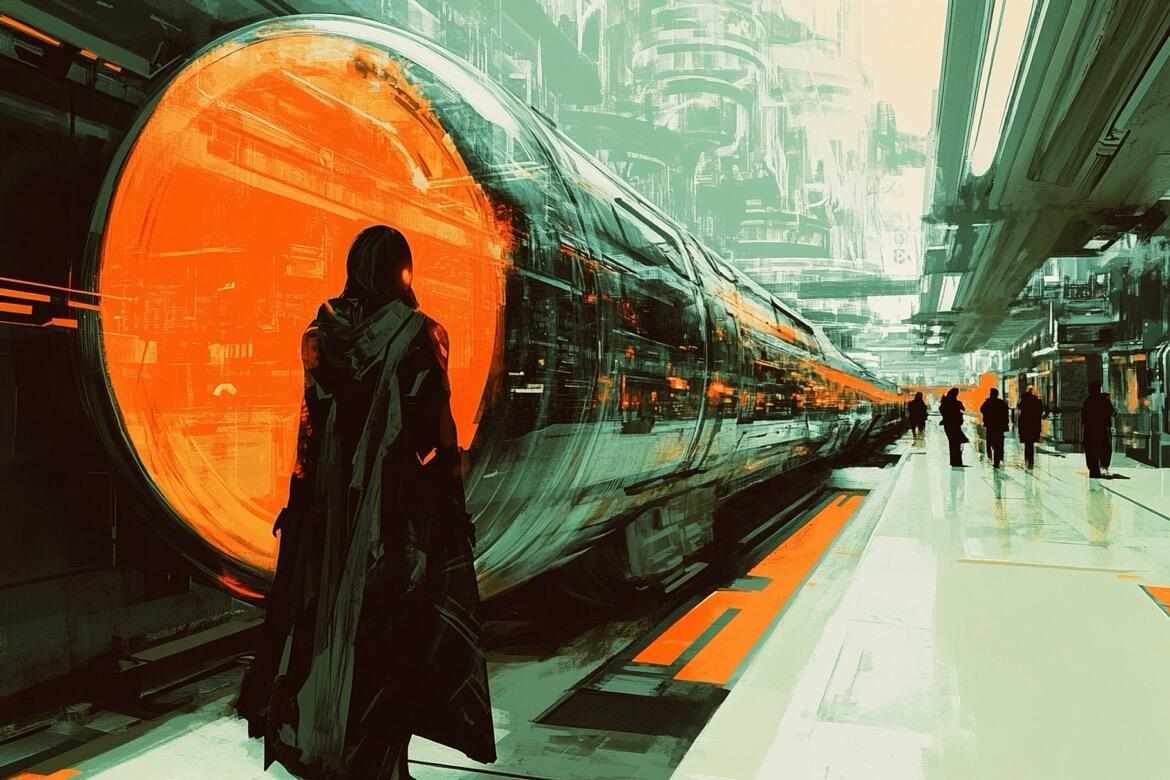
[^6]:If you are not yet convinced of the 1984 dystopia we live in I would encourage you to fully digest Whitney Webb’s breakdown of the Epstein era in her book One Nation Under Blackmail, Vol 1 & 2
[^7]:While there are many beautiful things going on in our Muslim Nostr community I would just like to highlight here the work that @PodSystems is doing in trying to build a decentralized media production studio. In particular they are documenting how experience economies can play an important role.

[^8]:There is a lot of literature on accelerationism and Nick Land’s idea of hyperstition. However, rather than providing newcomers with textbook philosophical and eschatological analysis I think it is best to understand hyperstition in the light of theory fiction where which a healthy reading of sci-fi could serve nicely.
Write a comment