The Chameleon Method: Three Skills That Future-Proof You in the Age of AI
- Why a Chameleon?
- Critical Thinking
- Creativity
- Communication
- The Method in Practice
- Adapt or Get Adapted
Everyone’s asking the wrong question about AI.
“Will AI take my job?” “Should I learn to code?” “Is my degree worthless now?” These are fear questions. They come from a place of paralysis. And paralysis is the one thing that will actually make you irrelevant.
The right question is simpler: what makes a human valuable when machines can do the technical work?
I’ve spent the past year and a half building AI tools, teaching AI workshops to small business owners, speaking at conferences, and watching this technology reshape how work gets done in real-time. I’ve seen non-technical people build functional web apps in a single afternoon. I’ve seen AI models go from 38% accuracy on coding benchmarks to over 80% in twelve months. I’ve watched the gap between idea and execution collapse toward zero.
And through all of it, the same three human skills kept surfacing as the ones that actually matter. Not technical skills. Not credentials. Not which programming language you know or which framework you’ve mastered.
I call it The Chameleon Method.
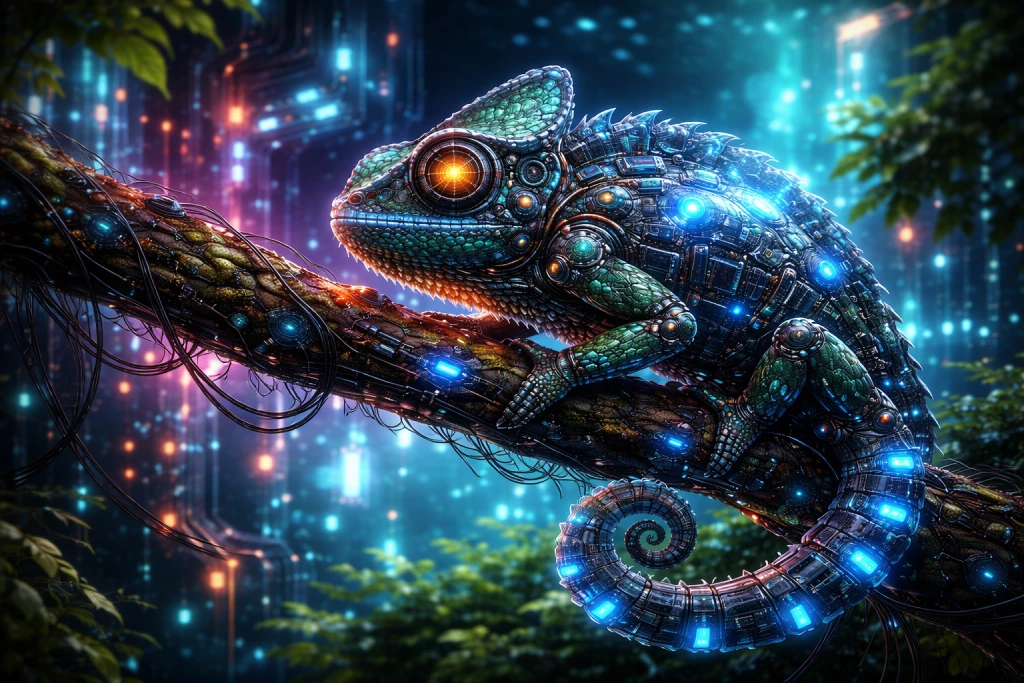
Why a Chameleon?
Chameleons survive by adapting. Not by being the strongest, the fastest, or the biggest. They read their environment and adjust. They’re deliberate. They’re patient. They see things others miss — literally, their eyes move independently, scanning for threats and opportunities simultaneously.
That’s the posture you need right now. The landscape is shifting fast. The people who thrive won’t be the ones who resist change or panic about it. They’ll be the ones who adapt — deliberately, thoughtfully, and with the right toolkit.
The Chameleon Method is three skills. Three C’s. They aren’t ranked. They work together, and you need all of them.
Critical Thinking
AI will give you confident answers. Beautifully formatted, articulate, completely wrong answers.
This is the part most people don’t understand yet. They interact with ChatGPT or Claude and think, “This sounds smart, so it must be right.” That’s a dangerous assumption. Large language models are sophisticated pattern-matching engines. They predict the next likely word based on training data. They don’t reason from first principles. They don’t fact-check themselves. They don’t know what they don’t know.
I saw this firsthand when 170 apps built with the AI coding platform Lovable exposed user data in a security scandal. The code worked. It looked right. The AI had generated it confidently. But nobody questioned the output. Nobody applied judgment. Vibes met production without a filter, and real users paid the price.
Critical thinking is that filter.
It means asking: is this output actually correct, or does it just sound correct? It means understanding the difference between a confident answer and a verified one. It means knowing when to trust AI output and when to push back.
In practice, critical thinking looks like:
-
Questioning assumptions. AI will build on whatever premise you give it. If your premise is flawed, the output will be flawed — just with better formatting.
-
Evaluating sources. When AI cites information, can you verify it? Do you know enough about the domain to spot when something’s off?
-
Thinking in systems. AI excels at narrow tasks. It struggles with how things connect. You need to see the second and third-order effects that the model misses.
-
Knowing what you don’t know. The most dangerous AI interaction is the one where you don’t have enough context to evaluate the response. Recognizing that gap is critical thinking in action.
This isn’t about being skeptical of AI. It’s about being a responsible operator of powerful tools. A chainsaw is incredibly useful. You still need to know which direction the tree is going to fall.
Creativity
AI can generate. It can’t originate.
It can remix, recombine, and interpolate from everything it’s been trained on. It can produce variations at a speed no human can match. But it can’t see what’s missing. It can’t imagine what doesn’t exist yet. It can’t have the insight that comes from lived experience, from frustration with how things are, from the stubborn belief that something better is possible.
Every product, every company, every movement started as something someone pictured that no one else had. AI is an incredible amplifier. But amplifiers need a signal.
I think about this a lot. When we built Agora at the AI Hack for Freedom hackathon, the AI did a huge amount of the heavy lifting, generating code, scaffolding interfaces, handling translations. But the AI didn’t decide to build a censorship-resistant platform for Venezuelan activists. The AI didn’t understand why location-based feeds mattered for people who can’t find their communities when forced to migrate between platforms. The AI didn’t make the judgment call that Bluetooth mesh networking was essential for a country where the internet goes dark during critical moments.
Humans did that. The creative work, the vision, the empathy, the “what if we tried this”, came from people who understood the problem space in ways no model could.
Creativity in the age of AI isn’t about being artistic (though that counts too). It’s about:
-
Seeing problems others don’t see. AI optimizes known problems. Identifying the right problem to solve is still a deeply human act.
-
Connecting dots across domains. Your unique combination of experiences gives you a perspective that no training dataset replicates.
-
Challenging the default. AI gives you the average of its training data. Breakthroughs come from asking “what if we did the opposite?”
-
Having taste. Knowing what’s good — not just what’s functional — is the difference between something people use and something people love.
Andrew Ng called AI-assisted development “a deeply intellectual exercise.” He meant it as criticism of the term “vibe coding.” But he accidentally described the future of all work: deeply intellectual, deeply creative, with AI handling the execution.
Communication
This is the sleeper skill. The one nobody talks about enough.
The people who can clearly articulate what they want — to humans and to machines — will run circles around everyone else. This is already happening. I see it every time I run an AI workshop.
When I taught small business owners at a local Chamber of Commerce, the single biggest unlock wasn’t showing them a fancy tool. It was teaching them how to communicate with AI effectively. The prompting exercise was the turning point in both sessions. People who had been tentative and uncertain suddenly saw immediate results, not because the tool changed, but because their communication improved.
Prompt engineering is just the beginning. The real leverage is being able to describe systems, constraints, edge cases, and intentions with precision. In a world where you can go from imagination to software in minutes, the quality of your imagination isn’t what matters most. It’s the quality of your articulation.
But communication isn’t just about talking to machines. It might be even more important for talking to humans.
As AI handles more execution, the human work becomes coordination, alignment, and persuasion. Can you explain your vision to a team? Can you write a brief that an AI agent and a human colleague can both work from? Can you identify when a miscommunication happened three steps ago and is now compounding?
Communication in the AI era means:
-
Precision of language. Vague inputs produce vague outputs, whether you’re prompting an AI or briefing a team. The ability to say exactly what you mean is a superpower.
-
Active listening. Understanding what someone actually needs versus what they’re asking for. This applies to reading AI output too, what did it actually produce versus what you expected?
-
Storytelling. Data doesn’t move people. Stories do. AI can generate reports. It can’t build the narrative that makes a room care.
-
Translation. Being the person who can bridge technical and non-technical, strategic and tactical, human and machine, that’s the most valuable seat at the table.
The Method in Practice
The Chameleon Method isn’t a framework you implement on Monday morning. It’s an entire mindset. A way of approaching work, any work, that keeps you adaptive and valuable regardless of how fast the technology moves.
Here’s what it looks like day-to-day:
When you get an AI-generated output, you apply critical thinking before you accept it. When you’re deciding what to build or what problem to solve, you apply creativity to see beyond the obvious. When you’re describing what you want, to an AI, a colleague, a client, you apply communication to ensure the vision survives the translation.
The three skills reinforce each other. Creativity without critical thinking produces ideas that don’t hold up. Critical thinking without communication means your insights die in your head. Communication without creativity is just efficient mediocrity.
And here’s the part that should make you optimistic: these are trainable skills. They’re not genetic. They’re not reserved for people with the right degree or the right background. Anyone can get better at thinking critically, being creative, and communicating clearly. The barrier isn’t talent. It’s practice.
Adapt or Get Adapted
The AI landscape will look different six months from now. The specific tools will change. The models will improve. New capabilities will emerge that nobody predicted.
But the chameleon doesn’t need to predict what’s coming. The chameleon adapts to what arrives.
The three C’s: Critical Thinking, Creativity, Communication, are durable in a way that technical skills aren’t. They transfer across tools, industries, roles, and eras. They’re what made humans valuable before AI, and they’re what will make humans valuable after AI becomes ubiquitous.
The people who are going to struggle aren’t the ones who don’t know how to code. They’re the ones who can’t think clearly, imagine boldly, or communicate precisely.
The people who are going to thrive? They’re chameleons.
Start adapting.
Write a comment