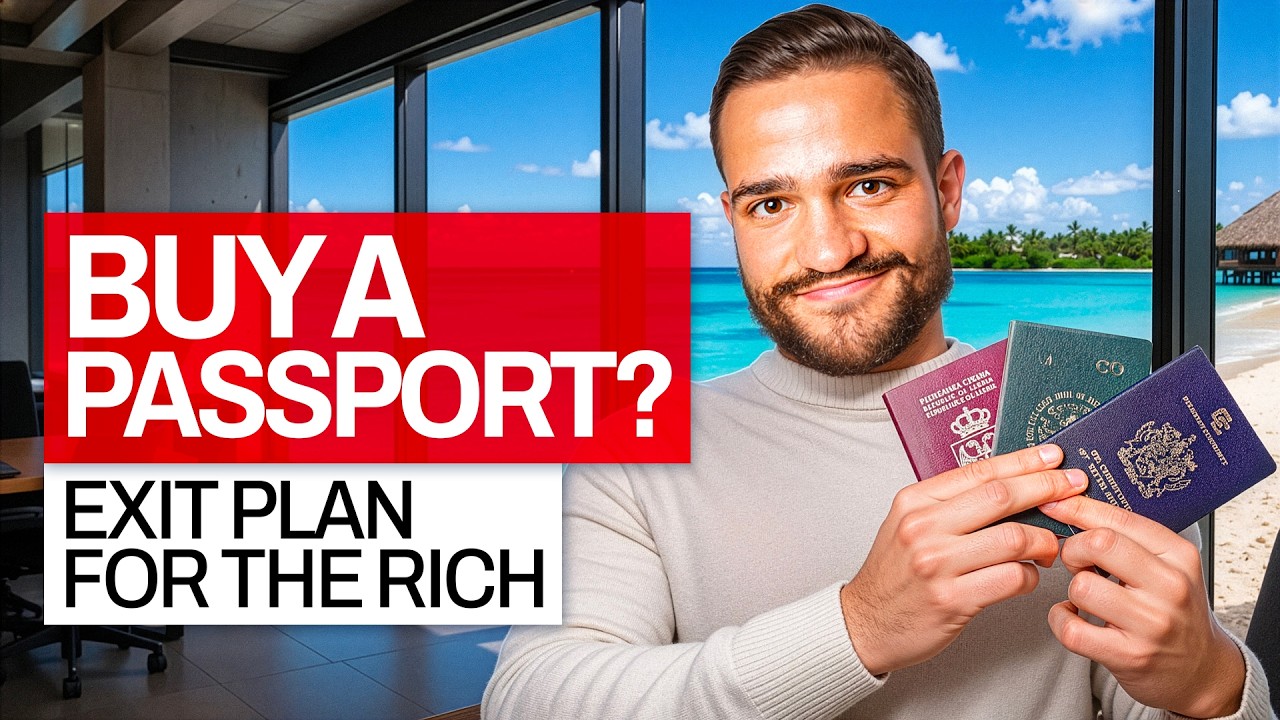
Buy a Second Citizenship & Reduce Your Taxes?
- The American Tax Situation
- Why Wealthy Individuals Want a Plan B
- Tax Residency Matters More Than Citizenship
- Banking, Companies, and Foreign Structures
- El Salvador and Crypto Investors
- Final Thoughts
Authored by Rafael via YouTube
I’m Rafael from Wealthy Expat, helping people obtain second citizenship and second residency in a smooth and simple way.
I personally obtained four citizenships, including citizenship by investment in the Caribbean.
Recently, I’ve seen several videos of people saying:
“The best way to pay less tax and optimize your tax situation is to get a second citizenship, and the best way to get a second citizenship is through investment. So, please buy a passport from me.”
I’ve seen these kinds of videos across multiple markets because I speak English, Spanish, German, and Russian. I’ve even seen them targeted at the German market.
I want to clarify a few things.
Having a second passport can absolutely be advantageous from a tax perspective, especially because some of these countries are essentially tax-free.
For example, St. Kitts and Nevis currently has a citizenship-by-investment program with a price point of around $250,000 and a processing time of approximately six to eight months. For me, it took about six and a half months over five years ago.
These countries can be tax-free if you actually relocate there. If you move from Germany, the UK, or Canada and genuinely establish residency in St. Kitts and Nevis, Antigua and Barbuda, or another Caribbean citizenship-by-investment country, you could potentially benefit from a tax-free lifestyle.
However, you would need to fully live there, become a tax resident, and establish strong ties to the country.
For example, I’ve had my Caribbean passport for over five years, but I do not live in any of those countries. Therefore, I cannot use them as my tax residency.
In some cases, these jurisdictions are also placed on tax blacklists or gray lists in certain countries, particularly in Europe. Some banks will not even accept tax residency from these countries because they consider them tax havens.
I remember visiting a bank in Europe with this passport just to test the situation. The banker looked at it, checked the system, and said:
“This is considered a fiscal paradise or tax haven. We’re not going to accept this passport.”
So, it’s not as straightforward as some of these videos make it seem.
The real way to legally pay less tax is by living in, structuring yourself around, or maintaining ties to a country with favorable tax policies.
For example, some Canadians and British citizens are moving to places like Greece through the Greek Golden Visa program and paying the lump-sum tax of $100,000 per year instead of paying significantly more elsewhere.
If you earn €3 million per year and only pay $100,000 annually in Greece, that can be a very attractive arrangement.
Italy has a similar system with a €300,000 flat tax.
There are also countries like Montenegro and Serbia, where I am also a citizen. I obtained Serbian citizenship by merit.
I recommend programs in Serbia and Montenegro to many of our clients.
These countries do not necessarily offer ultra-low taxes or flat-tax systems, but their taxes are generally reasonable. You may pay around 10–15% on profits instead of over 50% in countries such as the Netherlands, Sweden, or Austria.
The American Tax Situation
Second citizenship can also be very advantageous for Americans.
The United States taxes its citizens regardless of where they live. As a U.S. citizen, you are taxed worldwide.
That means special tax residency programs, lump-sum tax arrangements, or favorable foreign tax systems generally do not exempt you from U.S. taxation.
One possible strategy is obtaining another citizenship through ancestry.
For example, if your parents or grandparents were from Ireland, you may qualify for Irish citizenship. You could obtain an Irish passport, renounce your U.S. citizenship, and continue traveling internationally using your Irish passport.
Depending on your net worth, you may need to pay an exit tax to the United States. The process can be complex and involves filing an exit return.
However, after renouncing U.S. citizenship, you could potentially relocate to a more tax-friendly jurisdiction.
For example:
- Dubai and parts of the Gulf region offer very low taxes.
- Panama has a territorial tax system.
- Georgia (the Republic of Georgia) also operates a territorial tax system.
So, obtaining a second citizenship can become part of a broader tax optimization and lifestyle strategy.
Why Wealthy Individuals Want a Plan B
In countries like Germany and the Netherlands, interest in second residency and second citizenship is growing rapidly.
Historically, Americans, Russians, and Chinese citizens were the primary groups seeking additional passports. Now, wealthy Europeans with already strong passports are also looking for “Plan B” options outside the EU.
Many are obtaining residency or permanent residency in countries such as Paraguay or Uruguay.
Their concerns include:
- Potential war or conscription
- Digital ID systems
- Increasing restrictions
- Capital controls
South Africans are another example.
Many are concerned about increasing government control over cryptocurrency.
As a result, they are exploring nearby options such as Mauritius.
Mauritius recently launched:
- A $1 million Golden Visa program
- A $375,000 permanent residency program
By relocating to Mauritius, some South Africans can legally benefit from:
- Very low taxes
- Zero crypto tax
- No capital gains tax
- No corporate tax
At the same time, some are still obtaining citizenship in St. Kitts and Nevis to improve their travel freedom.
Tax Residency Matters More Than Citizenship
Second citizenship can absolutely fit into an overall international strategy.
However, the most important factor determining how much tax you pay is not your passport — it is your actual ties to a country.
Tax authorities often examine:
- Where your family lives
- Where your children go to school
- Where your business operates
- Where your home is located
- Where your income is generated
Even if you do not spend 183 days in a country, some governments may still classify you as a tax resident if your economic and personal ties remain there.
Countries such as Spain, Germany, the Netherlands, Colombia, and Brazil can be particularly strict in this regard.
Banking, Companies, and Foreign Structures
I also heard people recommending that individuals obtain a second citizenship and then:
- Open companies abroad
- Open foreign bank accounts
- Buy property overseas
These strategies can provide additional legal privacy and diversification.
However, they do not eliminate your reporting obligations.
For example, if you are a U.S. citizen and open a company abroad using a second passport, you still need to report that company to the United States because you remain a U.S. citizen.
Likewise, if you live in Germany and Germany requires disclosure of foreign bank accounts, having a second passport does not remove that obligation.
What a second citizenship does provide is:
- A backup plan
- Greater mobility
- Access to additional banking systems
- Investment opportunities
- Alternative residency options
For example, if a German citizen obtains Serbian citizenship, they now have another country where they can:
- Live
- Invest
- Open bank accounts
- Establish tax residency
- Operate businesses
If they still live full-time in Germany and maintain strong ties there, they may still remain German tax residents.
But the second citizenship creates flexibility and optionality.
El Salvador and Crypto Investors
El Salvador citizenship is another interesting example.
Although the program costs around $1 million, it offers access to a country that is highly supportive of cryptocurrency and also has favorable tax policies.
For crypto investors, this can be especially attractive.
Final Thoughts
I’m a huge fan of second citizenship.
However, it is not automatic tax optimization.
Everything depends on:
- Your personal ties
- Where you spend your time
- Where your income is generated
- Where your family and assets are located
Simply obtaining citizenship in a low-tax country does not automatically reduce your taxes.
As mentioned, more than 20 countries around the world currently offer citizenship by investment, donation, or exception.
Exploring these options can help you build a stronger international strategy, greater mobility, and a long-term Plan B.


Write a comment