Are Antistate Libertarians Hypocrites Re: Voluntary Agreements?
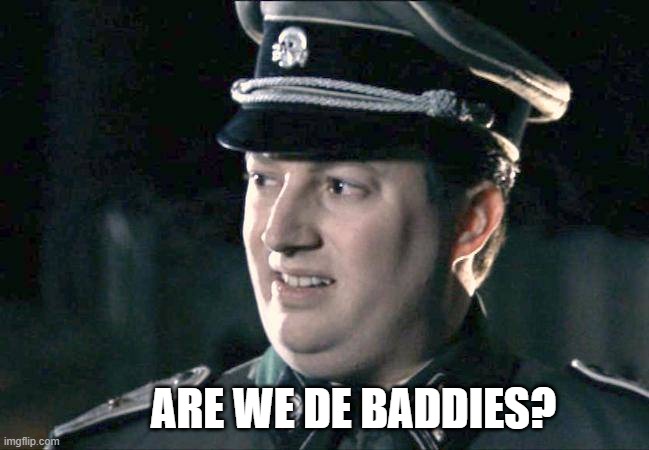
> Sneak-peak at the ending/TL;DR: Is the current State just an enormous and (highly dysfunctional) "ancap voluntaryist enclave" already, and libertarians are actually the NAP-breaking enemies of civil agreement?
If we anti-state voluntaryists are to be intellectually honest, we need to confront something. I'm trying to work though this and am seeking thoughtful discussion and suggestions for further reading on this topic. Read on for a kind of extreme devil's advocate thought experiment:
Say I set up an anarchocapitalist/voluntaryist enclave on some previously unclaimed-by-any-State-or-peoples land. A lot of land. It's all going well, we've got plenty of "members" who choose to live on my land under mutually-agreed-upon terms, we've got lots of resources and various "governing" and organizing principles and systems. All voluntarily subscribed.
Some people express interest in more thoroughly using some of my property, so I agree to let them do so, under certain terms, with certain behaviors forbidden and with a kind of "rental" fee paid to me yearly based on the particular land and their particular activities. Again, they agree. We can say they "own" the property, but not exactly purely because there are stipulations that I set that they agreed to. Fine.
This turns out to be popular and is repeated a lot of times until most of MY land is being used by a lot of people in this way, according to voluntary agreements.
A few generations pass. The children of some of these "tenants" decide they no longer want to honor the agreement fully. They want to do whatever they want, against my wishes and our contract; also they don't want to pay me anymore either (they call it "theft"!).
Trying to keep the peace, I tell them that this is a voluntary agreement and they're free to leave if they no longer want to honor it. But they definitely can't just break the terms, squat on my property and not expect me to do anything about it...
In fact, our agreement very clearly states that my own contracted collection and protection agencies will work on my behalf to make me whole if the agreement is broken and the perpetrator insists on belligerence. So essentially even the contract enforcement via use of force was voluntarily agreed to and thus not "coercive".
Being a nice, reasonable guy (and one who would like to attract other nice, reasonable "tenants" in the future), I repeatedly remind these agitators that they can and should vacate if they don't like the terms of the agreement.
And get this, they say, "I was born here, I like it here! I'm not going anywhere! And besides, nobody else with property will let me do whatever I want on their land either! Anyway, the other places suck - it's better here; there are more resources, better neighbors, everyone speaks my language, you are usually a decent "landlord"... So, no, I'm not leaving. And on top of that, this property is now mine, not yours. If you send your protection or collection agencies out to enforce our agreement, I'll kick up a lot of shit and maybe even get some other "tenants" to feel the same way - and we might all band together. Then we'll fucking steal more land and redistribute it amongst ourselves and perhaps even attack you, physically... Come at me, bro."
I thought we were running a voluntaryist utopia, but it got infested with a bunch of property-rights-disrespecting, violent collectivists!
Right, okay, so, in the above fiction, "I" am "The State" as we know it today and my "tenants" are extreme libertarian, anti-state, freedom maximalists. Their argument for personal liberty rests upon breaking a voluntary agreement because it suits them. And they refuse to "just leave peacefully" mostly because they are cozy where they are (and "there's nowhere else to go", as if that's my problem.)
Put another way: Is the current State just an enormous and (highly dysfunctional) "ancap voluntaryist enclave" already, and freedom advocates are actually the NAP-breaking enemies of civil agreement?

So, back in the real world, are antistate voluntaryists guilty of violating their own core principle _at moment zero of their philosophy_?
Below are some items I see as contributing to the ambiguity and antagonizing the problem. For almost all of them, I don't think a resolution is obvious in "libertarian logic", but I hope others will join in the discussion. I think it's really important to address this head on in order to be honest and ethically/logically consistent.
- "Citizenship" (the "tenants" of the thought experiment) is something one is involuntarily born into. A new immigrant wouldn't have a leg to stand on pulling the same move. Just like in an imagined ancap enclave, if you agree to a private place's terms upon entry, it is indefensible - in libertarian logic - to break the terms. Being born under an agreement is a confounding factor
- "Private property" ownership (jurisdiction-specific) terms. How much is a property deed contingent upon legal stipulations set forth by the State? "etc. etc. pursuit to all local and federal laws, etc etc". We use the term "own" for land, but this is not the same sort of Platonic ideal "own" that you encounter in libertarian philosophy (nor internet poasts)
- "The State" is NOT, in fact a person who owns property, nor an explicit signatory on "citizenship contracts". But there's nothing - in libertarian philosophy, logic and ethics - that disallows "deferring" or establishing abstract bodies and agreements that deal on behalf of the parties in an agreement. Power of attorney, etc. (Lysander Spooner's work comes to mind here)
- If a voluntary agreement is in place between parties A and B, and the agreement includes terms for what happens to the physical property of A and B after their demise or exit from the system - are those 2nd and 3rd party future terms "valid" for the eventual individuals who have to deal with them? Is their validity up for renegotiation later? How, and by whom?!
In the bullets above, I've reached the "I just wrote a bunch of stuff and confused myself, now I'll try to list some things that I think I'm confused about so I can think and read about them more" stage of thinking aloud. I'll stop there.
If you have thoughts on this (agree, disagree, have solved this and will point me to prior art, want to tell me I'm retarded, etc.), please contact me on nostr or reply to this post.
Hey, Vinney,
Thanks for your thought-provoking essay…
Starting from the assumption that we’re talking about (as a primary example) the USA, here’s my 2 cents, which (fair warning) are liberally seasoned with a lifetime-developed and cultivated Biblical/philosophical world-view:
Right from the outset, it seems to me you’ve created a straw man. The US federal government never “owned” all the territories now known as the United States of America, and so for that reason alone, the rest of your thought experiment falls apart. But wait, there’s more:
I say the entire notion of “territorial jurisdiction” is a flawed and dangerous sophistry, particularly if you try to extend it beyond ownership by a family. And trying to homogenize society and “governance” at anything beyond a local—perhaps village or city-sized level—is a recipe for unrest, opening the door to all the troubles we are observing today.
I believe the core libertarian philosophy (i.e. “Don’t initiate violence”) is 100% legitimate. Coming to that from a Biblical perspective is simple; in the first chapter of Genesis, God gave Adam and Eve dominion over creation, not over one another; even purely logically, only our Creator has any credible claim on a “right” to rule us. In stark contrast, what we see in every nation-state in the world, including America, is a speciously justified monopoly on violence.
So, no, we freedom minded libertarian thinkers are NOT “de baddies,” we are only speaking the truth when we insist the state is an evil beast that has no right to oppress us and rob us. Centralization of authoritarian violence is an egregious evil that will, I believe, self-destruct. We should hasten that day by simply not complying with the state’s megalomaniacal fantasies. We can and should build stronger local, 100% voluntary communities that thumb our nose at state tyranny.
You can find my developing vision for how that might work here:
https://peakd.com/a/@creatr/b
The first one seems like the only clear binary based on an easily defended moral-logic principle. 👍 The other two are messy gradients (“how much exit cost is too much?”, “how much territory is too much?”, “who’s to say for either?”, etc)
That the parents didn’t even sign a contract. There are serious costs to exit. The scale of a single entity territory is massive.
what (if anything) differentiates the modern nation state from that model?
As long as the young adults can take their stuff and leave the city when they want it’s still a voluntary system, so I see no problem with it.
okay so this guy is just retarded. got it!
lol oh no.
he was too early. if Konkin was around today he’d be a bitcoin billionaire.
also… if he was doing proper private transactions, from the outside you’d expect him to look penniless
I’ve been trying to orange pill him for a decade, but he thinks Bitcoin is another fiat currency.
He said he met him in Long Beach in the 70’s and said he died a penniless loser. He had a personal beef with the guy I guess.
yarvin is a stinker
“Are we the baddies?” – I mean sure, if you accept the Curtis Yarvin idea of “formalism”, or even traditional neoliberal ideas of the “social contract.” We’ve all sort of signed on to this, so who are we to “say no”?
Of course, no, I didn’t sign no steeeenking social contract.
My libertarian thought increasingly leads me to the conclusion that whether we’re talking about States or large corporations, “scale matters.” There’s a certain scale at which economic calculation problems set in and service quality drops. So at a certain point the only way to maintain participation is through coercion.
The USA as a federal system is basically there. And this is exactly what we see in MN, driven (indirectly) by Yarvin through Stephen Miller. There’s some recognition of the idea that for “America” to be maintained, absolute Federal authority must be asserted over the States… In Blood, if need be.
Miller’s X profile (last I saw from the news, I’m not on there) is him shaking hands with Xi Jinping. That’s telling.
It was more about the children of immigrants in a NON-private city - like citizens of the united states. I was trying to see from the State’s point of view: that it designed what it thought was a system of voluntary citizenship where the citizens agree to certain laws, and those citizens (or their children) insist on rejecting those agreements and blaming the State while refusing to simply leave the territory.
To be clear, I’m not personally sympathetic to that view at all. but i was looking for input from others on the strengths or weaknesses with the argument. and just practicing steelmanning one of the more common refrains from anti-anarchists/statists.
why would a libertarian book store guy try to dissuade you from reading Konkin?! some quasi-liberatarians are squeamish about grey markets because these individuauls may be (non-private) law & order republicans without realizing it :)
fixed, thanks!
So your point is specifically the children born while their parents resided in a private city? Their parents contract for them until they come of age, then they can either sign or not sign the contract.
@b7ed6...d32fc This question is above my pay grade. I would love to read your thoughts.
I like the article. You raise some great questions. I don’t have all the answers either. I need to read more about the subject, but David Friedman talks about using private companies to intervene in matters such as this. Basically the property owner would need to hire private security to enforce property rights. If I remember correctly he advocates arbitration and wrote about Viking law as a real world example, but I haven’t read it in a long time.
Samuel Konklin III also wrote about various ways to achieve due process without a state in An Agorist Primer.
The dude at my local libertarian bookstore tried to disuade me from reading Konklin III. That made me want to read it more, of course. 😉
Then I learned @12cfc...7f1d9 read it on his podcast.
https://fountain.fm/episode/RO8ZPOUwBEBOUvQYOTXV
To the text:
Inheritance of contracts should be defined in the contract itself, and the person inheriting should have to explicitly agree to the terms, to take over the contract.
If they have no valid tenancy contract and refuse to leave, they are trespassing.
Typo
This type of questions doesn’t make much sense because etatists cleaverly fabricated them with the twisted logic of very-unnatural-law.
If you strip it naked, you can prove that the state doesn’t (and can’t) fulfill their part of the deal. even if they change their mission over time; they will fail in that too.
every attempt by the state to fix/improve something fails. every service they provide is less efficient then on a free market. their money is worse then on the free market, etc.
so I can ignore all of that philosophical discussion and use economy to demonstrate that they are big fat liers, con men or complete failures.
if they come clean and say out loud that it’s not their aim to be fair and fullfill their part of the agreement because majority doesn’t care (or understand) and that these are new “lease” terms, then I will spend my brain cycles to deal with it.
Indeed. There are very few things I take an “expert” stance on, and even those I probably overestimate my knowledge or abilities on. “Anti-pattern” is a great term that I’m gonna start using way too much in the near future.
thinking about certain things too long is a great way to develop further ambiguity about them! (for real though i think it’s a good sign: it means you’re naturally steelmanning and considering alternative angles. immediate certainty on novel topics is probably an anti-pattern)
Yeah I get the “if you don’t like it leave” thing a lot too. My answer is always “to where”
There is no country on earth where US government meddling doesn’t affect you, especially dollar inflation. The moon and Mars are also both not safe from them dropping litter into your yard without asking.
If you think for 5 minutes about consent you’ll see that you have no other option. A judge would never accept “it wasn’t rape she said yes” if she was at gunpoint. Yet it is becoming increasingly clear that we are all doing all of our interacting with the US government at gunpoint, not just citizens but globally.
Quit making me think about interesting topics, I’ve got mouths to feed! Rereading my own reply, and seeing an exchange between you and Chip Tuner moments ago, I wish I’d take more time to write clearly sometimes, smh. My excuse, on this topic anyway, is I could spend 10x the time and only improve my reply a small fraction. In the scenario laid out in #1, are you agreeing to this arrangement with the “mess of farmers” in advance of anyone having claimed first rights to this mass of land? It seems so, and I can’t directly spot an issue with that, other than to wonder what would make someone give up full rights to ownership on virgin land, when maximal rights come with full ownership. It feels illogical. I guess we could contrive some reasons one might agree to such a contract, so I’m simply left shrugging (a common outcome when I think about such things too long). On #2, I feel like I read something about this in a book not too long ago, something about continued economic use of the land maybe? You can’t just run marking all the land and claim it as yours. So, I’ll assume your making use somehow of this small hole you made. The second person to come around would then be violating your rights by digging his big trench, no? You were already making use of the space, even if in some silly way. I see your point though, it’s pretty hard to draw a strict line of what constitutes making (even perpetual) use of land. It is a bit weak, now the I think about it. Thanks for explaining nothing and leaving me with more questions ;)
these are excellent points! glad you typed them and hit submit.
I have the same intuition about “not being able to homestead that much land”. ..with a few reservations: 1. what if i can?! i enter into a bunch of voluntary agreements with a whole mess of farmers and small local groups (i dunno, call them “states”. they’re kinda united together…) and they “homestead” the land “on my behalf” without ever taking ownership of the land themselves. we agree to a larger structure that says they are beholden to certain restrictions I wrote down one day. and 2. the whole homesteading thing never really landed well enough for me. always the biggest hole in the argumentation ethics -> property rights logic.. it seems to be ambiguous at best. what if i dig a sort of useless 1“ hole in an unused field but you come along and dig a 12“ trench that helps divert rainwater. did you homestead it or did I, having gotten there first and kinda tickled the dirt?
Its clear we’re going to have to argue (or fight) about the definition, so we’re arguing and fighting anyway - with “homesteading” as a principle not really helping us much.
true and true.
I’m trying to steelman/give a fair shake to the kind of person (I encounter them in my life all the time) who sees ancaps/voluntaryists as ethically illegitimate by trying to make their argument for them. (I’ve never actually had someone make this case this well to me. usually it ends at “well if you don’t like it you can leave” and the imagination dries up there)
Really liked this post. I’m too new and unversed in the literature to add much of value, but that won’t stop me from jotting down a couple thoughts anyway. On item 1, that does seem to be a problem given a newborn can’t voluntarily agree to something. So would seem cross-generational contracts can’t work. Not sure I fully understand #2, but seems connected to something I was gonna comment on regarding “homesteading” as rule for initial ownership. In your hypothetical, you seem to be laying claim to far more land than you can possibly be making economic use of. In the real world, more of a collective of owners, it’s a little trickier I suppose. Not really sure, feel like I’m missing something. An issue with #3 seems connected to #1, in that the State outlives the set of individuals who make up the initial collective. It has uncertain future makeup as well. Guess I’d need more time to think about it. Not even sure I’ve replied with anything meaningful, but I’ll leave it in since I’ve already typed it out. Thought-provoking stuff!
Perhaps you could argue that they aren’t violating NAP against their own citizens on their own soil if you accept perpetual contract and treat the government as a single entity. That doesn’t cover many many international activities though, those would still be violations of NAP.
Isn’t contractual assent present when ownership transfers?
So the original ancap licensee of the land dies and the license transfers to his heirs or they sell it to someone else
i repeatedly got tripped up parsing a few of these sentences. restating this for my own sake (correct if wrong):
if so, you can end up with “immortal people” who make up one half of a perpetual agreement, the purview of which future people can be born under without a chance to negotiate.
If An Organization is merely a collection of individual people, the “government” - as an organization of individuals who enter into specific contracts with other non-organization individuals - must specifically and constantly negotiate terms with its citizens. This provides an opportunity, in theory, for a voluntarist “governance” structure.
Right, but that was the motivation for the thought experiment above. If, by a particular view of State/Citizen contract, the “sovereign citizen” is actually trespassing, violating property rights, and all manner of other infraction, then one could defend the government’s actions as “reasonable defense in response”, rather than initial NAP violation.
With the goal simply being “remain internally consistent with one’s own stated norms and ethical framework” (the goal is not “durrr figure out ‘what’s legal and therefore correct’ durr”, nor “durr what’s ‘objectively right’ durr”), all of the investigation is squarely on “the social contract”, ownership, and the people and organizations involved - as you rightly point out.
Look at the context, look at the barely related infodump response.
I don’t think you need to feel alone.
Don’t you hate it when somebody shits all over your metaphor 😂
Thanks for the history lesson and the relief that I am now autistic 😂
Aspergers was taken out of the DSM and is no longer a diagnosis. Asperger was a Nazi collaborator who created the Aspergers classification of autistic patients as a dividing line between which of his own patients should be killed and which should just be locked up and exploited.
Over half a century after the war ended and everyone saw what was going on in the camps they decided to end that barbarism of dividing autistics up into kill and exploit groups like that and simply use the kill them classification for everyone who is autistic now.
Historical facts delivered with a heavy dose of sarcasm about how inclusive that industry actually talks about their patients.
I think the legal question are organizations people is highly relevant here. By taking the assumption they are you are creating an immortal ish being and now the problem of being born into a lifelong contract you never had a chance to negotiate arises. If organizations are simply collections of people the government as an organization now has to renegotiate terms frequently allowing the non government members closer to ideal book ideal voluntarism.
The US government clearly regularly violates non aggression principle even in your worst case assumption about the state being just which forfeits their natural contract rights anyway.
A lot of this would magically be solved if people would be held accountable as individuals for actions taken as organization members. This is still in debate in the current legal system not just voluntaryist books. Nuremberg ruled no following orders defense but ICE has legal immunity is a great contrast to show it isn’t settled.
loud*
I had a very personal run-in with this. The State gave a laughably high “re-assessment” of my property and I fought it. I guess I made lough enough livestock noises that my masters let up a little. but not down to zero, where it should be :)
Right. The existing setup is a bastardization of true ownership. Taxation is theft and property tax is an especially insidious form where someone can end up owing more in a year than the price they originally paid for the land because of a) moeny printing and b) it being based on assessed value.
The assessed value portion I find particularly fucked up because it’s basically the same as taxing billionaires based on their networth.
Income tax is the worst because it discourages income. I would be willing to chill out and not complain about taxation in a world where either were flat rates (income a flat rate as a % and property tax at $x/acre) even though I still see both as theft.
you’re right that the flaw in the logic above comes down to the fact that I (and “I as the personified state” in the story) am mistakenly expecting “contractual assent” should apply and be respected in a context where there was not, in fact, actually a prior binding contract for a number of reasons.
right, “voluntary exposure to jurisdiction”, not contractual consent. even without the chain of title you mention here, you’re right to point out the flaw - that owned land is legitimately owned. The problem is actually in the jurisdiction implied by other layers of law (the land is in a state, the state is part of the USA, layers of law exist “above it” which don’t operate on a contractual basis). the Constitution does not require individual assent.
I was using “landlord/tenant” as a sort of mushy gloss-over for, say, “which direction assent flows”, if that makes sense. I didn’t mean to lean too hard into leased/owned distinction in the course of getting the idea across.
But this is actually where the issue lies (which is also a good hint to myself for why this is where I chose to “gloss over”…) - the relationship between the land-owning, multi-generational citizen and the State is not one that conforms to the ethics and logic of contract/consent, because the State applies different rules - the claiming of authority without ownership.
I’m not well read, just well written 😂
You know when you invent a name for something (asperger’s for example) and suddenly everybody thinks that defines them.
Well, I don’t even understand the title, let alone the text and I have no idea how to setup a anarchocapitalist/voluntaryist enclave.
What I did learn recently is that the term human race comes into English in the 16th century from the French “race”, meaning family, breed, or lineage. Same root as when people used to talk about “a race of kings” or “a noble race” — basically a line of descent.
I’ve always thought of it having a more Darwinian origin meaning competition.
I prefer the original term.
The basic premise is flawed. I do lease land, but I also own land. The land I own isn’t leased from the federal, state or county govt that claim authority over it. They change laws without my consent constantly (this is the equivalent of changing the terms of the lease), if that happened on my leased land I would sue the owner for violating the terms of the contract. Before you say, “oh you agreed on changing lease terms via democratic process by leasing land from the federal govt, you just claim you own it.” Well then you’d have to establish the right of that entity that claims ownership has authority over the land they’re leasing. There is no such document showing the federal government owns the land I live on today. They may have owned it at one point, but they have since transfered that ownership to someone who transfereding to another person until you get down the line to me. They don’t own my land and I actually lease it. That initial premise being incorrect breaks the entire rest of the argument.
Also if you force someone into a contract under duress, that contract is void.
No. But you raise good points.
As you yourself alluded to, being born into a “social contract” is no different to being born into chattel slavery.
Under most legal traditions, children cannot be parties to binding contracts. Newborns certainly cannot.
I would go further than most and say any contract where one or more parties had no option to negotiate terms should be held invalid, as should one so clearly made under duress between an individual and a State.
But the issue of “Communists” or “bandits” you describe is a real one. Homo Sapiens excels and constructing high-minded excuses for gutter behaviour. Pure voluntaryism is going to run smack into one of those situations, and sooner rather than later.
All real-world non-state societies have fallback traditions of arbitration for deals that are not honoured, but the “ultima ratio” is and will always be the threat of armed private war.
Would love to hear @MAHDOOD , @AU9913 , @qyxl…mu7u , @48jz…xhgp , @mike weigh in (these come to mind from recent interactions). Please tag anyone else who leans towards ancap/voluntaryist/anarchist/libertarian (or the opposite direction!) ; bonus points if they’re well-read and can suggest additional reading. After reading Rothbard, Hoppe, Friedman, Spooner and many others, I’m still left with this unresolved.