Crossing 300: A Reflection on Continuity, Sovereignty, and Becoming
- I. The First 300 Were Written in Fragility
- II. Writing as a Survival Instinct — Then a Sovereignty Practice
- III. The Moment of Fragility That Forced the Breakthrough
- IV. Continuum and the Writer Growing Together
- V. What 300 Truly Means
- VI. The Road Ahead
Andrew G. Stanton - Nov. 16, 2025
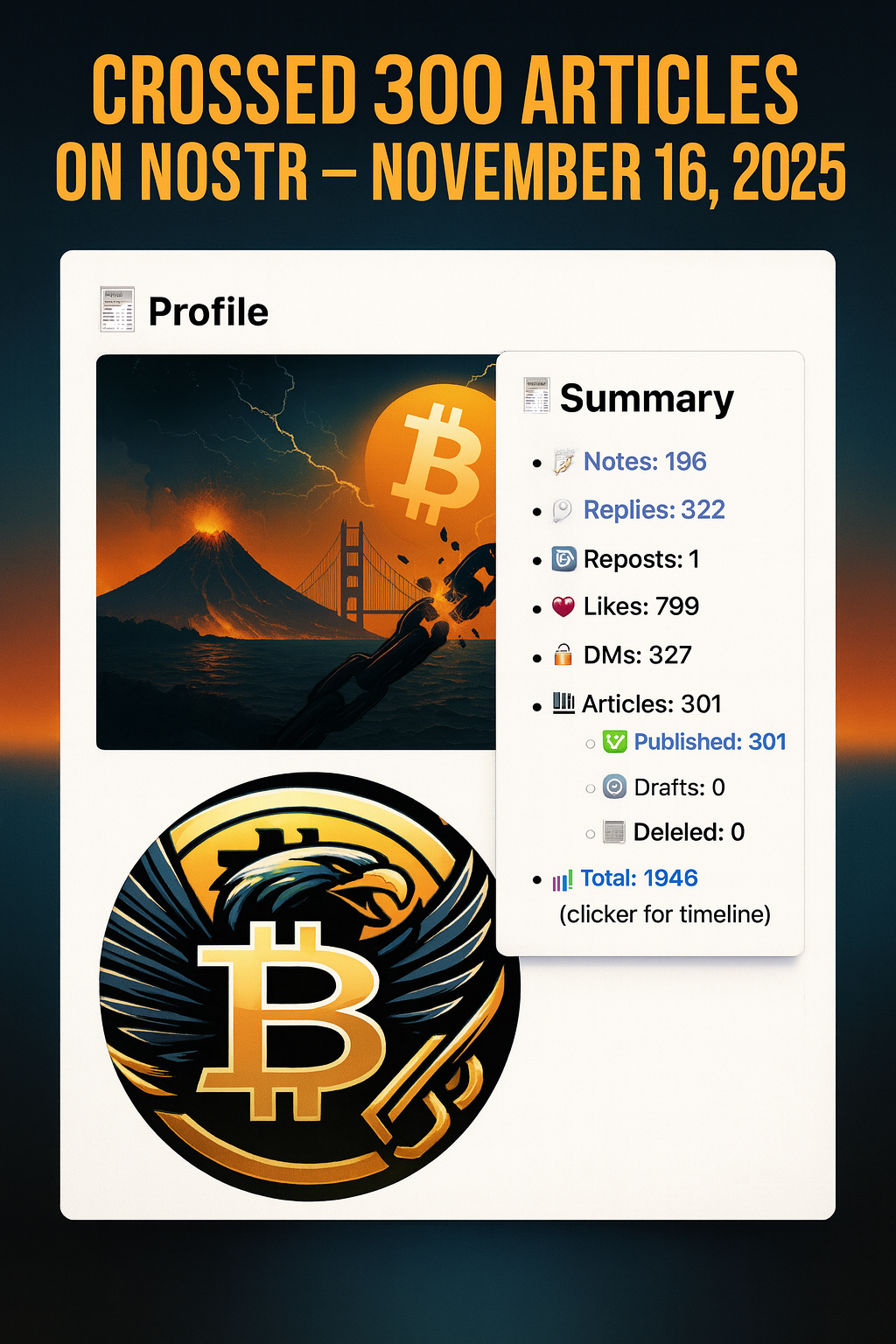
By the end of the week, sometime late on November 16th, I crossed a threshold I didn’t expect to reach this quickly — and certainly not under the mix of exhaustion, stress, and unrelenting responsibility that has defined so much of this year. I didn’t cross it with a celebration, or a countdown, or any conscious buildup. I didn’t even notice the exact moment it happened.
I only noticed the weight of it afterward.
300 published articles.
Since May.
And not “posts,” not fragments, not dopamine-baiting blurbs designed to satisfy an algorithm.
Articles.
Fully formed pieces.
Some free, some paid, all intentional — each one a reflection, an insight, a record of a moment in time.
There’s a point in any creative life when quantity becomes something else.
When repetition becomes rhythm.
When rhythm becomes a body of work.
And when that body of work becomes a legacy, whether you intended it or not.
Crossing 300 was that moment.
Not because it changes my life instantly.
Not because it suddenly brings money, attention, or external validation.
But because it marks a shift in identity.
Because it signals that the work is no longer episodic — it is cumulative.
300 means something is happening.
300 means something has taken root.
300 means continuity has become who I am.
And the timing is symbolic in ways I didn’t plan.
Because November 16 wasn’t just the day I crossed 300 articles —
it was the day the archive architecture finally came together.
The day Continuum gained sovereignty over its own memory.
The day I stopped depending on relays or client backups to remember the past.
The day I formalized the structure that will preserve every article I’ve written — and every article I will write — for years, even decades, if I choose.
In some strange, poetic way, the platform and the writer crossed their thresholds together.
I. The First 300 Were Written in Fragility
When I look back at the first months — May, June, July — I see writing done in a kind of creative survival mode. I wasn’t writing because conditions were ideal. I wasn’t writing because I had a clear plan or a stable life. I was writing because something in me needed to speak, needed to document, needed to express what I was living through.
My identity wasn’t stable.
My days weren’t stable.
My family life wasn’t stable.
Even my emotional bandwidth was stretched thin.
But I still wrote.
Some people create when conditions are perfect.
I write when conditions are uncertain.
It’s the only way I’ve ever known how to navigate chaos without drowning in it.
Looking back, I can see that the first 50 articles were me trying to find my footing.
The next 50 were me trying to understand my own voice.
The next hundred were me building Continuum — while Continuum was building me.
And now, the last hundred — especially the ones written through fatigue, discouragement, and the complexity of daily life — feel like the backbone of the entire journey.
The first 300 were written without permanence.
That alone says something about how committed I’ve become to this work.
II. Writing as a Survival Instinct — Then a Sovereignty Practice
When I started writing in May, I didn’t intend to produce a corpus.
I just needed to express the weight of everything happening inside me.
But something shifted over time.
Writing became routine.
Routine became discipline.
Discipline became practice.
And practice became sovereignty.
Somewhere around article 150 or 200, I realized I wasn’t just documenting my life —
I was building an identity system around my writing.
The act of publishing became a kind of spiritual rhythm:
- show up
- articulate
- process
- express
- publish
- preserve
Not for clicks.
Not for metrics.
Not for validation.
But because writing is how I remain grounded in a world that constantly tries to unground me.
Writing gave me a place to stand when everything else felt unstable.
And continuity — daily or near-daily publishing — became the quiet backbone of that stability.
III. The Moment of Fragility That Forced the Breakthrough
If the first 300 were written inside fragility, the turning point was discovering just how fragile they were.
The emotional punch of seeing the earliest articles missing from relays was real. Not panic — but a deep, almost existential discomfort:
“What if the story of these six months is more fragile than I thought?”
It wasn’t about nostalgia.
It was about continuity.
It was about identity.
It was about sovereignty.
Something in me refused to accept the idea that my work — work I poured myself into during some of the hardest months of my life — could disappear because of some arbitrary relay retention setting.
That moment is what led to the archive.
It required breaking through discouragement.
It required letting go of false assumptions.
It required accepting that real permanence must be built, not hoped for.
The archive architecture — the file structure, year-indexing, deterministic paths — emerged from that confrontation.
And the resolver URL — the final key — arrived the next day, on the same day the 300th article was published.
It’s hard to overstate the symbolism of that.
IV. Continuum and the Writer Growing Together
As Continuum became more sovereign, so did I.
As Continuum developed:
- a clear identity
- a stable architecture
- an archive
- a memory
- a structure
…I developed:
- a consistent voice
- a deeper conviction
- a clearer sense of what matters
- a more durable creative identity
- a rhythm that no longer depends on external stability
It’s rare to build something while it’s building you back.
Most projects are either technical or personal.
Continuum has been both.
It has been:
- a platform I built
- a mirror of what I believe
- a vessel for my writing
- a record of my growth
- a conversation with my own becoming
And now, with 300 pieces published, it feels like the beginning of something much larger — not the completion of a chapter.
V. What 300 Truly Means
Milestones are symbolic.
Their power lies not in the number, but in the meaning you assign to them.
Here’s what 300 represents to me:
1. A Body of Work
A real corpus — not fragments, not drafts.
2. A Proof of Devotion
No one writes 300 articles by accident.
3. A Timeline
Six months preserved in full.
4. A Transformation
Both Continuum and I changed through these 300.
5. A Beginning
Because 300 finally feels like the groundwork for what’s next.
6. An Anchor
A place I can return to — a record of who I was and how I’ve grown.
7. A Foundation for Everything That Comes Next
Books, anthologies, Continuum Magazine volumes, thematic collections, “Year One” retrospectives — all now possible.
300 is critical mass.
VI. The Road Ahead
I’m not slowing down.
But I’m not writing the same way, either.
Now that:
- the archive exists,
- the resolver works,
- the foundation is sovereign,
- and the first 300 are preserved,
…I can begin building with a longer horizon.
The next 100 will be different.
The next 300 will be something else entirely.
Continuum has become more than a platform.
It’s become a record of my inner world, written day by day.
And with sovereignty in place, that record now becomes a legacy — whether small or large, whether seen by many or few.
A legacy is not about fame.
It is about continuity.
And continuity begins exactly here —
article #300, on a Sunday morning,
as the archive finally became real.
Write a comment