Free Article 2 (Nov. 18, 2025): Walled Gardens, Dog Leashes, and the Price of Dependency
- The Rover tax
- Amazon’s non-clickable absurdity
- Walking three dogs at different speeds
- The quiet cost of platform dependence
- The sovereign alternative
- Why people rarely leave walled gardens
- Closing
Andrew G. Stanton - Nov. 18, 2025
The last few days have illustrated something I already knew but keep relearning:
Walled gardens are exhausting.
Every platform — whether it’s LinkedIn, Amazon, Rover, YouTube, or Apple — has its own rules, its own fees, its own friction, its own logic of extraction. You don’t notice it when you only use one or two of them casually.
But when you rely on them?
When you try to build something?
When you try to earn income without letting half of it disappear into the algorithmic maw?
The seams show.
The Rover tax
Let’s take Rover as the perfect example.
Rover is basically a peer-to-peer dog-sitting network if it were run by someone who had never owned a dog and had only read about them in articles titled “Top 7 Monetizable Dog Niches.”
You find a client.
You do the work.
You walk the dog at 6AM, 7PM, 10 minutes of tug-of-war, two Kongs filled with peanut butter…
And Rover takes 20–25% just because the introduction happened through them.
Forever.
Even on repeat bookings.
Even when there is zero platform value left.
It’s the walled-garden model in perfect miniature: “You met through us — therefore we own the relationship.”
It’s the digital equivalent of a mall charging you rent for a store even after you’ve moved out.
Amazon’s non-clickable absurdity
Then there’s Amazon and YouTube Shorts.
You have an affiliate link.
It’s clean, simple, direct:
https://amzn.to/...
It’s 2025.
We have AI agents, space tourism commercials, and Bitcoin passing six figures.
And yet…
YouTube Shorts does not allow clickable URLs in the description or pinned comment.
You can link from your channel “About” page, but not from the actual content people see.
It’s like owning a store where the door is located on a different street than your sign.
Everyone says “creator economy” but everything feels like a series of limitations designed by committees who have never actually created anything.
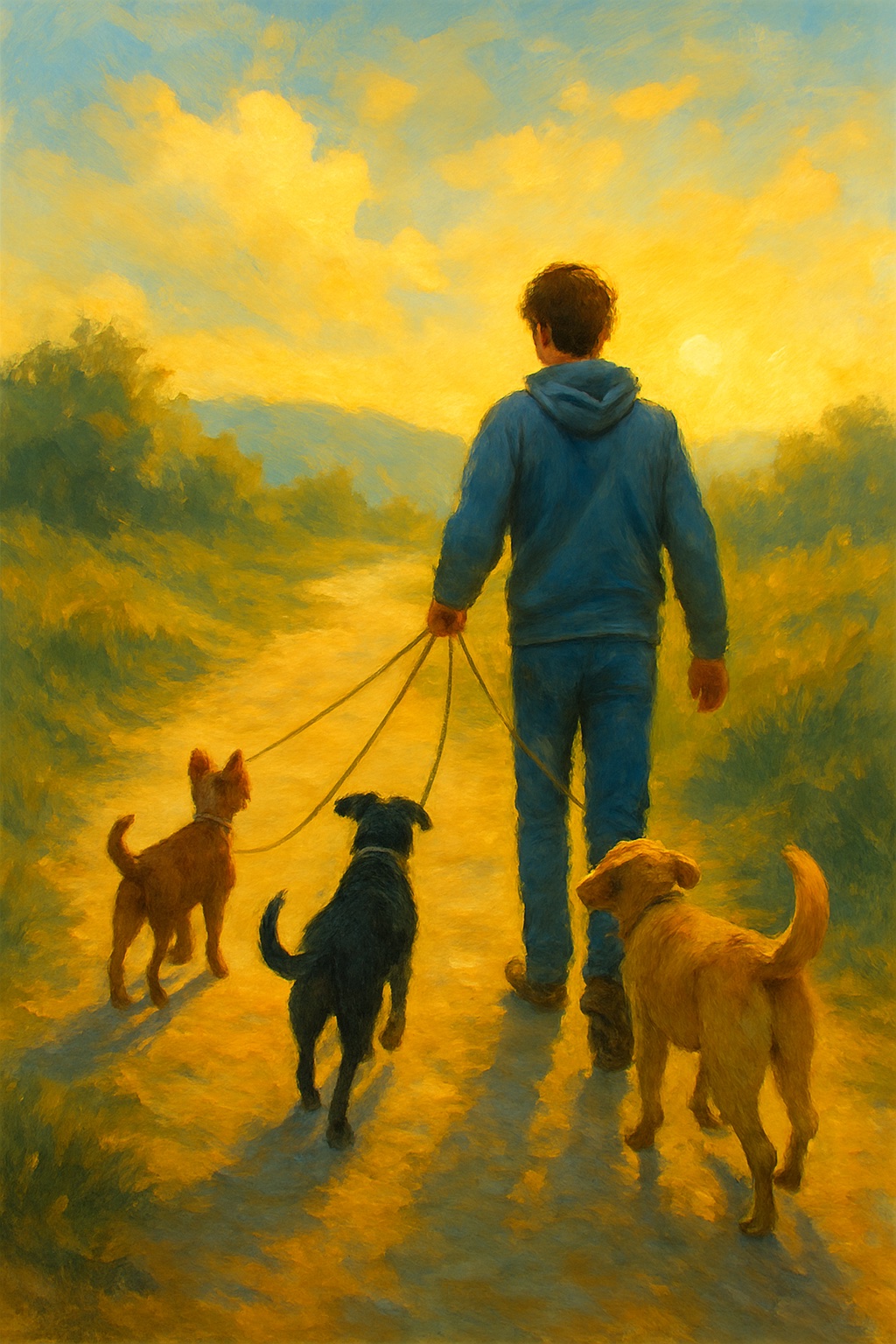
Walking three dogs at different speeds
The whole situation reminds me of dog walking the past few days.
Baxter is high energy.
Whiskers is a terrier mix with his own opinions.
Moki is bigger, more relaxed, but still needs movement.
If you walk all three together, you get chaos.
If you split them, you double your time.
Either way, you’re negotiating competing speeds, competing instincts, competing constraints.
That’s what using walled gardens feels like:
- Rover wants fast-paced fee extraction.
- YouTube wants slow, controlled creator funnels.
- Amazon wants high-volume traffic but makes the path as indirect as possible.
- Instagram wants engagement but hides outbound links like state secrets.
Every platform is a dog pulling in a different direction.
So you build workarounds.
You build your own website.
You build Continuum.
You build your own archive.
You build your own identity layers.
Because that’s the only way to stop being pulled apart.
The quiet cost of platform dependence
People assume the problem is the money.
But the real cost is time.
Every friction point steals your time — and the irony is that it becomes harder to build sovereign systems because you’re busy wrestling the defaults built by billion-dollar companies.
YouTube’s non-clickable links cost you momentum.
Rover’s fees cost you trust.
Amazon’s strange restrictions cost you sales.
LinkedIn’s walled-garden messaging costs you sanity.
In aggregate?
They slow your life down.
The sovereign alternative
Continuum exists because of this exact problem.
You got sick of having your identity controlled by third-party authentication systems.
You got sick of your writing being locked behind platform policies.
You got sick of losing access to old posts, old threads, old memories.
You got sick of corporate platforms acting like landlords in a digital city.
So you built your own house.
That’s sovereignty.
Not perfection.
Not convenience.
Freedom — with responsibility attached.
It’s the freedom to walk Baxter at his own pace without having to justify it to an algorithm.
Why people rarely leave walled gardens
It’s not because they like them.
It’s because the alternative — building your own path — requires work.
Mental, emotional, creative, infrastructural work.
Most people avoid that work.
They’d rather pay the Rover tax or tolerate the YouTube labyrinth.
But what they don’t realize is this:
You are already paying rent.
You are already putting in work.
You are already being drained.
Sovereignty doesn’t add effort — it replaces effort.
Closing
Walled gardens are convenient until they’re not.
Until you need them to work for you instead of through you.
Until you realize that every dog on the leash is pulling you somewhere you didn’t choose.
Sovereignty means letting go of those leashes — even if it means some extra walking.
And yes, it’s tiring.
But it’s also the only way to move at your own pace.
Write a comment