GAME REVIEW: Assassin’s Creed Mirage Takes The Series Back To Its Roots

\
*Assassin’s Creed Mirage* is Ubisoft’s attempt to remember what this series was before it became obsessed with leveling systems, continent-sized maps, loot tiers, and 100-hour checklists. For the most part, it succeeds. This is a leaner, more focused Assassin’s Creed built around stalking targets, slipping through crowds, climbing dense city streets, and making a clean escape after the kill.
It is not the bold reinvention that *Assassin’s Creed Origins* was, nor is it as massive or content-heavy as *Assassin’s Creed Odyssey* and *Assassin’s Creed Valhalla*. That is exactly the point. *Mirage* trades excess for intention—and while some of its old-school mechanics feel dated rather than nostalgic, the game is at its best when it lets you feel like an assassin again.
## **Baghdad Is the Star**
Set in ninth-century Baghdad, *Mirage* follows Basim Ibn Ishaq years before his role in *Assassin’s Creed Valhalla*. He begins as a street thief haunted by disturbing visions, then becomes entangled with the Hidden Ones and their fight against the Order of the Ancients.
s_!JzGz!,w_1456,c_limit,f_auto,q_auto:good,fl_progressive:steep/https%3A%2F%2Fsubstack-post-media.s3.amazonaws.com%2Fpublic%2Fimages%2F3f78108f-2d45-4cdd-8ea2-fe1d948c168f_738x414.jpeg)
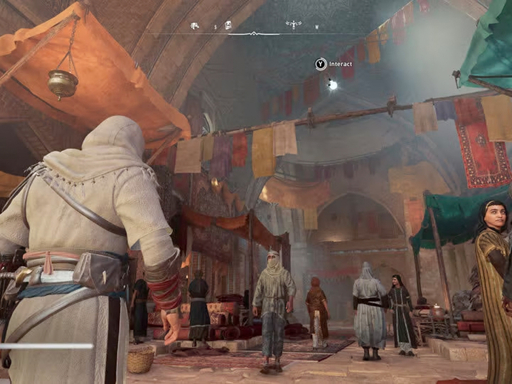
The story is serviceable, but Baghdad does much of the heavy lifting. Ubisoft Bordeaux has created one of the series’ most convincing cities: compact, colorful, crowded, and built vertically. Markets, mosques, palaces, alleys, rooftops, guard posts, and residential quarters all blend into a city that feels designed for infiltration rather than sightseeing from horseback.
That tighter focus is one of Mirage’s biggest strengths. Recent Assassin’s Creed games often overwhelmed players with enormous landscapes filled with repetitive icons. Baghdad, by comparison, feels deliberately constructed. You can learn its districts, recognize routes through a market, spot rooftop shortcuts, and use the city itself as part of a plan.
The smaller scale also restores something the franchise lost when it moved fully into RPG territory: the sense that an assassination is a problem to solve, not simply another combat encounter.
Stealth Finally Matters Again
The best thing about Mirage is that it understands the appeal of the older games. Basim is not an unstoppable warrior designed to bulldoze through a fort full of enemies. He is vulnerable in open combat, especially when surrounded, and the game strongly encourages patience, planning, and escape.
Stealth tools return in a meaningful way. Throwing knives, smoke bombs, noisemakers, blow darts, traps, disguises, benches, crowds, and rooftop routes all create options beyond simply crouching behind waist-high cover. Social stealth also makes a welcome comeback: blending into a crowd or using hired groups to create distractions gives missions a distinctly Assassin’s Creed flavor that had faded from the series’ more recent entries.
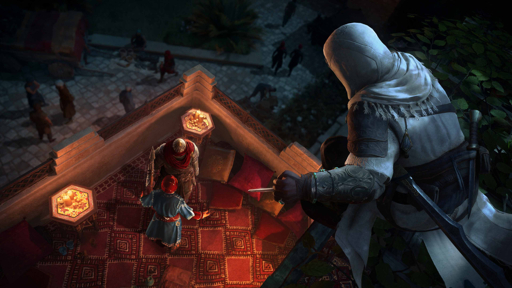
The investigation structure is another smart choice. Instead of marching directly from mission marker to mission marker, Basim gathers leads, identifies suspects, and works through connected cases before confronting major targets. The assassination missions themselves often play like smaller sandbox levels, with multiple entry points and opportunities to manipulate the environment.
A guarded compound may have a poorly watched roof, a bribable merchant, a hidden passage, or a crowd that lets you move unseen. Those moments make Mirage feel less like an action RPG and more like the assassination fantasy the franchise was originally built on.
A Return With Limits
Still, returning to the past also means bringing some of the past’s problems along with it.
Parkour is faster and more enjoyable than it was in Valhalla, but it lacks the precision and fluidity fans may remember from Assassin’s Creed Unity or even Assassin’s Creed II. Basim can occasionally feel sticky when navigating crowded rooftops or attempting a quick escape, and the movement system does not always cooperate when the game needs it to.
Combat is intentionally stripped down, which mostly works. It is dangerous, weighty, and clearly not the preferred solution. But the parry-focused swordplay can become repetitive, and the limited enemy variety means late-game encounters do not evolve as much as they should.
Then there is Assassin Focus, a new ability that lets Basim mark several targets and execute them in rapid succession. It can be satisfying, especially when a stealth plan begins collapsing. But it also feels oddly magical in a game otherwise committed to returning to grounded stealth systems. It is a useful emergency button, but not always a convincing fit for the classic Assassin’s Creed mood.
The narrative also falls short of the potential suggested by Basim’s role in Valhalla. His personal journey has compelling ideas—identity, destiny, trauma, loyalty, and the cost of devotion to a cause—but many supporting characters are thinly developed. The plot is strongest when it focuses on Basim’s uncertainty about himself, and weaker when it leans on interchangeable targets and familiar conspiracy plotting.
 ## Smaller Is Better—Mostly
For players exhausted by modern Assassin’s Creed bloat, Mirage is refreshingly restrained. There are no sprawling RPG skill trees, no constant chase for higher-level gear, and no need to spend dozens of hours clearing a map before the story becomes interesting. The campaign is comparatively concise, and that makes the overall experience feel more focused.
The tradeoff is that Mirage can sometimes feel slight. It is not packed with the systemic depth of Odyssey, the scale of Valhalla, or the elaborate parkour fantasy of Unity. It is a smaller game built from familiar ideas, and it rarely pushes those ideas forward in a major way.
But perhaps Assassin’s Creed did not need another giant reinvention. It needed a reminder of why people liked the series in the first place.
Mirage does not completely recapture the magic of the original games, but it gets closer than the franchise has in years. It brings back the tension of being outnumbered, the satisfaction of disappearing into a crowd, and the pleasure of finding a clean route through a hostile city without turning every mission into a loud brawl.
Verdict
Assassin’s Creed Mirage is a welcome reset for a franchise that had become too large for its own good. Its stealth, social systems, assassination missions, and richly designed Baghdad make it one of the more focused and satisfying Assassin’s Creed games in recent memory.
It is held back by uneven storytelling, a forgettable supporting cast, occasionally clumsy movement, and mechanics that sometimes feel more like a tribute to the old games than a true evolution of them. Still, for players who miss the days when Assassin’s Creed was about blades, rooftops, crowds, and carefully planned kills, Mirage delivers a version of that fantasy the series badly needed to revisit.
Score: 7.5/10
Write a comment