GAME REVIEW: Assassin’s Creed Shadows Is Ubisoft at Its Best

- A Living Work of Art
- A Natural Grind
- Revenge and Honor
- The Real Ending Is Awaji
- Verdict
- Rating: 9.5/10
Light spoiler warning: This review discusses the structure and broad narrative direction of the base game and Claws of Awaji, but avoids major twists, character fates, and specific details about the ending.
There were countless moments during my time with Assassin’s Creed Shadows when I stopped playing the game in front of me and simply stared at it.
Sometimes it was the light cutting through a forest. Sometimes it was a storm rolling across the landscape. Other times, it was the explosion of orange and red that transforms Japan in the fall, scattering leaves across the ground as the wind pulls at the trees. Whatever objective I had been heading toward could wait a minute. The world demanded my attention.
After roughly 70 hours on Xbox Series X, I finished my full playthrough with 86% Journey synchronization, 100% of Naoe’s journey, 73% of Yasuke’s, and 79% synchronization on Awaji. There is still a staggering amount left for me to do. I may continue grinding toward 100% off and on, but this is where my full playthrough—and this review—ends.
It ends with Assassin’s Creed Shadows firmly in my Top 5 of the franchise.

A Living Work of Art
Ubisoft’s version of 16th-century Japan is one of the most beautiful settings I have ever explored in a video game. That is not empty praise based on a few spectacular vistas. The beauty comes from how consistently detailed, varied, and alive the world feels during ordinary travel.
The seasons are the obvious centerpiece. Spring blossoms, thick summer greenery, autumn color, and winter snow alter the personality of familiar places. Fall is easily my favorite, but each season brings a different kind of beauty—and the system is more than cosmetic. Vegetation, water, snow, enemy behavior, visibility, and available hiding places can all change as the year advances. Rain can conceal Naoe’s movements, winter strips leaves from bushes, and snow preserves footprints.
The dynamic weather works with those seasons to keep the map from feeling frozen in place. You can feel that work when a bright afternoon darkens under storm clouds or a quiet forest begins whipping around in the wind.
That variety extends to the geography. The barren Warfields northeast of Himeji are blasted, bleak, and scarred by conflict. Kyoto and the surrounding Yamashiro countryside can burst with fiery autumn trees or spring blossoms, while Omi opens into sweeping forests, farmland, and the shores of Lake Biwa.
The contrast makes the world feel like a country shaped by both natural beauty and human violence, not a collection of interchangeable biomes.
\
Ubisoft has always been at its best when building places. Even when its games become too large or its systems begin competing for attention, the studio’s environmental artists know how to create worlds that beg to be explored. *Shadows* may be the clearest example of that strength yet.
The map is enormous, but what impressed me was not the raw square mileage. It was the density of detail inside it. Major cities, mountain communities, temples, castles, farms, forests, ports, and coastlines all possess their own visual character. I regularly found myself slowing down to absorb my surroundings rather than treating the countryside as empty space between icons.
Violence can suddenly erupt between NPC factions along the road or in the streets, grounding that beauty in the instability of the era. One minute, I was riding through peaceful farmland. The next, armed clans were colliding in front of me.
These encounters are small, but they reinforce the brutality surrounding Naoe and Yasuke without requiring another cutscene or exposition dump. The world communicates its history through atmosphere and activity as much as dialogue.
## Two Heroes, Two Games
The decision to divide the experience between two protagonists could easily have felt like a gimmick. Instead, Naoe and Yasuke give *Shadows* two distinct but equally satisfying identities.
Naoe feels like the character longtime *Assassin’s Creed* fans have been waiting for. She is fast, quiet, acrobatic, and built around infiltration. Darkness, elevation, distractions, tools, and environmental cover all matter when playing her well.
Sneaking into a heavily guarded castle, extinguishing lights, moving across rooftops, and removing guards one at a time captures the classic Assassin fantasy better than anything I have played from the franchise in years.
Yasuke is the opposite. He is a wrecking ball.
Where Naoe slips around defenses, Yasuke can smash directly through them. His combat is heavier, louder, and more deliberate, with attacks that feel powerful enough to shake the screen. If Naoe represents the classic formula, Yasuke feels closer to the combat-focused RPG direction of *Odyssey* and *Valhalla*.
s_!Hpb0!,w_1456,c_limit,f_auto,q_auto:good,fl_progressive:steep/https%3A%2F%2Fsubstack-post-media.s3.amazonaws.com%2Fpublic%2Fimages%2F4d17e53b-9dc9-48e4-8e65-e3152e1268a3_1800x1013.jpeg)
I missed a good portion of the franchise after it shifted toward that RPG structure, so Shadows became my first serious experience with the newer formula. Pairing it with a more traditional Assassin was a smart way to bridge those two eras.
Fans of the original games have Naoe. Players who prefer the scale and direct combat of the newer entries have Yasuke.
I played both relatively equally, choosing whichever character made the most sense for the scenario, and found both sides rewarding. Neither character felt like the “correct” choice. Their effectiveness depends on the situation and how you want to approach it.
That does not mean switching between them is always seamless. Spending several hours with one character builds muscle memory around an entirely different rhythm. Returning to Naoe after a long stretch with Yasuke can make her feel fragile and overly delicate. Switching back to Yasuke can initially make him feel slow and cumbersome.
The jolt usually passes after a few minutes, but it reveals just how differently the two were designed.
Their shared progression keeps that distinction from becoming a punishment. Naoe and Yasuke gain the same overall level, experience, Mastery Points, and Knowledge even though each has unique weapon and archetype trees. You can follow the story naturally, switch characters when the circumstances call for it, and avoid leaving one protagonist hopelessly underleveled.
A Natural Grind
For a game this large, Shadows does a surprisingly good job of making progression feel natural.
Quests overlap, target investigations point toward new areas, and optional activities tend to appear along routes you were already traveling. It creates a constant “since I’m here, I might as well” effect.
A castle on the horizon becomes a detour. That detour reveals a synchronization point, a shrine, a contract, or resources for the Hideout. Before long, the quick side trip has become an hour of exploration—and somehow it rarely feels like time wasted.
The Hideout gives much of that exploration a practical purpose. Buildings can improve your scouts, resource collection, experience gains, rations, equipment upgrades, contracts, and regional support network. It is not merely decorative base-building pasted onto the larger game. It connects directly to how efficiently you investigate targets and maintain your equipment.
\
The separation of Mastery Points and Knowledge also makes sense conceptually. Mastery Points purchase active and passive skills, while Knowledge Ranks open additional tiers of those skill trees. Knowledge comes primarily from quieter world activities such as praying at shrines, recovering lost pages, meditating with Naoe, or completing kata with Yasuke.
The drawback is that having Mastery Points does not necessarily mean you can spend them on the ability you want. You may still need to increase your Knowledge Rank by completing optional activities.
For players who enjoy systematically clearing objectives, this creates a satisfying reason to engage with the world. For casual players with limited gaming time, it may feel like the game is forcing side content between them and the build they want.
That concern applies to *Shadows* as a whole.
There is so much to do that the sheer volume can become daunting. Target boards, castles, character stories, contracts, Hideout upgrades, collectibles, Knowledge activities, equipment hunting, and regional objectives all compete for attention.
I enjoyed that abundance, but I can imagine someone playing only a few hours per week losing track of the story—or simply deciding that the climb is too steep.
## History and Fiction
The feigned outrage surrounding Yasuke’s inclusion never affected my opinion of the game. Much of it became so exaggerated that it overshadowed the basic facts about both the historical figure and the franchise portraying him.
Yasuke was real.
s_!yxkd!,w_1456,c_limit,f_auto,q_auto:good,fl_progressive:steep/https%3A%2F%2Fsubstack-post-media.s3.amazonaws.com%2Fpublic%2Fimages%2F9cb68974-669e-4d61-9279-5e5bc2005ccd_400x300.jpeg)
Surviving Japanese and Jesuit accounts place an African man by that name in Japan during the early 1580s. He initially arrived in connection with Jesuit visitor Alessandro Valignano before entering the service of Oda Nobunaga. Historical records indicate that Nobunaga provided him with a residence, weapons, servants, and a stipend.
Whether the precise title of “samurai” should be applied to Yasuke remains debated because the surviving historical record is limited. His presence in Nobunaga’s service, however, is not something Ubisoft invented.
Claims about Yasuke having been enslaved before arriving in Japan require more caution. Europeans were involved in the trafficking and enslavement of African people during that period, and Africans did travel through Portuguese trade and Jesuit networks. However, Yasuke’s early life and exact status before entering Nobunaga’s service remain poorly documented.
The honest historical position is not that every detail of Ubisoft’s version of Yasuke has been proven. It is that a real African man served close enough to one of Japan’s most powerful warlords to leave a mark in an otherwise limited historical archive.
Beyond that, Assassin’s Creed is historical fiction.
This is a franchise built around ancient artifacts, secret orders, massive conspiracies, impossible technology, and people reliving the genetic memories of their ancestors. Ubisoft has always used historical figures and events as the foundation for a fictional story.
Treating its dramatized version of Yasuke as some unprecedented violation of realism is ridiculous.
Historical debate is fair. Pretending Yasuke never existed—or acting as though a fictional action game owes players the standards of an academic history book—is not.
Revenge and Honor
The story itself is complex, layered, and packed with political and personal conflict.
At its center is a familiar Japanese revenge-and-honor structure, but it expands outward into competing clans, religious interests, foreign influence, secret organizations, and the shifting loyalties of an era in upheaval.
The emotional spine works. Naoe’s search for answers and Yasuke’s reckoning with the consequences of his service give the game more weight than a simple checklist of targets.
Their goals overlap without erasing their individual identities, and the revenge narrative gradually grows into something broader: a story about what these characters choose to preserve after violence has taken so much from them.
Still, the density can work against it.
Important names and alliances are introduced across dozens of hours, while side missions and exploration can create long gaps between major developments. If you play consistently, the layers are rewarding. If you step away for a week or spend several sessions clearing map icons, it can become difficult to remember why a particular target matters.
A basic understanding of the Sengoku period—particularly Oda Nobunaga’s campaigns and the fractured political landscape surrounding them—also helps. The game supplies context, but prior knowledge gives several alliances, betrayals, and encounters considerably more weight. Nobunaga was a central force in ending the Ashikaga shogunate and beginning Japan’s political unification, which explains why his ambitions cast such a large shadow over nearly every faction in the story.
Nobunaga was a central force in ending the Ashikaga shogunate and beginning Japan’s political unification, which explains why his ambitions cast such a large shadow over nearly every faction in the story.
\
That is not necessarily a weakness. The political complexity makes the world feel deeper and more authentic. It simply means *Shadows* demands more attention than its basic revenge premise initially suggests.
My biggest structural complaint involves Junjiro’s questline.
His personal missions did not feel important enough to justify making them mandatory for the final epilogue. Naoe’s and Yasuke’s arcs belong in that path. Junjiro’s felt like side material that had been promoted into a requirement.
That choice slows the ending at exactly the point when momentum should be building.
The missions are not offensive on their own. They simply add very little to the central conflict. Making them optional would have preserved their quieter character moments without forcing players to clear them before receiving narrative closure.
## Combat and Customization
Combat remains fluid and fun across the full run.
Naoe rewards timing, movement, evasion, and fast kills. Yasuke turns fights into controlled demolition. Their different weapon trees keep experimentation worthwhile, and tougher encounters eventually demand more than repeatedly using the same combination.
s_!Vpy0!,w_1456,c_limit,f_auto,q_auto:good,fl_progressive:steep/https%3A%2F%2Fsubstack-post-media.s3.amazonaws.com%2Fpublic%2Fimages%2Ffdc94b39-b0ff-48d9-9550-938d634fc942_1800x1013.jpeg)
The occasional movement problem does get in the way. I sometimes became stuck against scenery or caught on an object during combat, taking damage because the character would not move where I intended.
It is the familiar kind of frustration that appears in many large third-person action games—not enough to seriously damage the experience, but aggravating when it happens during a difficult fight.
I also experienced several crashes on Xbox Series X. A current-generation console should handle the game more reliably, regardless of how much detail is being processed.
Fortunately, the autosave system was frequent enough that I never returned far from where the crash occurred. The problem remained an annoyance rather than a disaster.
The equipment system offers one feature I wish every loot-heavy game would adopt: free visual customization.
After acquiring an appearance, you can apply it to stronger equipment while retaining that equipment’s statistics and effects. You are never forced to spend hours wearing armor you dislike simply because it has the better number.
The irony is that I rarely found enough cosmetic designs I truly cared about using.
The system is excellent, but the selection felt less varied and memorable than it should have been across a game of this size. Ubisoft solved the problem of choosing between appearance and performance, then gave me too few appearances that made the choice exciting.
The Real Ending Is Awaji
Claws of Awaji should not be treated as a disposable side adventure.
It directly continues unresolved threads from the base game, carries forward the hunt for the final Regalia, and provides the closure that the main release deliberately leaves beyond the horizon. Its placement after the personal stories of Naoe and Yasuke reinforces its position as a continuation rather than a separate episode.
The transition begins with “The Puppet Show,” one of the most creative sequences in the entire game. It temporarily transforms the presentation into an interactive side-scrolling stage production, using wooden scenery, narration, platforming, combat, and stealth to tell a story that points Naoe toward Awaji. It is visually distinct, mechanically unexpected, and exactly the kind of experimentation a game this long needs.
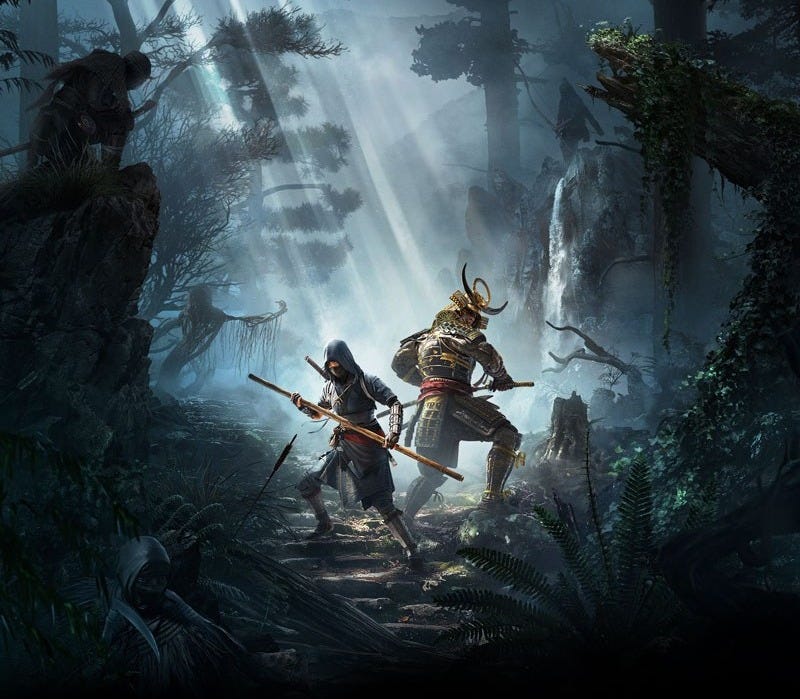
Awaji immediately feels different from the mainland. The sound design, shifting wind, mist, forests, and hostile roads give the island an eerie atmosphere. There is a constant sense that you are being watched rather than merely exploring another region.
That threat is real.
Shinobi attacks occur along the road through traps and ambushes, and they are noticeably harder to anticipate than most random encounters in the base game. The island’s bosses also rank among the toughest fights in the full experience.
They demand attention to your environment, positioning, movement, and attack patterns rather than simply giving an ordinary enemy a larger health bar.
Naoe’s new bo staff is a welcome addition. It fits her acrobatic style and gives her a more assertive option in open combat, but changing stances can feel clumsy when a fight becomes frantic.
I liked the idea and enjoyed using the weapon. I just never reached the point where its stance mechanics felt completely natural under pressure.
Most importantly, the expansion finishes what the base game leaves unfinished.
It resolves major questions involving Naoe’s personal journey and the Regalia storyline, offering the kind of genuine ending that makes the preceding 60-plus hours feel complete.
That creates a legitimate criticism: players should not need an expansion to experience what feels like the full conclusion.
But taken as part of the complete package I played, Claws of Awaji is essential. If you finished only the base game, you missed a massive part of the narrative and its most satisfying closure.
You have to play Claws of Awaji to experience the full story.
Verdict
Assassin’s Creed Shadows is enormous, occasionally unwieldy, and likely overwhelming for anyone hoping to casually breeze through its story.
Its movement can betray you. Its narrative can become difficult to track. Its cosmetics need more personality. Its base-game finale takes an unnecessary detour through mandatory quests that feel optional in every way except their label.
None of those problems came close to outweighing what the game does well.
Ubisoft created one of the most beautiful open worlds I have ever seen, then filled it with enough environmental variation, political tension, progression, combat, stealth, and incidental detail to keep that beauty from becoming an empty backdrop.
Naoe and Yasuke successfully connect two different eras of Assassin’s Creed, giving classic stealth fans and modern RPG players equally satisfying paths through the same adventure.
I came to Shadows having missed much of the franchise’s RPG era. Seventy hours later, it stands securely among my five favorite Assassin’s Creed games.
Even at 86% Journey synchronization, I can look across the map and see how much remains. For once, that does not feel like unfinished work.
It feels like a reason to return.
Taken together with the essential Claws of Awaji, this is Ubisoft at its most ambitious—and, more often than not, at its best.
Write a comment