The Cypherpunk Manifesto in 2026: From Eric Hughes to Nostr & Bitcoin
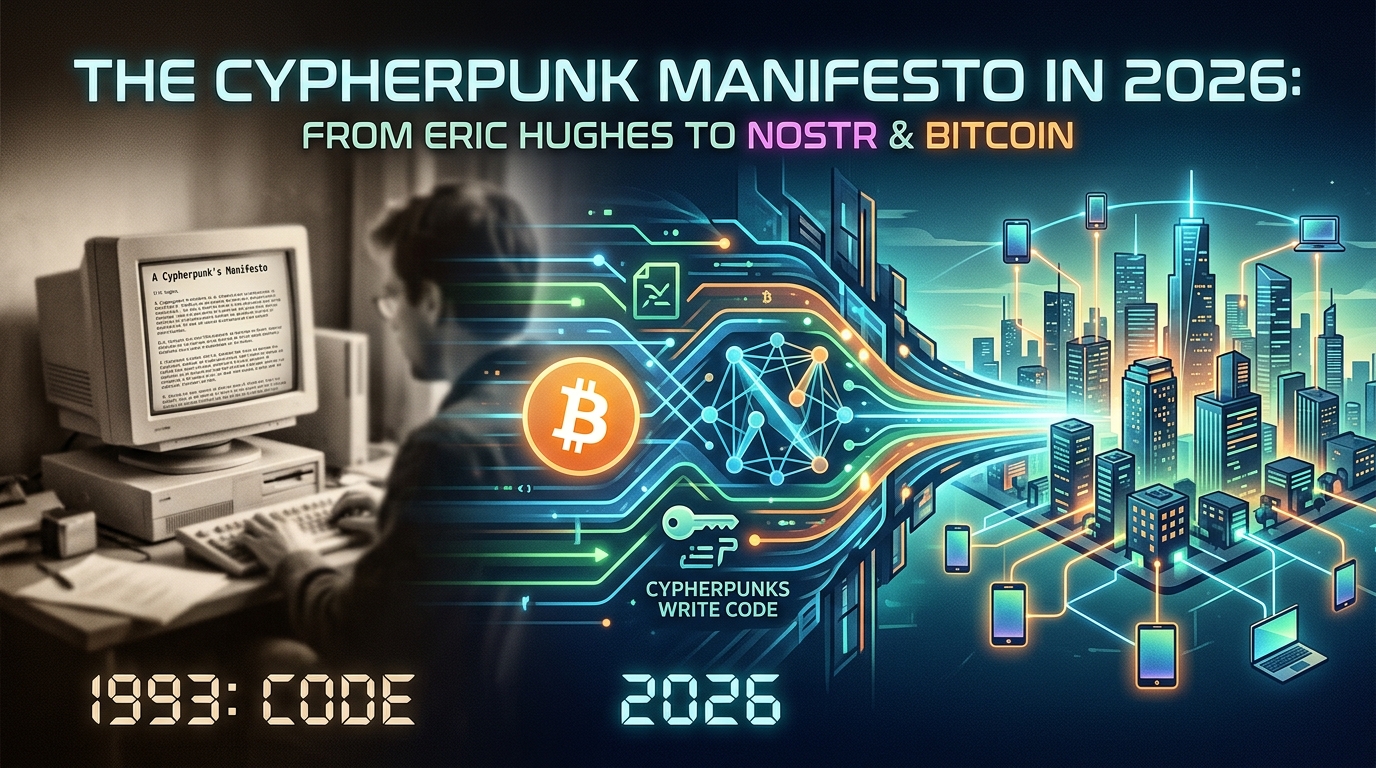
In March 1993, a mathematician and programmer named Eric Hughes published a short, visionary document that would quietely lay the groundwork for the modern decentralized web: A Cypherpunk’s Manifesto.
At a time when the commercial internet was barely taking shape, Hughes and a small group of cryptographers foresaw a fundamental threat to digital human rights: standard digital communication would inevitably lead to unprecedented mass surveillance and corporate control.
His diagnosis was straightforward, but his solution was revolutionary:
“Privacy is necessary for an open society in the digital age… Privacy is the power to selectively reveal oneself to the world.”
— Eric Hughes, 1993
For decades, the Cypherpunk movement remained a niche subculture of mathematicians, hackers, and privacy advocates. But today, in 2026, those theoretical concepts have transformed into global, censorship-resistant infrastructure.
⚡ Zap 2100 sats to unlock the full article on
https://fanfares.io/naddr/naddr1qvzqqqr4gupzpsz2urcgqnyttj5dl6l6zcjpg2ltk4vzl8rh5kla75jg8xcv645yqyvhwumn8ghj7enpdenxzun9wvhxummnw3erztnrdaksqfpjxqunset9xsmz6vmyv4jz6dph8yej6cfkx5cj6ve5v5enjc338yergvtr30pgld
Write a comment