The Blindfold Challenge: Dancing in the Dark as a Discipline of Surrender
- The Anatomy of the Challenge
- Why We Fear the Unseen Audience
- The Discipline of Losing Control
- Lessons from the Body
- How to Approach the Challenge Safely and Meaningfully
- The Broader Meaning
- Issue 4 of HBYB
There is a peculiar kind of courage required to perform when you cannot see. Strip away your sight, bind your hands, and place a whistle between your lips — then ask yourself to dance, to move, to make noise, all while an unknown audience watches from a darkness you cannot pierce. This is the essence of one of the more unusual discipline challenges circulating today, and beneath its playful surface lies a surprisingly rich lesson in self-mastery.
The Anatomy of the Challenge
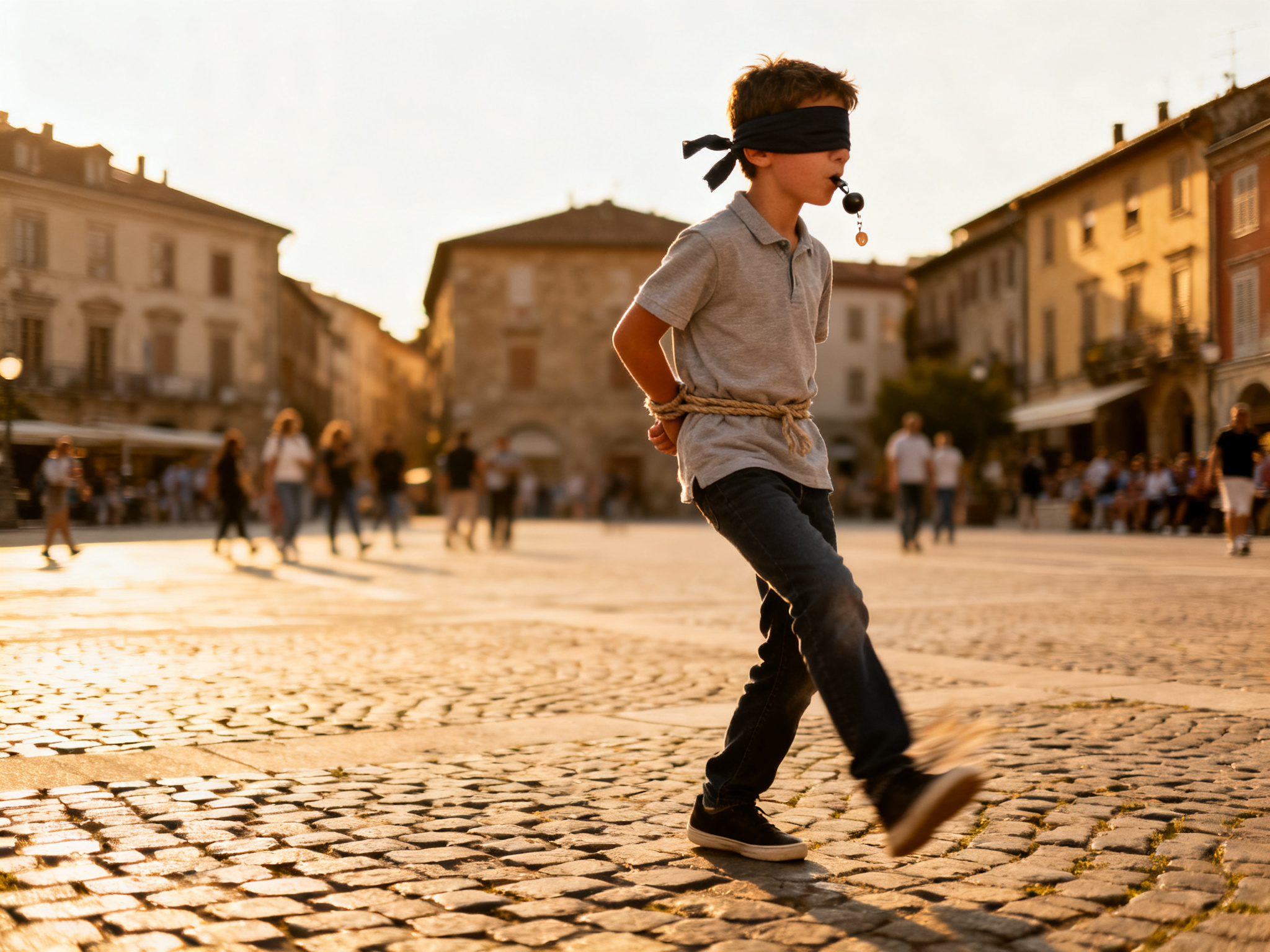
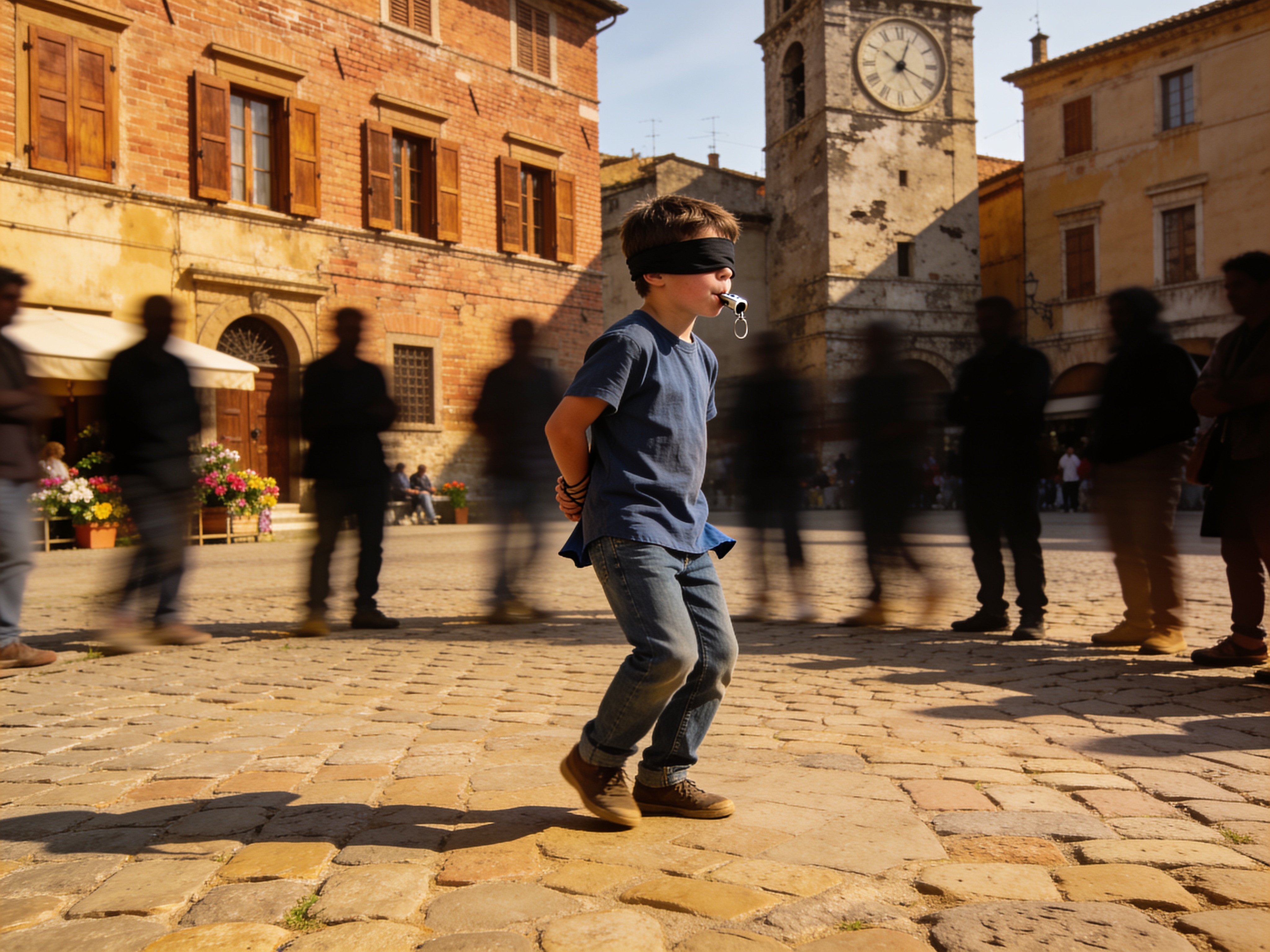
The setup is deceptively simple. A participant is blindfolded, removing the single sense we most rely on for orientation and self-assurance. Their hands are bound behind their back, stripping away the ability to balance, gesture, or self-soothe through touch. Finally, a whistle is placed in their mouth, and they are instructed to whistle a rhythm while dancing freely.
The final and most psychologically significant element: you never see how many people are watching you. There could be one person. There could be a hundred. There could be a camera streaming to strangers across the world. That uncertainty is not incidental — it is the entire point.
What appears at first to be a party game or a viral prank is, when examined closely, a compact and demanding exercise in vulnerability, focus, and the deliberate surrender of control. And control, or the letting go of it, sits at the very center of what discipline actually means.
Why We Fear the Unseen Audience
Human beings are wired to monitor how others perceive us. Psychologists refer to this as the “spotlight effect” — our tendency to overestimate how much attention others are paying to our appearance and behavior. Under normal circumstances, we manage this anxiety by watching the room, reading faces, and adjusting ourselves accordingly. We perform, and we edit our performance in real time based on feedback.
The blindfold destroys this feedback loop entirely.
When you cannot see your audience, you lose the ability to calibrate. You cannot tell if someone is laughing, cringing, cheering, or leaving. Your brain, deprived of data, tends to fill the void with worst-case scenarios. The imagined audience is almost always harsher than the real one. This is the same mechanism that makes public speaking terrifying and that makes the anticipation of an event more stressful than the event itself.
The challenge, then, forces a confrontation. You must move and make sound in a space where your inner critic has free rein and no evidence to contradict it. To continue dancing anyway is to override that critic — and that override is a trainable skill.
The Discipline of Losing Control
At “The Art Of Discipline,” we often frame self-mastery as the ability to make yourself do something difficult. But there is an equally important, and often neglected, dimension: the ability to make yourself stop controlling.
Consider what each constraint in this challenge removes:
The blindfold removes your control over information. You cannot gather data about your environment.
The bound hands remove your control over your body’s usual coping tools. You cannot fidget, cover your face, or steady yourself against a wall.
The unknown audience removes your control over your reputation in the moment. You cannot manage the impression you are making.
What remains is only your internal state. And this is precisely the arena where real discipline lives. When all external levers are taken away, the only thing left to govern is your own reaction — your breath, your posture, your willingness to keep going.
This is why the challenge is more than a game. It is a controlled dose of powerlessness, taken deliberately, in order to build tolerance for the uncontrollable circumstances that life delivers without warning.
Lessons from the Body
There is also a physical intelligence at work here. When you dance without sight, your body must rely on proprioception — the internal sense of where your limbs are in space. Without the visual anchor of a fixed horizon, and without your arms to counterbalance, your core and legs must work harder to keep you upright.
Many participants report that after the initial panic subsides, something unexpected happens: their movement becomes more honest. Freed from the compulsion to look good, they stop performing for an imagined lens and start simply moving. The whistle, requiring steady breath, forces them to regulate their breathing — which in turn calms the nervous system. A shaky, panicked whistle betrays inner chaos; a steady one signals a mind that has settled.
In this way, the whistle functions almost like a biofeedback device. You cannot fake calm with a whistle in your mouth. Your breath tells the truth about your internal state, and learning to steady that breath under pressure is a foundational discipline that transfers directly to any high-stakes situation — a job interview, a difficult conversation, a moment of crisis.
How to Approach the Challenge Safely and Meaningfully
If you decide to attempt this challenge, treat it as a genuine exercise rather than a stunt. A few principles will help you extract real value from it.
Prioritize safety first. Because your hands are bound and your vision is gone, clear the space of obstacles, sharp corners, and trip hazards. Have a trusted person nearby whose only job is to prevent you from falling or colliding with anything. Discipline is never worth an injury.
Establish an exit signal. Agree in advance on a sound or word that means “stop now.” Voluntary surrender is powerful; being trapped is not. The value comes from choosing to stay in discomfort, not from being unable to escape it.
Begin with the breath. Before you make a single move, take three slow breaths through the whistle. Let the steady tone become your anchor. When the anxiety spikes — and it will — return to that tone.
Release the outcome. Remind yourself explicitly: the number of people watching is irrelevant to how you should behave. Whether it is one or one hundred, your task is unchanged. This mental reframe is the true muscle being trained.
Reflect afterward. Once the blindfold comes off, notice the gap between what you feared and what actually happened. That gap is your data. It is proof, stored in memory, that your imagined audience is more punishing than any real one.
The Broader Meaning
We spend enormous energy trying to control how we are seen. We rehearse, we hedge, we hide the parts of ourselves we fear will be judged. The blindfold challenge is a small, absurd, and oddly beautiful rebellion against that instinct. It says: I will move, I will make noise, I will look ridiculous, and I will do it without the safety of knowing how it lands.
That willingness — to act with full commitment in the face of uncertainty and judgment — is not a party trick. It is the same quality that separates those who create from those who merely consume, those who speak from those who stay silent, those who live boldly from those who wait for permission.
Dancing in the dark, then, is really a rehearsal for living in the light without fear. And that may be the most disciplined thing of all.
Issue 4 of HBYB
This article is from issue 4 of HBYB - The Art of Discipline. Get it here: https://pressstr.shakespeare.wtf/naddr1qvzqqqymxvpzqmmu0ymwlkhv3egac00v8cde0xgp28z62ws8w45lg3g66k6g4y93qqvkjumnw4jj6dpdvfjkjmn8943xc6twv3nx7mryv4jq3xmx0q
Write a comment