Inside AI Chat V2: Autonomous Loops with /goal and /loop

Direct Answer: The aiFetchly /goal and /loop commands provide developers with deterministic, bounded autonomous execution inside AI Chat V2. While /goal establishes persistent objectives backed by verifiable acceptance criteria (command exit codes, file states, independent verifiers), /loop enables bounded iterations (1–10 runs) or scheduled interval polling within a unified conversation transcript.
In 2026, developers are moving past open-ended agentic loops that spin indefinitely, consume excessive API tokens, and hallucinate completion without writing unit tests. True enterprise-grade AI automation requires bounded autonomy: systems where the model cannot mark its own work “done” without verifiable, objective proof.
The aiFetchly desktop platform introduces this rigor into desktop workflows through two native slash commands: /goal and /loop. Operating directly inside AI Chat V2, these commands separate task execution from objective verification.
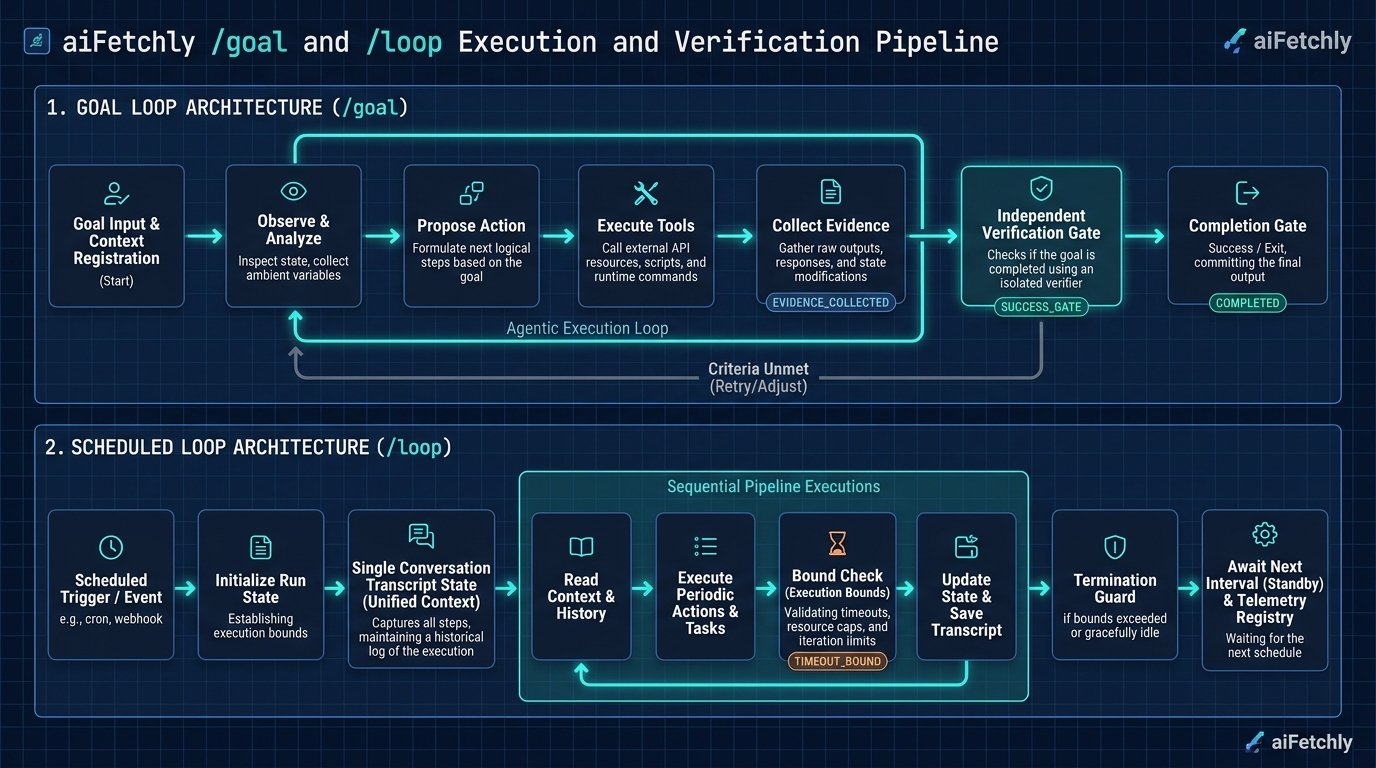
1. /goal — Defining Verifiable Acceptance Criteria
Setting a durable objective begins with /goal <objective> in the chat composer. When triggered, the assistant enters Plan Mode, prompting for clarification if parameters are ambiguous and generating concrete acceptance criteria.
Unlike conversational chatbots that declare victory through conversational text, aiFetchly ties completion to four deterministic verification mechanisms:
- Command: Validates that a shell or terminal script exits with code
0or matches a specific regex output. - File: Confirms the creation or modification of a target local artifact (e.g., build bundle or database table).
- Manual: Pauses execution and requests explicit human confirmation.
- Independent LLM Verifier: Employs an isolated evaluation prompt that inspects collected evidence to return structured verdicts (
satisfied,not_satisfied,blocked), preventing the worker model from grading its own homework.
2. Goal Loop — Bounded Iterations (/loop <N>)
Once a goal is approved, developers invoke autonomous iterations via /loop <maxIterations>, passing an explicit integer between 1 and 10 (e.g., /loop 5).
Every iteration follows a disciplined lifecycle detailed in the Goals & Loops specification:
- Observe: The assistant analyzes the current workspace state and prior run outputs.
- Act: Proposes and executes a bounded tool call (modifying code, executing builds).
- Verify: Fresh evidence is evaluated against required criteria. Stale passes from previous iterations are rejected.
The loop terminates automatically when all required criteria pass, when 3 consecutive identical failures occur (marking the goal blocked), or when the iteration ceiling is hit.
3. Scheduled Loops — Continuous In-Transcript Polling
For monitoring long-running processes—such as CI/CD deployments, scrapers, or lead imports—/loop supports scheduled durations:
/loop 5m check if the deployment finished and summarize errors
Unlike external cron services that fragment context across isolated chat sessions, aiFetchly appends each scheduled run directly into the existing conversation transcript. Developers can chat interactively between runs, pause with /loop pause, or stop via /loop stop.
By marrying structured acceptance criteria with bounded iteration limits, aiFetchly gives developers autonomous power without the risk of runaway agents.
aiFetchly is a local-first desktop AI business agent (free to download). Home: aifetchly.com · goal & loop docs: docs.aifetchly.com/docs/getting-started/introduction
- Reference: https://www.aifetchly.com
Write a comment