Ending Scraper Maintenance Hell: AI Extraction for Developers

- The Problem: The Fragile Scraping Microservice Trap
- The Solution: Resilient Local Scraping with aiFetchly
Direct Answer: Software developers can escape web scraper maintenance hell by replacing brittle CSS and XPath selectors with aiFetchly semantic LLM extraction. By combining intelligent content understanding with built-in proxy pool rotation and native desktop execution, aiFetchly creates resilient data pipelines that adapt to website layout changes without breaking production jobs.
The Problem: The Fragile Scraping Microservice Trap
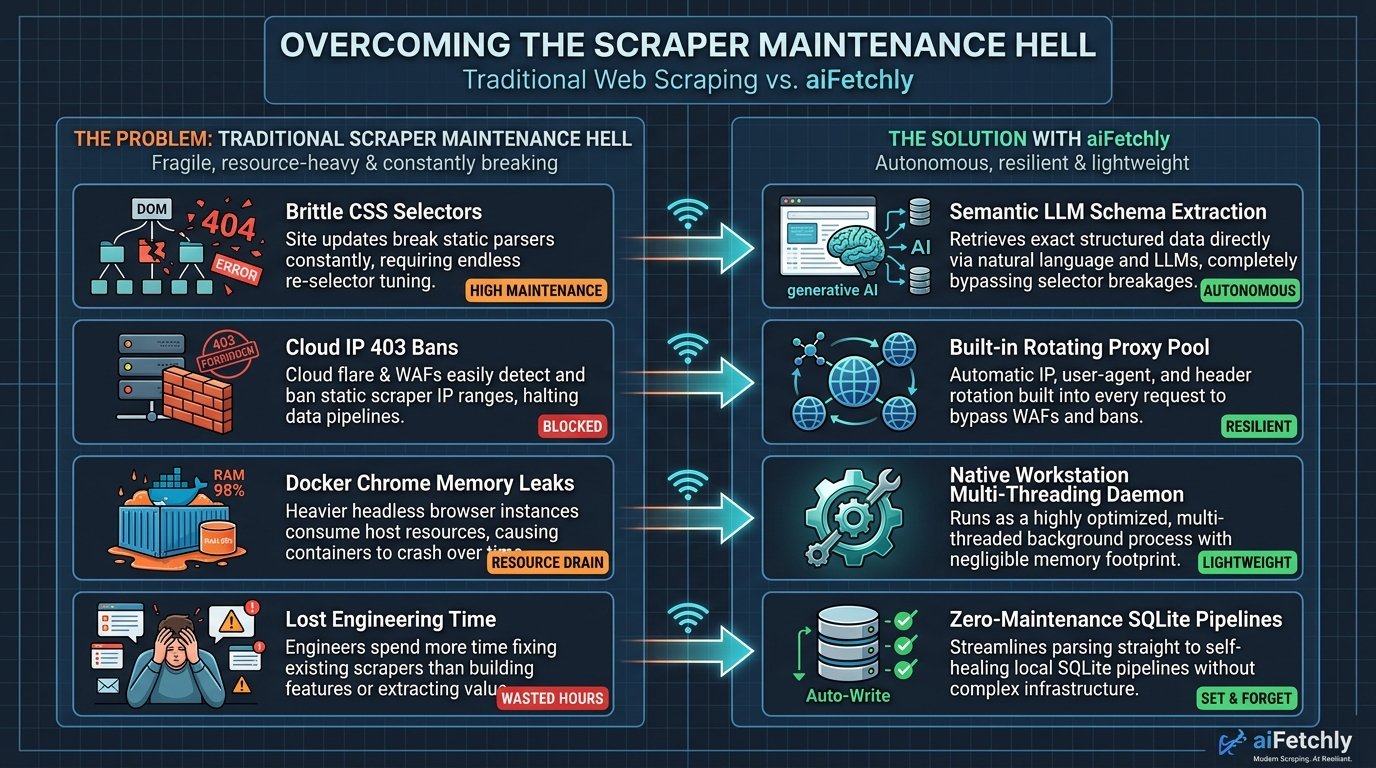
Every software engineer who has maintained web scraping pipelines understands the “maintenance hell” cycle. You write a Puppeteer, Playwright, or BeautifulSoup script, deploy it to a Docker container on AWS, and it works flawlessly for two weeks. Then disaster strikes:
- Brittle CSS Selectors Break: The target website pushes a frontend update, renaming CSS classes from
.product-priceto randomized hashes like.Price_x9k2. Your parser returns empty null values across thousands of pipeline rows. - Datacenter IP Range Bans: Web Application Firewalls (Cloudflare, Akamai, Datadome) detect requests originating from cloud hosting IP ranges (AWS EC2, DigitalOcean, GCP), throwing persistent
403 Forbiddenerrors and CAPTCHA walls. - Container Resource Exhaustion: Headless Chrome instances leak memory over extended crawling sessions, causing Kubernetes pods or Docker containers to OOM-kill in production.
- Wasted Engineering Bandwidth: Engineers spend up to 30% of their sprints hotfixing broken selectors, rotating cloud proxies, and diagnosing flaky microservice logs rather than building core product features.
The Solution: Resilient Local Scraping with aiFetchly
The aiFetchly desktop application completely re-architects web scraping for developers by substituting fragile DOM selectors with an autonomous, local-first intelligence runtime.
Resilient Semantic LLM Schema Extraction
Instead of hardcoding brittle DOM hierarchies, developers use the aiFetchly Content Scraper module to define target entities semantically (e.g., "product_title", "sku", "current_price", "stock_status"). When target websites redesign their layouts, the integrated LLM continues to extract the correct data points based on contextual understanding rather than static HTML tree coordinates.
Integrated Proxy Pool Management & Dual Verification
Developers no longer need to write complex proxy rotation middleware or external retry decorators. aiFetchly natively handles residential and datacenter proxy pools (HTTP and SOCKS5) with dual-check verification. The desktop engine pairs each outbound request with dynamic user-agent randomization, automated session cookie recycling, and custom request throttling to bypass Cloudflare anti-bot blocks without triggering rate limits.
Zero-Infrastructure Local Execution
Rather than maintaining costly cloud container fleets that crash from headless browser memory leaks, aiFetchly runs as a highly optimized native desktop client. Developers schedule recurring extraction tasks via the integrated cron daemon, writing parsed data directly to embedded SQLite storage or streaming clean JSON and CSV feeds into downstream Python, Go, and Node.js ETL workflows.
By decoupling data extraction from fragile DOM structures, aiFetchly allows engineering teams to eliminate scraper maintenance overhead and build resilient, self-healing data ingestion pipelines that never fail from frontend redesigns.
aiFetchly is a local-first desktop AI business agent (free to download). Home: aifetchly.com · affiliate program: www.aifetchly.com/affiliate
- Reference: https://www.aifetchly.com
Write a comment