The Battle of Lab Leak Hill
Source: The Battle of Lab Leak Hill
Publisher: The Skeptical Scientist | Author: Bob Morris, MD, PhD
Published: April 15, 2026 | Archived: July 18, 2026
“The Wrong Hill to Die On”
Yesterday, physicist Michael Weissman informed journalist Walker Bragman that, in disputing the COVID lab leak, he had picked the “wrong hill to die on”. By coincidence, just a few weeks earlier, I had an extended discussion with Weissman about that very hill. This seems like the perfect moment to examine that discussion and that presumably perilous hill.

### Weissman’s Gotcha Moment
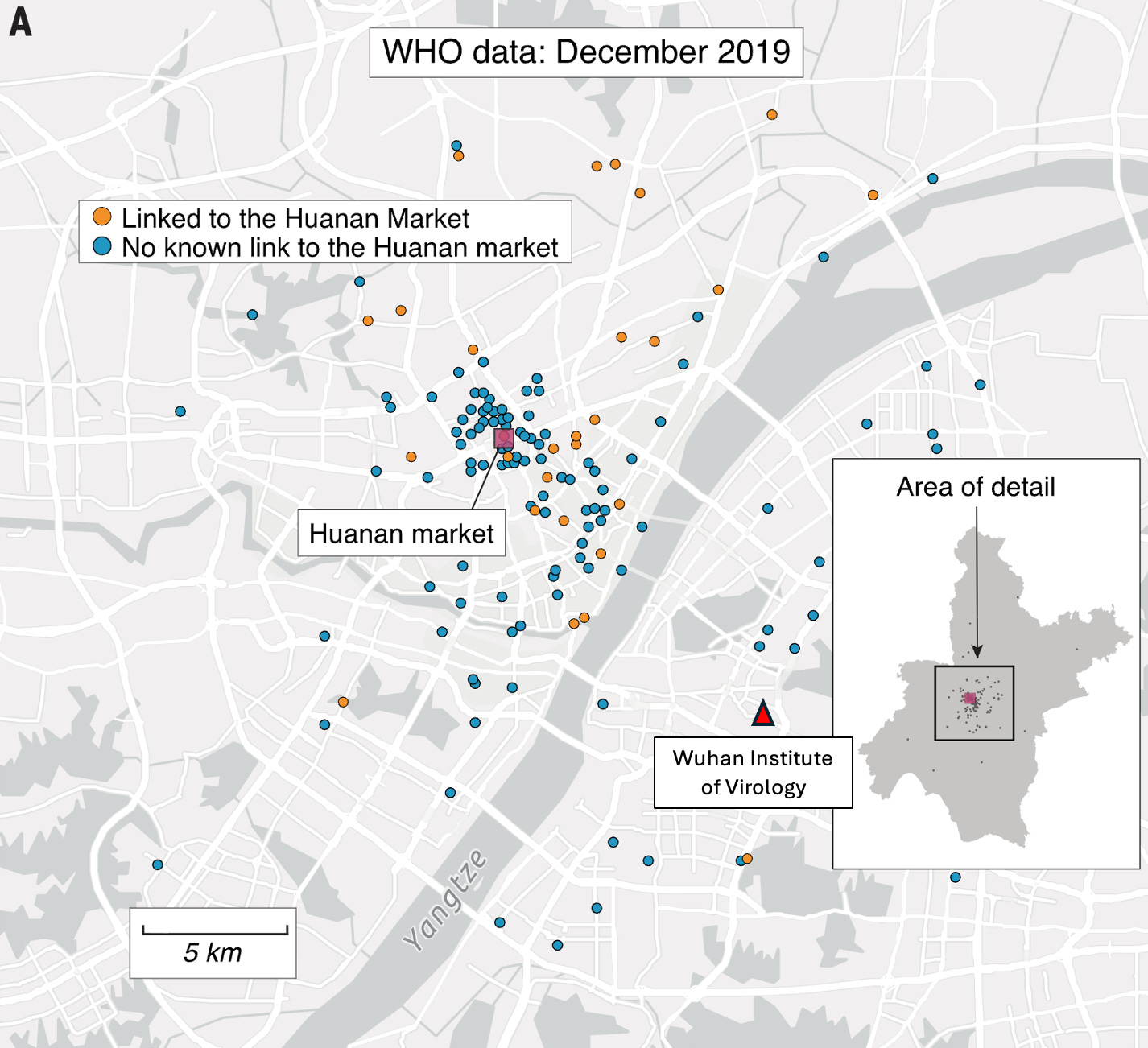
First consider the evidence Weissman puts forward to prove this was a lab leak. The map below is at the core of his argument for why this must have been a lab leak. He notes that the cluster of cases closest to the market had “no known link to the Huanan market” and concludes that this cluster must have been the result of the public health authorities preferentially looking for cases around the market.
The Skeptical Scientist is a reader-supported publication. To receive new posts and support my work, consider becoming a free or paid subscriber.
Weissman is a physicist who published his critique in a s[tatistics journal](https://doi.org/10.1093/jrsssa/qnae021) and an [economics journal](https://econjwatch.org/articles/an-article-in-science-on-covid-origins-contains-a-fundamental-error). He has no experience in virology, epidemiology, or outbreak investigations. And it shows.
This map recalls the most famous map in epidemiology, one drawn by [John Snow](https://web.archive.org/web/20150930052902/http:/collections.nlm.nih.gov/ext/cholera/PDF/0050707.pdf) to show cases of cholera clustered around the Broad Street Pump. The one difference is that identifying the source of the water a victim drinks is far easier than tracing the air they breathe. Weissman seems to have forgotten that fact.
He treats “no known link to the market” as if it were some sort of definitive, binary quantum state rather than an incomplete epidemiologic history. Given what we now know about the spread of COVID the fact that early cases were essentially all severe, hospitalized cases, the inability to trace a case to the market does not exclude it as a source. But the best way to show the weakness of his argument is to take it seriously.
The [first report](https://www.thelancet.com/journals/lancet/article/PIIS0140-6736MATHPH0XEND30183-5/fulltext) of the outbreak in Wuhan describes 41 cases. Of those, 27 had a direct link to the market. Because these were the earliest recognized severe cases, based on hospital cases identified before the market had been proposed as a source, collider bias due to market focused ascertainment was not possible.
Could that have been a random observation?
An estimated [10,000 people](https://www.sciencedirect.com/science/article/pii/S0013935122010295) shop at Huanan market on any given day. Standard protocol for investigating an outbreak is to consider exposures up to two weeks prior to onset. Even under an intentionally conservative assumption that there are no repeat shoppers, at most 140,000 of Wuhan’s 11 million residents visited that market in a 14-day window. The probability of observing 27 or more exposed individuals in a random sample of 41 is approximately 2 x 10\-41.
This is not impossible. But neither is winning the Powerball jackpot five times in a row, which has roughly the same probability.
And that is only the probability of observing this level of market association by chance. Any alternative explanation, such as a source located elsewhere in the city, must account not only for this extreme enrichment, but also for the absence of any corresponding clustering at the supposed true source. The joint probability of both is smaller still.
And that is Weissman’s gotcha evidence not simply that COVID did not originate at the market, but that it originated 11 km away from the market at the Wuhan Institute of Virology, which has no clustering of cases around it at all.
s_!NRNd!,w_1456,c_limit,f_auto,q_auto:good,fl_progressive:steep/https%3A%2F%2Fsubstack-post-media.s3.amazonaws.com%2Fpublic%2Fimages%2F5e03c7ba-08d5-429d-9bea-9de730f54e61_1426x1302.png)
The Lab Leak meets the Jenga Tower
This is only one improbability required to support the assertion that COVID resulted from a lab accident at the Wuhan Institute of Virology (WIV). In March, I laid these assertions out in two blog posts.
-
From among thousands of wildlife viruses collected, one specific SARS-CoV-2–like virus, showing no prior evidence of human infectivity, was selected for laboratory research.
-
Despite selecting it to study, researchers made an explicit decision not to deposit the virus’ sequence in GenBank.
-
When the virus failed to replicate in standard systems, researchers somehow identified its target receptor and engineered mice to sustain infection.
-
A laboratory accident infected a worker. In fact, lab leak proponents suggest there were three infected workers.
-
There was no identified community cluster for any of the infected workers and the virus spread unnoticed until a large outbreak appeared around the Wuhan wildlife market.
-
No physical, documentary, or genetic trace of this virus or of the research conducted on it was ever discovered.
Weissman immediately responded, asserting confidently,
“Almost everything you write here is incorrect. Even the overall framing.”
What follows is the record of what happened when math met his hill.
The Jenga Tower in Real Time
At this point I introduced a Bayesian framework — appropriate given that Weissman presents himself as a quantitative analyst with a Substack called “An Inconvenient Probability.” I asked him to assign probabilities to the six propositions above and evaluate the joint likelihood by multiplying them.
Weissman ignored this framing, constantly insisting we needed to discuss what he asserted as evidence against a wildlife origin, evidence he inferred provided proof of a lab origin. He jumped back and forth between Substack and Bluesky in responding, beginning with a reference to the “evidence” discussed above. I repeatedly tried to get him to assign probabilities to these events, all necessary for a lab origin to have occurred.
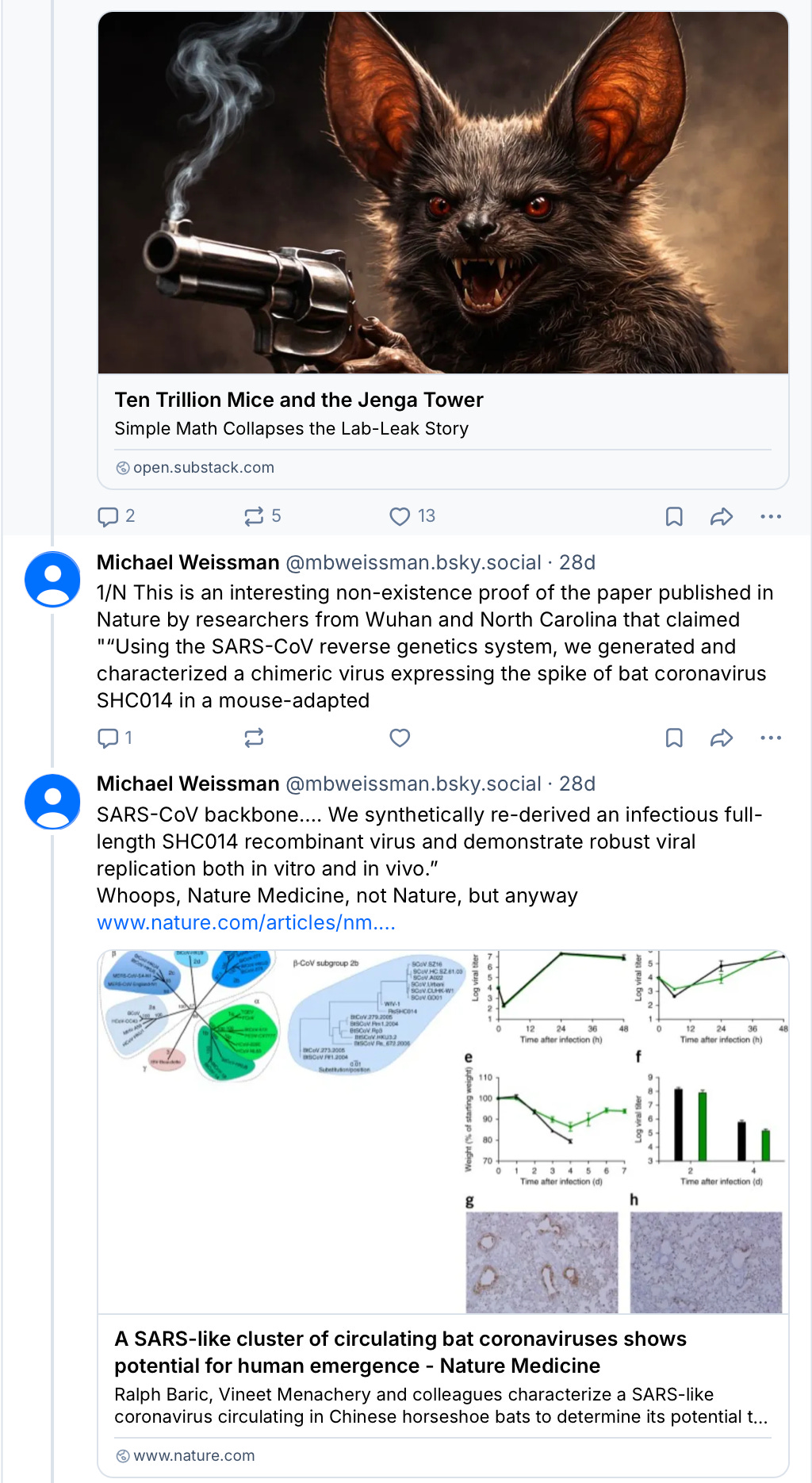
He declined to assign probabilities to five of the six, consistently redirecting to his critiques of the wildlife origin evidence rather than engaging with the probability framework. The one he engaged with — the probability of a lab accident — he conditioned on the assumption that DEFUSE-like work had started at WIV. DARPA rejected the DEFUSE proposal. There is no evidence that work began.
When I pointed this out, he suggested my Bayesian framing didn’t map to proper Bayesian techniques — a curious objection from someone whose Substack is called “An Inconvenient Probability.”
If It Began in a Lab, What Was the Precursor?
In a preprint, currently submitted for publication, I show how the COVID-19 pandemic gives us an empirical upper bound on how fast coronaviruses evolve under real-world conditions. After roughly 14 billion human infections, SARS-CoV-2 has accumulated fewer than 200 fixed mutations. Scaling that observed rate to the ~1,000 mutations separating SARS-CoV-2 from its closest known relatives requires on the order of 100 billion human infections — or the equivalent of ten trillion mouse infections in a laboratory setting.
This generates one unavoidable question: what was the precursor virus, and how did anyone get from there to SARS-CoV-2?
Weissman never answered it.
The Database
Much of Weissman’s argument rests on the claim that WIV took its sequence database offline in late 2019 for suspicious reasons, creating a black box that conceals a potential precursor virus.
I cited Flo Debarre’s detailed debunking of this claim. The “database takedown” story originated with DRASTIC, a lab-leak activist group, and was based on a fundamental misunderstanding of how scientific publishing works. The changes were to a journal article describing the database, not the database itself. The date was a publishing date. DRASTIC claimed to have Shi Zhengli’s MAC address and IP data, capabilities that would require NSA-level surveillance. Debarre concluded they fabricated it.
Weissman’s response: he never used DRASTIC’s timeline. The database went offline for no good reason and we don’t know what was in it.
He did not address Debarre’s debunking. The foundational claim went undefended.
Doing the Math
Throughout the exchange I returned repeatedly to the same request: assign probabilities to the six propositions and multiply them together. This is not a complex ask for someone presenting himself as a quantitative analyst.
He never did it.
When I did the math making very conservative assumptions, the probability of a lab leak in the absence of any direct evidence is somewhere north of 1 in 100 billion. Now we need to multiply that by probability that all that happened and cases were linked to the wet market by chance. So becomes . Add a couple more winning lottery tickets to that probability.
Maybe that’s why he didn’t do the math.
Instead, he:
-
Cited private emails obtained through FOIA
-
Invoked an undisclosed database whose takedown story appears to be fabricated
-
Raised Zhou Yusen’s suspicious death while explicitly disclaiming the story
-
Accused me of playing legal parlor games for asking for peer reviewed citations
-
Redirected repeatedly to his own Substack
He provided no counter example. He still hasn’t multiplied the probabilities.
The Devolution
As the exchange continued, the evidentiary base deteriorated in a way that is worth documenting precisely.
To recapitulate, he began with peer reviewed statistical critiques of Pekar and Worobey. It proceeded through FOIA-obtained private emails. It moved to an undisclosed database whose takedown story appears to rest on a fabrication. It arrived at a Twitter post from a bioinformatics professor at the University of Puerto Rico with no associated publication. It detoured through Zhou Yusen falling from the roof of WIV, a claim Weissman raised while explicitly disclaiming it. It reached SARS-CoV-2 sequences found in Antarctic soil samples from December 2019, reported by a website that no longer exists.
That website, I subsequently learned, was a shell misinformation site created specifically to give fabricated stories a veneer of credibility before being abandoned once flagged as fraudulent.
From peer reviewed statistics to a shell misinformation site reporting a Tweet about Antarctic soil. In one exchange. On a Substack called “An Inconvenient Probability.”
What “Almost” Is Doing
Weissman opened with “almost everything you write here is incorrect.” After several days of exchange across two platforms, here is what was actually rebutted:
Nothing.
The precursor virus was never identified. The probabilities were never assigned. The Debarre debunking was never addressed. The shell misinformation site was never explained. The central question — what was the precursor virus and how did anyone get from there to SARS-CoV-2 — was never answered.
“Almost” is doing extreme heavy lifting.
Why This Matters Beyond One Exchange
Weissman is not a crank. He is a credentialed physicist who has devoted serious effort to this question and who occasionally makes legitimate statistical points. That’s precisely what makes him consequential.
The mechanism by which fringe positions acquire mainstream legitimacy runs through people like Weissman. He provides the intellectual scaffolding, peer reviewed critiques, Bayesian frameworks, congressional testimony citations, that allows others to believe they are standing on scientific ground. That borrowed legitimacy then detaches from its careful framing and reattaches to increasingly extreme claims. By the time it reaches commenters invoking intentional bioweapon release and state sponsored crimes, the scaffolding is gone but the legitimacy remains.
This is the same mechanism that gave the Great Barrington Declaration its appearance of scientific credibility. An economist with a Stanford affiliation, a physicist with a Substack called “An Inconvenient Probability”, credentials borrowed from one domain and deployed in another, with the gap between expertise and authority hidden by the complexity of the argument.
The only response is rigorous quantitative work that meets the argument on its own ground. The pandemic gave us that opportunity. Every novel human infectious disease has been traced to wildlife. The epidemiology points to the Huanan market. The evolutionary mathematics establish what a laboratory origin would have required. And a quantitative analyst with five years of investment in this question spent several days unable to answer one question.
Where is the precursor virus?
Wildlife Origins
The Lab Leak is not a hill worth dying on because the entire hill vaporizes when you take it seriously.
For starters, the burden of proof has been wildly misplaced. Every novel human infectious disease in recorded history has been traced to a wildlife pathogen. Every one. SARS-CoV-1, MERS, HIV, Ebola, Nipah, Hendra, Marburg, Zika, West Nile — the list is long and the pattern is unbroken. Not one has ever been conclusively traced to a laboratory origin.
There is extensive data to support wildlife origins for SARS-CoV-2. Angela Rasmussen’s recent piece brilliantly lays out the evidence: raccoon dog DNA at the precise market stall where the virus was found, two independent spillover events consistent with an animal reservoir, early cases clustering around the Huanan market with a precision that survives every attempt to attribute it to sampling bias. Weissman’s failed critique of the Huanan Market epidemiology data is typical of the potshots directed at serious research by lab leakers.
The wildlife origin hypothesis isn’t speculation. It’s the null hypothesis. It’s what always happens.
So why has the burden of proof been placed entirely on wildlife origin advocates? Lab leak proponents have demanded a smoking gun with little bat fingerprints all over it. When asked to apply that skepticism to the lab origins, they balk, obfuscate, and wave hands.
Novel infections originate in wildlife.
There is no hill. Just bedrock.
The Skeptical Scientist is a reader-supported publication. To receive new posts and support my work, consider becoming a free or paid subscriber.
- Reference: https://drbobmorris.substack.com/p/the-battle-of-lab-leak-hill
- Reference: https://bsky.app/profile/mbweissman.bsky.social/post/3mjhm67kb4k2q
- Reference: https://substackcdn.com/image/fetch/$s_!fMpG!,f_auto,q_auto:good,fl_progressive:steep/https%3A%2F%2Fsubstack-post-media.s3.amazonaws.com%2Fpublic%2Fimages%2F7e50daa9-1b45-43a3-93a1-e855125dd759_362x280.png
- Reference: https://doi.org/10.1093/jrsssa/qnae021
- Reference: https://econjwatch.org/articles/an-article-in-science-on-covid-origins-contains-a-fundamental-error
- Reference: https://web.archive.org/web/20150930052902/http:/collections.nlm.nih.gov/ext/cholera/PDF/0050707.pdf
- Reference: https://www.thelancet.com/journals/lancet/article/PIIS0140-6736(20)30183-5/fulltext
- Reference: https://www.sciencedirect.com/science/article/pii/S0013935122010295
- Reference: https://substackcdn.com/image/fetch/$s_!NRNd!,f_auto,q_auto:good,fl_progressive:steep/https%3A%2F%2Fsubstack-post-media.s3.amazonaws.com%2Fpublic%2Fimages%2F5e03c7ba-08d5-429d-9bea-9de730f54e61_1426x1302.png
- Reference: https://www.who.int/publications/m/item/independent-assessment-of-the-origins-of-sars-cov-2-from-the-scientific-advisory-group-for-the-origins-of-novel-pathogens
- Reference: https://bsky.app/profile/mbweissman.bsky.social/post/3mhedkjbhyk2f
- Reference: https://substackcdn.com/image/fetch/$s_!3LP9!,f_auto,q_auto:good,fl_progressive:steep/https%3A%2F%2Fsubstack-post-media.s3.amazonaws.com%2Fpublic%2Fimages%2F38c9e460-2856-49b0-9f24-e6097c702728_1024x1870.png
- Reference: https://zenodo.org/records/19036903
- Reference: https://pandemonium.hypotheses.org/650
- Reference: https://x.com/stevenemassey/status/1788570303817494819
- Reference: https://web.archive.org/web/20230120174254/https://adeno-news.com/2023/01/20/breaking-sars-cov-2-spike-found-in-bacteria-samples-taken-from-china-2019
- Reference: https://substack.com/home/post/p-191547544
Write a comment