The media's lab leak fiasco
Source: The media’s lab leak fiasco
Publisher: Slow Boring | Author: Matthew Yglesias
Published: May 26, 2021 | Archived: July 17, 2026
As I believe I have said before, I spent the month of February 2020 intensely focused on covering the seemingly imminent victory of Bernie Sanders in the Democratic Party’s presidential primary. I dedicated approximately 0% of my journalistic energy to covering what was, in retrospect, the clearly more significant story of a novel coronavirus outbreak starting in Wuhan, China and clearly spreading to other parts of the world.
I was aware of the virus in much the way that I am aware of the National Hockey League, but I wasn’t paying attention to it as a journalist. The first piece I published on Covid on March 12 holds up pretty well I think, but it was way too late in terms of the kind of tough travel restrictions that, in retrospect, the country needed.
Due to not paying any attention, I missed the furious initial skirmish in what’s become the Long Discourse Wars over the idea that the SARS-CoV-2 virus came from the Wuhan Institute of Virology rather than originating naturally in bats.
What happened is that Tom Cotton raised this idea in February in his capacity as a China hawk, and then again in March as part of a nonsensical attack on Joe Biden. He got shouted down pretty hard by scientists on Twitter, by formal institutions, and by the media. Then this kind of pachinkoed down into being a politics story where writers and fact-checkers who didn’t cover science at all “knew” that this was a debunked story that right-wingers were pushing for their nefarious ends. I think it’s increasingly clear that this was a huge fiasco for the mainstream press that got way over their skis in terms of discourse-policing, and there is in fact a serious scientific question as to where the virus came from — a question that we will probably never be able to answer because the Chinese government has clearly committed to one viewpoint on this and isn’t going to allow a thorough investigation.
A separate question that’s less clear to me is what follows from this in terms of policy. You can break this down into three questions:
-
Suppose the media had been more open to Cotton’s point back in February 2020 — what would we have done differently?
-
Suppose definitive evidence arises this Friday that the virus in some sense came from the Chinese lab — what would we do differently going forward?
-
Or suppose definitive vindication of the zoonotic origin theory emerges — what difference would that make?
I think in all three of these cases, the answer is basically that nothing would be different. This is not to apologize for the bad coverage but, if anything, to underscore how egregious it was to lean so heavily into the Tom Cotton Is Wrong narrative. The subsidiary premise of that narrative was always that Cotton was doing something extremely nefarious. But while Cotton does indeed have a lot of opinions I disagree with, it’s just not true that this lab leak idea is now or ever was very closely linked to any hot-button policy controversies.
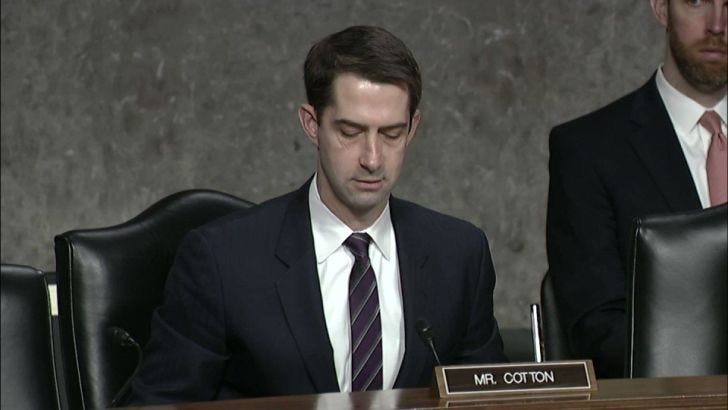
Looking back on the media fiasco side of this, it seems to trace back to statements Cotton made at a Senate Armed Services Committee hearing on January 30. This appears to have been a hearing with senior military commanders from U.S. Africa Command and U.S. Southern Command. I think talking about a virus outbreak in China probably sounded like a bit of a crank thing to do, but Senators say weird stuff at hearings all the time.
Cotton said that the Chinese government had been lying about the severity of the outbreak all month and that their story linking the outbreak to the Huanan Wholesale Seafood Market was dubious.
[
 Tom Cotton@SenTomCotton
China claimed—for almost two months—that coronavirus had originated in a Wuhan seafood market. That is not the case. @TheLancet published a study demonstrating that of the original 40 cases, 14 of them had no contact with the seafood market, including Patient Zero.
Tom Cotton@SenTomCotton
China claimed—for almost two months—that coronavirus had originated in a Wuhan seafood market. That is not the case. @TheLancet published a study demonstrating that of the original 40 cases, 14 of them had no contact with the seafood market, including Patient Zero.
 12:20 PM · Jan 30, 2020
4.3K Reposts · 6.76K Likes
](https://twitter.com/sentomcotton/status/1222962874932453377?lang=en)
Cotton’s remarks were not widely covered at the time, but this basic claim seems to me to have been well within the range of establishment consensus views.
He was referring to an article in the Lancet, a very establishment publication. Max Fisher at The New York Times used that same Lancet article to do a piece arguing that the virus situation in Wuhan [illustrated the flaws in China’s authoritarian governance model](https://www.nytimes.com/2020/01/25/world/asia/coronavirus-crisis-china-response.html?action=click&module=Top%20Stories&pgtype=Homepage) — that local officials would not circulate “bad news” if it would be seen as unwelcome to top leaders.
Julia Belluz at Vox did a piece about the [Lancet study and a few other pieces of evidence](https://www.vox.com/2020/1/27/21082354/coronavirus-outbreak-wuhan-china-early-on-lancet) that Chinese leaders weren’t telling the truth.
“These discrepancies add new urgency to a question many are already asking,” she wrote. “Did China downplay the outbreak early on? And if so, why?”
Her article surveys various experts and moots several theories, including Fisher’s. But she also raises Cotton’s argument that this was perhaps deliberate malfeasance:
> A third explanation is that China was purposely playing down the health emergency, as it did during the SARS outbreak of 2003. Back then, [China was heavily criticized](https://www.scmp.com/news/china/article/1155641/transparency-key-lesson-learned-sars-outbreak-mainland-china) for reacting slowly, withholding information about the outbreak for too long, and [putting economic considerations ahead of public health](https://www.ncbi.nlm.nih.gov/books/NBK92479/). The virus [eventually killed 774 people](https://www.cdc.gov/sars/about/fs-sars.html) and infected more than 8,000.
>
> “The fact that the *Lancet* report is different from the official early Chinese account does raise enormous concerns around the truthfulness of information coming out of China,” said [Steven Hoffman](https://globalstrategylab.org/people/steven-hoffman), director of the Global Strategy Lab and a global health professor at York University. “If China did intentionally withhold information, that would not only be bad for public health but also illegal under international law. It would be a violation of the International Health Regulations, a legally binding treaty that covers how 195 countries respond to outbreaks like this one.”
The [Lancet piece came out on January 24](https://www.thelancet.com/journals/lancet/article/PIIS0140-6736MATHPH1XEND30185-9/fulltext). Fisher wrote on January 25. On January 26, a piece in Science ran that was titled [“Wuhan seafood market may not be source of novel virus spreading globally.”](https://www.sciencemag.org/news/2020/01/wuhan-seafood-market-may-not-be-source-novel-virus-spreading-globally) Belluz wrote on January 27, and Cotton spoke and Tweeted on January 30.
But Cotton did one thing that those other sources didn’t do — he speculated a little. At the end of that clip he says “we still don’t know where coronavirus originated. Could have been a market, a farm, a food processing company. I would note that Wuhan has China’s only biosafety level-four super laboratory that works with the world’s most deadly pathogens to include, yes, coronavirus.”
That is all not only true, but entirely consistent with what mainstream media was reporting at the time. But then things went horribly off the rails.
Cotton’s statements did not get any immediate coverage, but several days later David Choi at Business Insider wrote them up with the headline [“Republican senator suggests ‘worse than Chernobyl’ coronavirus could've come from Chinese ‘superlaboratory.’”](https://www.businessinsider.com/tom-cotton-coronavirus-come-from-chinese-super-laboratory-2020-2)
Choi’s piece is one of those things that happens on the internet when the story is totally accurate but also doing a lot of sensationalization for clicks. What Cotton said at the hearing is that the Chinese government’s official story about the seafood market was wrong, which was something that was at the time also being floated in Vox and The New York Times and Science and the Lancet. Where Cotton differed from the consensus is that he attributed this to malice, which is not what the scientific articles said (but also isn’t a scientific question) and was not the NYT’s preferred interpretation of events.
But that was the actual parameter of the debate; Fisher thought this illustrated a point about the abstract functioning of systems while Cotton thought it illustrated a point about the malign intent of a foreign adversary. Belluz, a science journalist rather than a foreign policy writer, entertained both interpretations as consistent with the facts. And it seemed like a fairly classic foreign policy sort of argument. Throughout history, hawks see malice and threat behind everything that happens, while more dovish people tend to see misunderstanding and confusion. You can imagine the Tom Cotton of 1914 talking somewhere in Vienna about the Serbian government’s obvious complicity in the assassination of Franz Ferdinand while the Max Fisher of the time says the difficulty controlling the Black Hand and its operations reveals the fundamental weakness of the Serbian state.
What Choi did was not exactly *accusing* Cotton of spreading a conspiracy theory about Chinese bioweapons, but just sort of locating his remarks as adjacent to other people’s conspiracy theories and misinformation:
> Cotton was referring to China's first Biosafety Level 4 lab, the Wuhan National Biosafety Laboratory of the Chinese Academy of Sciences, which investigates “the most dangerous pathogens,” according to the US [Centers for Disease Control and Prevention](https://wwwnc.cdc.gov/eid/article/25/5/18-0220_article).
>
> While Cotton qualified his remarks by saying “we still don't know where” the virus originated, his comments come amid numerous [conspiracy theories](https://www.washingtontimes.com/news/2020/jan/26/coronavirus-link-china-biowarfare-program-possible/) about the virus's origins — including one that says the virus “originated in lab linked to China's biowarfare program.”
>
> The amount of false information spreading across social-media platforms has prompted several companies, including [Facebook](https://www.businessinsider.com/facebook-vows-to-limit-remove-misinformation-about-wuhan-coronavirus-2020-1), to limit the reach of such posts. In a statement, Facebook said it would display “accurate information” and notify users if they are suspected of sharing false or misleading information.
So now we have leaped from “everyone agrees the Chinese government’s claims were wrong but Cotton is an outlier in claiming they were deliberately wrong” to “Cotton’s views should be associated with conspiracy theories and misinformation,” even though his core factual claim was not particularly different from what anyone was else was saying. Then things blew up, thanks not so much to a Sunday show interview as to tweets about an interview.
On February 9, [Margaret Brennan interviewed China’s ambassador to the United States](https://mobile.twitter.com/FaceTheNation/status/1226540067805650944), Cui Tiankai, about the virus outbreak. During the course of the interview, she said to the Ambassador that Cotton “suggested that the virus may have come from China’s biological warfare program — that’s an extraordinary charge, how do you respond to that?”
I’m not sure that’s really the best characterization of what Cotton said, but it’s not wildly wrong either.
And Cui’s reply was pretty restrained and honestly very diplomatic considering that Cotton is a big hawk and China’s propaganda messaging is often heavy-handed and clumsy.
> I think it’s true that a lot is still unknown and our scientists — Chinese scientists, American scientists, scientists of other countries — are doing their best to learn more about the virus. But it’s very harmful, it’s very dangerous to stir up suspicion, rumors and spread them among the people. For one thing, this will create panic. Another thing is that it will send up racial discrimination, xenophobia, all these things that will really harm our joint efforts to combat the virus. Of course, there are all kinds of speculation and rumors. There are people who are saying that this virus are coming from some military lab MATHPH0XEND — not of China, maybe in the United States. How can we believe all these crazy things?
Then Brennan asks him squarely “where did the virus come from?” to which Cui responds, “We still don’t know yet, it’s probably — according to some initial outcome of the research — probably coming from some animals, but we have to discover more about it.”
So at this point, Cui’s official position is that we don’t know where the virus came from, but it was probably an animal. And Cotton’s position is that we don’t know where the virus came from, but it might have been the lab. Cui says it is irresponsible to speculate about the lab, while Cotton says the speculation is good. Cotton is not, I think, saying the virus was Chinese biowarfare — he is saying the PRC is not trustworthy. The PRC ambassador’s position, obviously, is that he is in fact trustworthy.
But whoever writes up the exchange for the Face The Nation Twitter account goes with Cui “dismisses #coronavirus conspiracy theories pushed by @SenTomCotton that it’s being used as biological warfare as ‘absolutely crazy.’”
It seems to me that Cotton did not say the virus was being used as biological warfare.
But Cotton’s Twitter account fired back.
[
12:20 PM · Jan 30, 2020
4.3K Reposts · 6.76K Likes
](https://twitter.com/sentomcotton/status/1222962874932453377?lang=en)
Cotton’s remarks were not widely covered at the time, but this basic claim seems to me to have been well within the range of establishment consensus views.
He was referring to an article in the Lancet, a very establishment publication. Max Fisher at The New York Times used that same Lancet article to do a piece arguing that the virus situation in Wuhan [illustrated the flaws in China’s authoritarian governance model](https://www.nytimes.com/2020/01/25/world/asia/coronavirus-crisis-china-response.html?action=click&module=Top%20Stories&pgtype=Homepage) — that local officials would not circulate “bad news” if it would be seen as unwelcome to top leaders.
Julia Belluz at Vox did a piece about the [Lancet study and a few other pieces of evidence](https://www.vox.com/2020/1/27/21082354/coronavirus-outbreak-wuhan-china-early-on-lancet) that Chinese leaders weren’t telling the truth.
“These discrepancies add new urgency to a question many are already asking,” she wrote. “Did China downplay the outbreak early on? And if so, why?”
Her article surveys various experts and moots several theories, including Fisher’s. But she also raises Cotton’s argument that this was perhaps deliberate malfeasance:
> A third explanation is that China was purposely playing down the health emergency, as it did during the SARS outbreak of 2003. Back then, [China was heavily criticized](https://www.scmp.com/news/china/article/1155641/transparency-key-lesson-learned-sars-outbreak-mainland-china) for reacting slowly, withholding information about the outbreak for too long, and [putting economic considerations ahead of public health](https://www.ncbi.nlm.nih.gov/books/NBK92479/). The virus [eventually killed 774 people](https://www.cdc.gov/sars/about/fs-sars.html) and infected more than 8,000.
>
> “The fact that the *Lancet* report is different from the official early Chinese account does raise enormous concerns around the truthfulness of information coming out of China,” said [Steven Hoffman](https://globalstrategylab.org/people/steven-hoffman), director of the Global Strategy Lab and a global health professor at York University. “If China did intentionally withhold information, that would not only be bad for public health but also illegal under international law. It would be a violation of the International Health Regulations, a legally binding treaty that covers how 195 countries respond to outbreaks like this one.”
The [Lancet piece came out on January 24](https://www.thelancet.com/journals/lancet/article/PIIS0140-6736MATHPH1XEND30185-9/fulltext). Fisher wrote on January 25. On January 26, a piece in Science ran that was titled [“Wuhan seafood market may not be source of novel virus spreading globally.”](https://www.sciencemag.org/news/2020/01/wuhan-seafood-market-may-not-be-source-novel-virus-spreading-globally) Belluz wrote on January 27, and Cotton spoke and Tweeted on January 30.
But Cotton did one thing that those other sources didn’t do — he speculated a little. At the end of that clip he says “we still don’t know where coronavirus originated. Could have been a market, a farm, a food processing company. I would note that Wuhan has China’s only biosafety level-four super laboratory that works with the world’s most deadly pathogens to include, yes, coronavirus.”
That is all not only true, but entirely consistent with what mainstream media was reporting at the time. But then things went horribly off the rails.
Cotton’s statements did not get any immediate coverage, but several days later David Choi at Business Insider wrote them up with the headline [“Republican senator suggests ‘worse than Chernobyl’ coronavirus could've come from Chinese ‘superlaboratory.’”](https://www.businessinsider.com/tom-cotton-coronavirus-come-from-chinese-super-laboratory-2020-2)
Choi’s piece is one of those things that happens on the internet when the story is totally accurate but also doing a lot of sensationalization for clicks. What Cotton said at the hearing is that the Chinese government’s official story about the seafood market was wrong, which was something that was at the time also being floated in Vox and The New York Times and Science and the Lancet. Where Cotton differed from the consensus is that he attributed this to malice, which is not what the scientific articles said (but also isn’t a scientific question) and was not the NYT’s preferred interpretation of events.
But that was the actual parameter of the debate; Fisher thought this illustrated a point about the abstract functioning of systems while Cotton thought it illustrated a point about the malign intent of a foreign adversary. Belluz, a science journalist rather than a foreign policy writer, entertained both interpretations as consistent with the facts. And it seemed like a fairly classic foreign policy sort of argument. Throughout history, hawks see malice and threat behind everything that happens, while more dovish people tend to see misunderstanding and confusion. You can imagine the Tom Cotton of 1914 talking somewhere in Vienna about the Serbian government’s obvious complicity in the assassination of Franz Ferdinand while the Max Fisher of the time says the difficulty controlling the Black Hand and its operations reveals the fundamental weakness of the Serbian state.
What Choi did was not exactly *accusing* Cotton of spreading a conspiracy theory about Chinese bioweapons, but just sort of locating his remarks as adjacent to other people’s conspiracy theories and misinformation:
> Cotton was referring to China's first Biosafety Level 4 lab, the Wuhan National Biosafety Laboratory of the Chinese Academy of Sciences, which investigates “the most dangerous pathogens,” according to the US [Centers for Disease Control and Prevention](https://wwwnc.cdc.gov/eid/article/25/5/18-0220_article).
>
> While Cotton qualified his remarks by saying “we still don't know where” the virus originated, his comments come amid numerous [conspiracy theories](https://www.washingtontimes.com/news/2020/jan/26/coronavirus-link-china-biowarfare-program-possible/) about the virus's origins — including one that says the virus “originated in lab linked to China's biowarfare program.”
>
> The amount of false information spreading across social-media platforms has prompted several companies, including [Facebook](https://www.businessinsider.com/facebook-vows-to-limit-remove-misinformation-about-wuhan-coronavirus-2020-1), to limit the reach of such posts. In a statement, Facebook said it would display “accurate information” and notify users if they are suspected of sharing false or misleading information.
So now we have leaped from “everyone agrees the Chinese government’s claims were wrong but Cotton is an outlier in claiming they were deliberately wrong” to “Cotton’s views should be associated with conspiracy theories and misinformation,” even though his core factual claim was not particularly different from what anyone was else was saying. Then things blew up, thanks not so much to a Sunday show interview as to tweets about an interview.
On February 9, [Margaret Brennan interviewed China’s ambassador to the United States](https://mobile.twitter.com/FaceTheNation/status/1226540067805650944), Cui Tiankai, about the virus outbreak. During the course of the interview, she said to the Ambassador that Cotton “suggested that the virus may have come from China’s biological warfare program — that’s an extraordinary charge, how do you respond to that?”
I’m not sure that’s really the best characterization of what Cotton said, but it’s not wildly wrong either.
And Cui’s reply was pretty restrained and honestly very diplomatic considering that Cotton is a big hawk and China’s propaganda messaging is often heavy-handed and clumsy.
> I think it’s true that a lot is still unknown and our scientists — Chinese scientists, American scientists, scientists of other countries — are doing their best to learn more about the virus. But it’s very harmful, it’s very dangerous to stir up suspicion, rumors and spread them among the people. For one thing, this will create panic. Another thing is that it will send up racial discrimination, xenophobia, all these things that will really harm our joint efforts to combat the virus. Of course, there are all kinds of speculation and rumors. There are people who are saying that this virus are coming from some military lab MATHPH0XEND — not of China, maybe in the United States. How can we believe all these crazy things?
Then Brennan asks him squarely “where did the virus come from?” to which Cui responds, “We still don’t know yet, it’s probably — according to some initial outcome of the research — probably coming from some animals, but we have to discover more about it.”
So at this point, Cui’s official position is that we don’t know where the virus came from, but it was probably an animal. And Cotton’s position is that we don’t know where the virus came from, but it might have been the lab. Cui says it is irresponsible to speculate about the lab, while Cotton says the speculation is good. Cotton is not, I think, saying the virus was Chinese biowarfare — he is saying the PRC is not trustworthy. The PRC ambassador’s position, obviously, is that he is in fact trustworthy.
But whoever writes up the exchange for the Face The Nation Twitter account goes with Cui “dismisses #coronavirus conspiracy theories pushed by @SenTomCotton that it’s being used as biological warfare as ‘absolutely crazy.’”
It seems to me that Cotton did not say the virus was being used as biological warfare.
But Cotton’s Twitter account fired back.
[
s_!owWd!,w_40,h_40,c_fill,f_auto,q_auto:good,fl_progressive:steep/https%3A%2F%2Fsubstack.com%2Fimg%2Favatars%2Fdefault-dark.png)
Tom Cotton@SenTomCotton
.@ambcuitianki, here’s what’s not a conspiracy, not a theory: Fact: China lied about virus starting in Wuhan food market
 Face The Nation @FaceTheNation
NEW: @AmbCuiTiankai dismisses #coronavirus conspiracy theories pushed by @SenTomCotton that it's being used as biological warfare as "absolutely crazy." WATCH --> https://t.co/26D4r67Kj9
9:54 AM · Feb 9, 2020
884 Reposts · 1.7K Likes
](https://twitter.com/SenTomCotton/status/1226549890160963594)[
Face The Nation @FaceTheNation
NEW: @AmbCuiTiankai dismisses #coronavirus conspiracy theories pushed by @SenTomCotton that it's being used as biological warfare as "absolutely crazy." WATCH --> https://t.co/26D4r67Kj9
9:54 AM · Feb 9, 2020
884 Reposts · 1.7K Likes
](https://twitter.com/SenTomCotton/status/1226549890160963594)[
Tom Cotton@SenTomCotton
Fact: super-lab is just a few miles from that market Where did it start? We don’t know. But burden of proof is on you & fellow communists. Open up now to competent international scientists.
9:54 AM · Feb 9, 2020
490 Reposts · 1.31K Likes
](https://twitter.com/SenTomCotton/status/1226549891360546817)
Cotton doubled-down on the idea that China “lied” (as opposed to was just wrong) because he’s a China hawk and he pressed for more openness “to competent international scientists.”
Politico then wrote up the interview (but really the tweets rather than the actual interview) in fairly sensationalistic terms, saying that “when asked about comments made last week by Sen. Tom Cotton (R-Ark.) — who, according to Brennan, suggested the virus may have come from China’s biological warfare program — Cui did not mince words” then quoting the part of Cui’s statement that started with “it’s very harmful.”
I have to insist, though, that Cui really was kind of mincing words. If you watch the video, there is no epic slam on Tom Cotton — he is deflecting diplomatically.
But then Blake Hounshell from Politico tweeted about the article about the tweets about the interview, calling it “wild” that Cotton was “spreading rumors about a Chinese bioweapon,” which just didn’t happen.
At this point, Cotton had achieved what’s really the greatest achievement possible for a Republican Party politician — he was unfairly maligned by the MSM.
I think it’s important to remember that at this point in American history, the Covid issue was not polarized the way that it is today.
On January 27, Joe Biden published a USA Today op-ed calling the outbreak a major crisis, but his presidential campaign seemed to be on the ropes at the time.
By contrast, Trump’s message was that everything was fine thanks to his confidence in the Chinese government:
-
2/7 Tweet: “Great discipline is taking place in China, as President Xi strongly leads what will be a very successful operation. We are working closely with China to help!”
-
2/7 remarks: “I had a great conversation last night with President Xi. It’s a tough situation. I think they’re doing a very good job.”
-
2/10 Fox Business interview: “I think China is very, you know, professionally run in the sense that they have everything under control.”
-
2/10 campaign rally: “I spoke with President Xi, and they’re working very, very hard. And I think it’s all going to work out fine.”
-
2/13 Fox News: “I think they’ve handled it professionally and I think they’re extremely capable and I think President Xi is extremely capable and I hope that it’s going to be resolved.”
That’s the context for Cotton’s February 16 appearance on Maria Bartiromo’s Fox show.
Cotton does not believe that it’s all going to work out fine, that the Chinese have everything under control, or that President Xi is worthy of all this praise. He thinks that Biden is right and the outbreak is a very serious problem. Cotton is going on television mostly to do the “Audience of One” thing where, because Trump doesn’t read briefing documents, the best way to persuade him of something is to go on television. And because the conservative movement is totally dysfunctional in terms of its relationship to Trump, Cotton does not say squarely that Trump is wrong. Instead, he gushes with praise for Trump’s restrictions on flights from China but says we should do even more. And he emphasizes that the Chinese government is not trustworthy — though again totally leaving out how gullible and obsequious Trump is being.
Here’s what Cotton says in the interview specifically about the lab:
Here’s what we do know: this virus did not originate in the Wuhan animal market…So we don’t know where it originated, but we do know that we have to get to the bottom of that. We also know that just a few miles away from that food market is China’s only biosafety level 4 super laboratory that researches human infectious diseases. Now, we don’t have evidence that this disease originated there, but because of China’s duplicity and dishonesty from the beginning, we need to at least ask the question to see what the evidence says. And China right now is not giving any evidence on that question at all.
This is provocative, but not so different from what Joe Biden (who, again, at this point was the enemy progressives were trying to beat in a primary) would say 10 days later:
What I would do were I president now, I would not be taking China’s word for it. I would insist that China allow our scientists in to make a hard determination of how it started, where it’s from, how far along it is. Because that is not happening now.
But while Biden’s remarks were mostly ignored, Cotton’s caused several prominent media outlets to fly off the handle.
Paulina Firozi at the Washington Post wrote a story headlined “Tom Cotton keeps repeating a coronavirus conspiracy theory that was already debunked.”
But the theory Firozi cites as being debunked is the theory that the virus was deliberately engineered as a weapon. That’s not what Cotton said, and indeed the text of her story seems to acknowledge that he didn’t say that.
Yet Cotton acknowledged there is no evidence that the disease originated at the lab. Instead, he suggested it’s necessary to ask Chinese authorities about the possibility, fanning the embers of a conspiracy theory that has been repeatedly debunked by experts.
A similar piece by Alexandra Stevenson in the New York Times is headlined “Senator Tom Cotton Repeats Fringe Theory of Coronavirus Origins.”
But again, the article is overwhelmingly about people who are not Tom Cotton saying something different from what Tom Cotton said. Stevenson’s piece is also a reminder that this was a different era of Covid politics, because one of the reasons she gives for doubting that it’s a deliberately engineered bioweapon (which again, is not what Cotton said) is that the virus isn’t really that big of a deal because younger and healthier people don’t have much to fear from it.
Although much remains unknown about the coronavirus, experts generally dismiss the idea that it was created by human hands. Scientists who have studied the coronavirus say it resembles SARS and other viruses that come from bats. While contagious, so far it appears to largely threaten the lives of older people with chronic health issues, making it a less-than-effective bioweapon.
Within a month or two, of course, the Covid discourse would become the subject of partisan polarization and this media critique of Cotton would become the consensus Republican view — Covid was no big deal.
Cotton essentially failed in his effort to persuade Trump, and as far as I can tell assimilated himself to the emerging GOP consensus that a few hundred thousand dead here and there is not a huge problem.
Meanwhile, the conventional wisdom of the media shifted in the opposite direction — that the pandemic was a really big deal and people should take stern countermeasures against it. At the same time, the “fact check” complex started taking an increasingly hard line against laboratory origin theories that it claimed had been debunked by scientists.
Among actual scientists, it is much less clear to me what the conventional wisdom ever actually ways. Politifact’s now-retracted fact check deeming lab leak theorists to have their “pants on fire” ran in September 2020. Also in September of 2020, Boston magazine ran a profile of Alina Chan, a molecular biologist at the Harvard-MIT Broad Institute, who believes the virus escaped from the biolab in Wuhan. It’s clear from the article that while Chan perhaps had a minority viewpoint, this was the kind of thing that was the subject of ongoing disagreement among researchers. And the main thing about it, as best I can tell, is that we just have a long history of viruses crossing from animals to humans so virologists’ baseline belief about a new virus is going to be that it came from animals.
When New York Magazine ran its lab leak theory story in January 2021, I tweeted disparaging things about it only to be told quietly by a number of research scientists that I was wrong and plenty of people in the science community thought this was plausible.
By March, Biden was in office and his team was arguing that China was not being sufficiently forthcoming about the origin of the virus. In May, a distinguished group of scientists called for a more rigorous inquiry.
Because there is obviously a big media fuckup angle to this story, the two biggest deal accounts for a lot of media-skeptics are Donald McNeil making the case for a lab leak and Nicholas Wade making the case for a lab leak because those are both veteran science reporters who got “cancelled.” But I do think it’s important to try to understand exactly who got what wrong here. My best assessment is to agree with Josh Rogin that this is a case of a smallish group of reporters and fact-checkers proclaiming a scientific consensus where none ever really existed.
[

Josh Rogin@joshrogin
To anyone saying there is a “scientific consensus” about the origin of the coronavirus - Robert Redfield is a scientist. There is no consensus. Stop writing that falsehood into your stories, please.
9:15 AM · Mar 28, 2021
294 Reposts · 1.46K Likes
](https://twitter.com/joshrogin/status/1376206303295643648)
There’s a question as to why that fake consensus emerged. But I think the more troubling question is: How did people let the original story of what Tom Cotton even said go so badly awry? Essentially Cotton said something that was then transformed into a fake claim of a Chinese bio-attack, then the fake claim was debunked, and then the debunking was applied to the real claim with little attention paid to ongoing disagreement among researchers.
Beyond the genuinely catastrophic media fuckup, the actual policy stakes in this controversy are less clear to me.
On Monday, I wrote that alcohol taxes should be raised, citing research about crime and liver disease. If new research emerged indicating that alcohol was more or less harmful than I previously thought, I would revise my estimate of the optimal alcohol tax.
By contrast, the stakes in the lab leak fight seem to be political. In 2014, Olga Khazan wrote an Atlantic article calling for stricter curbs on “gain of function” research at labs. Kelsey Piper wrote an article with a similar thesis in 2019 for Vox. If people believe the lab leak is true, that will bolster their case rhetorically. But I found Kelsey’s article persuasive when she wrote it — and I will continue to think she’s correct even if lab leak theory is eventually debunked.
Then there’s China policy. Cotton is a huge foreign policy hawk. Former Secretary of State Mike Pompeo is a lab leak fan and also a big foreign policy hawk. Lab leak theory could bolster anti-China politics. That being said, even if lab leak is false, it’s not that hard to find evidence for the proposition that the PRC regime is bad. They crushed Hong Kong. They’re running concentration camps in Xinjiang. My position on China is we need “One Billion Americans” in order to stay number one forever, and I’m not going to change that view. Rand Paul says this whole episode proves that Dr. Fauci is bad, but again, that’s what he already believed.
I hope the prior zillion words establish that I’m not trying to be an apologist for the bad media coverage of this issue. But there is a difference between a factual controversy where a change in facts affects people’s views and a factual controversy that is mostly about raising or lowering the status of different people and arguments. And this, I think, is a case of the latter. Evidence in favor of leak theory lowers the status of the media and raises the status of Tom Cotton but doesn’t drastically alter the policy landscape.
Beyond the gross irresponsibility of the earliest media coverage, I think the story of Dr. Chan and her struggle to be heard illustrates the perils of expert dialogue on social media.
Social media is truly social in the sense that it features incredible pressures to form in-groups and out-groups and then to conform to your in-group. Unless you like and admire Cotton and Pompeo and want to be known to the world as a follower of Cotton-Pompeo Thought, it is not very compelling to speak up in favor of a minority viewpoint among scientists. Why spend your day in nasty fights on Twitter when you could be doing science? Then if you secure your impression of what “the scientists” think about something from scanning Twitter, you will perceive a consensus that is not really there. If something is a 70-30 issue but the 30 are keeping their heads down, it can look like a 98-2 issue.
I do not know a lot about science, so I will not opine how generally true this may or may not be.
But in economics, which I do know well, I think it’s a big issue. If someone tweets something you agree with, it is easy to bless it with an RT or a little heart. To take issue with it is to start a fight. And conversely, it’s much more pleasant to do a tweet that is greeted with lots of RTs and little hearts rather than one that starts fights. So I know from talking to econ PhD-havers that almost everyone is disproportionately avoiding statements they believe to be locally unpopular in their community. There is just more disagreement and dissension than you would know unless you took the time to reach out to people and speak to them in a more relaxed way.
My strong suspicion is that this is true across domains of expertise, and is creating a lot of bubbles of fake consensus that can become very misleading. And I don’t have a solution.
- Reference: https://www.slowboring.com/p/the-medias-lab-leak-fiasco
- Reference: https://www.vox.com/2020/3/12/21176750/trump-coronavirus-response-disaster
- Reference: https://en.wikipedia.org/wiki/Wuhan_Institute_of_Virology
- Reference: https://en.wikipedia.org/wiki/Pachinko
- Reference: https://www.wired.com/story/if-covid-19-did-start-with-a-lab-leak-would-we-ever-know
- Reference: https://en.wikipedia.org/wiki/Huanan_Seafood_Wholesale_Market
- Reference: https://twitter.com/sentomcotton/status/1222962874932453377?lang=en
- Reference: https://www.nytimes.com/2020/01/25/world/asia/coronavirus-crisis-china-response.html?action=click&module=Top%20Stories&pgtype=Homepage
- Reference: https://www.vox.com/2020/1/27/21082354/coronavirus-outbreak-wuhan-china-early-on-lancet
- Reference: https://www.scmp.com/news/china/article/1155641/transparency-key-lesson-learned-sars-outbreak-mainland-china
- Reference: https://www.ncbi.nlm.nih.gov/books/NBK92479
- Reference: https://www.cdc.gov/sars/about/fs-sars.html
- Reference: https://globalstrategylab.org/people/steven-hoffman
- Reference: https://www.thelancet.com/journals/lancet/article/PIIS0140-6736(20)30185-9/fulltext
- Reference: https://www.sciencemag.org/news/2020/01/wuhan-seafood-market-may-not-be-source-novel-virus-spreading-globally
- Reference: https://www.businessinsider.com/tom-cotton-coronavirus-come-from-chinese-super-laboratory-2020-2
- Reference: https://wwwnc.cdc.gov/eid/article/25/5/18-0220_article
- Reference: https://www.washingtontimes.com/news/2020/jan/26/coronavirus-link-china-biowarfare-program-possible
- Reference: https://www.businessinsider.com/facebook-vows-to-limit-remove-misinformation-about-wuhan-coronavirus-2020-1
- Reference: https://mobile.twitter.com/FaceTheNation/status/1226540067805650944
- Reference: https://twitter.com/SenTomCotton/status/1226549890160963594
- Reference: https://twitter.com/SenTomCotton/status/1226549891360546817
- Reference: https://www.politico.com/news/2020/02/09/chinese-diplomat-coronavirus-gop-senator-112820
- Reference: https://twitter.com/blakehounshell/status/1226584234221023232
- Reference: https://www.usatoday.com/story/opinion/2020/01/27/coronavirus-donald-trump-made-us-less-prepared-joe-biden-column/4581710002
- Reference: https://www.cnn.com/2020/04/21/politics/trump-china-praise-coronavirus-timeline/index.html
Write a comment