Alchemy Is Back. Scarcity Isn't.
- The arithmetic of dilution
- What a mine actually is
- The diamond precedent
- The bull case, argued properly
- Cold water
- What a bank account actually is
- Bitcoin’s honest part
- What remains
A startup in San Francisco says it turned mercury into gold last month. The claim is unverifiable, probably uneconomic, and beside the point. What it exposes is older and more uncomfortable: gold’s scarcity is a production cost, a bank deposit is a promise, and only one asset on earth has neither.
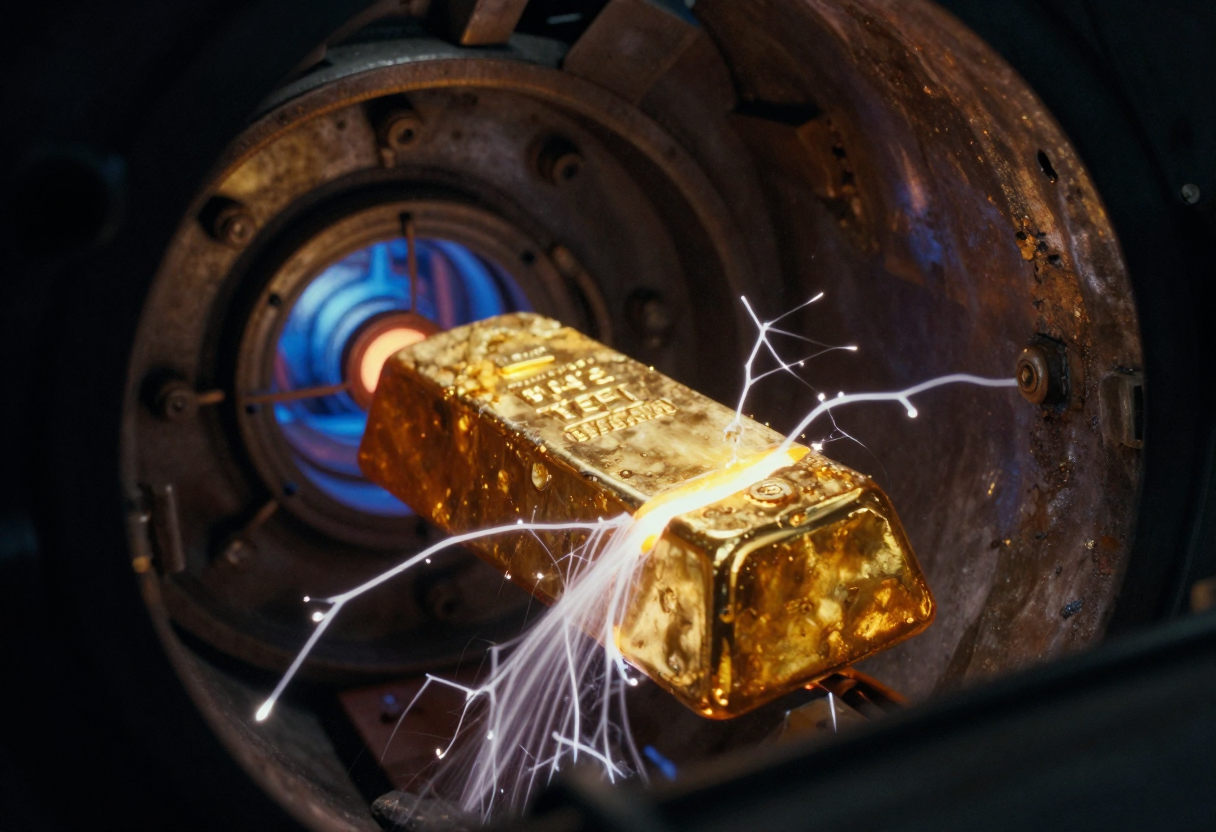
On 21 October, Marathon Fusion posted that it had demonstrated “high-rate alchemy: turning mercury into real, stable gold, beating CERN’s record by a factor of 10.” The mechanism is not magic. Neutrons from a fusion reaction hit mercury, knock it into an unstable isotope, and that isotope decays into gold. CERN did something similar in the Large Hadron Collider between 2015 and 2018, and reported in 2025 that it had produced about 29 picograms in total. A picogram is a trillionth of a gram.
Twenty-nine picograms of gold, at today’s price, is worth three-billionths of a dollar. It is the most expensive gold ever made and it is not worth a rounding error. Marathon says it beat that by ten times, which puts its output somewhere under a nanogram, a quantity too small to weigh and too small to sell. The company has not said how much it made or what it cost. It has said what the process might eventually do: five tonnes of gold a year for every gigawatt of fusion capacity, and if a hundred plants were running, about 500 tonnes a year.
That number is the whole story. Five hundred tonnes is roughly 14 per cent of the gold the world mined last year, and it would arrive without a mine, without a shaft, without a permit, without a country that owns the deposit.
The arithmetic of dilution
Start with what exists. The World Gold Council puts the above-ground stock at 222,600 tonnes at the end of the second quarter of 2026, worth about $29 trillion at the time. Mines added 3,672 tonnes in 2025, a record. Divide one by the other and the stock grows 1.65 per cent a year.
Now add the fusion gold. Five hundred tonnes a year takes dilution from 1.65 per cent to about 1.87 per cent. That is not a collapse. It is a rounding difference in a market that has absorbed the Spanish plunder of the Americas, two South African gold rushes, and the entire twentieth century without running out of vault space.
So the stock does not break. The cost does. That is the part worth understanding, because it is the difference between gold and bitcoin, and it is not a difference of degree.
What a mine actually is
A gold mine is a machine that converts energy and labour into metal at a price. The World Gold Council’s cost curve, built with Metals Focus, put the production-weighted median all-in sustaining cost at about $1,709 an ounce in 2025. With gold near $4,008 on 24 October, the median mine earns a margin of roughly $2,300 an ounce. That margin is a standing invitation: dig more, dig deeper, dig lower grade.
That is what makes gold’s supply curve elastic. When the price doubles, marginal deposits become economic, recycling rises, and new tonnes appear. Above-ground reserves are estimated at 61,000 tonnes, with another 114,400 tonnes in resources that are not yet economic. Those numbers are not a limit. They are a price list.
Bitcoin has no such list. The issuance schedule was fixed in 2009 and has never been changed by anyone. At block 972,920 the network pays 3.125 bitcoin per block, 450 a day, 164,250 a year, against a circulating supply of about 20.1 million. That is 0.817 per cent annual dilution, half of gold’s, and it halves again in 2028. No price, no discovery, no breakthrough moves that number. Not a mine, not a fusion reactor, not a central bank.
The newest money on earth is now scarcer than the oldest, and the gap widens on a schedule nobody can lobby.
The diamond precedent
There is a recent test case for what happens when a manufactured good undercuts a natural one. Lab-grown diamonds have pushed wholesale prices down by 90 to 95 per cent from their 2015 levels, according to reporting cited by Business Standard. The mined stones did not disappear. The premium did.
Gold is not a diamond. Its stock is enormous relative to annual flow, so cheap production cannot flood the market quickly, and its monetary role is five thousand years deep. But the mechanism that killed the diamond premium is the same one fusion threatens: a good whose scarcity rests on how hard it is to make is only as scarce as the cost of making it.
The bull case, argued properly
This is an argument, not reporting, and it deserves to be made at full strength.
If fusion works at industrial scale, the consequences run far past gold. Energy is the input that sets the price of everything extracted, refined, and shipped. Cheap neutrons would mean cheap aluminium, cheap desalination, cheap ammonia, cheap steel. It would mean that a great many things currently priced by their energy content stop being scarce in any meaningful sense.
In that world, gold becomes an industrial feedstock with a monetary hangover. Its price would not fall to zero, because jewellery and electronics and central bank reserves do not vanish. It would fall toward the cost of production plus a shrinking premium, and the premium is the part that made it a store of value. The same logic applies to silver at $53.95, to platinum, to diamonds, to beachfront land protected only by planning law, to art protected only by taste. Every store of value whose scarcity is a production function is exposed.
What is not exposed is the asset whose scarcity is a rule. That is the bull case for bitcoin in one line, and it does not depend on fusion failing. It depends on fusion succeeding: the more abundant energy becomes, the cheaper it is to make things, and the more valuable it becomes to hold the one thing that cannot be made at any energy price.
There is a human scale to that. For two thousand years the best minds in Europe tried to make gold from lead, and the search produced chemistry, and chemistry produced industry, and industry produced the abundance that alchemy was reaching for by the wrong route. If the last wall between energy and matter falls, abundance stops being a promise and becomes a price. The thing that remains scarce in an age of abundance is not material. It is a rule that nobody can print.
That is worth holding even if it never happens, because the alternative is holding something whose scarcity depends on the cost of digging.
Cold water
Fusion has never delivered a watt to a grid. Not one. The joke in the industry is that it is thirty years away and always has been, and the joke has survived every funding round since the 1970s.
A hundred gigawatts of fusion capacity does not exist and is not scheduled. Building it would be a project on the scale of the world’s entire nuclear fleet, in a technology that has not yet demonstrated net electricity. The gold would also arrive radioactive, according to the same reporting: isotopes that may need up to 18 years of storage before the metal is safe to sell. That is a cost, and the company has not published it.
Even the arithmetic cuts against drama. Gold’s above-ground stock is sixty times annual production. A new source that adds 14 per cent to the flow moves the stock by a fraction of one per cent a year. Prices are set at the margin, so a cheaper marginal producer can compress the price, but it cannot replace the stock.
And the demand side is doing something the supply side never expected. Central banks have bought heavily for three years running, not because gold got easier to make but because the dollar system became a weapon and reserves became a liability. That is a monetary story, and fusion does not touch it.
What a bank account actually is
Here is the part that gets skipped in most comparisons, and it is the part that matters more than any of the above.
A deposit is a loan to a bank, repayable on demand, insured up to a limit.
A deposit is not money in a box. It is an unsecured loan you made to a bank, repayable on demand, insured up to a limit by a state scheme. That structure is fine until it is not, and the failure mode is not hypothetical.
In 2023, three American banks with about $548 billion in combined assets failed in eight weeks: Silicon Valley Bank, Signature, and First Republic. In 2013, depositors above the insurance limit at the Bank of Cyprus lost 47.5 per cent of their balances, converted into equity to recapitalise the bank. That was the template the eurozone wrote into law for every bank resolution since.
The theft is not always a man in a hoodie. The FBI’s Internet Crime Complaint Center logged 859,532 complaints and more than $16.6 billion in reported losses for 2024, up a third on the year. Most of that is fraud against people and firms, and a large share of it ends with a payment that cannot be reversed, because the rails were built to be final for the recipient and reversible for nobody.
And the quiet one: inflation. A deposit paying less than the rate at which the currency loses purchasing power is a slow bail-in with better marketing. No hack required, no headline, no bank run.
Bitcoin’s honest part
Bitcoin has its own graveyard and it would be dishonest to skip it.
Mt. Gox lost 850,000 bitcoin in 2014, which at today’s price is about $68.6 billion. Bybit lost $1.5 billion in February 2025, in what the FBI attributed to North Korea. FTX lost customer funds on a scale that turned an exchange into a crime scene.
Every one of those failures was a custodian. Not one was the protocol. In seventeen years the issuance schedule has not been altered, the 21 million cap has not been moved, and no transaction has been reversed by a committee. Theft has happened at the edges, where someone held the keys for someone else, which is the same place where banks fail.
That distinction is the entire argument, and it comes with a cost that should be stated plainly: if nobody can freeze your bitcoin, nobody can rescue it either. You are the custodian. Lose the seed and the asset is gone, with no insurer, no ombudsman, and no 47.5 per cent haircut to complain about. Freedom of custody is not a feature. It is the price.
What remains

Scarcity by rule, not by cost.
Gold survives fusion the way it survived everything else: as a metal with a memory. It will still be in vaults, still be worn, still be bought by central banks that distrust each other. What fusion would take from it is not its price today but its claim to a permanent premium, the idea that its scarcity is a fact of nature rather than a fact about shovels.
Bitcoin never had that claim to lose. Its scarcity is a property of a rule rather than of matter, and rules are the one thing humans have learned to make expensive to change. The network does not need to be trusted. It needs to be checked, and checking is what anyone can do with a laptop.
Every store of value except one asks you to trust an issuer, a vault, a custodian, or a state. The last one asks you to hold a key.
Alchemy spent two thousand years trying to make gold. The escape was never a better furnace. It was money that cannot be made at all, only earned, and only kept by whoever holds the key.
Sources
- Business Standard, “US startup claims it turned mercury into gold in lab using nuclear fusion”, 23 October 2026 (Marathon Fusion claim of 21 October 2026; CERN’s 29 picograms; 18-year radioactivity; 5 tonnes per gigawatt-year).
- World Gold Council, How Much Gold Has Been Mined, data as of Q2 2026: 222,600 tonnes above ground, US$29.0 trillion; reserves 61,000 tonnes, resources 114,400 tonnes.
- World Gold Council, Gold Demand Trends Full Year 2025, supply: mine production 3,672 tonnes, total supply 5,002 tonnes.
- World Gold Council / Metals Focus, all-in sustaining cost curve: production-weighted median about $1,709 per ounce in 2025.
- Coin metrics: block height 972,920, subsidy 3.125 BTC, 450 BTC per day, circulating supply about 20.1 million, annual issuance 0.817 per cent (own calculation, 24 October 2026).
- Federal Bureau of Investigation, IC3 2024 Internet Crime Report: 859,532 complaints, losses above $16.6 billion.
- FDIC and congressional records on the 2023 failures: Silicon Valley Bank ($209 billion), Signature ($110 billion), First Republic ($229 billion).
- Central Bank of Cyprus, July 2013: 47.5 per cent haircut on uninsured deposits at the Bank of Cyprus.
- FBI, February 2025: North Korea responsible for the $1.5 billion Bybit theft.
- Mt. Gox, February 2014: 850,000 bitcoin lost.
- Own measurement, 24 October 2026: gold $4,007.90 an ounce, silver $53.95, bitcoin $80,694.
Write a comment