You Cannot Forge a Rounding Rule

You Cannot Forge a Rounding Rule
On 9 October, a Senate investigation published 27 pages concluding that seven of the largest operators of artificial-intelligence datacenters refuse to pay for the electricity infrastructure their own facilities require. Amazon, Google, Meta, Microsoft, CoreWeave, Digital Realty and Equinix all rejected the standard the investigators call “but-for” cost allocation: if a transmission line, a substation upgrade or a generation addition would not exist without a given datacenter, then that datacenter pays for it. All seven said no, and the costs flow instead to residential ratepayers, with no line item disclosing that the increase is funding someone else’s buildout.
One day earlier, a contractor for a different part of the same industry stood in federal court in Manhattan and admitted to moving roughly 2.5 billion dollars of export-restricted Nvidia servers into China behind forged end-user paperwork and unmarked boxes.
Two stories about the largest capital project in commercial history, and they look unrelated. They share one property, and it is the property that decides who ends up holding the bill. Both describe a cost that lands somewhere other than the invoice: on a household meter, or on a document that says whatever it needs to say.
In the same week, bitcoin rose about 12 percent into a liquidity backdrop that, by every conventional reading, should have pushed it down. That is not a coincidence in the sense of a cause. It is a coincidence in the sense of a test. The AI trade rests on two acts of trust — that the grid is free, and that the paperwork is true. Bitcoin rests on neither, and this month both of those acts of trust got a price.
The bill that never arrives
The report is the work of Senators Elizabeth Warren, Richard Blumenthal and Chris Van Hollen, released on 9 October after nearly a year of staff requests and company interviews that began on 15 December 2025. It covers Amazon, Google, Meta, Microsoft, CoreWeave, Digital Realty and Equinix, and it turns on a single accounting question.
A datacenter needs power, and power needs wires. Some of those wires serve only the datacenter. Others are shared — a transmission line that has to be rebuilt, a substation that has to be enlarged, a generating unit that has to be added because the load on the system grew. The “but-for” principle asks whether the upgrade would have been built if the datacenter had never existed. If the answer is no, the datacenter is the reason the money was spent, and the datacenter should be the one paying it. Every one of the seven companies rejected that principle, according to the report.
What is left when a private cost is refused is a public one. Utility rate cases allocate the shared upgrade across the whole customer base, and the load that triggered it disappears into the average. The ratepayer sees a higher bill and no explanation, because the arrangement that produced it is wrapped in non-disclosure agreements. The report documents Amazon, Google, Meta and Microsoft routinely seeking those agreements with utilities, landowners and local officials during project development — in some cases with public officials. The communities nearest the facilities end up with the least information about what is being built and who is paying for it.
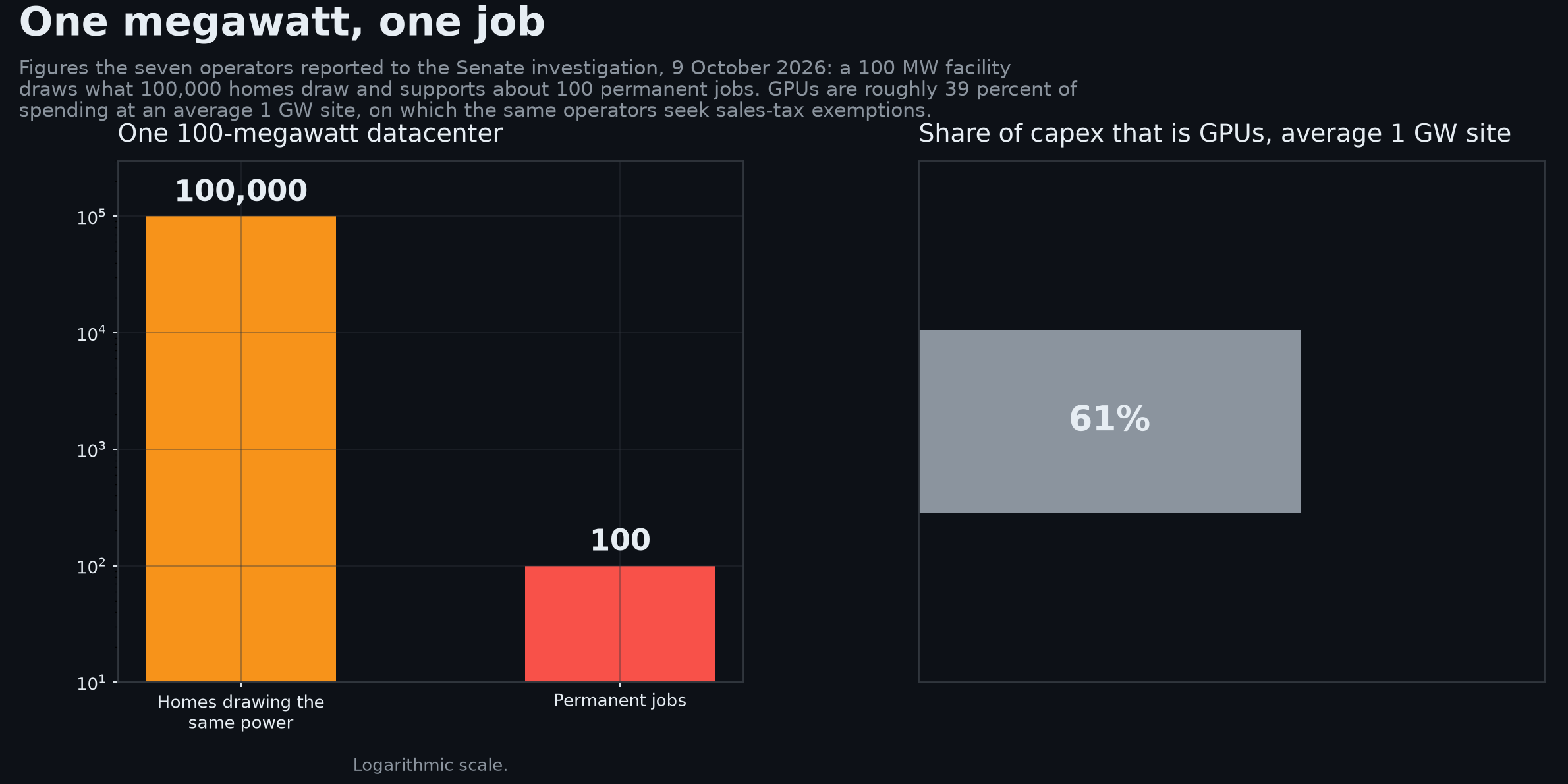
The public case for these buildings has always been jobs. The numbers the companies themselves supplied to the investigators tell a different story. A 100-megawatt facility draws as much electricity as roughly 100,000 homes and generates about 100 permanent jobs — one per megawatt. And the same operators are pursuing sales-tax exemptions on the hardware that drives the buildout, with GPUs accounting for roughly 39 percent of spending at an average one-gigawatt site, per the report. Van Hollen put the finding in one sentence: “working Americans and local communities are footing the bill for Big Tech’s massive expansion of data centers, while these companies continue to operate without transparency.”
Warren has separately called for a national moratorium on new AI datacenters until developers agree to cover full costs. As a member of the Senate minority she cannot impose one, and nobody should pretend otherwise. What the report does is build a Congressional record — the raw material that later feeds permitting legislation, state utility commission proceedings and rate cases. That is a slow mechanism, and it is the mechanism that matters. The regulatory risk here is not this quarter. It is the next one to three years, and it is being written down now.
The strongest case against this
There is an honest counterweight, and it comes from the same newsletter that carried the report. Marty Bent, who hosts TFTC and sits on the board of a data center company, describes an expansion his firm announced in Hopkinsville, Kentucky: 50 megawatts of new capacity, supported by a 65-megawatt substation that the company is building and funding privately. On that project the ratepayer pays nothing and the grid gets better infrastructure. So the report’s standard is not the only practice in the industry. It is the practice that seven of the biggest operators refused to commit to, and the difference between the two is exactly the difference between a cost that stays on the invoice and one that leaves it.
That counterexample narrows the finding without dissolving it. The report is a staff document from three senators in the minority, and its central standard is contested policy rather than settled economics. A datacenter that arrives first in an under-served part of a grid can genuinely widen capacity that everyone downstream then uses, and the argument that a large load customer should carry the whole upgrade competes with the argument that ratepayers would have paid for it sooner or later anyway. What I cannot verify from here is how the seven companies answered the investigators, because their positions reach the public only as summarised by the side that published the report. What survives the doubt is narrower and still worth 27 pages: shared grid costs are real capital expenditure, they do not appear on any hyperscaler’s capex line, and nobody has put a public number on them.
The license that was a document
The second story is the same failure inside a stricter system.
Ting-Wei “Willy” Sun, a former contractor for the San Jose server manufacturer Super Micro Computer, pleaded guilty in Manhattan federal court to four charges: conspiring to violate United States export controls, smuggling, defrauding the government and obstructing justice. The scheme he admitted to moved approximately 2.5 billion dollars of servers equipped with restricted Nvidia GPUs — H100, H200 and B200 models — to customers in China without the export licenses those chips require, as Reuters first reported.
The mechanics are worth sitting with, because they are not exotic. The defendants allegedly ran the hardware through a Southeast Asian pass-through entity, repackaged the servers in unmarked boxes, and generated false end-user documentation. In a single window from late April to mid-May 2025, prosecutors say, more than 510 million dollars of restricted servers moved. In December 2025, the indictment alleges, the network staged dummy servers to deceive a Commerce Department inspector. The indictment was unsealed on 19 March 2026 and charged Sun alongside Super Micro’s co-founder Yih-Shyan “Wally” Liaw and Taiwan sales manager Ruei-Tsang “Steven” Chang. Liaw has pleaded not guilty and has a trial date; Chang has not resolved his charges, and at least one report places him outside the country. Super Micro is not a defendant, and its own internal investigation, completed in August 2026, found no evidence that current senior management knew of the diversion.
Five hundred and ten million dollars in three weeks is the number that removes any “isolated incident” framing. That pace requires organized logistics, dependable demand at the Chinese end and a sales channel corrupted at the point of sale. The export-control regime exists precisely because these chips are the substrate of an arms race, and it restricts Nvidia’s fastest products for national-security reasons. But the regime’s enforcement does not live in the silicon. It lives in a broker, a sales manager and a customs declaration. The adversary’s attack surface was a phone call and a shelf company.
Bent draws the contrast in a line worth quoting in full, because it names the shape of the problem: “You cannot forge a license to mine a block. You cannot stage a dummy ASIC to fool a BIP validator.” The rules of a permissionless network are not administered by an official who can be lied to. They are checked by arithmetic, and arithmetic does not take a meeting.
That is the same asymmetry as the grid report, seen from the other end. In one case a private cost is refused and socialized; in the other a private permission is forged. Both are systems where the truth depends on a person or a document behaving. Neither is a scandal of bad apples. It is what a chokepoint looks like when it is made of trust.
What the buildout borrows in
Now put the cost of the AI expansion where the money actually is, because the bond market is the one ledger in this story that cannot be moved off the books. It can only be repriced. The ten-year Treasury note paid 5.244 percent on 9 October, after printing 5.311 percent on 5 October — a rate that prices nearly every loan on the planet. Nik Bhatia of The Bitcoin Layer states the mechanism in four words: “rates lead the Fed.” The central bank follows the market’s price of money; it does not set it. When AI capital spending, sticky inflation and a war-driven oil bid all pull demand for credit at the same time, the lenders want more, and the whole curve moves.
The second force is fear in the very collateral the system runs on. The MOVE index — what traders pay to insure against large swings in Treasuries — stood at 69.55 on 10 July. It reached 113.6 on 5 October, then eased back to 98.47 by 9 October [own readings of the MOVE index, Yahoo Finance]. The jump matters more than the level. Treasuries are the collateral behind an enormous share of global borrowing; when their prices swing, lenders cut the amount they will lend against each bond, demand more collateral, and the system quietly delivers less credit when the debt rolls over. Bhatia calls this the single main reason his liquidity signal turned red at the end of August.
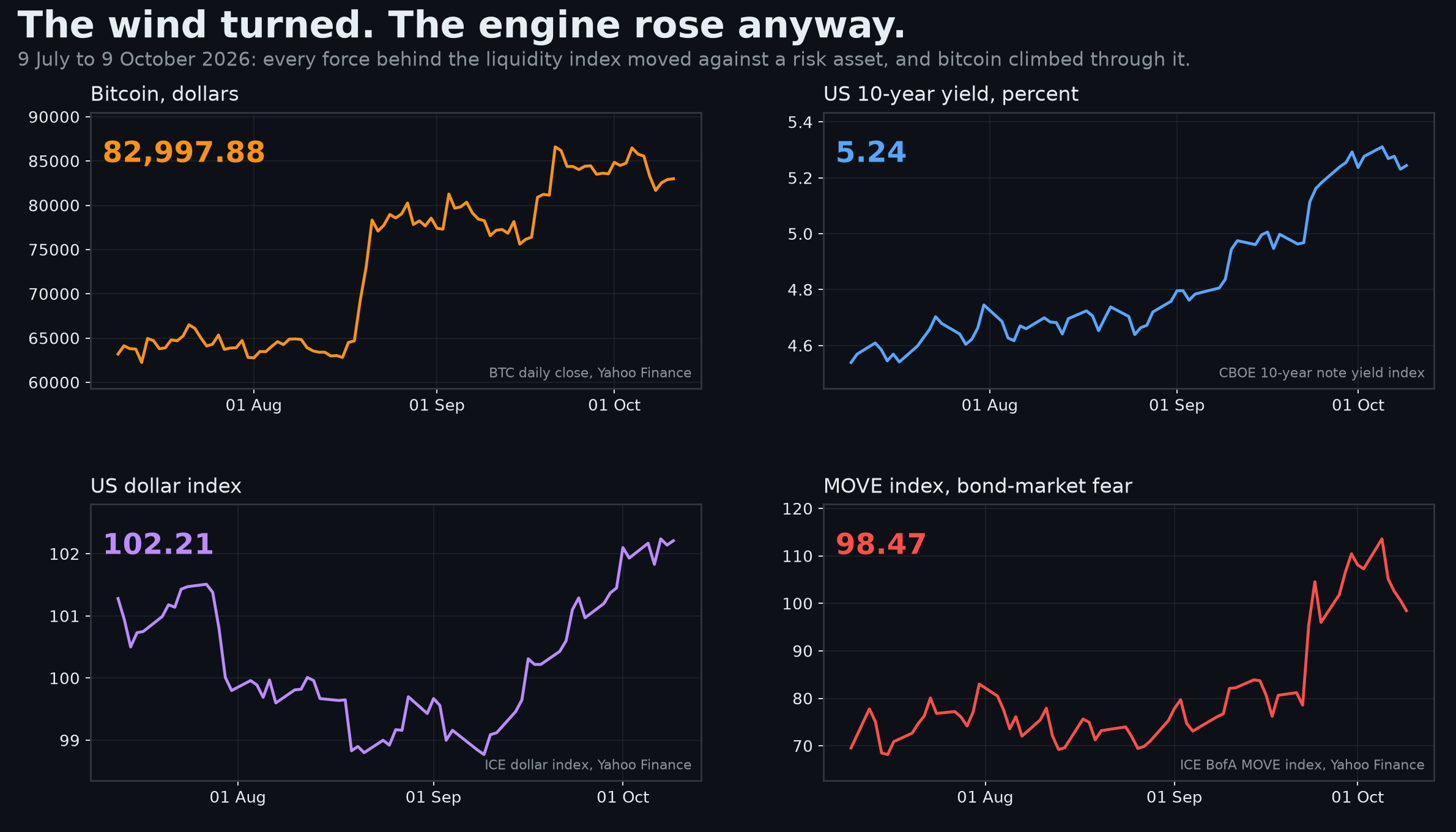
The third force is the dollar, and it is where the story stops being American. The dollar index rose from 98.77 to 102.24 between July and 7 October, and sat at 102.21 on 9 October [own reading, Yahoo Finance]. Every borrower in the world who owes dollars suddenly owes more of their own currency, so they borrow less and spend less. On the other side of that trade is a weak euro, and the euro is where the stress is now legible.
France paid 4.846 percent on its ten-year debt on 9 October. Germany paid 3.465 percent. Italy, which spent the last decade as the designated weak link of the currency area, paid 4.577 percent. Read those three numbers together and something odd appears: the core pays more than the periphery. France’s spread over Germany is 138 basis points; France’s spread over Italy is a positive 27 basis points [own subtraction of CNBC government-bond quotes, 9 October].
Bhatia describes the French-German spread as the widest since the euro crisis, and Tom Luongo, on the same show, frames the mechanism: the European Central Bank anchors the entire sovereign curve on the German bund, holding German yields down so that Italian, French and peripheral spreads can be contained. It works until it does not.
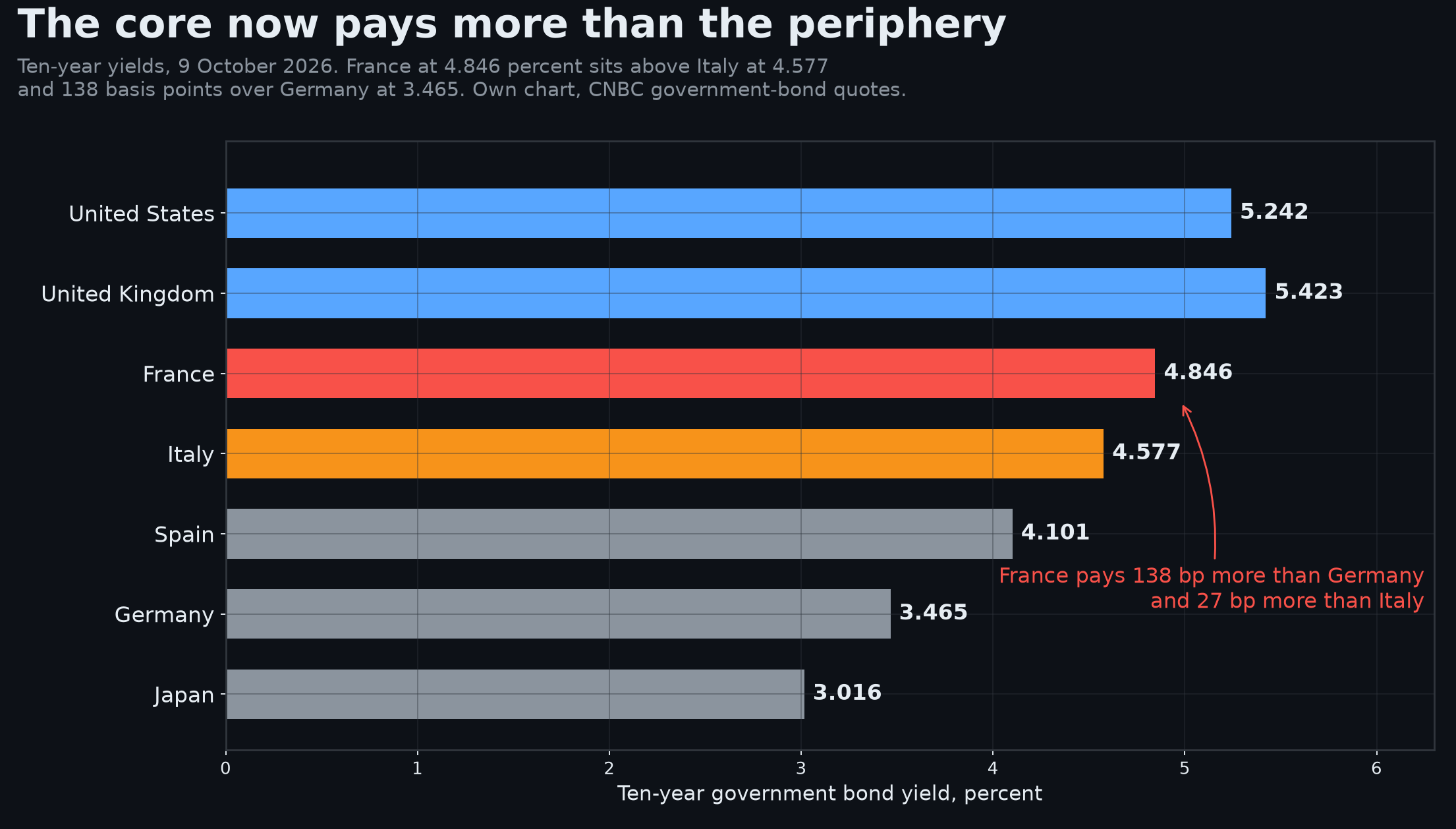
Luongo’s summary of the constraint is blunt and, judging by the spread, defensible: Europe “can save the bond market or save the currency, but not both.” He expects the bond market to win and the euro to fall. That is a forecast, not a fact, and it should be held as one.
He makes one more argument that deserves to be handled carefully, because it is arithmetic wrapped around a hypothesis. The Treasury is running a buyback programme that retires long-dated debt at a discount, and Luongo walks the math on tape: a thirty-year bond issued ten years ago carries a 2 percent coupon, so a million dollars of face value pays twenty-five thousand dollars a year. Twenty years of remaining life is half a million dollars of interest, plus the million-dollar principal at maturity — a 1.5 million dollar future liability. If a forced seller dumps it at 75 cents on the dollar and the Treasury buys it for 750,000 dollars, the government retires a 1.5 million dollar obligation for half of it. The arithmetic is his and it is internally consistent; the claim that European central banks are the forced sellers is his reading of Treasury International Capital flows. The math is checkable; the motive is a thesis, and he presents it as one.
The oil market is the same kind of tell. Brent crude traded at 104.43 dollars and WTI at 91.66 on 10 October, a spread of 12.77 dollars [own readings, private market dashboard]. Luongo reads a Brent premium that wide as a financial signal rather than a supply signal, because Brent is effectively the world’s largest contract for difference while WTI settles physically. When the paper spread blows out while the physical grade lags, he argues, someone is short collateral and needs the Brent price elevated to stay solvent. The spread is measurable; the cause is his interpretation, and it is the kind of interpretation that only resolves after the fact.
The engine that outran the wind
Which brings us to the thing that did not behave.
Bhatia’s framework for the year is that bitcoin is driven by two forces, and that they are different in kind. There is the wind — global liquidity, the amount of money moving through the system and how easily it reaches a risk asset. And there is the engine — bitcoin’s own buyers and sellers, its own cycle. Through most of 2026 the wind was stronger, which is why a liquidity indicator that flagged a turn at the end of August (confirmed as a sell on 11 September) would, following its own dots, have returned 60.9 percent this year against a loss of 8 percent for holding the coin [The Bitcoin Layer, own backtest of its published indicator; the number is the publisher’s, not independently verified here].
Then the wind turned down and bitcoin rose anyway. The rally ran into a ceiling near 86,000 dollars in late September and has not broken through. The reason, in Bhatia’s account, is that the engine started. The sellers who dominated the first half of the year are gone. James Check of Checkonchain, a guest on the same show, puts it in one line: “People who are going to hit the red button have done so.” Bitcoin absorbed Strategy’s selling, roughly 8.5 billion dollars of ETF outflows and the Coldcard seed-phrase losses, and by the July low bad news stopped moving the price down. More than 70 percent of supply now sits at a profit, up from 45 percent, and leverage fell during the rally — holders who are up are more likely to buy the next dip than to sell into it.
My own reading of the year puts the scale on that. Bitcoin closed at 110,807.88 dollars on 11 October 2025, printed its twelve-month high of 115,271.08 two days later, and bottomed at 58,558.86 on 30 June 2026. At 82,997.88 on 11 October 2026 [own readings, Yahoo Finance], it is 25.1 percent below where it stood a year ago, 28.0 percent below the high, and 41.7 percent above the low. The disbelief rally Bhatia describes is real and it is partial: the market has stopped falling on bad news, and it has not yet gone anywhere on good news. That is what an engine looks like before the wind helps.
The cap nobody voted on
Every system above depends on someone being trustworthy: a utility, a sales manager, a customs officer, a central bank that decides which yield to hold down. There is one number in this trade that does not.
Cory Klippsten took up the arithmetic in his 10 October note, testing the obvious objections one at a time. Eighty-four million coins instead of 21. Five-minute blocks instead of ten. Halvings every two years instead of four. The arithmetic closes, and nothing in the monetary logic forbids it. The reason it never happened is software architecture, and it is the most quietly satisfying part of the whole design.
Bitcoin’s own accounting uses 64-bit whole numbers, which can count up to roughly 92 billion coins to the last satoshi — more headroom than the supply will ever need. But the surrounding software does not. Spreadsheets and web applications commonly use IEEE-754 double precision, which carries 53 bits of integer precision. The largest value a double can hold exactly is 2^53 minus 1, which is 9,007,199,254,740,991 — about 90.07 million bitcoin expressed in satoshis.
That is the wall. Eighty-four million coins is 8.4 quadrillion satoshis, which consumes the entire 53-bit budget with nothing left over. Forty-two million, the figure Satoshi reportedly considered, needs 52 bits and leaves one bit spare — still not enough, because converting a satoshi balance into coins and back introduces decimal places, and rounding to the nearest satoshi will lose or gain one unless two bits are held in reserve. Reserve two bits and the ceiling falls to 2^51 satoshis, which is 22,517,998 coins. Twenty-one million fits with room to spare.
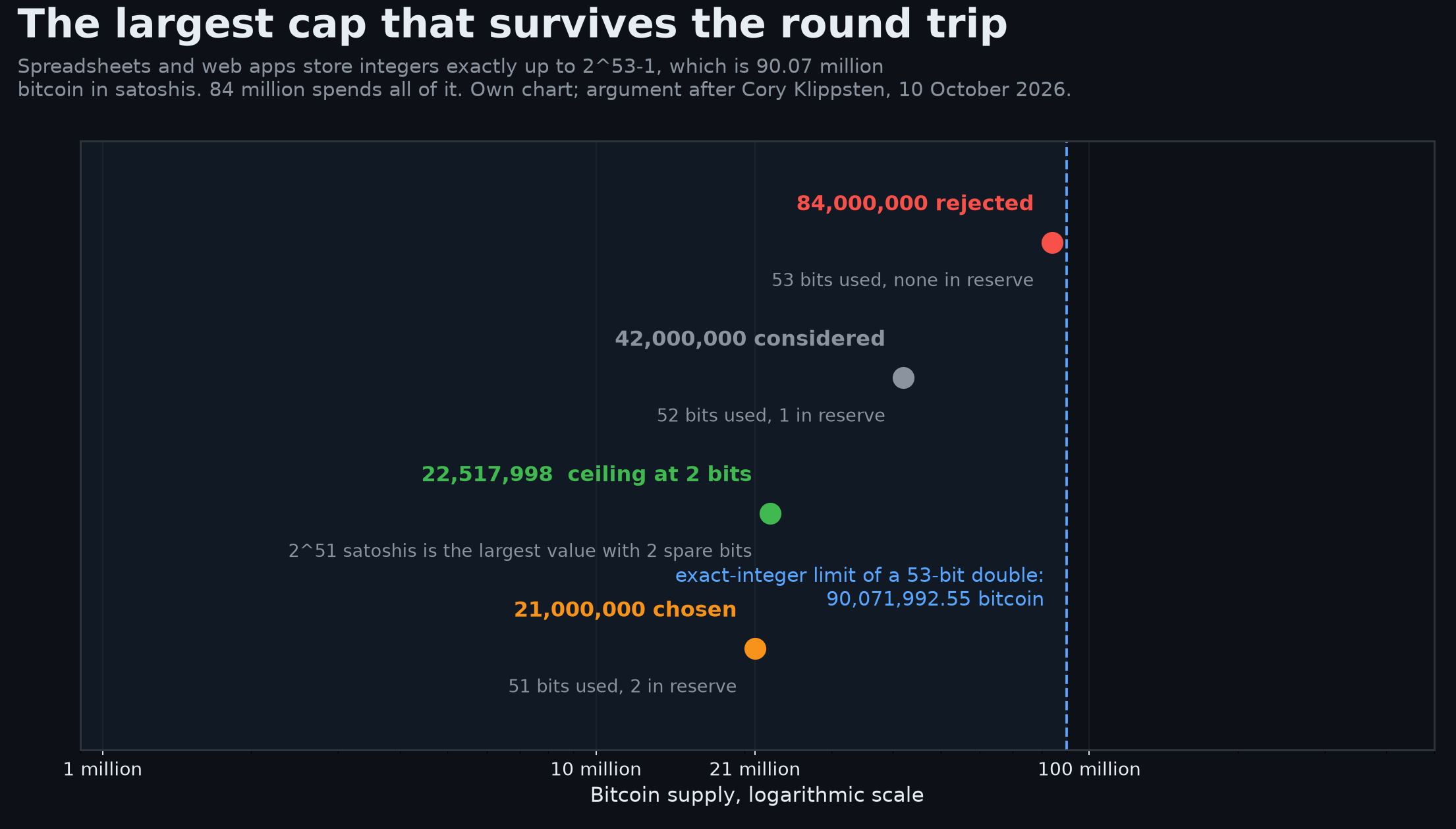
So the issuance schedule is not arbitrary at all. Start at 50 coins per block and halve the reward every 210,000 blocks. The rewards run 50, 25, 12.5 and so on. That series sums to 100, and 100 times 210,000 is exactly 21 million. Starting at 60 coins would give 25.2 million, above the conservative ceiling. Fifty is the largest round starting reward that survives the test. And the ten-minute block interval is Satoshi’s own trade-off, argued in his original messages: a one-minute propagation delay is ten percent of a ten-minute interval, but twenty percent of a five-minute one, and the difference shows up as competing blocks and wasted work. The halving interval itself — the one parameter that really was free — he admitted in April 2009 was an “educated guess.”
That is the whole point, and it is the reason this article ends here rather than with a forecast. A grid upgrade can be socialized, a chip license can be forged, a deal can be buried under an NDA, a bond’s coupon can be held under water by a central bank sitting on someone else’s curve. A supply cap cannot be any of those things, because nobody administers it. It is a property of a number format — the largest quantity of money that survives being written as a balance, converted into whole coins with decimal places, and converted back without losing a single satoshi.
You can lie to a compliance officer. You cannot lie to a rounding rule.
Write a comment