Settlement, Not Announcement
Settlement, Not Announcement
The 25th World Petroleum Congress opened in Riyadh on Sunday morning, on Airport Road, several hundred metres from Terminal 4 of King Khalid International Airport. A ballistic missile had hit the terminal the day before. Twelve people died and 309 were wounded, according to Saudi Arabia’s General Authority of Civil Aviation. It was the third strike on the same airport in one week and the deadliest attack on the kingdom in more than a decade. Roughly 85 percent of scheduled flights were grounded at the peak of the disruption and more than 600 were cancelled, per Flightradar24. Saudi’s coalition spokesman, Major-General Turki al-Malki, called it “a full-fledged war crime”. Twenty-five thousand energy ministers, petroleum officials and oil executives from 62 countries, representing more than 96 percent of global energy consumption, took their seats a few hundred metres from a live target.
Then the market opened. Brent crude traded at 104.21 dollars a barrel on Monday morning, down half a percent. West Texas Intermediate sat at 91.26 on the same feed, also down. Bitcoin was at 84,024 on my dashboard. Neither the deadliest strike on Saudi Arabia in years nor the oil congress convened beside the crater produced a bid.
Something else happened that weekend, and it is the more instructive event. On Sunday, President Trump declared on Truth Social that there was an “ENERGY CEASEFIRE in the War between Russia and Ukraine”, effective immediately, with both parties in agreement and an instruction not to break it. No treaty text was published. No terms were named. No monitoring mechanism exists. The Kremlin said nothing, and Kyiv said nothing until a journalist asked. Ukraine’s president, Volodymyr Zelensky, told Axios that “the ceasefire announcement was news for me”, adding that if Russia agreed to a ceasefire, Ukraine would agree. A head of state learned that his country’s war had a ceasefire from a reporter.
Both of those statements are now priced. The missile that killed twelve people at an airport is trading as a rounding error in a barrel of crude; the ceasefire that nobody signed is trading as nothing at all. That is not the market being cynical. It is the market distinguishing between an announcement and a settlement, and it is worth understanding why, because the same distinction runs through everything that decides what bitcoin is worth.
What a settlement looks like
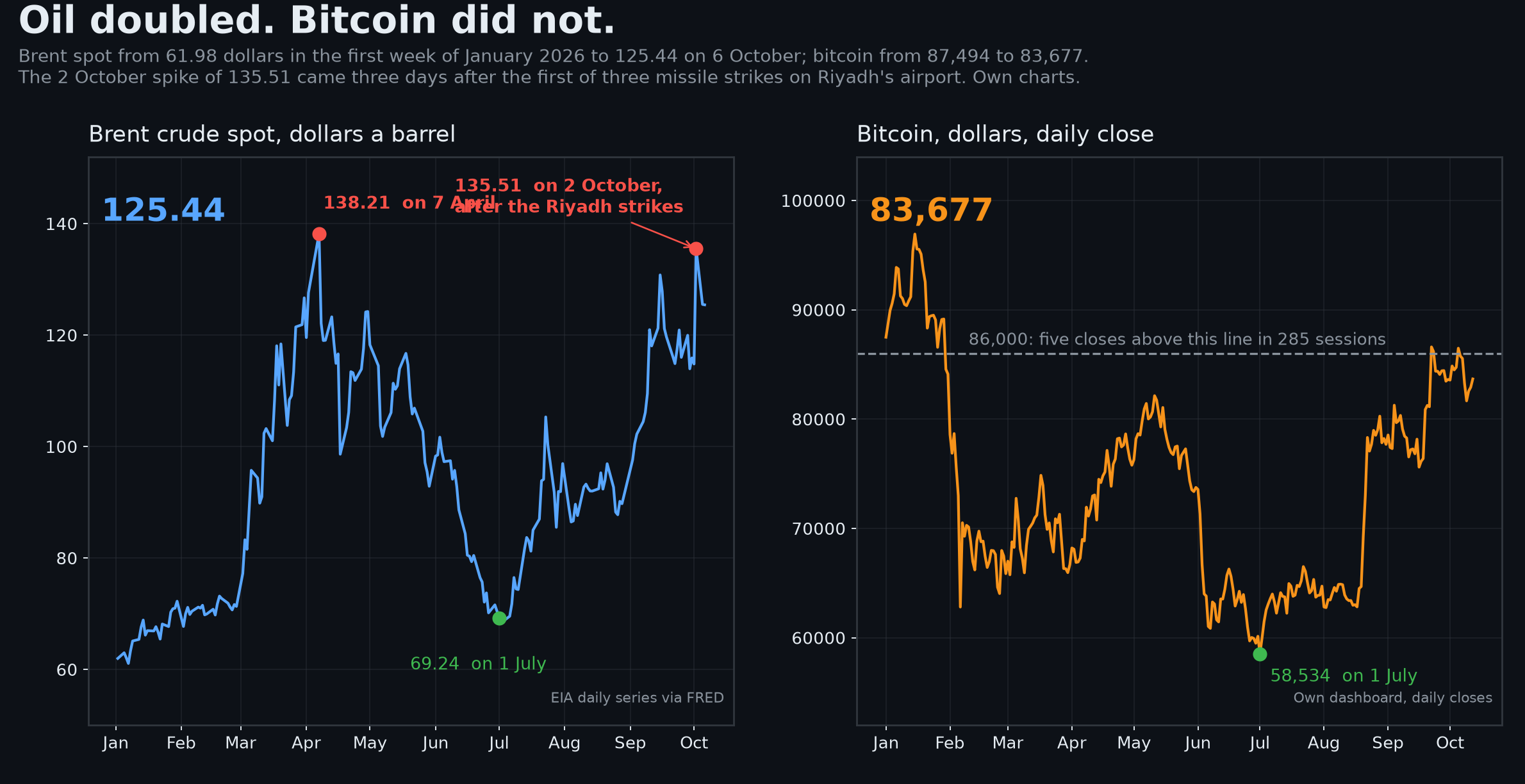
Oil is the cleanest case in finance because it ends in a physical delivery. Someone has to take possession of a barrel, at a port, on a date. The futures market knows this, and it prices the delivery, not the news. Brent spot, according to the US Energy Information Administration, opened 2026 at 61.98 dollars a barrel. According to that same daily series it peaked at 138.21 dollars on 7 April, then slid back to 69.24 by the first of July. Last Tuesday it closed at 125.44. On 2 October alone it printed 135.51, an 18 percent jump in a single day.
And yet nothing in that path is a crisis. Brent’s own record is 143.95 dollars, set on 3 July 2008. In the dollars of August 2026, using the consumer price index, that is 219.61 dollars a barrel. April’s 138.21 is not close. If you want the number that explains why a missile strike barely moved the tape, it is that one: the market has a memory of what an actual supply shock costs, and this is not it.
Now take the same arithmetic to the pump. The retail price of diesel in the United States reached 6.529 dollars a gallon in the week of 21 September 2026, according to the weekly federal series. That is the highest nominal reading in a series that begins in March 1994, and it breaks the previous record of 5.810 dollars set in June 2022. Deflate it the same way and the record softens. In the dollars of July 2008, September’s 6.529 becomes 4.28. Diesel cost 4.764 dollars a gallon in the summer of that year, which leaves the new peak about ten percent below the old one in real terms. A nominal record, a real-terms second place. That distinction is the whole argument between the two weekends.
Because the political system responds to the nominal number, not the real one. Diesel at 6.53 dollars a gallon is a sticker price every American voter can read, and the midterm elections are less than thirty days away. So the sequence ran in a straight line. Diesel peaks in the third week of September. On 9 October the Trump administration lifts sanctions on Russian diesel exports, per Axios: 300,000 tons unlock immediately, 500,000 tons follow in November, and a million tons a month after that. On 11 October the ceasefire is declared. By then the barrels were already moving. Sanctions relief is a settlement. A post is not, which is exactly why the price of oil ignored the post.
The wind and the engine
Bitcoin has spent the year in the same condition, except that its version of the weekend’s news was not a missile but a liquidity index.
Nik Bhatia of The Bitcoin Layer built that index out of bond volatility, interest rates, dollar strength and global banking assets, and published his read on 10 October. His indicator turned red at the end of August and was confirmed as a sell on 11 September, as he reported in his letter. In the three weeks after, interest rates jumped, the dollar ripped higher and bond-market fear spiked. His published backtest has buying on a green dot and holding Treasury bills on a red dot returning 60.9 percent in 2026, against a loss of 8 percent for holding bitcoin the whole way. His explanation is a single sentence worth keeping: “Liquidity is the wind, not the engine.”
I can measure the wind myself. The US ten-year yield was 5.22 percent on 8 October, per the Treasury’s daily curve, and 5.242 percent at the time of writing. The thirty-year sat at 5.60. The dollar index reads 102.2 on the same quote screen. Those are not conditions that flatter a risk asset that trades around the clock and can be sold in seconds at three in the morning. Bitcoin is the easiest thing in the world to dump when the news is bad, which is a feature of being always open and a bug of being always priced.
Bitcoin itself did have a year of its own. Daily closes put the price at 87,494 dollars on 2025’s last day, with a touch of 96,932 in mid-January. It then fell to 58,534 by the first of July, before recovering most of that ground. At Monday’s price it is still about a third below the record 124,777 it printed on 7 October last year, according to daily closes. That is a loss of roughly 4 percent for the year, with a 43 percent recovery off the July low inside it. Bhatia’s observation is that the sellers who dumped in the first half of the year are gone, and that the rally is real but capped: it hit a ceiling around 86,000 dollars in late September and has not broken through since.
That ceiling can be measured, and it is narrower than the story suggests. Bitcoin has closed at or above 86,000 dollars on five days out of 285 this year: three in the last week of January, two in the second half of September, and once on 5 October. It got there on Monday as well, intraday. For all the talk of a bull market resuming, there is a level the market has refused to hold since February.
James Check has a better name for the feeling that produces. His 9 October letter is called “Sidelined”, and its argument is not about levels at all. The pain of watching an asset you wanted to own rally is worse than the pain of taking a loss, so people buy too much at local highs, panic-sell the next dip, and wait for cheaper prices that never arrive. The emotional hardware is designed to lose money. Note what this implies about the last three weeks: if the ceiling is a wall of sidelined buyers waiting for a pullback that has already happened twice, then the wall is psychological and the flow behind it is unspent capital, not indifferent capital.
What a kilowatt settles
There is one more party in this story that does not read posts, and it happens to be the only party whose activity can be audited by anyone.
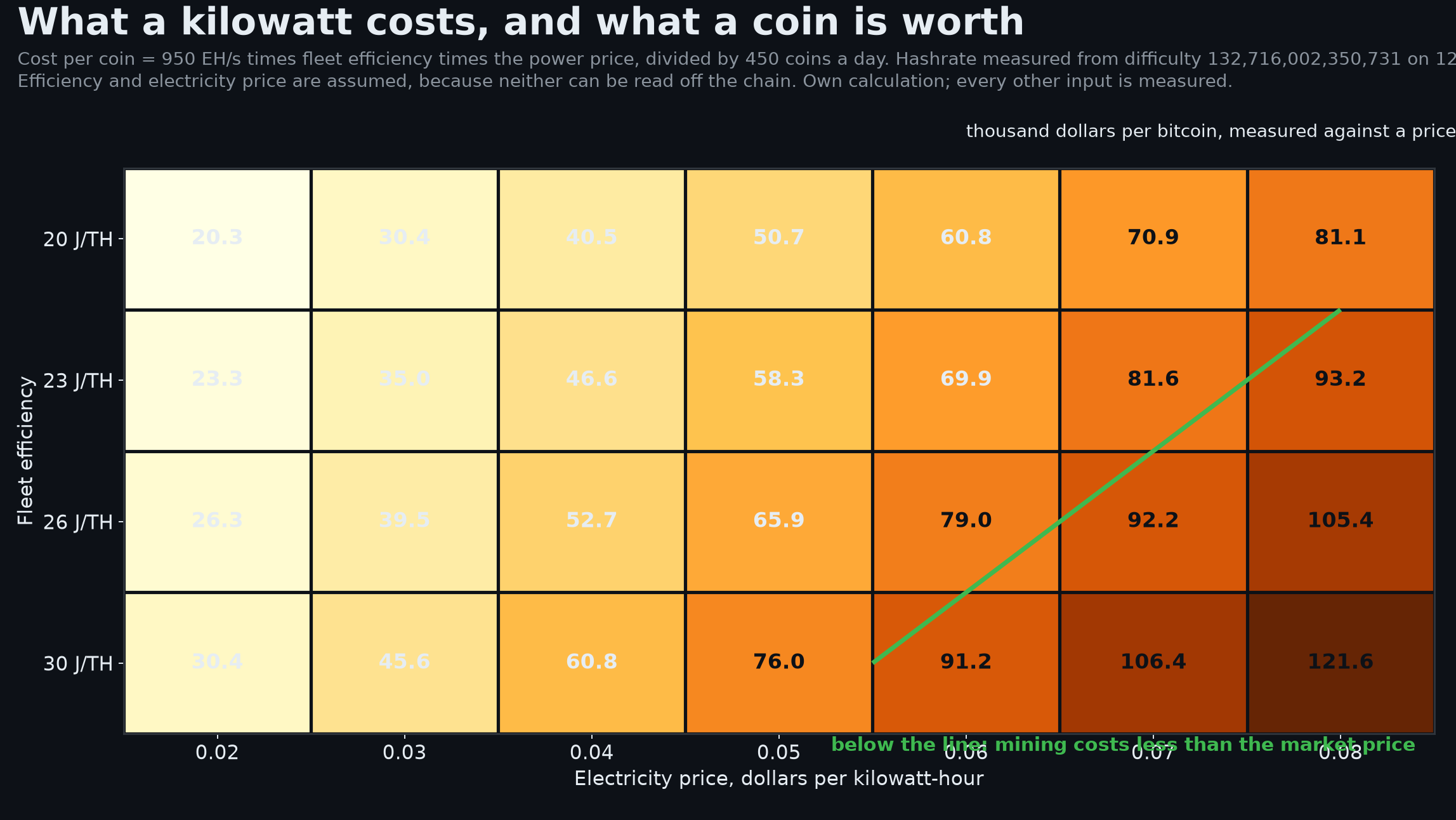
Bitcoin is produced by spending electricity against a difficulty target, so the network’s cost base is not an opinion; it is arithmetic once you know the difficulty. I keep a node, and at block height 971,059 it reports a difficulty of 132,716,002,350,731. That implies a network hashrate of 950 exahashes per second. Feed that through a plausible modern fleet efficiency and you get the physical size of the machine. At 20 joules per terahash the network draws 19 gigawatts of continuous load. At 30 joules per terahash it draws 28.5 gigawatts. A fleet averaging 23 sits at 21.9. Annualised, that is somewhere between 166 and 250 terawatt-hours per year, roughly what a mid-sized industrial country uses, and it is spent continuously regardless of what anyone posts.
Price that power at five cents per kilowatt-hour and the electricity bill runs to 22.8 million dollars a day at best fleet efficiency and 34.2 million at worst. Now compare it with what the machine produces. This epoch pays 3.125 bitcoin per block, which is 450 coins a day. At Monday’s price of 84,024 dollars that is 37.8 million dollars of new supply per day. Fees are negligible: my node’s mempool held 46,511 transactions carrying 0.044 bitcoin in total, with an estimate for the next block of about 5.65 satoshis per virtual byte. A quiet chain means the entire business rests on the subsidy, and the subsidy is worth what the market says it is worth.
So the spread between 22.8 and 37.8 million dollars is the gross margin of the only industry on earth whose product is priced against the cost of a kilowatt and the value of a number at the same time. At the pessimistic end of my range, the modeled cost of production is 76,001 dollars per coin against a price of 84,024. I am explicit that this is my own calculation with an assumed efficiency and an assumed power price, not a measured fact. What is measured is the hashrate, the difficulty, the subsidy and the price.
That is the point of the exercise. When a missile lands next to the world’s oil congress, the thing it threatens is not a portfolio; it is the price of the input under every miner’s revenue line. Bitcoin does not need anyone to believe in it to keep converting joules into blocks. It needs the joules.
The supply is a settlement
Meanwhile, the one variable that decides the long-run outcome of all this was set before the first block and has not been touched since.
The chain is 971,059 blocks old. It pays 3.125 coins per block. That is 164,250 coins per year against a circulating supply of 20,097,059. The inflation rate is 0.82 percent. The emission halves one more time in 78,941 blocks, about 548 days from now, in April 2028. Those figures come from the block height, the protocol’s own schedule and a division; anyone with a node can reproduce them in a minute.
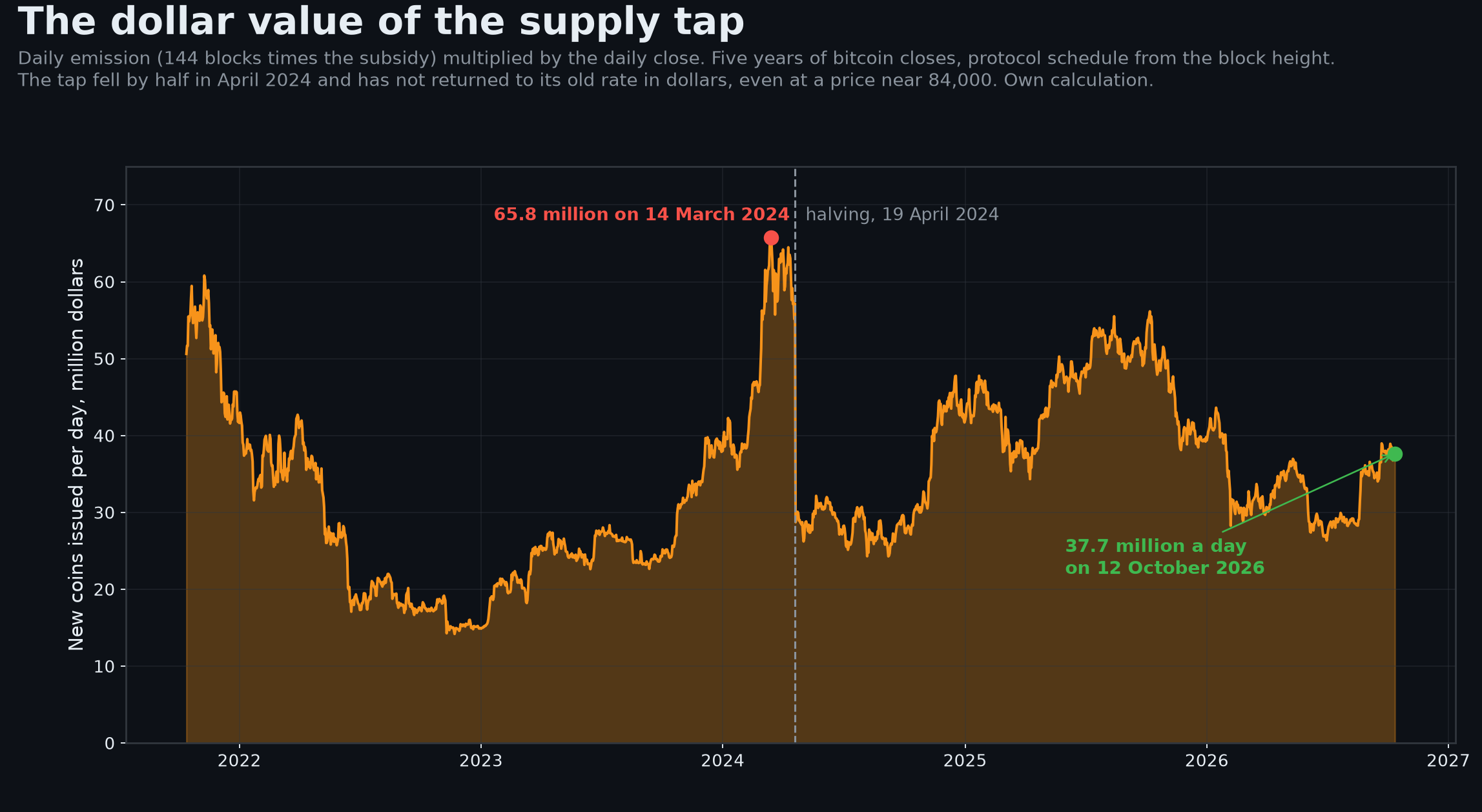
Put the price series next to that schedule and a second story appears, one that has nothing to do with sentiment. The dollar value of one day’s new coins peaked in March 2024 at 65.8 million dollars, in the last weeks of the 6.25-coin subsidy. The halving in April 2024 cut the emission in half, and the daily dollar flow fell from 55.2 million to 29.2 million within four days. It has since climbed back to about 37.7 million per day, less than it was two years ago at a higher price, because half as many coins are being sold into the same market. The tap tightens in dollars as well as in coins.
Nothing in that schedule has an input field. There is no parameter for a president, a central bank, a council, an exchange listing or a roadmap. The only free parameters were chosen in 2008 and 2009, and one of them was chosen by accident of engineering rather than economics: 21 million coins is the largest cap that survives a round trip through the double-precision floating point that spreadsheets and web applications use. Ask why the number is not 84 million and you get an answer about 53 bits of mantissa, not about monetary policy.
Which brings us to the counter-example of the same weekend. On Wednesday an Ethereum employee warned that bitcoin’s digital signatures could become vulnerable, in the worst case, in “months, not years” — and called for “bunker mode”. There was no new attack, no demonstration of a shortcut for recovering a private key, and no calculation supporting the timeline. By his own account the recent AI results in mathematics contain few cryptographic breakthroughs, so he suggested suppression of the evidence instead. Yehuda Lindell, who runs cryptography at Coinbase, called it, as Cory Klippsten reported, the very definition of FUD. The warning closed with an altcoin roadmap. Standard Ethereum accounts use the same ECDSA curve the warning is about, so the roadmap cannot deliver what the post implies on any timescale that matters.
A roadmap is an announcement. A halving is a settlement. The market has now spent two decades learning to price the first and to ignore the second, and the bill for that habit arrives in a currency nobody prints.
The strongest case against all of this
If bitcoin is a high-beta liquidity asset, then the cost of production is not a floor under the price; it is a consequence of it. This is the correct objection and it deserves better than a dismissal. Miners who cannot pay the electricity bill shut down, hashrate falls, the difficulty target re-adjusts every 2,016 blocks, and the network’s cost base converges on whatever the market is willing to pay. On that reading, my 76,000-dollar production cost is a lagging indicator wearing a fundamental’s clothes, and the only things that matter are the dollar and the ten-year yield.
That objection gets stronger still when you look at the real-terms numbers I calculated above. Brent at 138 dollars in April is 37 percent below the peak of July 2008 in today’s money. Diesel at a nominal record is ten percent below its own real peak. If this were a genuine energy crisis, oil would be at 200 dollars and bitcoin would not be drifting sideways; it would be the only asset anyone talked about. What the tape actually shows is a world absorbing an unpleasant but manageable energy premium. On that reading, the Houthi campaign, the diesel sanctions and the ceasefire post are all noise around a liquidity cycle, and Bhatia’s dots beat my kilowatts in 2026 by 60.9 percent to minus 8.
Two things survive that objection. Time scale is the first answer: the difficulty adjustment is real but slow, the capital is sunk, and a mining fleet does not redeploy on a Tuesday. Over quarters the floor is soft; over a full halving epoch it is not, and the next epoch begins in 548 days with the emission cut in half again. The second answer is that the floor is the wrong number to stare at in the first place. What the energy bill actually tells you is what the network is currently willing to pay for the privilege of not being edited. That is not a price prediction. It is a statement about who settles things.
The honest part
I did not measure the other half of the energy story. Artificial intelligence is bidding for the same firm power and the same capital, and Jordi Visser’s argument that “AI is conducting price discovery on cognitive work” is the most useful framing I have read for why that matters. But datacenter power draw is reported, contracted and partly fictional, and I have no way to verify it from here. The only side of that competition I can audit is bitcoin’s, and I did.
I could not verify the ceasefire either, and neither can anyone else, which is the point. Nor will I pretend to know where the 86,000-dollar ceiling breaks. What would falsify the argument in this article is specific and testable: if bitcoin closes above 86,000 dollars for a week while the dollar index rises and Brent stays above 100, then the wind framing is wrong and the engine is doing something the liquidity complex cannot explain. If instead the next leg comes when the dollar rolls over and the ten-year falls, Bhatia was right and my kilowatts were a footnote.
There is a third possibility, and it is the one that costs the least to prepare for.
What the two weekends actually taught
The market repriced nothing on Sunday, and in doing so it priced two things correctly. It refused to pay for a ceasefire nobody signed, because a post cannot occupy a refinery. It also refused to panic over an airport strike, because the physical system had already responded — with a sanctions waiver signed on Friday and 300,000 tons of diesel already moving — and because the shock, priced in today’s dollars, is smaller than one that happened eighteen years ago.
Both refusals are the behaviour of a market that understands the difference between an announcement and a settlement. That understanding is what the last three years of bitcoin discourse has been missing from both directions. Anyone who says bitcoin is digital gold has spent the year watching gold at 4,208 dollars an ounce while bitcoin trades at 19.97 ounces of it. Anyone who calls it a risk asset has spent the year being right about the quarters and silent about the decades.
What separates them is not a chart, and it is not a narrative. It is that one of the two instruments is issued by a process that anyone with an internet connection can verify down to the last block, and the other is issued by a committee that tells you what it decided after it decided it. In October 2026 that difference is worth nothing on a Monday morning, and it is the only difference that will still be there when the oil is back at 70 dollars, the ceasefire has been declared for the third time, and the subsidy has halved again. Price is a claim. Supply is a settlement. Only one of the two can be audited, and only one of the two can be announced.
Write a comment