Momentum Is Not Solvency
Momentum Is Not Solvency
On 12 October, at the DBS Asia Future Forward Conference in Singapore, Hock Tan told a panel that “a lot of investors have no clue what they are investing in”. He compared AI buyers to casino gamblers. No official transcript of that session has been published, and Marty Bent said so in TFTC the next morning. That caveat matters because of who was speaking.
Tan runs Broadcom. Broadcom is arranging more than $50 billion of debt so that OpenAI can buy Broadcom chips. A second package of $60 billion is tied to Anthropic chip leases. A financing platform anchored by Apollo and Blackstone sits behind both. Roughly $145 billion of chip-collateralised borrowing carries his company’s name. The borrowers are the same firms he described from that stage as money-losing and economically unproven.
Technology executives warning about AI froth have become routine in October 2026. The man arranging the loans, calling the borrowers gamblers, is the part worth reading twice.
What the structure actually does
The plumbing comes before the opinions. On 7 October the Wall Street Journal reported that Broadcom is arranging more than $50 billion for OpenAI’s custom chips, with Apollo and Blackstone among the lenders in early talks. The Financial Times put the second package at $60 billion against Anthropic’s chip leases, the largest chip-financing deal on record. In June, Broadcom set up the “Big Sky” vehicle with those same two private-credit houses. It targets more than 20 gigawatts of computing capacity through 2028, and it opened with a $35 billion transaction. The programme for OpenAI runs under the codename Nexus, with chip generations called Jalapeño and Serrano and a target of 10 gigawatts deployed by late 2029.
Broadcom books its revenue at the point of sale. Repayment risk travels to the lenders, which are private-credit funds and insurance balance sheets rather than banks. Apollo and Blackstone anchor the vehicle doing the lending, so the money arrives from capital that is itself somebody else’s liability.
Put the two sizes next to each other. Tan told the panel that OpenAI reached about $50 billion in annualised revenue by September. Broadcom’s package for OpenAI alone is roughly one year of that revenue, and the borrower still loses money on training and compute. Own arithmetic on two figures the lenders were told.
The public market moved on the arithmetic before the private market did. Firmus, an Australian data-centre operator backed by Nvidia, withdrew its ASX listing application on 9 October after cutting the offer price, and went looking for private capital instead. The offering had been sized at A$7.1 billion, about $4.94 billion, according to the company’s filing. That is a small deal and a clean signal: equity investors lost their appetite for AI infrastructure paper before the debt behind it has been tested.
The first invoice goes to the smallest borrower
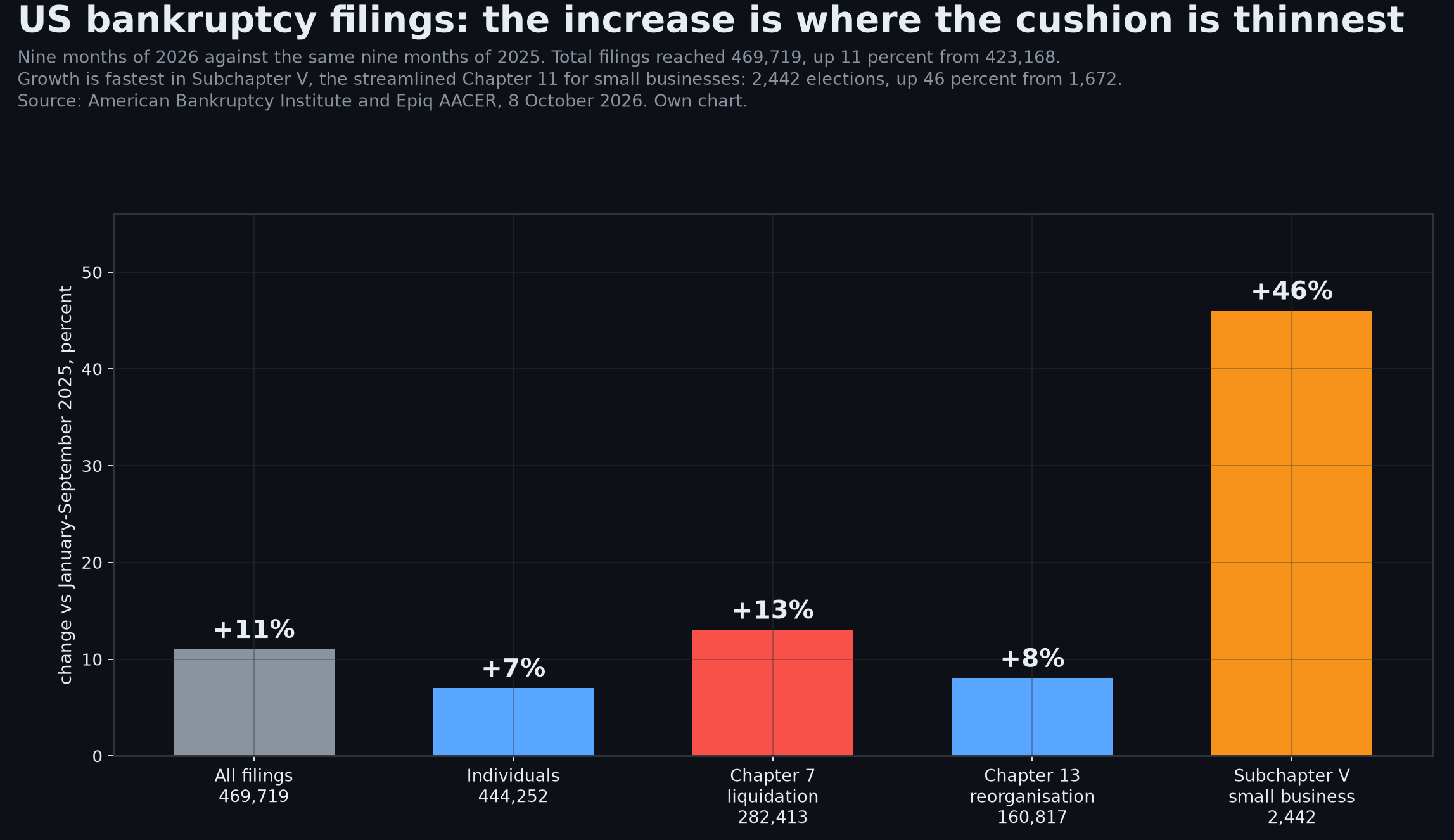
The American Bankruptcy Institute and Epiq AACER published the nine-month count on 8 October. US filings reached 469,719 between January and September, up 11 percent from 423,168 in the same window of 2025. Individuals accounted for 444,252 of those, businesses for 25,467.
The composition of the increase is the interesting part. Individual Chapter 7 liquidations, the chapter people use when there is nothing left to reorganise, rose 13 percent to 282,413. Chapter 13 reorganisations reached 160,817, up 8 percent. One line in the release stands apart. Subchapter V elections jumped 46 percent, to 2,442 from 1,672, in a filing vehicle most readers have never met.
Subchapter V is where a contractor, a restaurant or a machine shop files when the cash buffer is gone. Corporate restructuring teams work somewhere else. Its cause sits in the household balance sheet. Credit card rates have stayed above 20 percent for more than three years. Household debt reached $18.8 trillion in the first quarter of 2026 and delinquency across outstanding balances hit 4.8 percent late last year, both per Epiq AACER. September payrolls added 29,000 jobs against expectations near 84,000, per the Bureau of Labor Statistics.
Scale it honestly. Nine months at this pace annualises to roughly 625,000 filings, and the 2010 post-crisis peak ran at about 1.6 million. The current rate is 39 percent of that peak. Own arithmetic on the ABI data. What has changed is direction and composition together: the level is manageable, the acceleration is not, and the fastest-growing chapter is the one built for the smallest businesses.
One caveat belongs here, and it is mechanical rather than economic. Congress passed the Bankruptcy Threshold Adjustment Act. It lifts the Subchapter V debt ceiling to $7.5 million from about $3.4 million, and it raises the Chapter 13 individual limit to $2.75 million. More businesses now qualify for the reorganisation track. Part of what the next two quarters report will be arithmetic, not distress.
The second invoice is denominated in gas
Europe enters this heating season with a thinner cushion than the calendar implies. Storage reached 73.1 percent on 7 October, per GIE AGSI+, and the ENTSOG Winter Supply Outlook published a day later confirmed 72 percent at the start of the month. The fifteen-year seasonal average sits near 90 percent. Europe is 15 to 16 points below the five-year average for early October and roughly a tenth below where it stood a year ago.
Brussels adjusted the target rather than the supply. The mandatory storage level for winter 2026 was relaxed from 90 percent to 80 percent under flexibility provisions. On 13 October the Dutch TTF benchmark printed €85.88 per megawatt hour, up 1.8 percent on the day and about 170 percent above a year earlier, per Trading Economics. TFTC had the market in the €80 to €84 band two days before that, up 149 percent on the same source.
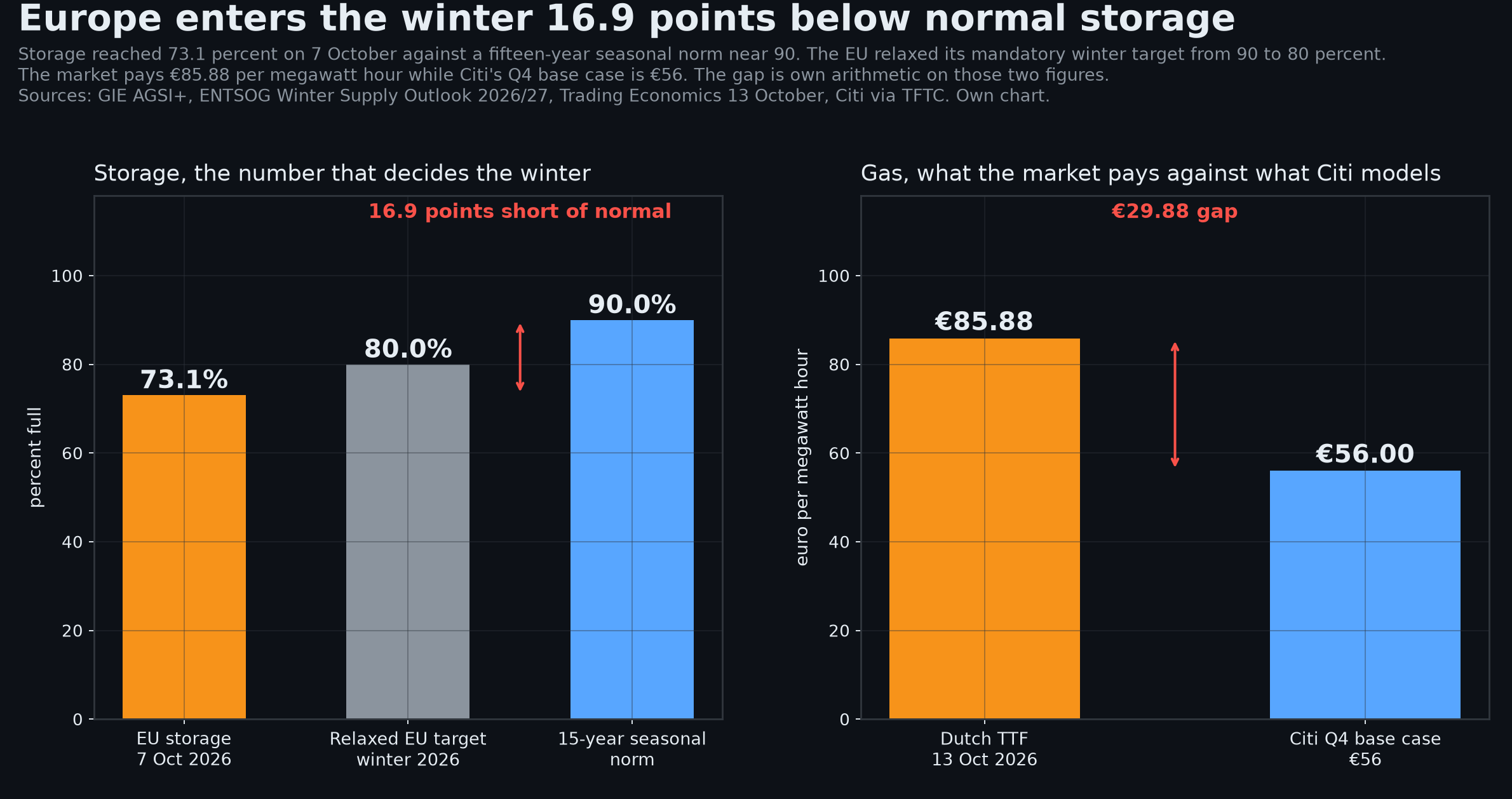
Citi’s Maggie Xueting Lin published a fourth-quarter base case of €56, more than thirty percent below where the market trades. Her case is the strongest optimistic version, and it deserves stating as she states it. Storage filled faster than expected even without Qatari volumes. Industrial demand is down about 8 percent year over year in her six-country sample, and nearly 30 percent below pre-2022 levels. The weather cooperated. Ukraine might re-export as much as 1 billion cubic metres this winter, which Citi estimates would loosen the balance by 4.5 billion.
Now price the gap. A 30 percent cut in industrial gas demand is not a buffer sitting in reserve. It is deindustrialisation that has already happened. European manufacturers did not become more efficient; they curtailed production or moved it. That demand cannot be cut by another third when the next shock arrives. The two remaining easers, mild weather and Ukrainian flows, are each one cold snap away from reversing. ENTSOG’s own outlook notes that landlocked central European states face real LNG access constraints even at current storage levels.
The physical thread compounds it. ACER’s monitoring report puts a global shortfall of 26 billion cubic metres on the table if Qatari production stays offline until December. Qatari cargoes transit the Strait of Hormuz, and no alternative route exists. Oil is pricing a related premium. Brent trades at $105.18 a barrel and WTI at $92.29 on my own dashboard this morning, 13 October.
Governments can cap the price, subsidise it, or pass it through. Intervention means borrowing. Pass-through means political pressure that ends in borrowing. The euro absorbs the difference either way.
The strongest case against all of this
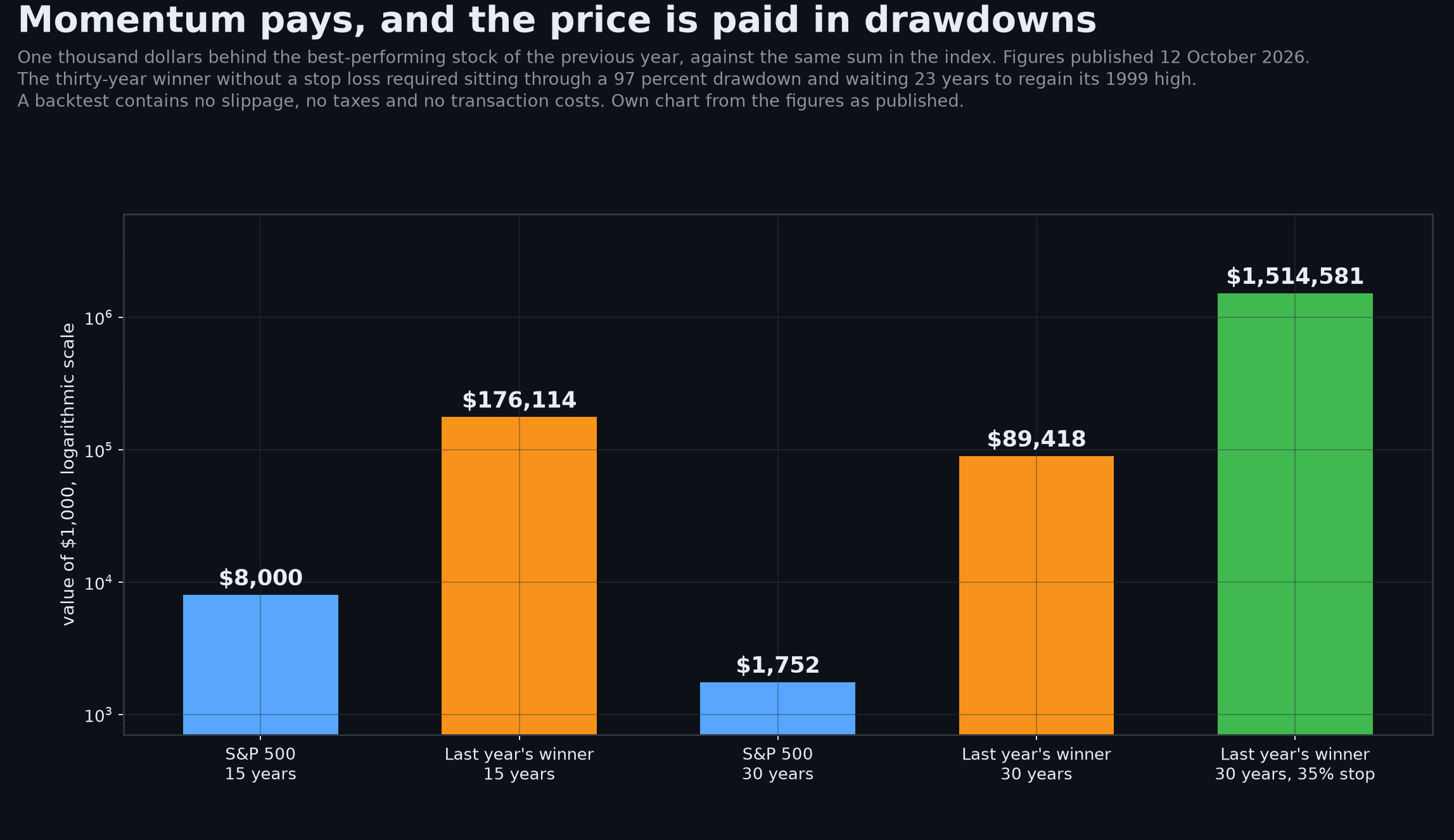
Anthony Pompliano made the optimistic argument better than anyone did this week, and it rests on evidence. Since 2020 the world absorbed a pandemic, inflation near 10 percent and the fastest tightening cycle in modern history. It also absorbed three of the five largest bank failures on record, sweeping tariffs and the closing of the Strait of Hormuz. US equities sit near all-time highs through all of it. His momentum data, credited to an X user named Gurgavin, is starker. Over fifteen years $1,000 in the S&P 500 becomes $8,000. The same $1,000 in last year’s best-performing stock becomes $176,114.
Over thirty years the strategy still wins. It wins only for someone who sat through a 97 percent drawdown after the dot-com bust, then waited 23 years to regain the 1999 high. Add a 35 percent stop loss and the same test produces $1,752 for the index, $89,418 for last year’s winners and $1,514,581 with the stop.
His conclusion is that resilience and momentum are the game, and that “fear sells, but it doesn’t create returns”.
The objection is serious, and about prices it is correct. Momentum has paid for a decade. The stop-loss version converts an unwatchable path into a survivable one. What a trend cannot tell you is who pays. Momentum describes the direction of flows; solvency describes whether a counterparty can meet the terms of a contract. In a market financed out of cash, the distinction costs nothing. Where the marginal buyer of the winning asset is funded by a vehicle whose collateral loses most of its value within a few years, the distinction is the whole price.
The mechanism lives in the collateral. A graphics processor is bought with borrowed money, securitised against its own resale value, and leased to a company that has never produced free cash flow. Its useful life is short and its second-hand price is a fraction of what the lender financed. The loan can outlast it. Every depreciation schedule is a repayment schedule, and no momentum chart contains one.
That is the falsifiable core, and Bent states the test himself. If OpenAI or Anthropic reaches sustainable free cash flow within 12 to 18 months, the structures self-liquidate instead of rolling over. If a sovereign wealth fund or the US government arrives as lender of last resort, the cycle extends rather than snaps. Neither has happened yet.
The wind and the engine
Nik Bhatia runs the other useful test, and he runs it honestly against his own signal. His liquidity index combines bond volatility, interest rates, the dollar and global banking assets into one number, with a red dot at each turn. The red dot came at the end of August and he confirmed it as a sell on 11 September. The index fell to 52.5 on 5 October, its lowest reading of the cycle, against a line at 50 that separates expansion from contraction.
Following those dots would have left you up 60.9 percent for 2026, against a loss of 8 percent for simply holding bitcoin, on his own accounting. And yet bitcoin rose 12 percent into that headwind and stalled at about $86,000 in late September, which is his point rather than a contradiction of it. Liquidity is the wind. Bitcoin has an engine too, made of its own buyers and sellers.
The engine is visible in the on-chain data. More than 70 percent of the supply now sits at a profit, up from 45 percent, and leveraged positions have shrunk since the rally began. James Check put it plainly on Bhatia’s show: “People who are going to hit the red button have done so.” His own note this morning carries the title Lingering Fear. Its subject is the opposite problem, investors bringing bear-market habits into a recovery.
I measured my side of it this morning. Bitcoin trades at $83,711, with the dollar index at 102.3 and the US ten-year at 5.189 percent, all read from my own dashboard. The ceiling at $86,000 has held. In gold terms, at $4,217 an ounce on the same feed, one bitcoin buys 19.86 ounces, which is my arithmetic on two of those readings.
The honest part
I cannot verify Hock Tan’s quotes beyond the reporting of them; no transcript exists. The sharpest move I would like to cite reached me secondhand through ZeroHedge, and I could not confirm it. It was a JPMorgan note attributing a 4.3 percent drop in an AI memory basket to his remarks. Much the same applies to the 2.6 percent fall in the SOXX semiconductor index on 13 October, which is consistent with the story without proving it.
The private-credit books are closed to me. I cannot audit the leverage inside Big Sky or the spreads on either debt package. Nor can I say whether the ultimate holder is insurance float, a pension fund or a bank’s trading book wearing a different name. Anyone who tells you the size of that exposure to the dollar is guessing. Datacentre power draw is reported, contracted and partly fictional, and I have no way to check it from here.
The bankruptcy figures I did check. The 469,719 total and the 11 percent increase appeared within two days of the ABI statement in independent trade reporting. The 46 percent Subchapter V jump was confirmed separately by the American Bankruptcy Institute Journal. That confirms the reporting, not the underlying data.
One more limit belongs on the record. A backtest is not a track record. Those momentum numbers contain no slippage, no taxes and no transaction costs, and the winner is chosen after the fact.
What would prove this wrong
The tests are specific. TTF falling below €50 before 1 December on genuine Qatari cargoes arriving at European terminals would break the energy argument. Subchapter V growth flattening toward 3 to 4 percent, with card rates back under 18 percent and real wages rising, would recast the bankruptcy data as normalisation. Watch whether Apollo or Blackstone slow their commitments to Big Sky. Packages pricing wider than expected would show the private market applying discipline the public market already has. A week of bitcoin closes above $86,000 while the dollar index rises and Brent stays above $100 would say the engine had taken over from the wind.
If none of that happens, the sequence runs the other way. Depreciating collateral is repriced first and the borrower’s equity is written down second. The credit that funded the expansion is marked last, because marking it is somebody’s job and their own balance sheet sits on the other side of the trade.
What the invoice actually says
Three payers are already being billed and none of them signed a financing agreement with Broadcom. The household with a 20 percent credit card and no cushion files under Subchapter V. A European manufacturer pays €86 a megawatt hour for the privilege of staying open, or it closes. The asset that needs a bid to hold a level pays in liquidity, which is a bill settled in price rather than in cash. Credit does not stay inside the structure that created it.
Bitcoin sits in the middle of that with one property the rest of the story lacks. Its supply is not a forecast, a gigawatt target or a financing plan. Whatever Hock Tan says about the buyers of chips, the 21 million coin limit was settled in 2009 and nobody has to trust a counterparty to read it. This morning one coin is worth $83,711, which is 19.86 ounces of gold, and it has not closed above $86,000 in weeks.
Momentum decides who is proved right this quarter. Solvency decides who is paid when the roll-over comes due, and the difference between those two sentences cannot be refinanced.
Write a comment