Nobody Regulates a Session
Nobody Regulates a Session
On 1 October the Financial Times reported that Tencent will pay Oracle roughly $7 billion over five years to run advanced Nvidia chips it is forbidden to import. The hardware sits in Oracle data centres across Southeast Asia.
The chips never cross into China. They do not need to.
That detail is the whole story, and the story is not about chips.
The rule and the thing it cannot see
America’s semiconductor containment regime is built on a physical event: a controlled item crossing a border. The Export Administration Regulations define the trigger exactly that way.
A compute session in Singapore is not a border crossing. It is a login.
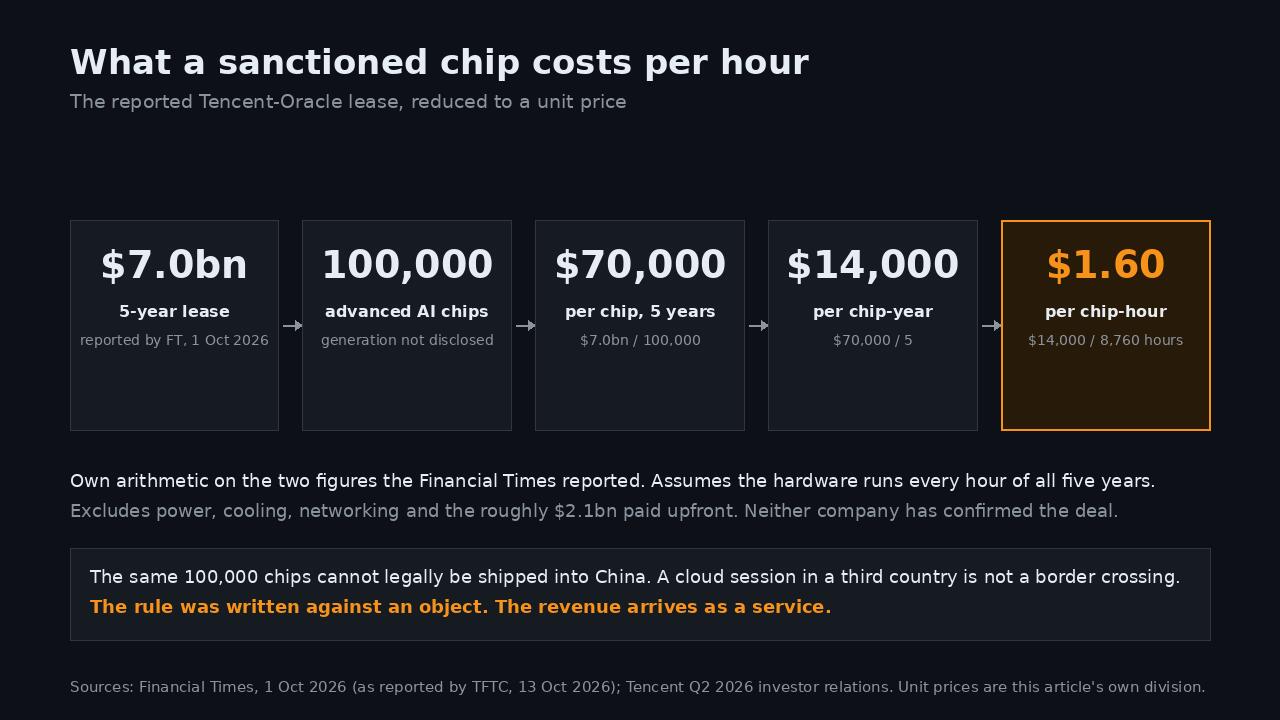
Tencent’s commitment, as reported by the FT from people familiar with the matter, runs to about 100,000 advanced AI chips, five years, and roughly $7 billion, with around $2.1 billion paid upfront. Neither company has confirmed the deal on the record. Reuters could not independently verify it. The chip generation has not been identified in the primary reporting, so anyone telling you these are Blackwell accelerators is guessing.
Take the two numbers that are on the record and divide them. Seven billion dollars against 100,000 chips is $70,000 per chip for the full five-year term. That is $14,000 per chip-year, or about $1.60 per chip-hour if the hardware runs every hour of the year, excluding power, cooling and network. Those are my own divisions of the reported figures, not a disclosed price list. They describe the rate at which a sanctioned object becomes a service.
Tencent’s own filings show the appetite behind it. Second-quarter capital expenditure rose 176% year on year to RMB 52.8 billion, and free cash flow went negative at RMB 13.8 billion. Whether that spending preceded the Oracle contract or anticipated it, the direction is unambiguous.
The enforcement question has moved to Congress because the agencies may not own it. Commerce officials have reportedly been drafting rules to reach cloud compute, but export-control lawyers cited in secondary coverage doubt the department has statutory authority over a session in a third country. The Remote Access Security Act would give it that authority. Nothing has passed.
Be precise about what the gap does and does not do. It does not make the lease illegal. It makes the lease legal under a rule that was never written to see it.
The permit and the load
The same architecture error has been running 7,000 kilometres away, in a different currency and against a different regulator.
Greenidge Generation spent years fighting New York over its power plant on Seneca Lake. In July it renamed itself Vulcan Infrastructure and Power and now wants to put a hyperscale AI campus on the same site. The company raised $39.4 million in a PIPE that closed on 10 September, led by affiliates of Machine Investment Group and Atlas Holdings alongside Conversant Capital.
Put the two deals next to each other. One is a $7 billion lease signed by a hyperscale cloud provider. The other is $39.4 million raised by a distressed miner to change what its computers do. The first is 177 times the size of the second. Both are wagers on the same scarce input, and both were announced inside thirteen weeks.
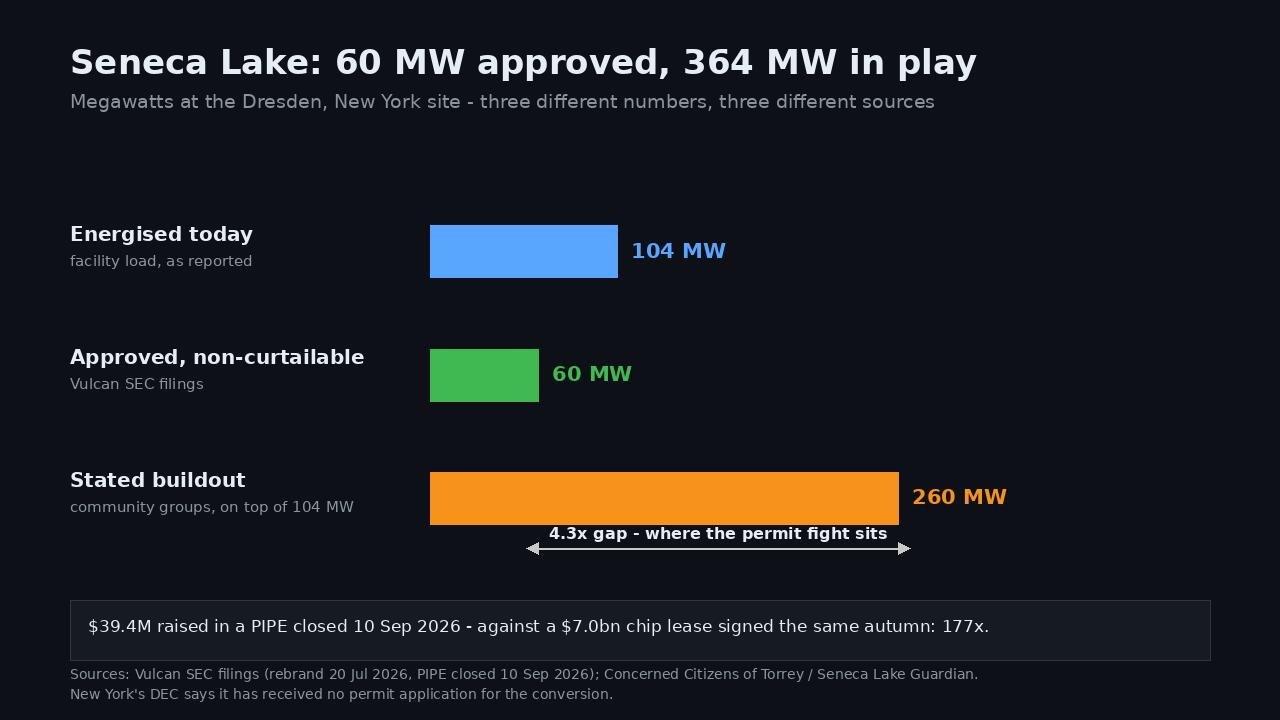
The fight at Seneca Lake is about megawatts, and the published numbers do not agree. Vulcan’s SEC filings confirm approval for 60 MW of non-curtailable power at the Dresden site. The facility already has 104 MW energised. Community groups, including Concerned Citizens of Torrey and Seneca Lake Guardian, put the full buildout at an additional 260 MW from the grid.
Sixty approved against 260 claimed. That is a 4.3-fold gap, and it is where the case will be decided.
Governor Hochul’s executive order placed a moratorium on data centres requiring 50 MW or more while the state studies grid and environmental impact. Vulcan argues the moratorium does not apply, because this is an existing operation. Its president, Dale Irwin, gave the company’s framing to Spectrum News in August. “We’re simply pivoting what the data center computers will be used for, from using computing power for cryptocurrency to high-performance computing.” Permitted emissions, water use and noise would not change, the company says.
New York’s Department of Environmental Conservation says it has not received a permit application tied to the conversion. It has not endorsed the existing-operation reading either.
Here is the strongest version of Vulcan’s case, and it deserves stating plainly. If the physical plant does not change, the moratorium’s 50 MW trigger is aimed at new load on a strained grid, and the load at Dresden is already connected. A regulator who wanted to block this could point at the interconnect queue. That argument has force, and it is why the DEC has been careful rather than declaratory.
The weakness is the arithmetic on the other side. The same site’s permit history runs from a 2022 Title V denial, upheld three times in court, to a 2025 settlement granting a five-year permit. A regulator that lost that fight three times and then settled has reason to be slow before losing a fourth.
The pattern is now national. Acquire stranded mining infrastructure. Rebrand for compute. Argue that the regulatory clock resets to zero. Each step is legal, and the sum of the steps is a regulatory perimeter drawn around a building rather than around a load.
Coinbase proposes the same architecture lesson
On 13 October Coinbase, which custodies around 5% of all bitcoin for banks, asset managers and hedge funds, published a protocol position paper asking Bitcoin to begin its post-quantum migration now.
Read the technical ask closely, because it is the same move as the Oracle lease. Coinbase wants the output container decoupled from the signature scheme, via BIP-360 or P2TRv2. That separation lets the signature algorithm be swapped without redesigning how outputs are constructed. The recommendation is a 1-of-2 hybrid: wallets holding a classical path and a post-quantum path at the same time, so funds stay spendable under either scheme during the migration. Candidate algorithms named in the paper include ML-DSA, SLH-DSA, FN-DSA and SHRINCS.
Decouple the container from what it carries. That is the cloud-session argument stated in cryptography instead of in jurisdiction.
The timeline is the uncomfortable part, and the paper says so itself. BIP-360 was merged into Bitcoin’s official BIP repository on 13 February 2026. As of early 2026, Bitcoin Core had made no implementation progress on it. SegWit and Taproot each took years from concept to activation.
The most consequential line in the post is not technical. Coinbase argues that the debate over lost and dormant coins must run in parallel rather than as a precondition, so it cannot hold the signature upgrade hostage. That debate touches Satoshi’s holdings and every abandoned wallet from the early years, and it has no clean answer. Coinbase is trying to stop a governance argument from setting the schedule of a cryptographic one.
Numbers here vary by an order of magnitude and should be reported that way. Michael Gutkin, vice president of research at Fireblocks, has cited public estimates of roughly 6.7 to 7 million BTC sitting behind already-exposed public keys. Other analyses put the near-term at-risk figure far lower. Nobody knows when the window closes, and anyone who says otherwise is selling something.
The physical layer does not negotiate
Three days before the Coinbase paper, the compute buildout acquired an adversary who does not file comments with the DEC.
Iran’s Supreme National Security Council secretary, Mohsen Rezaei, said on Press TV around 11 October, via the state IRNA agency: “We have not yet included these assets among our targets. But if war breaks out, many of these cables, data centers, artificial intelligence facilities, and numerous other sites will be destroyed.”
The venue is not incidental. In the week ending 9 October the Strait of Hormuz carried about 8.5 million barrels per day. The Congressional Research Service puts the pre-war baseline at roughly 20 million barrels per day, a quarter of global maritime oil trade. That is 40% below pre-war throughput. Tanker attacks reached a wartime high of 11 in a single week ending 4 October, per IMO data cited by Kpler. The Wall Street Journal reported on 13 October that Tehran had privately warned Gulf neighbours of possible ground incursions.
I measured the market side of this from the tower dashboard this morning. Brent at $106.18 and WTI at $94.48. The US 10-year sits at 5.20% and the British gilt at 5.41%. Japan’s 10-year yields 3.003%.
Japan is worth one beat of attention. A 3% ten-year government yield in a country that spent two decades at or below zero is a repricing of sovereign credit, and it has nothing to do with AI.
So the layered picture is this. Washington controls the object crossing a border and misses the session. Albany controls the permit for a new building and misses the load already connected. Bitcoin’s own community controls the pace of a signature upgrade and risks losing it to a debate about dead wallets. And a state actor in Tehran is openly describing strikes on the data centres and subsea cables that the first three fights assume will keep working.
Every chokepoint on that list was written against an object. Value moves at the session, the load, the algorithm and the cable.
The record that is now live
Set the geopolitics aside and look at what the market has actually been doing, because one of these claims is falsifiable inside eleven weeks.
Nik Bhatia’s newsletter on 13 October carried the headline that bitcoin has never been down two years in a row. It is a good line and it has been true. It is also a very small sample, and 2026 has put it in play.
I pulled monthly closes and computed the annual returns myself, using Yahoo Finance’s BTC-USD series, cross-checked against Binance’s BTCUSDT monthly candles for the overlapping years, where the two agree within about 0.2%.
2015 closed up 34.5%. 2016, up 123.8%. 2017, up 1,369%. Then 2018, down 73.6%. 2019, up 92.2% — the first rebound. 2020, up 303.2%. 2021, up 59.7%. 2022, down 64.3%. 2023, up 155.4% — the second rebound. 2024, up 121.1%.
Then 2025 closed down 6.3%, at $87,509.
And 2026 is down 4.7% year to date. The price this morning was $83,383.
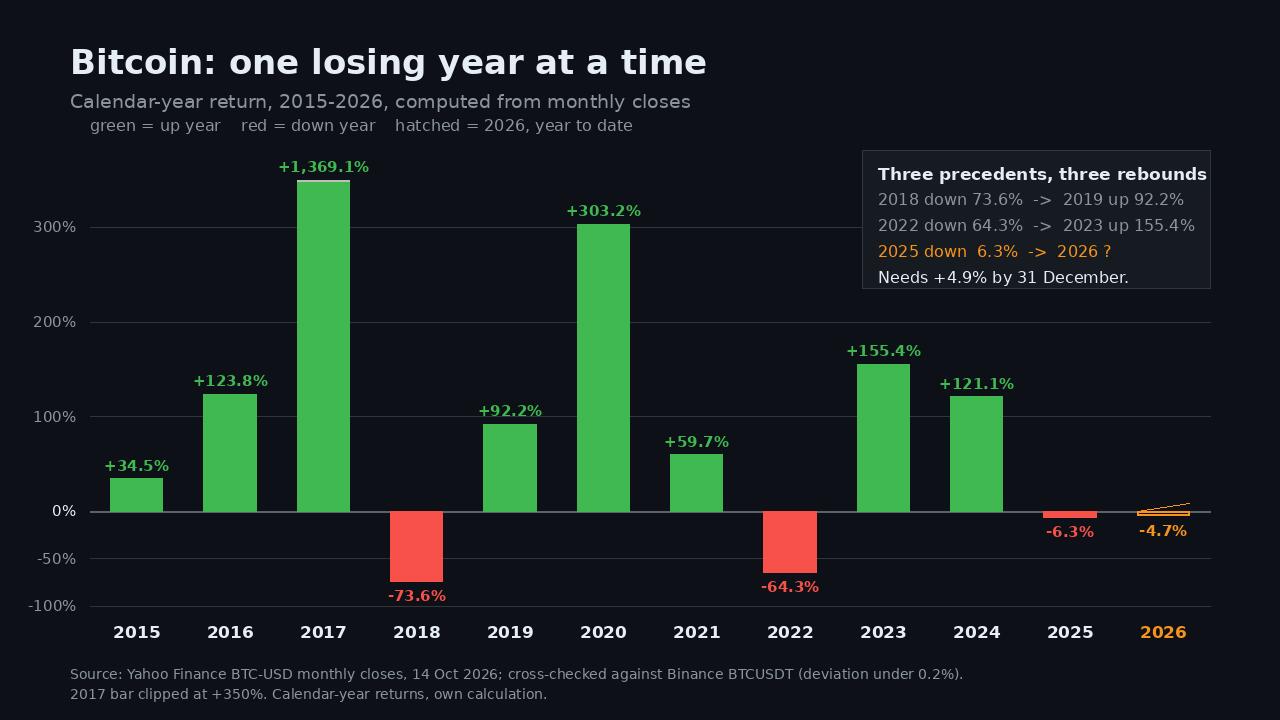
That is the fourth test of the pattern, and unlike the first three it is unfinished. Bitcoin needs to close above $87,509 on 31 December. From $83,383 that is a gain of 4.9%, with 78 days left on the calendar.
Be honest about how thin the evidence is. Three precedent pairs, three rebounds, in a fifteen-year-old asset whose first years are not in this data set. That is not a law of nature. It is a base rate with three observations in it, and the third one is live.
James Check’s point on the same day fits what is happening in the tape. He describes investors expressing “bear market PTSD” across on-chain, ETF and derivatives metrics, and names recency bias and confirmation bias as the two that cost the most. People who survived a bad year make fear-driven decisions in the first phase of a recovery.
There is a harder version of that idea, and Jordi Visser supplied it two weeks earlier. In a system where generating a convincing artifact costs nothing, effort stops signalling value. Artificial intelligence conducts price discovery on cognitive work, and the appearance of work becomes cheap. Bitcoin’s proof of work does the opposite: the protocol does not infer that work happened because an output looks sophisticated. It verifies how much was spent proposing and securing blocks.
That is the link back to the beginning. Chokepoints can be arbitraged wherever the enforcement addresses an object. Verifiable expenditure cannot. A rented chip session. A rebranded power plant. A signature scheme with no implementation. Three tellings of one story, in which the rule is always pointed one layer away from the value. Bitcoin is the market where this year’s claim can be settled by arithmetic.
The strongest case against all of this
Cory Klippsten published the counter-argument on the same day as Bhatia, and it is a serious one.
America’s position at the top is 81 years old, counting from 1945. Rome held its Mediterranean supremacy for 584 years, counting from the destruction of Carthage in 146 BC to the Vandals taking Carthage in 439 AD. Britain managed 182. The Ottomans 257. The Soviet bloc collapsed after 44. On those runs, 81 years is early, not late.
His structural case is not sentiment. Two oceans and no hostile great power on either land border. Domestic energy production that exceeds total consumption. The greater Mississippi river system carries more navigable mileage than the rest of the world’s rivers combined, by analyst Peter Zeihan’s estimate. A single towboat pushing 15 barges moves as much cargo as more than 1,000 trucks. An immigration machine that turns arrivals into participants. A political system that can lose an argument and reverse course.
Read fairly, that argument says the four broken chokepoints prove nothing about American decline. I accept that. A rule that misses the layer where value sits is a design error, and competent states commit design errors continuously.
The honest limits of my own case go further than that.
The Oracle-Tencent lease is unconfirmed by both companies and rests on unnamed sources at a single newspaper. No filing discloses it. The chip generation is unknown. The Vulcan buildout figure of 260 MW is the community’s characterisation, not the company’s. The only Vulcan number in an SEC filing is 60 MW. Its claim that emissions and water use will not change at all has not been tested by a regulator. BIP-360 has zero implementation in Bitcoin Core, so the quantum story is a mailing-list position paper and nothing more. And the annual-return series I computed starts in 2015, because that is where the price source starts.
One more thing the fiscal data adds, and then I will stop. Pompliano’s letter on 13 October cites a chart from Steve Rattner showing the US government spending about ten times more on seniors than on children. I have not verified that ratio against the underlying budget tables, so treat it as their figure and not mine. If it is roughly right, it belongs on the same list. A democracy allocates by voting bloc, and the bloc with the votes is the one that has already accumulated the assets.
What happens next
Commerce will publish a cloud-compute rule or it will not. Congress will take up the Remote Access Security Act or it will not. New York’s DEC will decide whether an existing 104 MW plant can become 364 MW without a new review. Bitcoin Core will pick up BIP-360 or a competing proposal, or the lost-coin debate will consume another two years. Iran will or will not reopen Hormuz.
Every one of those outcomes produces the same next step: a new rule written one layer too shallow, aimed at whatever the previous rule missed.
The chart that resolves first is the one with a date on it. Bitcoin needs $87,509 by 31 December to keep a record that has held for three tests and was never more than a small sample. If it holds, the line gets quoted for another year. If it breaks, the line dies, and the fourth test will have taken it apart with nothing more exotic than a calendar.
Write a comment