Strategy: net debt is 0.5% of its Bitcoin
- The leverage myth
- What the debt actually is
- The ratio that matters
- What the debt really costs
- What the company is actually doing
- The part nobody wants to price
The leverage myth
Every few weeks someone posts the same warning: Strategy is overleveraged, the debt is going to crush them, it is a house of cards. The numbers do not support it. Here they are, from the filings, as of September 17, 2026.
What the debt actually is
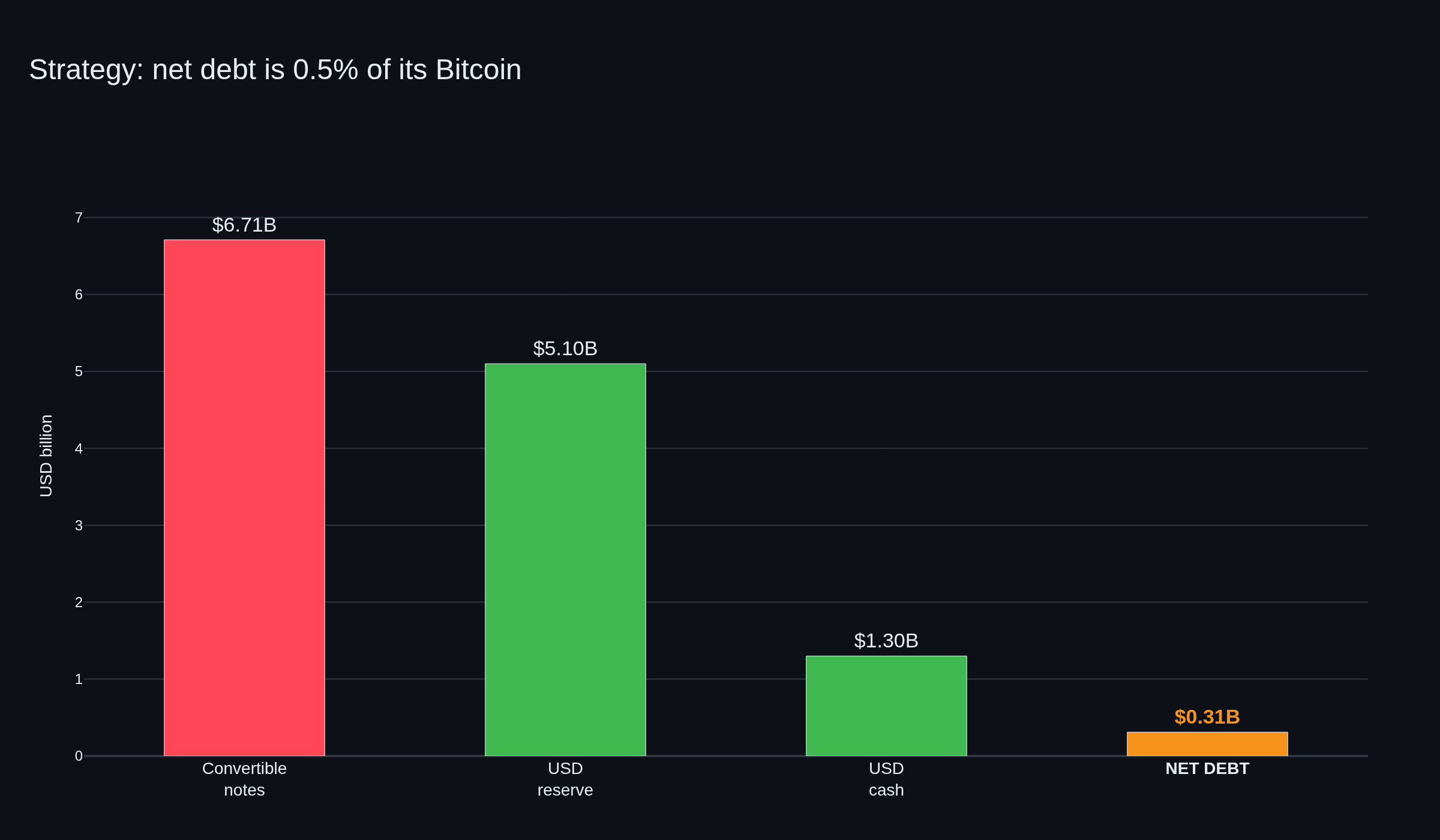
Strategy carries $6.71 billion in convertible notes. That number was $8.21 billion in June. The company retired $1.5 billion of it for $1.38 billion in cash — a 92-cent purchase of every dollar of debt.
Against that debt it holds:
- $5.10 billion in its USD reserve, reported in the 8-K of September 14
- $1.30 billion in additional USD cash
- 845,050 bitcoin
Net debt, meaning debt minus reserve minus cash: $0.31 billion.
The bitcoin alone is worth $64.8 billion and was bought for $63.7 billion — a blended cost of $75,416 per coin. At $76,669 that is a thin unrealized gain, and yes, the company is far from the top of its range. That is the honest part. What follows is the part the FUD skips.
The ratio that matters
Net debt is 0.5% of the bitcoin held.
If bitcoin fell another 50% from here, to roughly $38,000, the treasury would still be worth $32 billion against $0.31 billion of net debt. A 104-to-1 collateral ratio. That is not leverage in any sense the word is normally used. That is a company with almost no debt sitting on a very large asset.
The 12% preferred dividends people keep flagging? They are covered by the reserve alone for 37 months, or 46 months if you count the cash that is available but not committed. The weekly burn is $31.5 million against a $5.10 billion reserve. That is 110 weeks to the floor the board committed to defend — and that floor assumes no further issuance, no bitcoin sales, and no other inflows. A standstill worst case.
What the debt really costs
The convertible notes carry a weighted average of 0.421% annual interest. Less than half a percent. You cannot borrow that cheaply anywhere on earth, and they did it because the converts are not really debt in the conventional sense — they are equity in waiting, sold to investors who want bitcoin exposure with a floor.
Meanwhile the preferred stack — STRC, STRF, STRK, STRD — pays between 8% and 11.5% and trades near par. STRC has raised its rate seven times in a row and now pays 12%, twice monthly. Investors are paying above par for the privilege.
What the company is actually doing
Read the last eight weekly filings and the pattern is not a company in distress. It is a company buying back its own preferred stock at a discount and retiring the claims:
- 9,961,554 STRC repurchased — 9.5% of the issue — at an average of $95.45
- Every share bought below $100 retires a full $100 claim and kills its dividend permanently
- $119.5 million per year of recurring dividend obligations eliminated
- On track to save $129.8 million annually if fully deployed
Buying your own paper at 3% below par, retiring a claim larger than what you paid, and cutting the dividend bill for good — that is not a company drowning in obligations. That is a company cleaning house while the market offers it a discount.
The part nobody wants to price
Strategy holds 845,050 bitcoin. That is 4.0% of all bitcoin that will ever exist. The market values the entire company — enterprise value, all securities, all common — at $69.3 billion. The bitcoin is worth $64.8 billion of that.
You are buying the largest corporate bitcoin position on earth, plus a software business, plus the capital-markets machine that has raised more cheap capital than any treasury company in history, for roughly the price of the coins.
Some of that is doubt about the preferred stack. Some of it is a bear market being a bear market. Some of it is people repeating a claim about leverage they never checked.
Now you can check it. $6.71 billion of debt, $6.40 billion of reserves, $64.8 billion of bitcoin. Do the division.
The FUD was never about the math. It was about the assumption that the math would never be done.
Write a comment