The Credit Gold Delusion
The Credit Gold Delusion
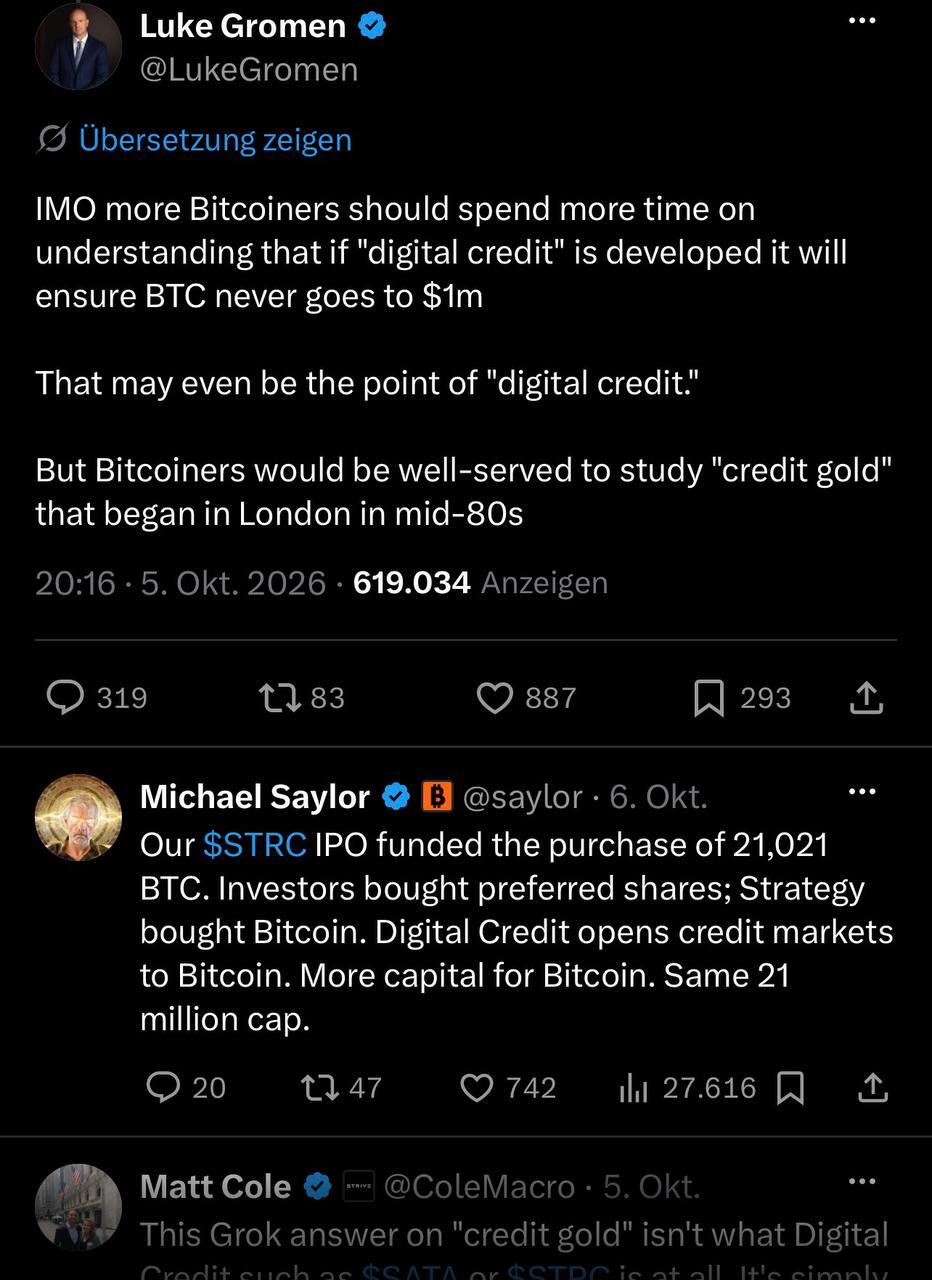
On 5 October 2026 Luke Gromen wrote that Bitcoin will never reach one million dollars.
His argument, in his own words: if “digital credit” is developed, it “will ensure BTC never goes to $1m.” He added that this “may even be the point.” Then the advice: Bitcoiners would be well served to study “credit gold,” the market that began in London in the mid-1980s.
Michael Saylor answered the next morning: “Our $STRC IPO funded the purchase of 21,021 BTC. Investors bought preferred shares; Strategy bought Bitcoin. Digital Credit opens credit markets to Bitcoin. More capital for Bitcoin. Same 21 million cap.”
Two men, one mechanism, opposite conclusions about which way the money flows. Gromen’s history is real, and the World Gold Council tells it in its own words. But that history needed three things Bitcoin does not have, and the credit instrument he points at currently does the opposite of what he says it will do. The analogy holds. The ceiling does not either: at a million dollars a coin, bitcoin would be worth $21 trillion, about 72% of all the gold ever mined.
The mechanism he is actually pointing at
Gold fixed at $850 an ounce on 21 January 1980. In nominal terms it did not see that level again for 28 years. By the summer of 1999 the price was $251.70 — a retreat of 70% from the peak. It was the low of that generation.
Something besides a bear market happened in between. A lending market grew up among the bullion banks, and the World Gold Council’s own retrospective, published in October 2020, describes the loop without embarrassment:
From the 80s until September 1999, the gold market was bearish. The sales of gold reserves by some central banks as well as the uncertainty about their behaviour going forward were accentuating downward expectations for the gold price. Therefore, the mining producers’ hedging demand increased, sometimes without accurate risk management considerations. To put it simply, miners were increasing selling forward their production and central banks were responding to that increase by lending their gold as GLR were high. However, selling forward implies a spot sale which depresses the spot gold price.
Read it again. Producers sold metal they had not yet dug up, and central banks handed over the metal to settle those sales. The Council calls the pattern a “vicious” circle, and notes that its own members disagreed about how much the lending mattered: for some central banks it had no effect on the price, for others it contributed to the fall.
Notice what ended it. Not an argument about paper claims, and not a market force. On 26 September 1999 fifteen European central banks signed the Washington Agreement and capped their own sales and lending for five years. The owners of the metal changed their behaviour, and the bear market died.
So Gromen is not inventing anything. A credit market layered on a hard asset can hold the price down for fifteen years. That much is documented, by the industry itself.
The borrower problem
Now ask who did the suppressing. Not the instrument. The owners of the metal.
A leasing market requires a lender who holds a stock big enough to matter and is willing to part with it. Gold has exactly that lender. The World Gold Council puts the above-ground stock at 216,265 tonnes at the end of 2024, of which central banks hold about 37,755 tonnes. Mine production adds roughly 1.7% a year to the pile, so the stock runs close to sixty times the annual flow. When the existing pile is that large, a handful of reserve managers decide the price.
Bitcoin has no equivalent, and this is not a technicality. There is no vault of twenty million coins held by an institution that will lease them out. There is no producer whose forward hedging is settled with metal supplied by a central bank. The suppression worked because someone with a stock was willing to lend it. Remove the lender and the mechanism has nothing to attach to.
The direction of the money
Then there is the part Saylor compressed into a sentence. When Strategy sold preferred shares, the proceeds went out and bought coins. The STRC offering alone funded 21,021 Bitcoin. The tracker strc.live, which counts purchases out of SEC filings rather than press releases, puts the confirmed total from that one series at 21,379 coins.
Credit gold worked by lending metal that was then sold into the market. Digital credit works by selling a dollar claim and buying coins. The word is the same and the flow is reversed.
It is worth stating why that is structural rather than incidental. A claim on Bitcoin cannot be manufactured without buying Bitcoin. Every dollar that walks into that market arrives as a bid for a coin. In the gold version, the new claim and the new sale were the same event: leasing moved metal to a borrower whose business was selling it. Nothing of the sort happens here, because the instrument is not settled in the asset. It is settled in dollars, and the asset is what the dollars bought.
His own bear case, in arithmetic
His price target deserves a balance sheet instead of an adjective.
Strategy held 848,000 Bitcoin on 4 October 2026. The most recent addition was 334 coins, bought in the first week of October for $28.7m — the smallest weekly purchase of the year. Against the coins: convertible debt of $6.71bn in the Q2 filing, down from $8.21bn. Add the dollar reserve of $5.10bn and $1.30bn in cash reported in mid-September. The net position is roughly $0.31bn.
Now use his own number. At $38,000 a coin, the treasury would still be worth $32.2bn. That is arithmetic. It says the credit structure does not break in the scenario he is warning about. The thing he fears cannot be the thing that kills the position he is describing.
The oracle problem, which his own history exposes
Here is the part credit gold teaches that Gromen did not say out loud.
Gold never really had a price. It had an announcement. From 12 September 1919 the fixing came out of a room containing five London bullion houses. Since 2015 it is the LBMA Gold Price, a twice-daily auction administered by ICE Benchmark Administration. Every bar, every vault receipt and every ounce of jewellery on earth is valued against a number that a committee declares twice a day.
And the declaration was rigged. On 23 May 2014 the Financial Conduct Authority fined Barclays £26,033,500 over control failures that allowed one of its traders to influence the fix. The regulator’s final notice is public. The London Gold Fixing was replaced the following year.
The supply side is worse. That 216,265-tonne stock is an estimate. It is the industry’s own figure, and no holder can audit it. The same World Gold Council commentary describes the lending market as “less prone to full transparency,” which is the polite version of nobody knows how much of the official gold is already spoken for.
That is the oracle problem, and it is the reason the whole credit gold story was possible. An administered price, an unauditable stock, undisclosed lending: three things that have to be trusted rather than checked, and one of them ended in a fine.
Bitcoin does not have them. At block 970,807 the protocol has issued 20,096,275 coins. That is 95.7% of the 21 million cap. Anyone can recompute that from the block subsidy and the height, and the spendable figure trackers print is 20,096,237, because a handful of coins are unspendable. Possession needs no custodian’s word either: either the key signs or it does not.
The price still needs a market. Supply and ownership need no oracle at all. That difference is what the comparison actually reveals. The market Gromen recommends for study grew in the space created by a trusted centre, and the centre is the point. Take it away, and there is nowhere for the plumbing to attach.
One million dollars, in arithmetic
There is one word in Gromen’s post that the numbers do not support: never.
At a million dollars a coin, bitcoin’s market value would be $21 trillion, the whole 21 million supply repriced. Set that against the metal he prefers. The world’s above-ground gold, 216,265 tonnes, was worth about $29 trillion at $4,166 an ounce. A million a coin leaves bitcoin at roughly 72% of the value of the asset it is meant to lose to.
So the claim in his post is not that bitcoin fails to reach a fantasy number. It is that bitcoin never reaches 72% of all the gold ever mined. Nothing in the plumbing described above makes that impossible.
The mechanism is the one he already believes in, pointed at the right asset. Capital sitting in instruments that lose purchasing power has to move somewhere, and it moves into the thing whose supply cannot answer. At a million dollars the question is not whether bitcoin deserves $21 trillion. It is whether $21 trillion of the world’s savings keeps being held in assets that pay less than the inflation they suffer.
A rebuttal should not hide where its author stands, so here it is: bitcoin can reach one million dollars, and it can go past it. Gromen says never. On this arithmetic, never is the weakest word in his post, and the credit market he blames puts a bid under the price instead of a ceiling over it.
The empirical test he proposes
His claim is testable, and the test has been running for nine years. CME listed its first bitcoin futures in December 2017, when bitcoin traded near $18,000. The spot exchange-traded products arrived in January 2024, handing the largest asset managers in the world a paper wrapper for the coin. Cash-settled contracts, in other words, have been available the entire time, through the largest expansion of bitcoin’s market value in its history — and bitcoin peaked at $126,080 in October 2025.
That correlation is not a mechanism, and this argument should not lean on it. But it does dispose of the strong version of his claim. A channel that has stood open for nine years while the price rose sevenfold is not the channel holding the price down.
The strongest version of his case
A rebuttal that skips the other side’s best argument is noise, so here it is, unsoftened.
First, the credit machine competes with coins for capital. In the first week of October, Strategy bought 334 Bitcoin for $28.7m. In the same days it spent $176.3m repurchasing about 1.77m of its own STRC shares. Six dollars went back to preferred holders for every dollar that went into coins. That is a real complication, and it belongs in the piece rather than out of it.
Second, cycle returns are shrinking in percentage terms. On an asset this size, doubling the market means another trillion dollars arriving; the percentages have to fall, and they have fallen.
Third, and this is the argument worth having: a state digital credit is a genuine threat. Stablecoins, tokenised deposits and central bank digital currencies let the world hold dollar claims with no coin underneath, which is how a monetary premium gets drained. That is a different animal from a preferred share that has to buy Bitcoin to exist, and it is not what Gromen is warning about. He uses one phrase for two opposite things — private credit that must purchase the asset, and public credit designed to replace it. Only one of them is dangerous, and it is not the one in his post.
The honest part
Bitcoin traded at $82,946 while this was written. Its record high, set on 6 October 2025, was $126,080. That is a gap of 34%. Nothing here refutes a price level: his $40,000 call has not been falsified, and a drawdown of that size is ordinary for this asset.
What does not survive inspection is the mechanism. The market that held gold down for fifteen years needed lenders with a vault and a price fixed by committee. Bitcoin has neither, and the instruments he says will cap it are, at this moment, among the largest single buyers of the thing he says they will cap.
He told Bitcoiners to study credit gold. He is right that they should. The lesson is not the one he drew.
Write a comment