The Experience Economy (Pt 1)

- Why Events?
- What makes Satlantis unique
- The Experience Economy
- What about Destinations, Places, Chat and other features?
- In Closing
- Aleksandar Svetski
Satlantis is changing.
We are transitioning away from ‘Social & Travel’ and towards events or more broadly what I’m calling the ‘Experience Economy.’ As I alluded to in the last post, and will explain a little further below, we’ve discovered which part of our product actually solves a real problem and shifting all of our focus there.

The attention economy is saturated
Satlantis is no longer a social app, but an events app. The social layer will remain, but for context, not content.
In other words, the social connections will be used to make the product better, but it’s no longer the* focus *of the product.
Without further ado, let’s dive in.
Why Events?
We’re doubling down on events for a few reasons.
First, because this is what people actually used at the conferences. What worked at each of the events we went to was not the booths or the promise of a new social network, or even the content creator angle — but simply getting the majority of side events either listed or hosted on Satlantis.
Since the last update we’ve continued to partner with key Bitcoin conferences: Bitcoin Ireland, Bitcoin Bali, Watch Out Bitcoin in Spain and Adopting Bitcoin in Salvador most recently. The goal is to first become the preferred partner for all satellite events, followed by the agenda & networking app partner, and ultimately, the end to end event solution for these conferences.

Second, while we paid the conferences to have a booth, get exposure and talk about our product for what (aside from the feedback) ultimately amounted to cheap vanity metrics (new social users who didn’t stick around), I saw the conferences pay** for agenda apps like Brella & Cowboy because they need some sort of agenda and networking tool for the attendees.
And not only did they pay money for these shitty tools, but in order to make their investment worthwhile, they had to tell ALL their attendees to download and use those apps.
And what do the attendees get for downloading them? Yet another app to manage, which either doesn’t work well or feels straight out of the 90’s… only to forget about it after the event and delete it the next time they’re running low on space on their phones, because there is no use for it outside of that specific event.
This is why I made the comment above re: the second stage of our relationship with conferences. These collaborations made me realise that events are not just a product feature — they’re a go-to-market strategy. One that goes over the heads of the Brella-type tools. Sure, people will begrudgingly download these apps for a conference and use them as a means to an end, but that’s it.
We can make this so much better because of the social nature of our product. At Satlantis we can actually leverage this utility to help event organisers build community post-event.
We did some research and found that more than 40% of people who go to one conference will go to another in the same year and, most often, they will download yet another networking app. Unlike Brella, Whova and others, we offer all the necessary functionalities for communities not only to stay active, but to emerge and thrive through both our marketplace and social discovery features.
Meetups, retreats, communities & conferences are the perfect atomic networks — they need the digital space to coordinate and stay in touch, but they exist in the real world. By building an event-tool, and partnering with the actual events whether as a partial or end-to-end solution, we can onboard entire networks and then:
-
Thanks to the social layer, create an ever-improving discovery experience & ‘Event Marketplace’ that helps match events & attendees in-app.
-
Give people a place to extend that initial moment of genuine, in-person connection with powerful community tools, and finally;
-
Use the Map to bring a the place-discovery element to the event — which adds an extra layer of stickiness because both hosts and attendees can use it to curate the best places around the event to enhance the experience.
The key takeaway: The tool is the product — the social layer just makes the tool better.
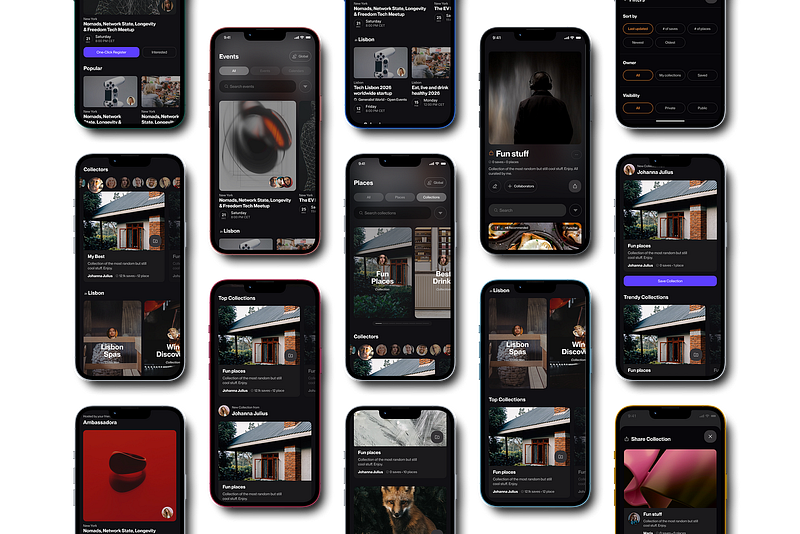
Specifically, that tool is an Events App, with a combination of key features that no other product offers. Let’s go through them.
What makes Satlantis unique
A self-serve events app is not a new concept. There are many out there: Eventbrite, Luma, Meetup probably come to mind. Some are old and tired, but well known; others new and exciting, but either not as established, or focused on a particular niche, demographic or experience.
How does Satlantis compare to both these incumbents and more recent challengers? What do we offer that is unique and superior for our target market?
Here are the 6 Key Differentiators that set us apart:
-
Bitcoin: No major events platform today offers native Bitcoin and stablecoin ticketing. That means we’re not just onboarding users and creators into the Bitcoin economy — we’re unlocking major new markets still cut off by Stripe, PayPal, and fiat rails, making Satlantis a truly global product.
-
Calendars: Calendars are collections of events you can follow and subscribe to. They’re a de-facto community page and can be used for different purposes. For conferences, a calendar can be clean view of the whole constellation of side events to help maximise attendance and networking. For communities, it’s an ongoing hub of events across the year. Anyone can subscribe to public Calendars, or create their own personal Calendars, to keep everything tidy and organised.
-
Event Marketplace: Just like Spotify aggregates songs, artists, and playlists with a social layer, we aggregate and tag events with our AI tools and map them to user interests. Combined with the social graph — showing what people in your network are hosting, attending, or interested in — we surface the most relevant events wherever you are, making Satlantis a true Social Marketplace for events.
-
Agenda & Networking: We’re bringing agenda and networking tools into the 21st century with support for both small-scale conferences and, in time, large-scale events too. Satlantis natively supports rich user profiles (perfect for speaker or partner/sponsor profiles) and of course, via DMs will support attendee networking out of the box. In the future, it will also come with full agenda support and live event-only feeds, all for a fraction of the cost of current incumbents like Cvent or Brella.
-
Map Integration & Curation: No other event management platform on earth offers a fully functional Map and discovery experience for places and merchants. The number 1 request by attendees traveling to events, anywhere in the world, is “where to go” and “what to do” while they’re there. What are the cool restaurants, cafés, gyms, bars or clubs? On Satlantis, hosts can link curated lists of places to their events, making it easy to build great-looking guides, complete with an in-app map.
-
The Social Layer: The Nostr-powered social graph works in the background and ties all of our features together to maximise personalisation and discovery. You can see who’s hosting or attending events, follow their profiles, and track what friends are exploring. This all comes together beautifully in a personal activity feed where you can keep track of your own activities and, if you want, share them with friends (like when Facebook was actually cool).
Satlantis is a self-serve event platform first, but that’s only the beginning. The vision, the long game, is to become the Social Discovery App for the Experience Economy.
The Experience Economy
The Experience Economy is where the travel & events industries collide with the creator and curator economies (I’ll do a do a dedicated piece on this in the future).
At its core, it’s about people wanting to do things in the real world — with friends, with like-minded people, and with new people they meet along the way — whether it’s meetups, festivals, fitness classes, hackathons, pop-up cities, food tours, surf retreats, or the kind of unique activities and local experiences that companies like AirBnB are now pushing with their “Experiences” platform.
It’s about Connection, Community, and Curation. The stuff that makes us feel human.

This movement is being driven by the fact that Social media cooked everyone! Despite the promise of connection, we’ve never been more disconnected
These platforms became about content, ads and engagement, not about connection. As a result, people have become glued to their screens and disconnected from reality
But… things are changing. The younger generation is starting to switch off and go offline. We’re slowly realising that we’re social creatures, yes — but physical ones too (which is why stupidities like the metaverse failed and why VR continues to fail)
At the same time, it’s why the events and travel industries are exploding and giving rise to this new experience economy.
Coupled with the creator economy, the increasing desire to build community and connect with other human beings — and the inevitable end goal of every community becoming an IRL group, it’s created the perfect storm for a community-centric events application like ours.
And it’s not just a passing trend. This is going to accelerate as AI automates digital work and takes over the online world. As this larger macro trend continues, tens of millions of people more will move across to the experience economy.
We’re truly at the beginning of the next big shift.
What about Destinations, Places, Chat and other features?
Since the beginning we’ve wanted to bring together People, Places & Events. We had just not clarified the message and the sequence of product features.
Events as the focus and the Experience Economy as the market does a nice job of not only summarising our approach, but directing us.
Events give us a clear path to market and with Bitcoin, we can do things other event apps cannot. But, eventually, we will expand the functionality. An event is a broad concept. It’s any moment where people meet — online or offline. Could be anything from a dinner to a curated trip across Morocco.
Likewise with communities. A community is a group of people who keep showing up around shared values, interests or identity — online or offline. In many ways, a community is a recurring event with continuity.
We intend to build a marketplace for events, communities, places, creators and experiences — and tie them all together through the social graph.
But we have to start somewhere and for now, we’re going to build the best possible Bitcoin-native event app for both hosts and attendees worldwide.
Which of course does mean that some of the features we built will either be hidden, deprecated or transformed into a version that helps enhance the event experience.
For example, Places and Collections are still prominent, but will in time be moved into the event experience where hosts can link them to their events and create a more holistic experience for their attendees (transformed).
Since destinations are no longer a focus in the app, they will become a filter to help people find events in the places they live, love or are traveling to (deprecated and reused).
The same will go with chat and communities. When it comes time for us to build these, they will be associated to events (and of course the existing social accounts on Nostr).
In Closing
The team and I are excited for this next chapter. By simplifying the product, we can streamline our operations and** make our message to the market more clear. We can put our limited resources toward making a single core product better and getting it into the hands of more event hosts and organisers, who are our true target market.
Entrepreneurship, as Drucker said, is not an art or a science, but a process. I always wish we were farther along, and there’s so many things I wish we’d done differently — but I guess that’s just part of the process.
I recommend you try out the new app. It’s much smoother, has the first really good, functional version of the events app and you can go create an event & get paid in Bitcoin now (more on this in the next post).
Thank you for reading,
Aleksandar Svetski
CEO, Satlantis
Download the App
TestFlight (latest, cutting edge version. Newest features, but might have bugs)
TestFlight App (you need this if you want the TestFlight app)
Apple App Store
Google Pay Store
Write a comment