OpenAI President Greg Brockman Claims AI Writes 80% of Company's Code
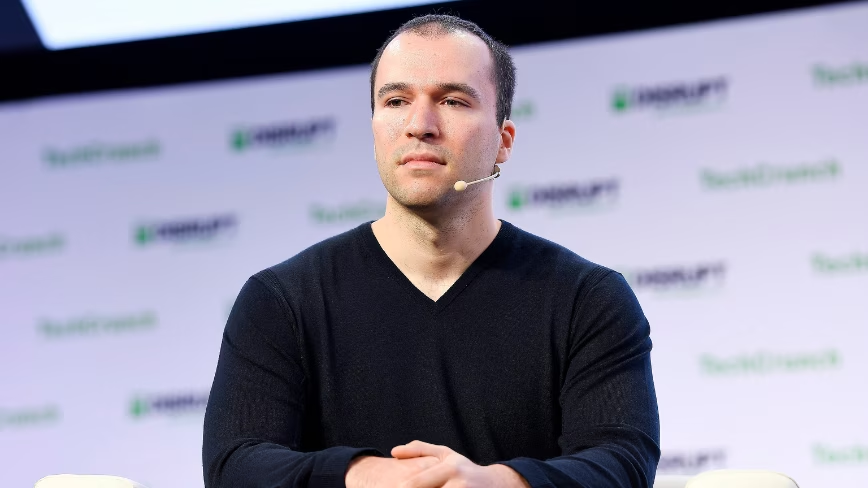
OpenAI President Greg Brockman Claims AI Writes 80% of Company’s Code Human Human coverage reports Brockman’s 80% figure but frames it cautiously, juxtaposing it with independent studies that show modest or unclear productivity gains from AI coding tools. It emphasizes ongoing human responsibility for merged code and raises questions about measurement, generalizability to the wider industry, and long-term effects on software engineers’ jobs. @TNW @7dlt…clgf OpenAI president Greg Brockman is widely reported as claiming that AI now writes around 80% of the company’s code, a sharp increase from earlier figures of roughly 20%. Both AI and Human-aligned narratives agree on the core who/what/when: Brockman, speaking in recent public remarks and interviews, framed this as evidence of how deeply AI coding tools are integrated into OpenAI’s internal software engineering workflow. Coverage consistently notes that these tools can now generate the majority of code in many tasks, and that other major tech leaders, including figures at Google and Anthropic, similarly describe AI as taking on a dominant share of code generation within their organizations.
Across sources, there is shared context that this claim reflects a broader trend in the software industry, where AI coding assistants have rapidly evolved from autocomplete-style helpers to central instruments in development pipelines. Outlets consistently link Brockman’s remarks to the wider competitive race among AI labs and big tech firms to demonstrate successful internal deployment of their own tools. Both perspectives situate the 80% figure within ongoing debates about how AI will reshape software engineering work, productivity, and the division of labor between humans and machines, while emphasizing that human engineers still review and merge code to maintain accountability and quality.
Areas of disagreement
Reliability of the 80% figure. AI-aligned coverage tends to treat the “80% of code” claim as a credible, if approximate, metric that showcases the maturity of AI coding tools, often repeating the number with minimal caveats. Human coverage, by contrast, frequently foregrounds skepticism, citing independent studies that find limited or mixed productivity gains from AI coding tools and questioning how “80%” is actually measured. While AI sources lean toward accepting internal self-reporting from OpenAI, Human sources emphasize that the figure may conflate boilerplate generation, drafts, and final production code.
Framing of productivity and impact. AI-aligned accounts generally portray the shift from 20% to 80% AI-written code as clear evidence of substantial productivity gains and a step-change in developer efficiency. Human reporting is more cautious, noting that empirical research has not yet consistently validated large-scale productivity transformations and suggesting that time saved on coding might be offset by new review and debugging burdens. AI coverage tends to highlight speed and innovation, whereas Human coverage stresses uncertainty about whether real-world, measurable output and software quality are improving proportionally.
Labor and responsibility narratives. AI-focused narratives often present the 80% figure as an exciting redefinition of the developer role, where humans supervise, design, and integrate while AI handles most implementation details. Human coverage, however, underscores that OpenAI still assigns formal responsibility for merged code to human engineers and raises questions about job security, deskilling, and how accountability works when AI produces most of the text. The AI angle typically emphasizes empowerment and augmentation, while the Human angle gives more attention to risks for workers and the potential concentration of power in companies that control these tools.
Generalization to the broader industry. AI-oriented sources are more likely to extrapolate from OpenAI’s internal experience and similar claims by other AI labs to suggest an imminent, industry-wide norm where most code is AI-generated. Human reporting more often treats OpenAI as a special case, noting that such heavy reliance on AI tools may not translate to smaller firms, regulated sectors, or legacy codebases, and that many organizations remain in early experimentation phases. This leads AI coverage to frame the 80% figure as a near-future benchmark for everyone, while Human coverage frames it as a bold outlier that may or may not scale.
In summary, AI coverage tends to treat Brockman’s 80% claim as a forward-looking proof point of rapid AI-driven transformation in coding practices, while Human coverage tends to treat it as a provocative, partially substantiated data point that warrants skepticism, independent validation, and closer attention to labor and accountability implications. Story coverage
Write a comment