Former DeepMind Researcher David Silver Raises $1.1B for AI Startup Ineffable Intelligence
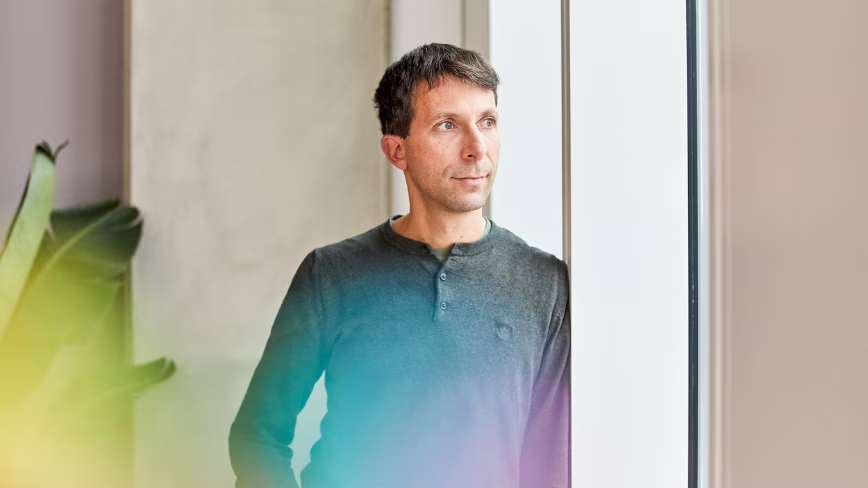
- From DeepMind star to founder-in-a hurry
- A company with a thesis — and a $5.1B price tag
- The anti–LLM bet: a “superlearner” without human data
- Investors vs. skeptics: conviction collides with reality
- Silver’s own framing: a life’s work and a moral bet
- What happens next
Former DeepMind Researcher David Silver Raises $1.1B for AI Startup Ineffable Intelligence Human Human coverage portrays Ineffable Intelligence as a London-based AI startup founded by David Silver that has raised $1.1 billion at a $5.1 billion valuation to pursue a reinforcement-learning-driven “superlearner” that does not rely on human data. It emphasizes that investors like Sequoia and Nvidia are making a high-risk, thesis-driven bet on Silver’s track record despite the company having no product, revenue, or clear public roadmap. @TC @TNW David Silver has persuaded some of the world’s most powerful tech investors to bet over a billion dollars on an AI lab with no product, no revenue, and a plan to sidestep human data entirely. Whether this is genius, hubris, or both is now a $5.1 billion question.
From DeepMind star to founder-in-a hurry
The story starts at Google DeepMind, where British researcher David Silver spent more than a decade quietly rewriting AI history. He led the creation of AlphaGo, the first system to topple a professional Go player and then 18-time world champion Lee Sedol in a 2016 match watched by some 200 million people across Asia, an event that became a “Sputnik moment” for modern AI and helped pave the way for breakthroughs like AlphaFold.1
Silver followed with AlphaZero, which mastered Go, chess and shogi from scratch through pure self-play, without any human examples—effectively proving that a single reinforcement learning system could reach superhuman levels across multiple complex games.1 Then came AlphaStar, achieving grandmaster-level play in the messy, real‑time strategy world of StarCraft II.1
By late 2025, Silver walked away. After years leading the reinforcement learning team at DeepMind and holding a professorship at University College London, he left to build something that extended his most radical intuition: that the most powerful intelligence might emerge not from imitating humans, but from trial, error and raw experience.2
A company with a thesis — and a $5.1B price tag
In November 2025, Ineffable Intelligence was quietly incorporated in London. On paper, it was little more than a name and a founding vision. No product. No revenue. No public roadmap. Yet, as one account notes bluntly, “what it has is a thesis, and a founder whose track record is worth a billion dollars to investors on conviction alone.”1
That conviction escalated quickly. Within months, Ineffable Intelligence had raised $1.1 billion at a valuation of $5.1 billion, instantly joining the upper tier of global AI labs by sheer financial firepower.2 The fundraising round is one of the largest ever for a startup at such an embryonic stage.1
Sequoia Capital led the deal, with managing partner Alfred Lin and partner Sonya Huang reportedly flying to London specifically to secure Silver’s signature.1 Nvidia’s venture arm added at least $250 million, bolstering the hardware and compute side of the bet.1 Another breakdown lists Lightspeed Venture Partners, Index Ventures, Google, Nvidia, the British Business Bank and the U.K.’s new Sovereign AI fund among those piling in.2
In an era where AI valuations are ballooning, Ineffable still stands out: a multi‑billion‑dollar price tag based on a moonshot idea more than a concrete product.
The anti–LLM bet: a “superlearner” without human data
At the core of Ineffable Intelligence is a deliberate rejection of the current AI orthodoxy. Today’s leading systems—from OpenAI’s GPT line to Google’s Gemini—are giant statistical mirrors, trained on oceans of human‑generated text, code, images, and video. Silver wants to build something fundamentally different.
According to the company’s newly launched site, Ineffable aims to create a “superlearner” that “discovers knowledge and skills without relying on human data” by using reinforcement learning, where systems learn through feedback from their own actions rather than copying human examples.2
This isn’t a vague aspiration. It’s a direct continuation of the logic behind AlphaZero, which learned to dominate classical games by starting with zero human guidance and improving solely by playing itself millions of times.2 Ineffable’s thesis scales that idea: if a system can bootstrap from scratch in games, perhaps it can do the same in the real world—science, engineering, maybe even general intelligence.
The company itself makes no effort to hide the ambition. Its site claims that if successful, its work will amount to “a scientific breakthrough of comparable magnitude to Darwin: where his law explained all Life, our law will explain and build all Intelligence.”2 Capital letters and all.
Investors vs. skeptics: conviction collides with reality
From the investor perspective, this is a bet on pedigree and paradigm shift.
Sequoia and other backers are wagering that Silver can do in general AI what he did in games: produce a leap so obvious in hindsight that everyone else looks conservative. They’re also clearly betting that the current large‑language‑model gold rush is not the final form of AI. Ineffable wants to “join the race for novel AI models that could outperform large language models,” positioning itself as a challenger to the reigning data‑hungry giants.2
Nvidia’s prominent role signals another angle: any frontier lab that leans hard on reinforcement learning at scale will consume vast amounts of compute. A $250 million early stake is both a financial play and a strategic alignment around future GPU demand.1
But the skeptics’ case is also straightforward.
On one side, the company is essentially a thesis wrapped in a war chest. Ineffable “has no product, no revenue, and no public roadmap,” which makes its $5.1 billion valuation a pure speculation on future breakthroughs rather than any demonstrated commercial momentum.1
On another, the technical challenge is punishing. Games like Go and chess are clean, fully observable environments with well‑defined rules and cheap simulations. The physical world—and even messy digital spaces like markets, social systems, or protein folding—is noisy, partially observed, ethically fraught, and extremely costly to simulate. Building a “superlearner” that can safely and usefully acquire all its knowledge from experience, without leaning heavily on human data, is far from guaranteed.
The economic model is hazy, too. As one report notes, “it is unclear how, when or how much the venture will make money,” yet that uncertainty “clearly hasn’t hindered fundraising.”2 In other words, this is long‑horizon, winner‑takes‑most thinking: if Silver is right, the payoff could be civilization‑scale; if he’s wrong, $1.1 billion goes up in compute credits.
Silver’s own framing: a life’s work and a moral bet
Silver, for his part, is trying to cast Ineffable not just as a technical project, but as a scientific and moral mission.
He has described the lab as “his life’s work” in a personal note on the company blog, and told Wired that “any money that I make from Ineffable will go to high-impact charities that save as many lives as possible.”2 That pledge positions him closer to the effective‑altruist wing of the AI world than to the stereotypical billionaire‑founder narrative.
At the same time, he remains a consummate reinforcement learning evangelist. His career arc—from AlphaGo’s televised triumphs to AlphaZero’s self‑play revolution and AlphaStar’s messy‑world dominance—has consistently pushed the line that intelligence may emerge more reliably from systems that learn by doing than from those that merely compress past human behavior.12
Ineffable is that thesis, industrialized.
What happens next
Chronologically, the arc is clear:
- 2010s–early 2020s: Silver builds his reputation at DeepMind through AlphaGo, AlphaZero, AlphaStar and contributions to Gemini, defining much of the modern reinforcement learning playbook.1
- Late 2025: He leaves DeepMind and incorporates Ineffable Intelligence in London, sketching an early‑stage vision with no product and no public roadmap.1
- Early 2026: Ineffable quietly launches its website, staking out the “superlearner” concept and explicitly challenging human‑data‑driven AI paradigms.2
- April 27, 2026: Public reports reveal that the lab has raised $1.1 billion at a $5.1 billion valuation, backed by Sequoia, Nvidia and a roster of top‑tier investors betting on Silver’s next act.12
From here, the narrative forks.
If Ineffable can turn its Darwin‑sized rhetoric into even a fraction of the promised breakthrough—an AI that genuinely learns new science or engineering from first principles without leaning heavily on human corpora—it could redefine where the frontier lies, and embarrass the current crop of LLM‑centric giants.
If it stalls, it will become a case study in late‑cycle excess: billions committed to a beautiful idea that couldn’t escape the lab.
For now, all anyone can say with certainty is that one of the field’s most accomplished reinforcement learning pioneers has convinced some of tech’s sharpest investors to underwrite his most audacious hypothesis yet. In an AI landscape dominated by models trained on us, David Silver is betting the future on a machine that teaches itself.
1. Sequoia and Nvidia back David Silver’s Ineffable Intelligence at $5.1B — “Ineffable Intelligence, the London-based AI startup founded by David Silver … has been backed by Sequoia Capital and Nvidia at a valuation of $5.1 billion.”
2. DeepMind’s David Silver just raised $1.1B to build an AI that learns without human data — “Ineffable Intelligence … has raised $1.1 billion in funding at a valuation of $5.1 billion… to create a ‘superlearner’ capable of discovering knowledge and skills without relying on human data.”
Story coverage
Write a comment