OpenAI President Greg Brockman's Journal Entries Read in Court
- From private notebook to public evidence
- Musk’s narrative: the moment the mission flipped
- Brockman’s counter: messy thinking, not a master plan
- The pivot: philanthropic no more
- Inside the diary: greed, guilt, and spin
- Competing stories of betrayal
OpenAI President Greg Brockman’s Journal Entries Read in Court Human Human coverage presents Brockman’s journal as a rare, unfiltered look at OpenAI’s internal thinking, highlighting quotes about not remaining philanthropic, considering B‑corp or C‑corp status, and aiming for $1 billion as potentially incriminating evidence in Musk’s lawsuit. It stresses how these entries may undermine Brockman’s credibility and suggest a departure from OpenAI’s original nonprofit mission. @Verge @Arstechnica OpenAI’s courtroom drama has turned into something far stranger than a standard tech-lawsuit slugfest: a public dissection of Greg Brockman’s private thoughts, with a jury and livestream audience cast as voyeurs to the moment a nonprofit AI lab allegedly decided it really wanted to be a billion‑dollar business instead.
From private notebook to public evidence
The road to Brockman’s journal becoming Exhibit A started long before anyone said “for-profit.” According to his testimony, he began keeping the journal back in 2010, treating it as a place for “stream-of-thought, jotted notes, and disorganized thoughts that sometimes contradicted each other.”1 In court, he described seeing it weaponized as “very painful,” stressing that these were “very deeply personal writings that were never meant for the world to see but there’s nothing there I’m ashamed of.”1
That distinction—personal, messy thinking versus hard evidence of intent—is the core of Brockman’s defense. But Elon Musk’s legal team sees something very different in those pages: the moment OpenAI, founded as a nonprofit with a lofty public mission, veered toward enriching its leaders.
The journal was submitted as sealed evidence in October and unsealed in January, giving Musk’s lawyers a trove of quotes they say reveal OpenAI “abandoned its nonprofit mission to instead focus on personally enriching leaders like Brockman and Sam Altman.”2 The entries cited in court stretch from 2015, when OpenAI was founded, through 2023, when Brockman and CEO Sam Altman were briefly ousted in a governance crisis.2
Musk’s narrative: the moment the mission flipped
Musk’s team argues the journals show, in real time, the betrayal of the original deal: OpenAI as a philanthropic counterweight to Big Tech’s AI arms race. The prosecution’s theory is simple and brutal: somewhere in those scrawled pages, the people running the lab stopped thinking like stewards of a charity and started thinking like founders of a unicorn.
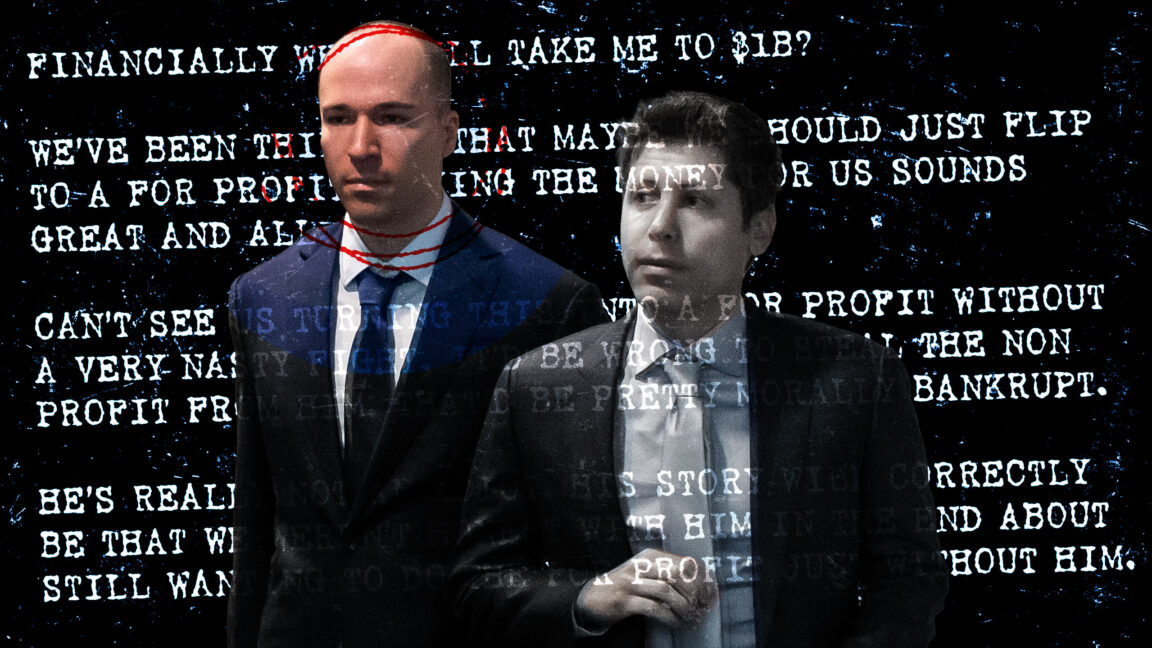
They’ve leaned heavily on lines that sound less like a nonprofit mission statement and more like a startup pitch deck. One headline quote that surfaced in court—“Financially what will take me to $1B?”—is presented by Musk’s attorney, Molo, as a smoking gun: evidence that Brockman was “plotting to get rich” rather than figuring out “funding for the non-profit.”3
From Musk’s side, the logic writes itself: if the president of OpenAI is journaling about his personal path to a billion dollars, how seriously could he have been taking the nonprofit’s philanthropic purpose?
Another passage that Musk’s camp calls “the most solid thing” they’ve gotten out at trial comes from Brockman’s own words about Musk’s role at OpenAI. In one entry, Brockman wrote that “it’d be wrong to steal the non-profit from him,” and that to “convert to a b-corp without him… that’d be pretty morally bankrupt.”4 The line plays neatly into Musk’s core allegation: that OpenAI’s leadership executed a bait-and-switch, taking a charity he bankrolled and converting its work into for‑profit corporate value while shoving him out.
Stack those quotes together and Musk’s narrative is clean, if ruthless: they knew it would be “morally bankrupt,” they did it anyway, and they hoped to get very rich in the process.
Brockman’s counter: messy thinking, not a master plan
Brockman, under direct and cross-examination, has tried to smash that neat storyline by attacking its premise: that his journal should be read like a board memo instead of a stream of consciousness.
On the stand, he explained that the journal entries were not a straightforward record of his “actions or feelings,” but a way to explore alternate viewpoints, sometimes even writing down other people’s thoughts just to “feel them out” for himself.2 That, he said, is why the notebook can “appear self-contradictory at times” and why pulling lines out of context makes them look worse than they are.2
That defense is being tested against some extremely inconvenient sentences.
In one entry, written just six days after telling Musk that he and others wanted “more results in the non-profit and to fundraise there,” Brockman pivoted in his notebook: “We’ve been thinking about that maybe we should just flip to a for-profit. making money for us sounds great and all.”5 He also wrote, with striking clarity, “His story will correctly be that we weren’t honest with him in the end about still wanting to do the for profit just without him.”5
In court, Brockman insisted these lines were “an expression of a frustration and not a plan,” and denied “rehearsing” that explanation before testifying when asked by Molo.5 But even with that spin, the text reads like someone fully aware of how this would look from Musk’s point of view—and acknowledging he’d be “correct.”
That’s the credibility problem stalking Brockman throughout this testimony: he says it’s all exploratory and emotional, but the language often sounds precise and predictive.
The pivot: philanthropic no more
Another fraught moment came when Molo pressed Brockman directly on OpenAI’s nonprofit identity. “Molo asks if the non-profit should still be a philanthropic endeavor,” a courtroom dispatch reported. “Brockman says, forcefully, ‘no.’”6
The answer opens the door wide for Musk’s argument. Here is the president of a charity saying, in open court, that it should no longer behave like a philanthropic entity. That admission is then paired with a diary note in which Brockman records Musk himself saying they had to “figure out how do we transition from non-profit or something which is essentially philanthropic endeavor and is b-corp or c-corp.”6
This is where the timeline gets messy—and where both sides find ammunition.
On one hand, the entry helps Brockman: it shows Musk actively contemplating a shift to B‑corp or C‑corp status, undermining the idea that OpenAI’s pivot was some secret betrayal behind his back. Musk, too, was talking about corporate structures and monetization.
On the other hand, Brockman’s emphatic “no” on continuing philanthropy and his billion-dollar musings do him no favors. As one liveblog put it bluntly: “Brockman is not doing himself any favors.”6
Inside the diary: greed, guilt, and spin
In the Ars Technica account of the trial, Brockman comes off as both exposed and oddly controlled. He “never wanted to discuss his personal journal in public,” but ended up spending “days doing exactly that,” reading some of his “most embarrassing entries aloud in front of a jury and a packed courthouse, as well as over a YouTube livestream that peaked at around 1,200 viewers.”2
Musk’s lawyers, Ars notes, argue that the entries “show the moment when OpenAI leaders decided to abandon the nonprofit mission, with Brockman explicitly discussing stealing a charity from Musk and hoping to earn a billion for his contributions at OpenAI.”2 The courtroom spectacle is tailor-made for that story: the president of OpenAI literally forced to explain “why his diary entries sound greedy.”2
Brockman’s rejoinder is that greed is only one of many emotional registers in the notebook—and not necessarily the one that governed his decisions. He estimated about 100 pages of entries, spanning his schooling through major professional turning points.2 Sometimes, he testified, he was recording text or Signal messages from others. Sometimes he was deliberately trying on someone else’s worldview. Sometimes he was venting.
Yet some lines are hard to shrug off as pure thought experiment. The admission that to convert to a B‑corp without Musk would be “pretty morally bankrupt”4 is not the language of a dispassionate analyst. It sounds like conscience—and the awareness of crossing it.
Competing stories of betrayal
By now, the Musk v. Altman trial has hardened into two starkly opposed narratives anchored in the same scraps of handwriting.
-
Musk’s story: OpenAI was founded as a nonprofit to serve humanity, underpinned by his money and his expectations. Its leaders quietly plotted a for‑profit pivot that would “steal the non-profit from him,”4 lock him out of the upside, and make themselves rich. The diary is the unguarded confession.
-
Brockman and OpenAI’s story: The journal is a chaotic brain dump, not a boardroom conspiracy. Yes, it contains ugly lines about money and betrayal, but those sit alongside contradictory, half‑formed, and borrowed thoughts. What Musk calls a moment of moral collapse is, in their telling, the messy interior monologue of someone wrestling with impossible trade‑offs in a field where building state‑of‑the‑art AI is brutally expensive.
The truth likely involves elements of both. OpenAI’s nonprofit ideals collided with the commercial reality of training frontier models—and with the gravitational pull of Silicon Valley wealth. Musk, who now runs a rival AI company, has every incentive to cast that collision as betrayal. Brockman, who remains president of OpenAI, has every incentive to reframe it as tortured but principled evolution.
What makes this trial unusual isn’t just the stakes for AI governance. It’s the way it has turned a founder’s diary into a battlefield, where phrases like “making money for us sounds great and all”5 and “Financially what will take me to $1B?”3 are no longer private cringe but public evidence.
Whatever the jury decides, one thing is already clear: in the fight over who stole what from whom, Brockman’s own words may prove his harshest accuser—or his most complicated alibi.
Story coverage
Write a comment