Nvidia’s Blowout Quarter Rekindles the AI Boom—and Its Financing Doubts
Nvidia’s Blowout Quarter Rekindles the AI Boom—and Its Financing Doubts
Nvidia sees accelerating, increasingly broad AI demand; investors see a blockbuster earnings signal; skeptics see an ecosystem whose spending—and financing—still needs to prove it can endure.
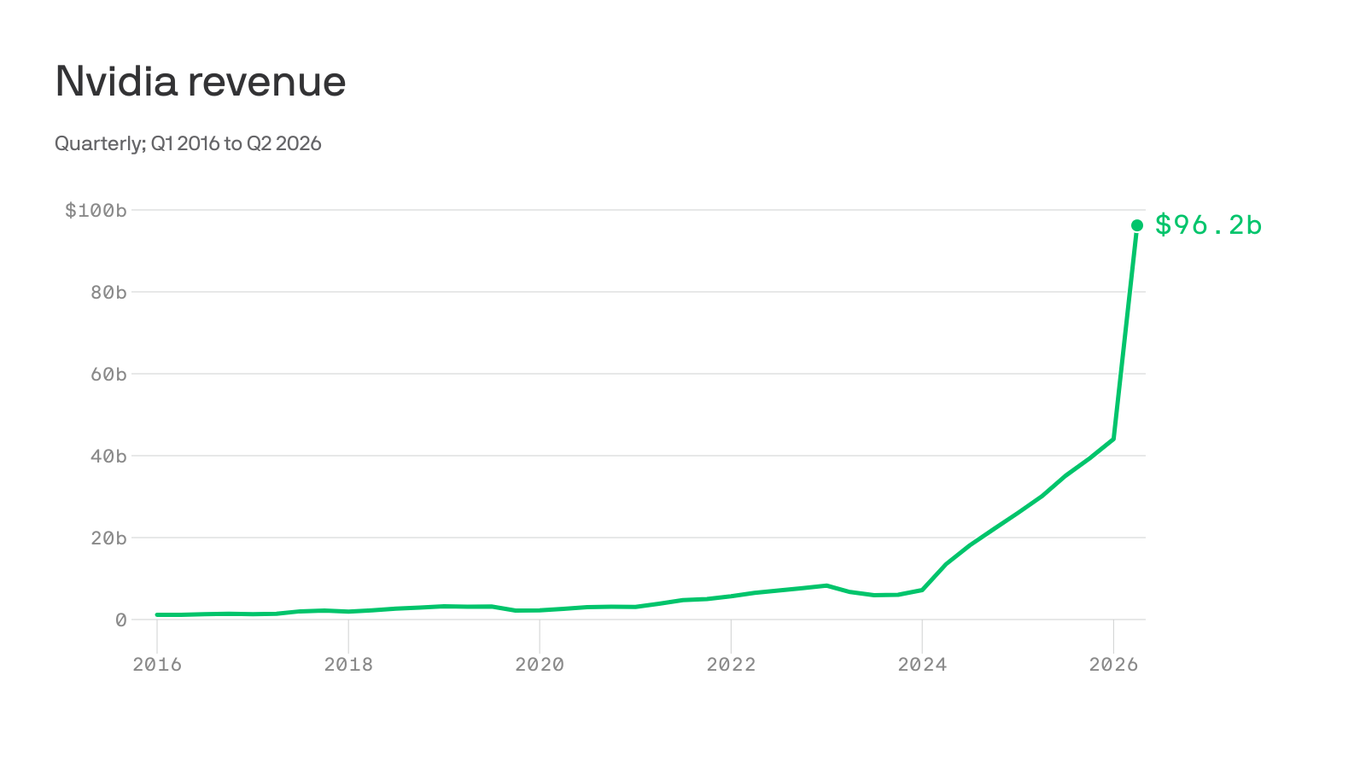
Nvidia opened its fiscal second-quarter report with numbers that reset expectations. Revenue for the quarter ending July 26 reached $96.2 billion, up 106% year on year, while net income rose 126% to $59.7 billion. Its data-center division delivered $89 billion, underlining just how completely AI infrastructure now drives the company.
Jensen Huang framed the result as evidence that AI has crossed from promise to commercial utility. “AI has reached its inflection point. It’s doing useful work. Its tokens are productive and profitable,” the chief executive said. “Now, compute is revenue, and demand is accelerating.” Nvidia then forecast roughly $108 billion in third-quarter revenue, excluding China data-center compute sales from that outlook.
The company’s more startling move came on its earnings call: an unusual year-ahead projection for 70% revenue growth in fiscal 2028, far above the growth analysts had modeled. Huang said the constraint was supply, not appetite: “Even though our demand is much greater than 70%, our supply allows us to confidently deliver 70%.” Memory shortages are also pressuring margins, a reminder that the AI buildout is stretching the supply chain as fast as it lifts chip sales.
Nvidia and its backers argue the demand base is widening beyond a handful of hyperscalers. CFO Colette Kress said sovereign projects, neoclouds, enterprises and edge deployments should account for about half of data-center business, challenging the notion that the boom depends solely on Big Tech capital expenditure. David Sacks echoed the market’s triumphant reading, declaring the “AI capex is a bubble” narrative was “getting shredded” after the report.
Yet the strongest results have not silenced the hardest question: whether Nvidia’s investments, guarantees and support for AI customers create circular financing. Kress defended those arrangements as limited-risk investments in companies whose growth is constrained by compute, while critics remain wary of interdependent spending that may be masking fragile returns. The quarter delivered the numbers; the durability test is still ahead.
Continue reading https://foxvector.com/stories/01a04dad-0b4a-0a93-727f-0a5d274222e1
Write a comment