Deindustrialization: Causes and Consequences
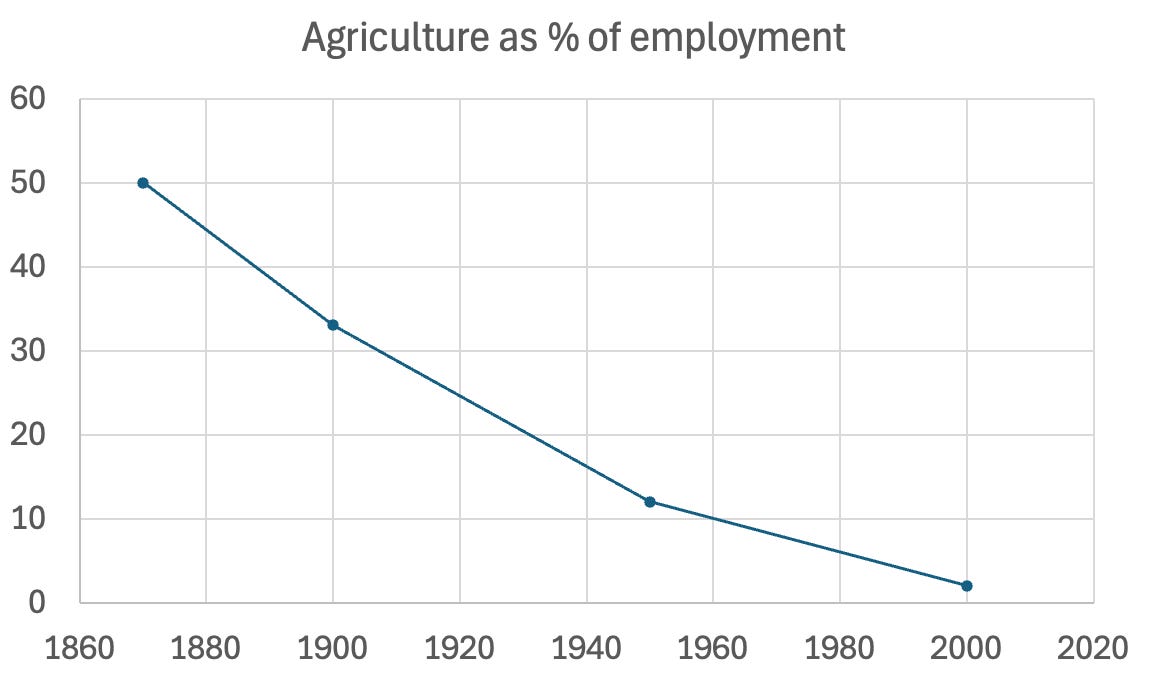
A few months before the 1992 election I, along with some other Democratic-leaning economists, flew to Little Rock to meet with Governor and presidential candidate Bill Clinton. The ostensible purpose was to discuss policy, but it was obviously also an audition for a job in the administration. At one point Clinton asked what could be done to restore manufacturing to its previous share of employment.
Heads turned to me; this was clearly my department. I said something like this: “Sorry, governor, but that’s really not feasible. Even if we could eliminate the trade deficit, manufacturing employment would only rise modestly and would still be a much smaller share of the economy than in the past.”
Needless to say, I didn’t get a job. It was one of the best things that has ever happened to me.
The inconvenient fact is that economy changes over time and so do the industries in which people work. A century and a half ago, despite the growth of manufacturing, America was still largely a nation of farmers. Today hardly any of us work on the land:

Source: Census, BLS
Oh, and many, possibly a majority of farm workers are foreign-born, and many of them undocumented.
Although some politicians still portray rural areas and small towns as the “real America,” you don’t hear a lot of nostalgia for the days when agriculture dominated American employment. (If you ask me, Queens, New York comes a lot closer to being who we are now.)
There is, however, a lot of nostalgia for the 1950s and 1960s, when more than a quarter of U.S. workers were employed in manufacturing. Income inequality was much lower in that era, so much so that many blue-collar workers considered themselves middle-class. And there’s a widespread narrative that (a) attributes those good times for American workers to the availability of well-paid jobs in manufacturing (b) attributes the relative decline of American manufacturing to overseas outsourcing and trade deficits.
But is this narrative right? Yes, it’s a simple, compelling story. But as I tried to explain to Clinton all those years ago, the math behind the story doesn’t work. To preview the conclusions: Even if we could somehow eliminate our trade deficit (which Trump’s tariffs won’t do, but that’s another story), America would not reindustrialize. — our manufacturing sector would be slightly bigger, but nothing like what it used to be in the 1950s and 1960s. And any wage gains for ordinary workers would be trivial at best.
I should say that some people who have bought into the deindustrialization-through-globalization story get annoyed if you point out that it’s mostly wrong. They seem to believe that pointing out the weakness of the deindustrialization story means that you don’t care about American workers. So let me be clear: I do care, a lot, about the fate of American workers. But as I’ll explain later, trying to recreate the economy of the 1950s won’t help them.
This post will, by the way, be a somewhat wonky exercise. But it’s important to understand that policies based on misplaced nostalgia (especially those being wielded so disastrously by Donald Trump) will hurt workers, not help them.
Beyond the paywall I’ll discuss:
1\. The limited (not zero) role of international trade in deindustrialization
2\. The limited (again not zero) role of deindustrialization in depressing wages
3\. What would actually help restore the middle-class society I grew up in
*Why did manufacturing decline?*
The America of yesteryear really was much more of a manufacturing nation than it is today. Here’s the share of manufacturing in total employment since World War II:
s_!bWBb!,w_1456,c_limit,f_auto,q_auto:good,fl_progressive:steep/https%3A%2F%2Fsubstack-post-media.s3.amazonaws.com%2Fpublic%2Fimages%2F7ad4ebe6-7c27-4b23-b02a-0338082f12d1_800x450.png)
In 1950 more than 30 percent of U.S. nonfarm workers were employed in manufacturing.
As late as 1970 that share was still high, at 25 percent. But now it’s less than 10. The perception that we used to be an industrial nation, but aren’t any more, is correct.
For the calculations I’ll do in a minute, it’s helpful to use a somewhat different measure of manufacturing’s importance: its value-added as a percentage of GDP:

Source: Bureau of Economic Analysis
Economists use value added to measure a company’s net contribution to GDP. If we add up the value-added of every manufacturing company in America, we get the total contribution of manufacturing value added to GDP.
Manufacturing’s share of national employment measures bodies employed in manufacturing. Manufacturing’s share of value added is a number measured in dollars, which makes the latter easier to compare with other things measured in dollars, like the trade deficit like the trade deficit. Fortunately, the two measures look more or less the same. Either way, the share of manufacturing in the economy has declined by around 15 points percentage points since the 1960s, from 25 to 10 percent.
What explains the decline? A plausible story, which many people believe, is that it’s all due to imports. Beginning around 1980, America began buying more manufactured goods from other countries than it sold in return. And there’s no question that when consumers buy an imported good rather than one produced here, that means fewer jobs in U.S. manufacturing.
So this isn’t a matter of first principles; it’s a numbers game. Here’s what has happened to the U.S. trade balance in manufactured goods, measured as a percentage of GDP, since the 1960s:
s_!1Rrj!,w_1456,c_limit,f_auto,q_auto:good,fl_progressive:steep/https%3A%2F%2Fsubstack-post-media.s3.amazonaws.com%2Fpublic%2Fimages%2Fd1a8b1e8-b406-410e-b141-81f592fda669_800x450.png)
OK, what I actually show is nonagricultural exports minus nonoil imports, but that closely matches the manufacturing balance and is easier to calculate. Segments of the blue line above the bold horizontal indicate periods and amounts of US trade surpluses in manufactured goods. Segments below the bold horizontal line indicate periods and amounts of US trade deficits in mmanufactured goods. As you can see, this balance went from roughly zero before 1980 to a persistent manufacturing goods trade deficit of around 4 percent of GDP. How did this affect American manufacturing?
Let’s assume that a dollar spent on imported manufactures is a dollar subtracted from spending on domestic manufactures. Caveat: This might not be exactly right: if we reduced spending on imports, some of the money might be spent on services instead. But this assumption is, as my father would say, good enough for government work, and if anything overstates the impact of the manufacturing trade deficit.
So look at the numbers. Manufacturing has declined by 15 points of GDP, but the trade balance has deteriorated by only 4 points. This tells us that the trade deficit can’t be the main explanation of deindustrialization.
And even 4 points is clearly an overstatement. When you spend a dollar on U.S. manufactured goods, not all the money stays in manufacturing. Some of it “leaks out” to other parts of the economy, mainly because industrial firms buy a lot of services. My read of the input-output tables (you don’t want to know) says that on average a dollar spent on U.S. manufactures translates into only 63 cents of manufacturing value added.
So imagine that we could somehow eliminate our manufacturing trade deficit, as Trump claims he can do. Given what I’ve said, that would increase manufacturing value-added by 4*0.63 = ~2.5 points of GDP, that is, from around 10 to around 12.5 — not nothing, but a far cry from the 25 percent people remember as the good old days.
When I do a calculation like this, I usually try to kick the tires by seeing if another approach yields similar results. In this case, that involves comparing the United States with Germany — another wealthy economy, but one that for reasons we needn’t go into runs a massive surplus in manufactures trade rather than a deficit. This surplus does give Germany a bigger manufacturing sector as a share of the economy, but how much bigger? Here are the numbers:
Germany vs. United States in 2022
Difference in manufacturing trade balance as % of GDP: +7 - (-5) = 12
Difference in manufacturing value-added as % of GDP: 19-11 = 8
Source: World Trade Organization and World Bank
That is, using the Germany-US comparison, around 67 percent of a dollar spent on manufacturing stays there, while 33 percent leaks out to the service sector. This is very close to the 63/37 division I estimated from the input-output table.
Now, America never has and never will run a German levels of manufacturing trade surplus. Even under prohibitive tariffs that effectively shut down international trade, we would at most close around a third of the gap between US and German shares of manufacturing value added as a percentage of GDP. That is, even prohibitive tariffs would raise the share of manufacturing in US GDP from 10 to less than 13 percent, far short of the 25 percent of yore.
In short, globalization explains at most a small fraction of US deindustrialization. What explains the rest? The same phenomenon that explains why we have so few farmers these days: rising productivity.The reason we’ve become mainly a service economy is that modern manufacturing workers are so productive that we need a lot fewer of them than we used to.
Does this mean that we’ll face mass unemployment once AI or whatever raises the productivity of service-sector workers? No. I explained why in an old article, “The Accidental Theorist.” But let’s move on.
Manufacturing and the “good jobs” fallacy
The belief that globalization destroyed American manufacturing often goes hand in hand with the belief that a manufacturing revival is the only way to restore good, well-paying jobs for ordinary American workers. Is that right?
Let’s break that into two questions. First, do jobs in manufacturing consistently pay more than jobs elsewhere in the economy? Second, is the pay difference enough to matter?
There’s no question that in the past, and to some extent even now, some union jobs in manufacturing paid quite well, providing blue-collar workers with a middle-class standard of living. \[Note that I put in the qualifier “union.” That’s important.\]
But are manufacturing jobs still good? A 2017 Congressional Research Service report by Marc Levinson argued that they aren’t, that
the assertion that the manufacturing sector as a whole provides better wages and benefits than the rest of the economy is increasingly difficult to defend
Larry Mishel of the Economic Policy Institute responded with a paper titled “Yes, manufacturing still provides a pay advantage, but staffing firm outsourcing \[e.g. making cafeteria workers subcontractors rather than full employees\] is eroding it.” After adjusting for different characteristics of workers, Mishel found that
Manufacturing workers earn 13.0 percent more in hourly compensation (wages and benefits) than comparable workers earn in the rest of the private sector.
This is a good faith debate between two of my favorite economists. Levinson is, among other things, the author of The Box, a fascinating (really!) account of how standardized shipping containers transformed the world economy. Mishel was the long-serving president of the Economic Policy Institute, a progressive think tank that has been an invaluable source of data and analysis about the state of American workers.
My guess is that Mishel is probably right. But even if he is, the manufacturing wage premium he finds is too small to justify making reindustrialization the centerpiece of a policy to help American workers. Suppose that manufacturing workers are paid 13 percent more than other workers, and that — as I argued above — even a complete elimination of the U.S. trade deficit would move around 2.5 percent of the work force back into manufacturing. That would raise the wages of ordinary, nonsupervisory workers by around one third of one percent. Not exactly what you’d call a labor renaissance.
Are there any other reasons besides wages we should want more manufacturing? National security is a good reason to promote some crucial kinds of manufacturing. And some industries probably generate valuable technological spillovers. So there is a case for limited, strategic industrial policies to promote key sectors. But that’s very different from imposing tariffs on everyone and everything in a doomed attempt to bring back the 1950s.
One last argument is the belief by Trump and those around him that manufacturing jobs are good because they’re “masculine.” Excuse me while I gag.
Actually, many women work in manufacturing, especially in the labor-intensive sectors people like Howard Lutnick want to bring back. They are a majority of the work force in textiles and apparel.
So how can we help American workers?
America has become a vastly more unequal society over the past 45 years, with wages of ordinary workers lagging far behind economic growth. Economists are often accused of having ignored that fact, but I wasn’t one of them. Look at my article “The rich, the right, and the facts,” refuting right-wing inequality denial, and notice that I originally published it in 1992.
Unfortunately, the widespread belief that we can make work great again by turning ourselves back into a mainly industrial economy is just wrong. It’s mostly not feasible, and even if we could partially reindustrialize it would do almost nothing for workers.
So what can be done? Earlier I said that historically “some union jobs in manufacturing paid quite well.” The key word there isn’t “manufacturing”; it’s “union.” Manufacturing jobs used to be good because that was where we had powerful unions, largely because that was where we also had big employers.
But unionization declined even in manufacturing as industry moved to anti-union southern states. Furthermore, these days the biggest employers are service-sector companies like Walmart and Amazon. There’s no fundamental economic reason they can’t be unionized — as they are in Europe — and pay decent wages. The fact that they aren’t and don’t has nothing to do with economic fundamentals and everything to do with a hostile political environment.
So if you want to improve the lives and earnings of American workers, drop the obsession with manufacturing, which is a dead end, and focus on improving workers’ bargaining power all across the economy.
Write a comment