Understanding Inequality, Part III: Tariffs
Last week I promised that this week’s entry in my series of inequality primers would focus on the surge of giant fortunes since 2000. I’m going to break that promise and delay that entry, for two reasons. First, I’m still doing the research: high-end wealth inequality is not an issue I’ve worked on personally, so I need to do a lot of reading and talk to some specialists before weighing in.
But second, I have something more topical to discuss. This past week the CUNY Stone Center on Socio-Economic Inequality, my academic base, held its annual workshop on Inequality by the Numbers. Mainly this involved research presentations by young scholars, but as an over-the-hill-guy academic statesman I was asked to give a relatively non-technical talk about stuff currently on my mind.
So I talked about how recent tariff changes might affect inequality. I had a few newish things to say, and people seemed interested. And this was also the week we got the CBO’s estimates of the income distribution effects of the One Big Beautiful Bill Act (embarrassingly, that really is its official name.) So it seemed worth writing up and elaborating on the points I made.
Spoilers: In principle tariffs can either increase or reduce income inequality. Under current circumstances, I’ll argue, they probably won’t have much effect either way on the distribution of market incomes (wages, profits etc). Tariffs are, however, regressive taxes, and they increase inequality through that channel.
Beyond the paywall I will cover the following:
1. Tariffs and inequality: What economic models say
2. Can tariffs reverse the effects of globalization on inequality?
3. Can tariffs reverse the “China shock”?
4. Tariffs as regressive tax policy
Tariffs and inequality: Theory
The tariffs Donald Trump has imposed since taking office are the highest since 1934, when FDR passed the Reciprocal Trade Agreements Act. That U.S. legislation later became the basis for an international agreement, the 1947 General Agreement on Tariffs and Trade. The result was a system in which countries negotiated mutual tariff reductions, and the new, lower tariffs were “bound,” that is, countries couldn’t put their tariffs back up except under a limited set of circumstances.
In case you’re wondering, yes, that does mean that almost everything Trump has done on trade is a clear violation of past U.S. agreements. But that’s another topic.
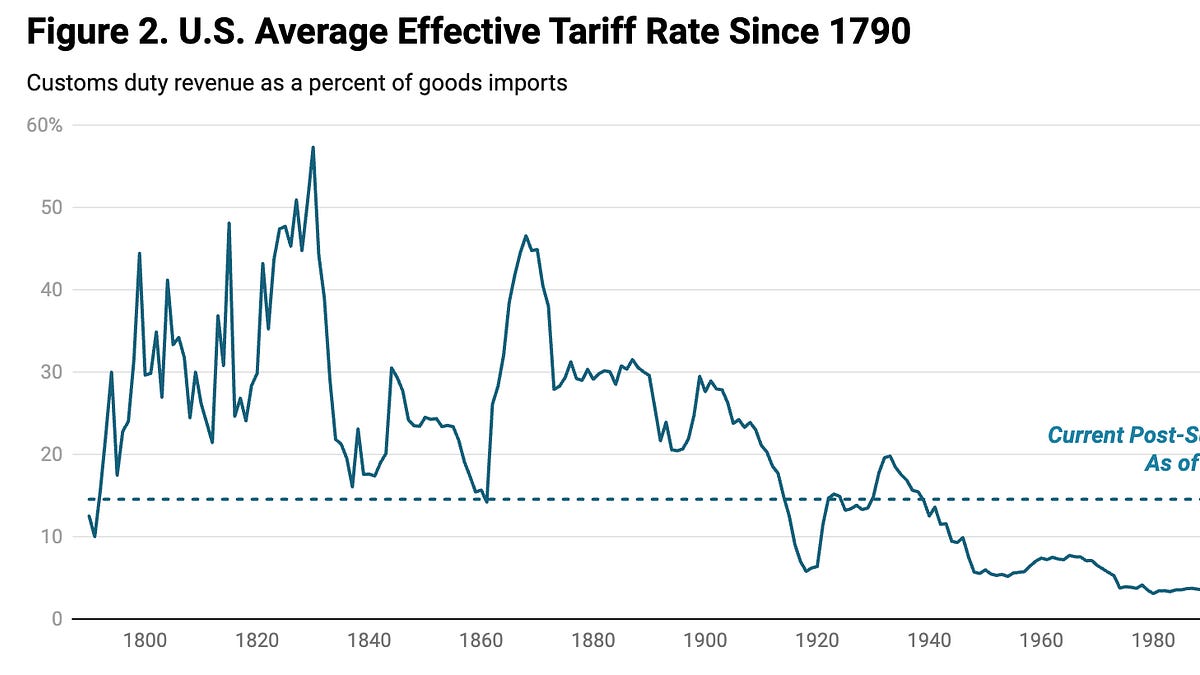
Although one quite often sees news reports suggesting that Trump has backed down on tariffs, you can’t see that in the average tariff rate, which remains just slightly below what it was in the aftermath of the infamous Smoot-Hawley tariff of 1930:

[Source](https://budgetlab.yale.edu/research/state-us-tariffs-june-1-2025).
Also, Smoot-Hawley came after generations of high tariffs. The Trump tariffs represent a sudden jump from quite low tariffs just a few months ago. Furthermore, imports as a percentage of GDP are about three times what they were in 1930. So Trump’s tariffs are by far the biggest trade policy shock in U.S. history.
A shock that big can’t help but have significant effects on the distribution of income. What does economic analysis have to say in general about such effects?
Clearly, tariffs can benefit specific industries that are protected from import competition. If you own a factory making lawn ornaments, your profits will rise if there is a new tariff on imports of plastic pink flamingoes. (Not an arbitrary example: My uncle was in that business.)
But can broader groups — say, workers without a college degree — benefit from tariffs? Supporters of free trade might be tempted to say something like this: “Well, tariffs might shift the distribution of income toward less-educated workers, but they also make the economy as a whole less efficient, so surely these workers end up worse off overall.”
That, however, is not what textbook international economics says. In 1941 Wolfgang Stolper and Paul Samuelson published a highly influential theoretical paper, “[Protection and real wages](https://academic.oup.com/restud/article-abstract/9/1/58/1588589),” that refuted this plausible-sounding argument. They modeled a country producing a mix of capital-intensive and labor-intensive goods — that is, goods requiring either a relatively high or a relatively low amount of capital per worker. And they showed that if this country was a net importer of labor-intensive goods, tariffs would increase workers’ real wages — not just relative to returns on capital, but in absolute terms.
In short, tariffs can, in principle, strongly affect the distribution of income across broad classes of society. And under certain circumstances tariffs can reduce income inequality — while tariff reductions, correspondingly, can increase inequality.
Notice my careful hedging about “certain circumstances.” As we’ll see, that’s a crucial qualification when it comes to the Trump tariffs. But the effects of tariffs on inequality depend on the details. They can’t be deduced from general principles.
Stolper-Samuelson had a huge impact on international economic theory. It had much less effect on discussions of real-world trade policy over the next few decades, for reasons that would take me too far afield to discuss.
But Stolper-Samuelson came into its own after around 1980, as U.S. inequality began rising — and imports of manufactured goods from emerging markets were definitely one factor in that rise.
So can the Trump tariffs be seen as a way to reduce inequality? In practice, no — but that verdict requires some explanation.
*Can tariffs reverse the globalization shock?*
The character of world trade began to change in the 1980s. Until then, poorer, relatively low-wage countries basically sold agricultural and mining products to wealthy nations while buying manufactured goods in return. After about 1980, however, emerging market nations became major manufacturing exporters, initially of labor-intensive products.
China is the example everyone knows, but it was part of a broader picture. For example, in the early 1980s Bangladesh basically exported jute and products made from jute (such as burlap). Since then it has become an economy centered around clothing exports.
This change in the character of world trade reflected at least two developments. First, there were big policy changes in the developing world, as nations stopped trying to industrialize by producing for their small domestic markets and shifted to a strategy of industrialization through exports instead. Second, the worldwide adoption of standard-sized shipping containers — a seemingly prosaic innovation that changed everything — made it possible to break up the production of many manufactured goods into multiple stages, with the labor-intensive stages taking place in low-wage nations.
Did the surge in labor-intensive exports from emerging markets reduce the demand for less-educated labor in wealthier countries? Definitely — and honest economists, even those who were generally pro-globalization, admitted it at the time. Back in 1995, using data up through 1990, I [estimated](https://www.brookings.edu/wp-content/uploads/2016/07/1995a_bpea_krugman_cooper_srinivasan.pdf) that imports had raised the premium for college-educated workers by around 3 percent. An updated estimate by Bivens [doubled](https://www.epi.org/publication/standard-models-benchmark-costs-globalization/) that number. There are many assumptions involved in such calculations, but no real question that trade did have a significant effect on inequality.
But can the Trump tariffs reverse that effect? At this point we have to note a crucial qualification to Stolper-Samuelson: A tariff on labor-intensive imports can raise wages *if it leads to an expansion of labor-intensive production*. After all, the only way tariffs can raise anyone’s wages is if they lead to an expansion in employment.
And the Trump tariffs are unlikely to do that, because at this point highly labor-intensive production in the United States won’t be competitive even with very high tariffs. Take the example of apparel, which is now almost the sole support of the Bangladesh economy and is the classic example of a labor-intensive import. Apparel production, aside from high-end specialty items, has basically ended in America:
s_!fVbP!,w_1456,c_limit,f_auto,q_auto:good,fl_progressive:steep/https%3A%2F%2Fsubstack-post-media.s3.amazonaws.com%2Fpublic%2Fimages%2F915f8cb6-1c70-4b10-b619-69bfb03f6d9b_800x450.png)
And even the 37 percent tariff Trump initially proposed on Bangladesh won’t bring it back.
What about labor-intensive components of the value chain? Howard Lutnick, the commerce secretary, has said that
The army of millions and millions of human beings screwing in little screws to make iPhones — that kind of thing is going to come to America.
No, it isn’t.
There are some goods that we both import and produce domestically in substantial quantities, notably cars, steel and aluminum. But these aren’t labor-intensive sectors! So tariffs on these goods, while they will raise costs and consumer prices, are unlikely to reduce inequality.
The bottom line is that while tariffs can in principle reduce inequality by increasing production of labor-intensive goods, the Trump tariffs in practice just aren’t going to do that.
Can tariffs reverse the China shock?
China is the biggest of the developing countries that began exporting labor-intensive products to the West. That may actually be less of an issue now than it used to be, because China’s wages have risen and its production has moved upscale (although that raises other concerns.) But the very rapid growth of Chinese exports between the late 1990s and roughly 2010 created a different kind of inequality problem, usually referred to as the “China shock” after work by Autor, Dorn and Hanson.
According to ADH, the rapid rise of Chinese exports displaced 1-2 million U.S. manufacturing jobs over the course of around a decade. That’s actually not a big number for a huge, dynamic economy. In America, around 1.7 million workers are laid off or fired every month.
But as ADH documented, these job losses were very unevenly distributed across regions, with particular manufacturing clusters hit very hard. My favorite example is the furniture industry, which didn’t face much import competition until the Chinese entered the game, but then proceeded to lose hundreds of thousands of jobs:

Again, that’s not a huge number from the national point of view. But the U.S. furniture industry was largely concentrated in the North Carolina piedmont, and the import surge was devastating for small cities like Hickory.
So again, imports increased inequality — in this case geographical inequality, contributing to the problem of left-behind regions. But will the Trump tariffs do anything to reverse that shock?
Again, that seems unlikely. It’s hard to see how the tariffs could bring back the North Carolina furniture industry.
Furthermore, the China shock, while dramatic — and, mea culpa, largely unforeseen even by economists who took the effects of trade on income distribution seriously — mostly happened before 2010. Since then some communities have transitioned to other industries, while some have gone into long-term decline. Workers have moved on, or aged out of the labor force.
Maybe we could and should have done more to mitigate the effects of the China shock as it was happening. But high tariffs imposed in 2025 aren’t going to recreate the industrial landscape of 2005. If anything they just impose another set of disruptions.
The point is that while imports from emerging markets surely did contribute to rising inequality in the 1980s and 1990s, and possibly into the 2000s, the Trump tariffs won’t reverse that history. To a first approximation I would argue that the tariffs won’t have much effect on the inequality of market income — income before taxes and transfers — either way.
Which is not to say that the tariffs will have no effect on inequality. For tariffs are taxes, which will affect the inequality of income *after* taxes and transfers. And they will clearly make this inequality worse.
*Tariffs as regressive tax policy*
A tariff is a selective tax on consumption — selective in that it only taxes consumption of imported goods. Nonetheless, it is a consumption tax on households. And consumption taxes are generally regarded as regressive, falling more heavily (as a percentage of income) on low-income than high-income households.
I actually have some mild qualms about that assessment, which I’ll get to in a minute. But these qualms don’t undermine the main point, which is that if we consider the impact of the Trump tariffs on income after taxes and transfers, they clearly *increase* inequality.
Here’s another useful chart from the invaluable team at the Yale Budget Lab, combining the effects of the Trump tariffs and the One Big Beautiful Bill Act on after-tax-and-transfer income by decile (the black dots show the net effect):
s_!pd2F!,w_1456,c_limit,f_auto,q_auto:good,fl_progressive:steep/https%3A%2F%2Fsubstack-post-media.s3.amazonaws.com%2Fpublic%2Fimages%2Fefcd7afd-941b-4941-a5e7-3c18678206b4_1812x1072.png)
This is a huge redistribution of income from the poor to the rich, probably the biggest such redistribution in U.S. history. And as you can see, the tariffs are an important part of that redistribution, turning a 4 percent income decline for the bottom decile into a 6.5 percent decline while having little effect at the top.
The reason tariffs hit the poor so much harder than the rich, in this analysis, is that low-income households consume a much larger fraction of their income than high-income households. The Budget Lab draws on an analysis by Clausing and Lovely, which includes this chart:
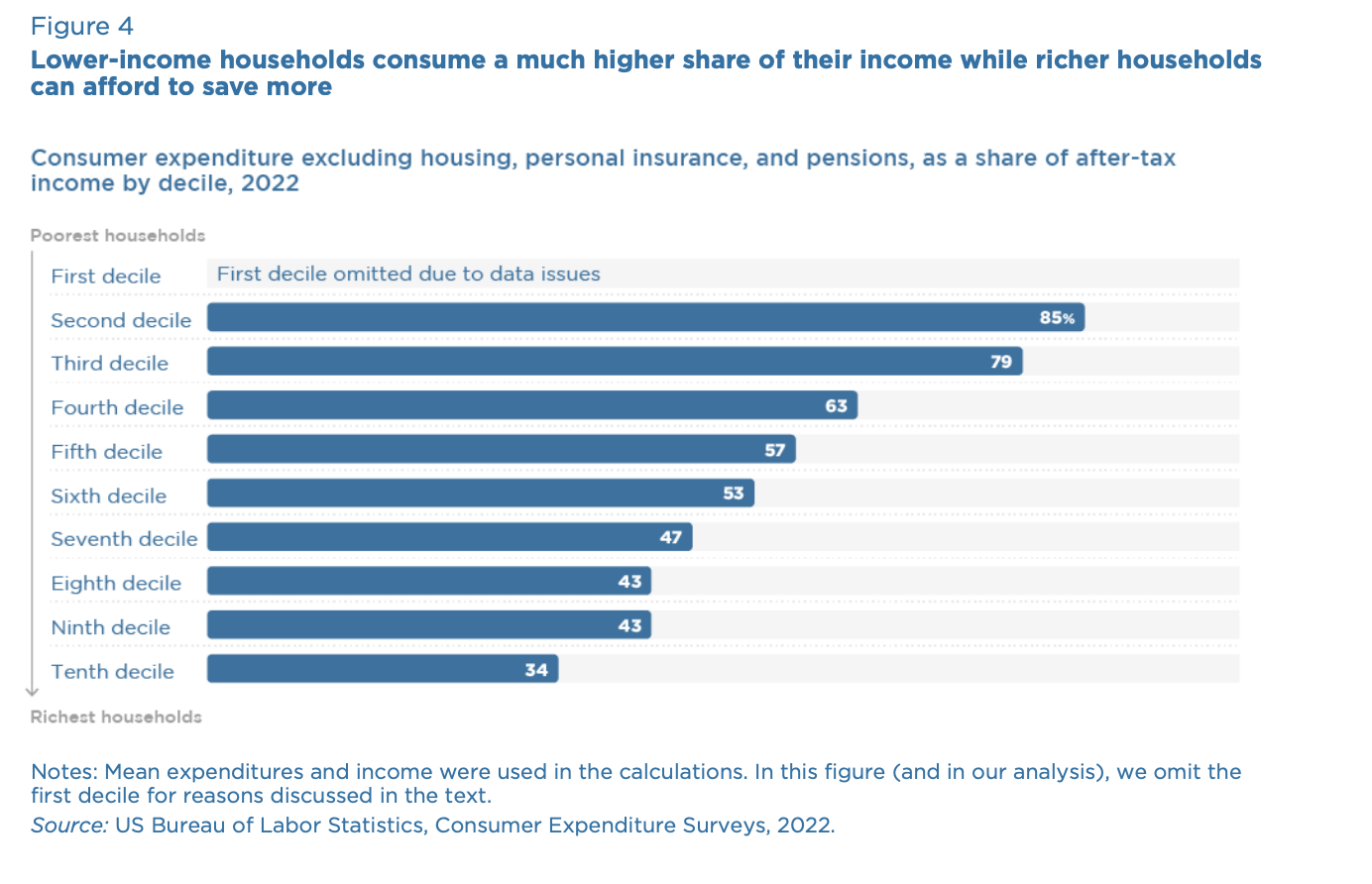
OK, now for my qualms. Why is there such a strong relationship between household income and the share of that income spent on consumption? Long ago Milton Friedman argued — and this happens to be an argument I agree with — that it is at least partly a statistical illusion. In general, Friedman argued, consumer spending is based largely not on one year’s income but on what he called “permanent income,” something like the annual income a family can normally expect to have over a fairly extended period of time. Five years? Ten years? Whatever.
And here’s the thing: If you take a snapshot of income and spending in a single year, the bottom 10 or 20 percent of households will contain a disproportionate fraction of people having an unusually bad year, while the top group will contain a lot of people having an unusually good year. So the correlation between income and consumption shares would be much less if we averaged over a longer period, which in turn means that tariffs and other consumption taxes aren’t as regressive as they may at first appear.
There’s a lot more to say here, but let me hold off, because it basically doesn’t matter. Why?
Because even if tariffs aren’t quite as regressive as they may seem on casual observation, Trump and co are claiming that tariff revenue will offset the revenue losses from their big cuts in other taxes. And while the offset will be much smaller than they imagine, the fact is that at least mildly regressive tariff hikes that hurt the poor are being used to help finance extremely regressive tax cuts for the rich. Put the two together, and we’re looking at policies that will greatly increase inequality.
Bottom line: Trump’s tariffs won’t reduce inequality before taxes and transfers. But they’re part of a policy mix that will greatly increase inequality after taxes and transfers.
Populism!
Write a comment