Understanding Trump’s Budget Proposal
Still in the Netherlands, and I may write a letter from Europe tomorrow if I can get my computer, which is refusing to charge, fixed. Today, however, I wanted to write about the so-called “skinny budget” the White House just released. It will be a bit truncated because my battery is running down!
To be clear, this budget was only a proposal, and it’s unlikely that what Congress eventually passes will involve spending cuts as savage as those the Trump administration wants. But like all budgets, Friday’s document was a statement of values and priorities, and federal spending will surely move in the direction it points.
My own values and priorities are no secret, and I found this budget horrifying. But for today let me try to be relatively analytical, although I won’t hide my views. Beyond the paywall I’ll try to answer four questions:
1. This budget only addresses “discretionary spending,” with all of the big cuts concentrated on “nondefense discretionary spending” (NDD). What does that mean, and how does it fit into the overall fiscal picture?
2. Why is NDD singled out for big cuts?
3. Why are some pieces of NDD cut so much, while other kinds of spending are left intact or even increased?
4. Is this budget fiscally responsible?
NDD in the budget
Economists tracking consumer behavior often distinguish between spending on essentials like food and housing and discretionary spending — spending on things like restaurant meals and new cars that families can live without, at least for a while. You might be tempted to think that the word “discretionary” means the same thing when applied to government spending. But it doesn’t.
What the budgetary distinction between “mandatory” and “discretionary” refers to, instead, is the process that determines spending — whether it’s bottom-up or top-down.
Mandatory spending is spending determined by longstanding rules about who is entitled to what (which is why we talk about “entitlement programs”). Congress doesn’t budget a certain amount of money to give to retirees and another sum to spend on their health care each year. Instead, each individual’s Social Security benefits are determined by a formula that sets payments based their average past earnings, while Medicare pays for seniors’, um, medical care, whatever it costs.
So total budget outlays on Social Security and Medicare aren’t determined by the amount Congress decides to spend in any given year. Instead, they sort of bubble up from rules about who gets what. Congress can, of course, change those rules, but that doesn’t happen often and is politically very controversial.
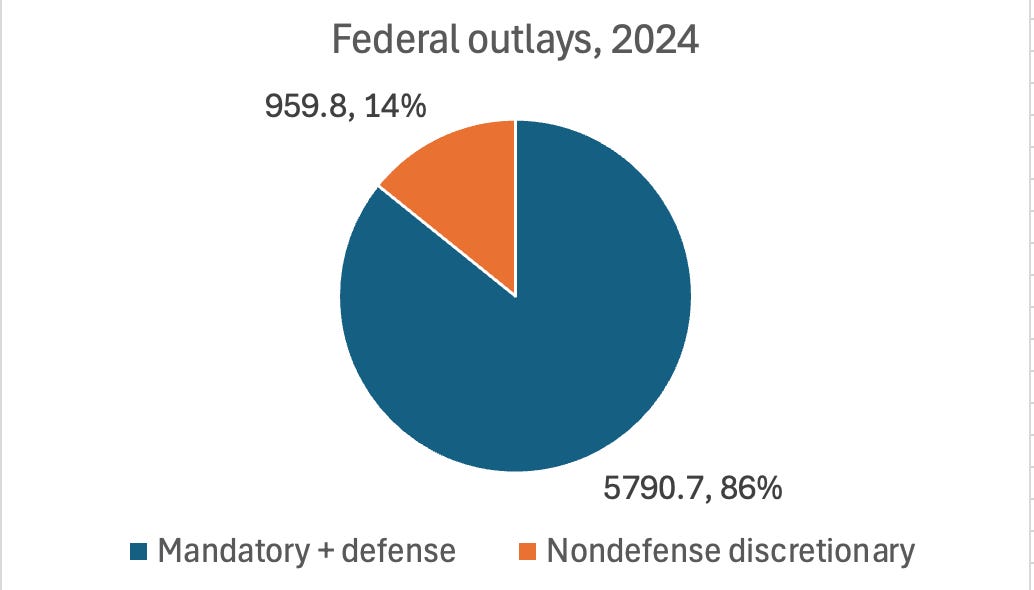
Discretionary spending, by contrast, is top-down. For example, last year Congress allocated $45 billion to the National Institutes for Health. If the Trump proposal were adopted, we would cut that to [\(27 billion](https://whitehouse.gov/wp-content/uploads/2025/05/Fiscal-year-2026-discretionary-budget-request.pdf#page=14). So the distinction between mandatory and discretionary is about the budget process rather than what the money is spent on. In practice, however, the mandatory/discretionary divide does correspond roughly to a distinction in purpose too. In my [first post](https://paulkrugman.substack.com/p/the-fraudulence-of-waste-fraud-and) after reviving this Substack, I repeated the old line that the U.S. government is basically an insurance company with an army. It turns out that mandatory spending roughly corresponds to spending on the social safety net. It’s dominated by Social Security, which provides income in retirement, Medicare and Medicaid, which are government-provided health insurance, and, a smaller segment, “income security,” which includes unemployment benefits, part of the Earned Income Tax Credit, and other items. The mapping from mandatory spending to the safety net isn’t perfect. Some safety net programs like LIHEAP, which helps low-income families pay energy bills, depend on annual allocations from Congress and therefore are considered discretionary. But in monetary as opposed to human terms these are relatively small change. So *is* the federal government an insurance company with an army? Basically yes, where by “basically” I mean 86 percent. Here’s the composition of federal outlays in 2024 (in billions of dollars): s_!5c_X!,w_1456,c_limit,f_auto,q_auto:good,fl_progressive:steep/https%3A%2F%2Fsubstack-post-media.s3.amazonaws.com%2Fpublic%2Fimages%2F256360be-35c5-4cd9-b078-5298bec43e90_1034x590.png)
Source: Congressional Budget Office
Mandatory spending (including interest on the national debt) accounted for almost three-quarters of spending last year. Defense spending accounted for almost half of the remainder. Federal spending that didn’t go either to social insurance or to the military — nondefense discretionary spending — is only 14 percent of the total.
Why, then, did Friday’s budget proposal — and all of DOGE’s efforts — focus on this relatively small slice?
Why does NDD get singled out for cuts?
People who worry about America’s fiscal sustainability and know what they’re talking about generally focus on mandatory spending (and increased revenue), because that’s where the money is. During the high tide of the deficit scolds, a dozen years ago, we constantly heard about the need for “entitlement reform,” a euphemistic way of saying cuts in Social Security, Medicare and Medicaid.
Republicans in Congress may yet pass a budget that imposes savage cuts in Medicaid — and I expect to be writing about that a lot. The Trump administration, however, has been completely focused on slashing nondefense discretionary spending, even though it’s only a small slice of the budget. DOGE’s search for waste has somehow ignored overpayments to Medicare Advantage plans, which the Committee for a Responsible Federal Budget (more about them later) predicts will cost taxpayers \(1.2 trillion over the next decade. How much does the administration want to cut NDD? The proposal released Friday calls for a 22% cut, which would bring that form of spending, measured as a share of GDP, to its lowest level by far in modern history: s_!NmK3!,w_1456,c_limit,f_auto,q_auto:good,fl_progressive:steep/https%3A%2F%2Fsubstack-post-media.s3.amazonaws.com%2Fpublic%2Fimages%2F433e4565-d4ef-4811-942d-04b93343c09d_1382x916.png)
Source: New York Times
Notice, by the way, that this estimate comes from Bobby Kogan of the Center for American Progress, who I spoke to last week.
Cuts that deep won’t actually happen, because they aren’t feasible. Even Republicans in Congress realize that there’s only so much blood you can squeeze out of a stone, that the level of cuts Trump officials are proposing would cripple essential government services. But there will probably be large cuts that do great damage even though, as I’ll explain later, they will do little to reduce deficits in the short run and probably make them worse in the long run.
The thing is, a misplaced focus on discretionary spending isn’t new. Some readers may remember when Paul Ryan, with his “plan” (which was more a concept of a plan) to balance the budget, was the darling of the Very Serious People. Well, his numbers depended on extreme cuts to nondefense discretionary spending, not too different from the new Trump proposal. When Republicans forced budget austerity after taking control of the House in 2010, it came entirely in the form of a squeeze on discretionary spending.
Again, why go where the money isn’t? I’ll get to Trump-specific issues in the next section, but there’s a generic reason right-wingers focus on NDD rather than Social Security or Medicare: The harm done by spending cuts is less visible to voters.
To cut Social Security, politicians would have to reduce the monthly checks seniors receive — and there would be mass public outrage. To cut Medicare, they would have to deny coverage for some medical procedures, creating a political firestorm. Even Medicaid cuts will generate a large backlash once voters realize that it’s not just a program for urban people of color.
But most people don’t have a clear picture of what cuts in discretionary spending — a complex mix that defies easy summary — would mean.
In fact, I’d argue that this is a general problem with discretionary spending: Politicians who want to hold down overall spending are often tempted to reduce spending that doesn’t provide direct benefits to voters because they don’t think anyone will notice.
To take a non-U.S. example, part (though not all) of the problem with Britain’s National Health Service is that, unlike insurance programs like Medicare, it provides universal coverage but is supposed to do so with whatever amount of money it is allocated. Austerity-minded governments have always been tempted to squeeze the NHS budget in the belief that it will manage to carry out its mission anyway, which is true until it isn’t, and suddenly British health care is in crisis.
As a result, politicians who want to make cuts always focus on discretionary spending. But the Trump cuts are also shaped by this administration’s particular prejudices.
The animus (animuses?) behind the Trump cuts
The Trump proposal cuts nondefense discretionary spending by 22%, but it isn’t evenly distributed. Some agencies, like the Federal Aviation Administration, are slated for modest increases. Other agencies, like multiple agencies helping poor countries develop, would be eliminated, as would LIHEAP, which I mentioned earlier.
As I mentioned above, Trump’s people are calling for a roughly 40 percent cut in funding for the National Institutes of Health. They’re also proposing a 56 percent cut to the National Science Foundation, and big cuts to research funding elsewhere in the government.
I won’t try to analyze these cuts in detail, just observe that there are two clear themes determining what faces large cuts.
First, the budget removes almost anything that hints at empathy toward people in difficulty, be they citizens of poor countries or U.S. citizens living in poverty. Bear in mind that Elon Musk has said that empathy is “the fundamental weakness of Western civilization.” OK, he claims to be empathetic himself, but do you believe him? And his disdain for empathy is clearly shared by Trump and many in his administration.
Second, the budget proposal takes aim at science. It’s especially harsh on research that might affirm climate change or the usefulness of vaccines, but there’s a clear hostility to science in general. As I wrote last week, MAGA wants to keep its prejudices, and hates anything that might force it to consider the possibility that it’s wrong.
And we’re talking about really massive cuts. As I said Friday, we’re arguably looking at the destruction of the whole edifice of US science, not some time in the future, but right away.
Is this in the national interest?
Is this responsible fiscal policy?
Earlier I mentioned the Committee for a Responsible Federal Budget. The CRFB issued a statement about the new Trump proposal, which basically endorsed it while calling for more:
Though this is not a full budget, we are encouraged that the Administration put forward a partial plan that includes discretionary spending reductions.
Did they read any of what the administration put out? Did they look at any of the numbers?
This is, in fact, an incredibly irresponsible budget proposal. It might save some money in the very short run, but not much, because discretionary spending is where the money isn’t. Beyond that, the cuts would reduce US economic growth and ultimately even increase the budget deficit, because lower growth means lower revenue.
This is obviously true for the cuts to science funding. American leadership in science is one of the pillars of our economic success. Tearing that pillar down is willfully sacrificing one of our key strengths. Some of the costs will come quickly, as foreign students stop coming to America and global businesses invest in places that aren’t hostile to knowledge.
Even humanitarian spending serves American interests. Foreign aid is a key tool promoting U.S. influence. Helping poor families within our country isn’t just the decent thing to do, it’s an investment in our future, because children who have adequate nutrition and medical care grow up to become more productive adults.
So policy is taking a disastrous turn, which worries me more than tariffs.
Now to see whether I can get my laptop fixed.
Write a comment