What Deindustrialization Can Teach Us About The Effects of AI on Workers
In 1952 Kurt Vonnegut published Player Piano, a cautionary tale about the social consequences of automation. In his vision, pre-programmed machines would eliminate the need for workers, leading to a society plagued by mass unemployment and anomie.
He was basically right about technology. We haven’t done away completely with the need for human workers in manufacturing, but U.S. manufacturing produced almost 10 times as much in 2024 as it had in 1947 while employing 10 percent fewer workers.
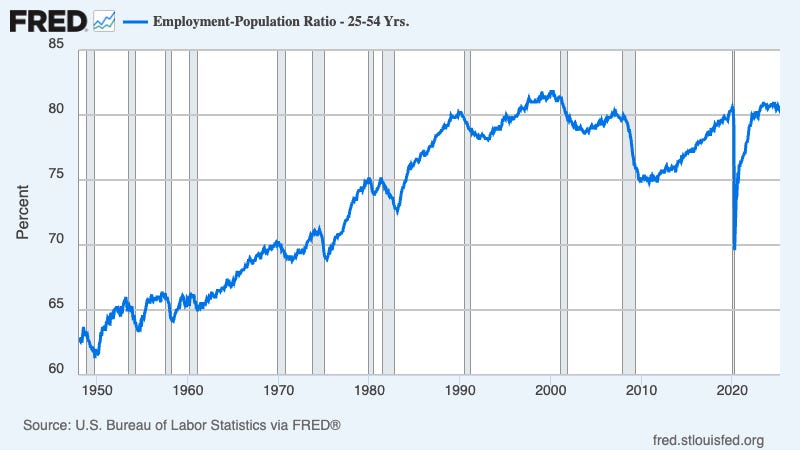
But he was completely wrong about technological progress causing mass unemployment. More than 70 years after Player Piano, the percentage of Americans in their prime working years with jobs was far higher than when he wrote:

True, this was largely because far more women entered the paid work force. But the important insight is that despite automation the vast majority of Americans seeking jobs continued to find them.
This may seem like a debate about history. But much of what Vonnegut and others said in the 1950s about the devastating effects automation would have on workers is echoed, almost word for word, in what many people are saying now about the employment effects of AI. Now as then there are pervasive warnings of a job apocalypse that will leave much of the population surviving, if at all, on government handouts.
Yet fears that technology can destroy *some* jobs aren’t misguided. In fact, last week I argued that technology-driven productivity growth, rather than globalization, is the main reason employment in manufacturing has declined from around 30 percent of the work force in the 1950s to less than 10 percent today.
But while technology can and has destroyed some jobs, even whole occupations, it has never led to mass unemployment. And it probably never will, because other jobs have always emerged to replace those that have been lost. This phenomenon of technology-induced job creation alongside job destruction is inherent in the logic of how the economy works.
Which is not to say that no one is hurt in the process. Technological progress — like international trade — makes the economy richer as a whole but often makes some people, possibly millions of people, worse off. That is, overall incomes may rise, but there are almost always losers as well as winners. And it’s a policy choice whether to use some of the economy’s increased bounty to help some of those who are hurt.
So today’s primer will build on last week’s history of deindustrialization and globalization as a model for how to think about the likely future effects of AI on American workers.
Beyond the paywall I’ll address three issues:
1\. The history of technology and deindustrialization in America since World War II
2\. Why technological progress doesn’t cause mass unemployment
3\. Who is hurt by technological progress and why
*Technology and deindustrialization: The long view*
There was never a time when a majority of Americans worked in factories. Yet in 1952, when Vonnegut wrote *Player Piano,* the manufacturing sector employed almost a third of American workers, three times the current share. So why did American workers stop producing manufactured goods?
That’s a trick question, because they didn’t. As I’ve already mentioned, manufacturing output — measured by real value-added — was almost 10 times higher in 2024 than in 1947. In fact, over the long term manufacturing output has grown about as rapidly as overall GDP:
s_!n7ER!,w_1456,c_limit,f_auto,q_auto:good,fl_progressive:steep/https%3A%2F%2Fsubstack-post-media.s3.amazonaws.com%2Fpublic%2Fimages%2Fbcb0692a-cfaf-4dd8-8b2c-e6d6438909a3_1126x664.png)
Source: Bureau of Economic Analysis
Yet manufacturing employment hasn’t grown at all, in fact has declined slightly, even as overall employment has more than tripled:
The second objection is that this is just theory. How do we know what will happen in practice?
As it happens, however, I wrote that essay almost 30 years ago, and since then there has been a widening of productivity growth to the service sector. For example, output per worker-hour has risen 140 percent in retail trade (think scanners at cash registers and the huge improvements in inventory management this kind of electronic data flow makes possible.) Overall, service-sector productivity has risen 48 percent since 1997, but that hasn’t destroyed jobs: service-sector employment has risen 28 percent.
So we’ve had a lot of technological progress all across the economy, without a hint of widespread technological unemployment. And there’s no reason to believe that the story of AI will be any different.
Which is not to say that no one will be hurt.
Losers from technological progress
The Luddites have gotten a bad rap. The term “Luddite” has come to mean someone mindlessly opposed to technological progress in general. But the original Luddites were skilled workers — especially weavers — whose hard-won skills were abruptly devalued by new technologies like the power loom. While they weren’t blindly opposed to progress, they were trying to defend their real interests.
In practice there are almost always groups within a society — sometimes large groups — who are hurt by new technologies.
Consider the fate of translators. Translation is or was a highly skilled profession, and in general fluency in multiple languages was an advantage in many careers. But machine translation was one of the early success stories of big data, and the available evidence suggests that both the demand for human translators and the perceived value of foreign-language skills have plummeted.
Broader groups have also been affected by AI. Remember “learn to code”? This was a popular slogan in the 2010s, and quite a few people invested time and resources into developing what they imagined to be the skill of the future. But coding is one of those tasks that AI does quite well. As a result the economy is going to need a lot fewer coders, and the financial payoffs to skill in coding will be considerably smaller than expected.
Technological progress can even hurt broad classes. In the 1980s and 1990s many economists attributed rising inequality to “skill-biased technological change” that increased the demand for workers with college degrees while reducing it for those without. Many economists have since become more skeptical, but it was certainly a possible story.
Consider the early stages of the Industrial Revolution. Britain was clearly becoming much richer as it industrialized, in fact experiencing the most rapid economic growth in world history to that point. But most, maybe even all the gains went to the new class of industrial capitalists, because Britain was clearly experiencing “capital-biased technological change” that favored factory owners over workers. David Ricardo, whose 1817 Principles of Political Economy arguably did more to create modern economics than Adam Smith’s Wealth of Nations, included a chapter, “On Machinery,” in his third edition that can be seen as an early acknowledgement of this potential problem.
There is an intricate debate over whether the soaring inequality caused by biased technological change was so great that ordinary workers actually lost ground — whether real wages actually fell even as the economy grew richer. I am not competent to referee that debate. But the mere fact that we can argue this point shows that the initial gains from technology were very unevenly distributed.
And yes, there’s a clear parallel with modern debates about soaring U.S. inequality since around 1980. Did a few people at the top grab so much of the gains that ordinary workers lost ground? Probably not, but the fact that we can even ask that question is telling.
So yes, technological progress can and usually does hurt some workers, maybe even large groups of workers. But it has never caused mass unemployment. And in trying to devise policy, we should think about how to limit the harm to unlucky groups rather than worrying about a Player Piano dystopia.
What are my own ideas on that score? This post is already too long. So you’ll have to wait for next week..
Write a comment