Women, Men and Jobs
Last week I published two posts inspired by the murder of Charlie Kirk. Both focused on one key part of his message and, I’d argue, his appeal: gender politics. Kirk passionately advocated a return to long-gone traditional gender norms, in which women married early and focused on having children, not on building careers. That is, he wanted to reverse the “quiet revolution” in women’s lives identified by Claudia Goldin, in which young women’s decisions about education and work began to resemble those of young men.
Let me acknowledge that Kirk’s message wasn’t just about women. He was demeaning towards people of color, wanted to destroy the separation between church and state, attacked trans people, and was an absolutist on gun ownership despite our rising toll of gun violence. By not discussing the many ways in which Kirk tried to infuse polarization and exploit bigotry in our body politic, I am not attempting to airbrush his record. Because this post isn’t really about Kirk; rather, it’s about the relevance of Kirk’s views about gender roles and work and how that was a part of his appeal to his audience.
Kirk generally framed his arguments as being aimed at women themselves, arguing that their lives would be happier and more fulfilling if they lived the way their mothers had. But his support came largely from resentful young men, many of whom feel that society isn’t offering them the opportunities they deserve. And many of them blame women.
As I noted in my earlier posts, it is true that men in America are in trouble. In particular, there has been a striking rise in the number of prime-working-age men not in the labor force. And I also explained that neither Donald Trump’s nor Kirk’s prescriptions would improve the lot of men. In fact, Trump’s economic policies are making them worse off.
Today’s primer will offer a broader, more analytical discussion of the phenomenon of men not working. I’ve never done research on this subject, but I’ll try to draw on others’ work. Also, gender issues in employment are closely related, intellectually, to issues in two fields I have worked in: the economics of declining regions and the economics of immigration.
Beyond the paywall, I’ll address the following:
1. How many men aren’t working, and who are they?
2. Why do we care? Specifically, why are non-working men a bigger problem than non-working women?
3. The obvious, politically charged question: Are men’s problems the flip side of the rising economic role of women? (Spoiler: no.)
4. Why are fewer men working?
5. What can policy do to address the worsening problem of non-working men?
Men not working
What do I mean by saying that many men aren’t working? That may seem obvious, but there are actually two alternatives. By “working” we could mean literally having a job, or we could mean either having a job or actively searching for a job (which is how the statistics define the labor force.)
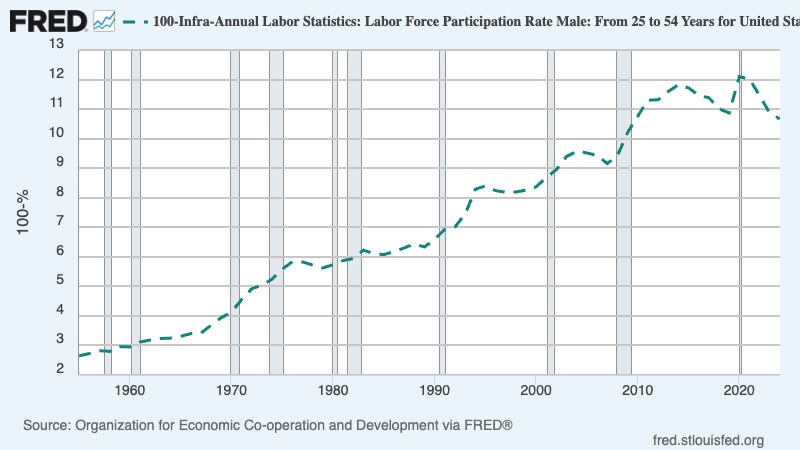
For this post I prefer to look at men who aren’t either working or actively job-searching, because this definition makes the extent of the transformation starkly apparent. Here’s the percentage of men aged 25-54 not in the labor force (that is, neither working nor job-searching):

In the 1950s only a tiny fraction of men in their prime working years — around 2.5 percent — were out of the labor force. That percentage has now more than quadrupled, to around 11%. That is, more than 1 out of 10 men of prime working age are neither employed nor looking for work.
Who are these non-working men? There was an extremely useful survey by [Binder and Bound](https://pmc.ncbi.nlm.nih.gov/articles/PMC7745920/) in the 2019 Journal of Economic Perspectives, which included the following chart:
s_!zqcW!,w_1456,c_limit,f_auto,q_auto:good,fl_progressive:steep/https%3A%2F%2Fsubstack-post-media.s3.amazonaws.com%2Fpublic%2Fimages%2F9b711253-fb28-4d0f-94bd-8845e0af2045_1430x1045.png)
Source: Binder and Bound
This chart is a bit busy, because it distinguishes between all men (solid lines) and native-born (dashed lines). But the basic point should be clear: The rise in the number of non-working men is overwhelmingly, although not entirely, accounted for by men with lower levels of formal education. This is important for understanding the causes of this disturbing trend.
Binder and Bound also ask an interesting question: What are these non-working men living on? Some are receiving government aid via disability insurance. Mostly, however, they’re being supported by “cohabitants”: Typically they’re living with their parents, or relying on income earned by their wives or other partners.
I find this a disturbing picture, and my guess is that most readers feel the same way. But it’s worth asking why it’s so troubling.
Why are non-working men a problem?
Last week I gave a talk to students describing the issues covered by this primer, and some of them asked a good question: Why view non-working men as a bigger problem than non-working women?
My short answer is that not working is more demoralizing and has more adverse social consequences for men than not working does for women. This isn’t a value judgment, a statement that men matter more (which I definitely don’t believe) just an empirical observation. And I won’t try to judge whether we’re talking about social norms that may change over time or about something inherent in the biological differences in the sexes. Maybe we will someday have a society in which being a man in his prime working years but not having a job doesn’t greatly damage one’s dignity, one’s self-esteem. But that’s not the society we have now.
Scholars have emphasized the social importance of job opportunities for men for many decades. I’m old enough to remember when social disarray and rising crime in inner cities was widely attributed to a culture of poverty and, sotto voce, to racial inferiority of Black Americans. But the sociologist William Julius Wilson, in his magnum opus When Work Disappears, made a strong case that social dysfunction was downstream from the disappearance of jobs for men as industry moved out of city centers.
If Wilson’s thesis was right, you’d expect to see rising social dysfunction in white, rural and small-town America as a changing economy caused jobs for men to disappear in much of what Austin, Glaeser and Summers called the “eastern heartland.” And that’s exactly what happened. Here’s their map showing where a high fraction of prime-aged males were not working in 2015:
 And here’s a map showing the rates of what Anne Case and Angus Deaton call [deaths of despair](https://press.princeton.edu/books/hardcover/9780691190785/deaths-of-despair-and-the-future-of-capitalism?srsltid=AfmBOoqwzJtKoeDYWutF8odeSdAwu4_TilptRgYQSL-zgIhkT4mk5GcJ): deaths from suicide, opioids and alcohol, with darker colors indicating a higher rate of such deaths: s_!vYfo!,w_1456,c_limit,f_auto,q_auto:good,fl_progressive:steep/https%3A%2F%2Fsubstack-post-media.s3.amazonaws.com%2Fpublic%2Fimages%2F9a9fe4b3-14a1-4c8c-bfc4-8ec62bf14cb1_1430x620.png](https://substackcdn.com/image/fetch/\(s_!7hg1!,w_1456,c_limit,f_auto,q_auto:good,fl_progressive:steep/https%3A%2F%2Fsubstack-post-media.s3.amazonaws.com%2Fpublic%2Fimages%2F04292e86-ffb4-40ab-aef2-2bdd9be992ba_1264x862.png)
Source: [Austin, Glaeser and Summers](https://www.brookings.edu/articles/saving-the-heartland-place-based-policies-in-21st-century-america/)
And here’s a map showing the rates of what Anne Case and Angus Deaton call [deaths of despair](https://press.princeton.edu/books/hardcover/9780691190785/deaths-of-despair-and-the-future-of-capitalism?srsltid=AfmBOoqwzJtKoeDYWutF8odeSdAwu4_TilptRgYQSL-zgIhkT4mk5GcJ): deaths from suicide, opioids and alcohol, with darker colors indicating a higher rate of such deaths:
s_!vYfo!,w_1456,c_limit,f_auto,q_auto:good,fl_progressive:steep/https%3A%2F%2Fsubstack-post-media.s3.amazonaws.com%2Fpublic%2Fimages%2F9a9fe4b3-14a1-4c8c-bfc4-8ec62bf14cb1_1430x620.png)
The correlation between non-working men and social disruption is obvious. As William Julius Wilson’s work would have predicted, the social disruption was a consequence of the lack of work.
Austin et al emphasized the problem of left-behind regions, which is very real, and advocated “place-based policies” to help those regions. But the issue of men without work, while most acute in places like Appalachia, is national in scope. What has caused it?
Did women do it?
Many young men were drawn to Charlie Kirk’s message that women should repudiate their career focus, reversing a phenomenon that Claudia Goldin documented in what she called the “quiet revolution” — between the late 1970s and early 1980s, women began pursuing careers in the same way that men did. Kirk advocated that women should return to their earlier role as wives and mothers first, wage-earners, if at all, only second. Many young men clearly found this message appealing because they believed that women’s career emancipation was responsible for their own frustrations.
But economic analysis doesn’t support that conclusion.
Interestingly, the economic considerations we should take into account when analyzing the role of women in the economy are similar to those we need to apply to immigration. Like immigrants, women expanded the size of the work force. Like immigrants, women differed from the incumbent work force in factors like education levels. But also like immigrants, women tend, even given their education level, to take different jobs from those taken by the incumbents. For example, women without a college degree are much more likely than men with the same educational level to work in health care and social services.
So let’s work down the list.
First, it’s crucial to understand that the number of jobs in the economy isn’t fixed. Total employment can and normally does expand to absorb increases in the number of willing workers. There was a huge rise in the prime-working-age population after 1970 — the blue line in the chart below — as the baby boomers grew up. It didn’t lead to a sustained rise in the unemployment rate, the dashed green line:
s_!7F9X!,w_1456,c_limit,f_auto,q_auto:good,fl_progressive:steep/https%3A%2F%2Fsubstack-post-media.s3.amazonaws.com%2Fpublic%2Fimages%2F837409bc-82cc-4c08-b029-ff40157ab67d_800x450.png](https://substackcdn.com/image/fetch/\(s_!N5fg!,w_1456,c_limit,f_auto,q_auto:good,fl_progressive:steep/https%3A%2F%2Fsubstack-post-media.s3.amazonaws.com%2Fpublic%2Fimages%2F422d8854-0233-42bb-954a-799fb858be55_800x450.png)
So everything we know about labor markets implies that the entry of women into paid work should have simply led to higher total employment. Women didn’t take away men’s jobs.
While total employment rises to meet absorb the higher number of willing workers, what can we say about the effect of new workers on *incumbent workers* – those who are already in the work force? The answer is that it depends upon the nature of the jobs the new entrants take. Specifically, it depends upon whether a new worker is a *substitute* for or a *complement* to an incumbent worker.
Here is an illustration of what I mean. Until the 1990s many economists, myself included, believed that immigrants with limited formal education were substituting for native-born workers. As a consequence, we thought that immigrants would put downward pressure on the wages of less educated native-born workers. Most of us changed our minds in the face of evidence that immigrants were taking very different jobs from native-born workers with similar education. This meant that they were complements, not substitutes, even for low-education native-born workers, and probably *raised* their wages. For example, more immigrants to pick fruits and vegetables translates into lower food prices and higher real wages for native-born workers.
The dynamics underlying the entry of large number of college-educated women in the workforce starting in the 1970s are similar. In the 1970s women began finishing college in large numbers and taking jobs that required a college degree. While these new female entrants competed with highly-educated men, they did not compete with less-educated men. Moreover, when women were not directly competing with highly-educated men, they were often employed in “gender-coded” professions such as nursing.
As in the case of large-scale immigration, the large numbers of women entering the labor force starting in the 1970s were generally complements, not substitutes, for less-educated men. And as complements, educated women should have raised the real incomes of less-educated men. For example, more highly trained nurses in the economy increases the living standards of less-educated men.
The bottom line is that while there are no doubt men who attribute their lack of job opportunities to women’s expanded role in the economy, that just doesn’t work as a coherent story.
*So what did happen?*
As I mentioned, I and others have put considerable effort into understanding the economic decline of the American heartland. And at this point the story seems clear. Beginning around 1980, the U.S. economy became increasingly oriented towards knowledge and services rather than manual labor and industry. This worked to the advantage of large metropolitan areas that already possessed highly educated work forces. Yet many small industrial towns and cities were damaged economically, stranded by economic change.
The same economic transformation also reduced the number of male-coded jobs while it increased the number of female-coded jobs. Below I have reproduced a chart from Thursday’s post:
s_!7F9X!,w_1456,c_limit,f_auto,q_auto:good,fl_progressive:steep/https%3A%2F%2Fsubstack-post-media.s3.amazonaws.com%2Fpublic%2Fimages%2F837409bc-82cc-4c08-b029-ff40157ab67d_800x450.png)
The share of employment in female-coded jobs like health care and social services, the blue line, has risen substantially in the past several decades, while employment in male-coded manufacturing, the dashed green line, has fallen dramatically.
It’s important to be aware that this phenomenon is not unique to the U.S. The percentage of jobs created by sectors that are male-coded – that disproportionately employ men without higher education – has declined in all advanced countries. Here, for example, is the share of industry (which includes construction and utilities as well as manufacturing) in Germany over time:
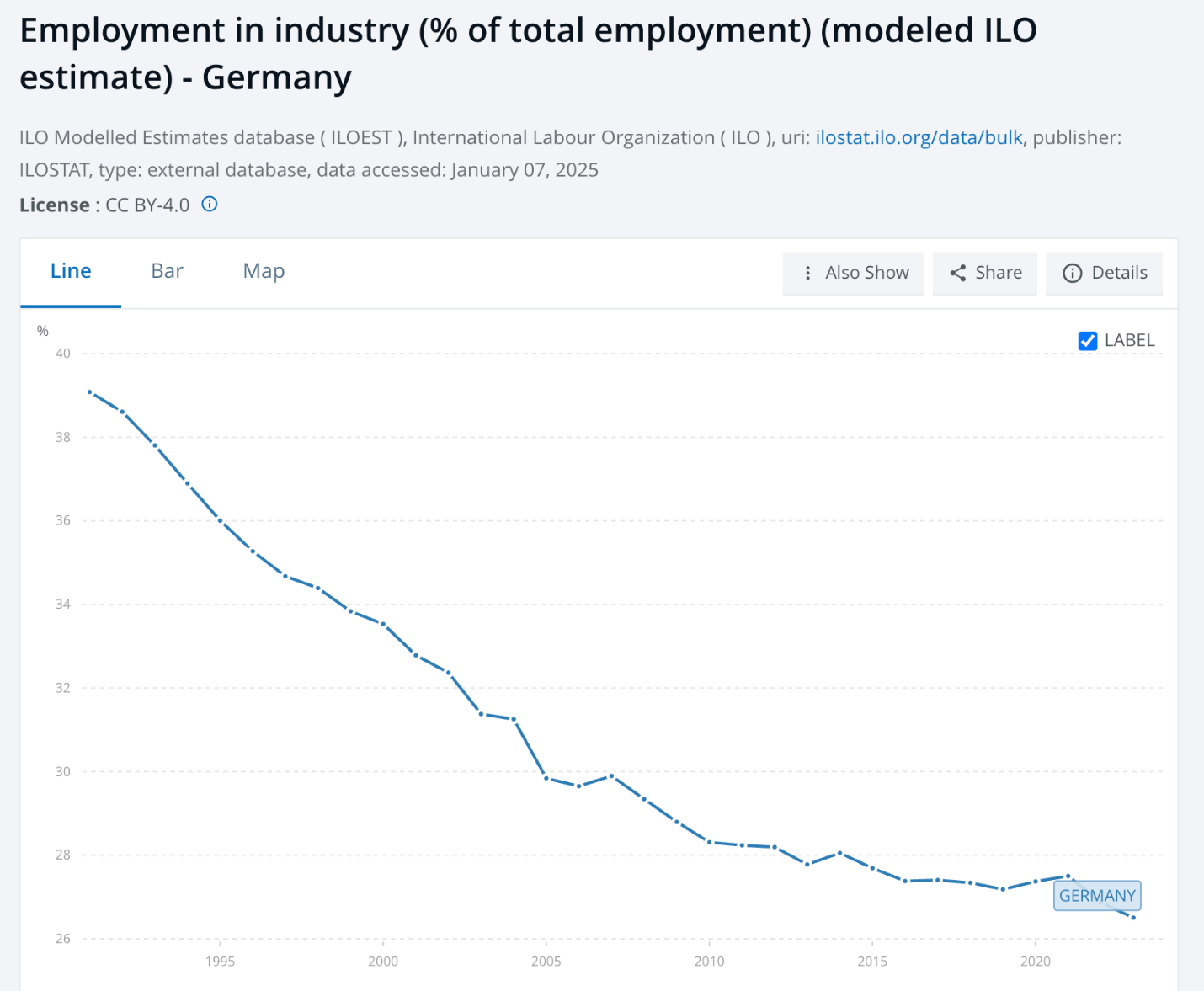

Source: World Bank
This decline has taken place even though Germany runs huge trade surpluses in manufactured goods. And that tells us a lot about what won’t work as a solution to the problem of men not working.
What can policy do to address the worsening problem of non-working men?
The phenomenon of men without work is an American tragedy. Never mind the money those men should be earning. The ultimate goal of an economy isn’t wealth, it’s well-being. And to be a man in his prime working years without a job is to be stripped of an important source of dignity.
But what can be done about it?
Donald Trump — who, incredibly, I haven’t mentioned to this point — actually has a fairly coherent answer: Bring back the “manly” jobs we’ve lost, mainly with tariffs that will eliminate our trade deficit in manufacturing.
Unfortunately, that won’t and can’t work. Even if Trump’s tariff strategy were coherent, even if it weren’t full of contradictions and dysfunctional measures that work at cross-purposes, even if it really could eliminate the trade deficit, it wouldn’t make much difference. Robert Lawrence of the Peterson Institute for International Economics has done the math (with a calculation very similar to my own back-of-the-envelope estimates), and finds that
even if the tariffs and other trade policies of the Trump administration eliminate the US manufacturing trade deficit by switching US purchases from foreign to domestic goods, the share of manufacturing employment in total US employment would increase by just 1.7 percentage points, from 7.9 to 9.7 percent, and the share of workers in production occupations in US manufacturing would increase by just under 0.9 percentage point, from 3.85 to 4.7 percent.
This matches up with the observation that even Germany, with huge trade surpluses, has seen a large decline in industrial jobs. The truth is that with modern production technology we just don’t need many workers producing manufactured goods, mining coal, etc. At the same time, we need many people providing health care and social assistance. Sorry, but the manly jobs of yore just aren’t coming back.
So what can be done? I’m not going to lay out a detailed policy agenda, but one way or another we need to expand the range of jobs men are able and willing to take. Many female-coded jobs pay too little; government aid and unions could help remedy that, making them more attractive to everyone. Some non-working men lack the skills needed for the jobs the changing economy is creating; measures like free community college and vocational programs could help remedy that.
It won’t be easy. But American men deserve real answers to their problems, not fantasies of turning the clock back 30 or 40 years.
Write a comment