Social media is turning into a freak show
Source: Social media is turning into a freak show Publisher: Silver Bulletin | Author: Nate Silver Published: April 5, 2026 | Archived: April 6, 2026
Substack Live on Trump/Iran Monday at noon
I needed a break today from writing about Iran, Trump, and/or basketball, so let’s talk about another of my favorite topics: social media.
However, I will be conducting a Substack Live with Galen Druke at 12 noon tomorrow (Monday), where we’ll discuss what increasingly looks like both a foreign policy and a political crisis for the White House. You can join us on the Substack App in real time, or I’ll send the video out to subscribers later.
I’m also taking questions for SBSQ #31, which I’m hoping to get to sooner rather than later.
FiveThirtyEight (re)launched under Disney/ESPN in March 2014. In retrospect, our timing wasn’t great. Despite various missteps, we were trying to deliver a differentiated, engaging, high-quality product. But this was probably the single period since the web rose to prominence when the quality signal was least well-rewarded.1
Publishers believed that maximizing “reach”, particularly as measured by the number of monthly unique visitors, was the key to success. It didn’t matter how long someone stayed as long as they visited your site, for any length of time, at least once during the month. And no platform provided more opportunities to trawl the ocean depths for potential customers than Facebook, which was then close to the peak of its influence. Entire businesses like Upworthy were premised on gaming the News Feed algorithm, often through peculiar clickbait headlines such as “You Won’t Believe What Happened Next”.
You will believe what happened next: it didn’t work. The whole period was like the Underwear Gnomes meme come to life. Phase 1: Collect lots of low-quality traffic from Facebook. Phase 2: ???. Phase 3: Pivot to video.
It didn’t help that Facebook was constantly tinkering with News Feed, and grossly exaggerating metrics like average time spent watching videos. But more fundamentally, it was locked into a zero-sum, adversarial relationship with publishers. Facebook wanted readers to stay within its walled garden, to spend as much time as possible on Facebook. Publishers, meanwhile, regarded Facebook as the equivalent of the Port Authority Bus Terminal: a miserable, liminal space where you’d hopefully spend as little time as possible before booking a one-way ticket out of town.
FiveThirtyEight eventually matured to the point where it got quite a bit of web traffic — our 2016 election forecast was literally the most “engaged-with” piece of content on the English-language Internet that year as tracked by Chartbeat.2 But we never got much traffic from Facebook. One of the major reasons for this, I later learned from talking with media friends who were much more successful at this stuff, was that Facebook tended to reward emotional sentiment in headlines: surprise and delight on the one hand, or outrage on the other hand. And that was pretty much exactly the opposite of our editorial goals at FiveThirtyEight. Instead, we wanted to encourage cool, analytical, nuanced reactions to things that people are ordinarily quite passionate about, such as electoral politics.
But every now and then, a FiveThirtyEight article would “go viral” on News Feed. When this happened, it seemed literally almost completely random. It wasn’t even particularly well-correlated with the headline. And it was inversely correlated with the depth and quality of the article. But here’s the thing: that “viral” traffic was almost worthless. A lot of it quite literally consisted of people who visited the site for 5 to 30 seconds, read a paragraph or two, and never returned.
Twitter, then also near the peak of its influence, was a comparatively better platform for us, often producing more overall engagement for FiveThirtyEight, even though Twitter was always much smaller. Back in the mid-2010s, Twitter rewarded newsworthiness, subject-matter expertise, and a certain kind of nerdy and snarky but relatively cerebral argumentativeness, all things we were pretty good at. Furthermore, the pre-Elon versions of Twitter were always surprisingly happy to let you direct traffic off of their platform.
By the late 2010s, Twitter would “evolve” in a direction that was more partisan, less pluralistic, and dominated by quote-tweets and dunks. For lack of a better term, it also became much more woke. The enforcement of groupthink was rigid, not unlike what Bluesky has become today. There was always a “main character,” someone who was the subject of the pile-on or the struggle session of the day. Your goal was supposedly never to become the main character. I spectacularly failed at this. Without exaggeration, I was probably a “trending topic” on Twitter (also something you never wanted to be) more often than all but a half-dozen or so other writers and journalists.
So, between my bad experiences with mid-2010s Facebook and late-2010s Twitter, I am elated in some ways that social media has become less and less relevant to media business strategy. For Silver Bulletin, social media is a rounding error. According to Substack’s internal dashboard, the share of Silver Bulletin traffic attributable to external social channels has consistently fallen to the point where it was just 0.7 percent of overall site views in March. And yet, the aggregate number of views of Silver Bulletin content increased by 40 percent from the first three months of 2025 to the first three months of 2026.3
Before you make too much of that data, or ask why we even bother to post to Twitter at all (in fact, we’ve started a Silver Bulletin X account just for shits and giggles) note that there are a number of caveats. Social media traffic is hard to measure. There’s direct traffic in the form of “dark social” where the source of origin is lost. There’s also indirect traffic in the form of the overall amount of buzz you might attribute to an article. Furthermore, that Substack data ironically isn’t counting traffic from Substack-specific social media channels. Substack increasingly considers itself a social media company (among other things), and we have quite a lot of readers who follow one or more Silver Bulletin-related accounts on Substack Notes but who opt out of email delivery of our newsletters. What’s more, the traffic you do get from Twitter and other social media channels tends to convert to subscriptions at relatively high rates. So we do very much appreciate it when you share Silver Bulletin articles. I should probably get more in the habit of including share buttons in articles like this one:
Nonetheless, I feel confident in asserting that social media is a secondary source of business for us and is trending toward being a tertiary one — and that this is probably also true for most other publishers. That’s very different from a decade ago, when Facebook was considered the Golden Goose.
And yet, while Facebook is now almost completely irrelevant to the political discourse, that isn’t quite true for Twitter. Google search traffic in the U.S. for the precise term “twitter” is down quite a lot, but that’s not fair to X because the platform now has a new name. Broader traffic for search topics related to Twitter/X is also down, by more than half relative to the peak in late 2012. But the recent decline has been more gradual: about 20 percent as compared to two years ago. That seems to track with other third-party data showing a slow-but-steady decline in Twitter engagement, though nobody can be quite sure since X is no longer a public company.

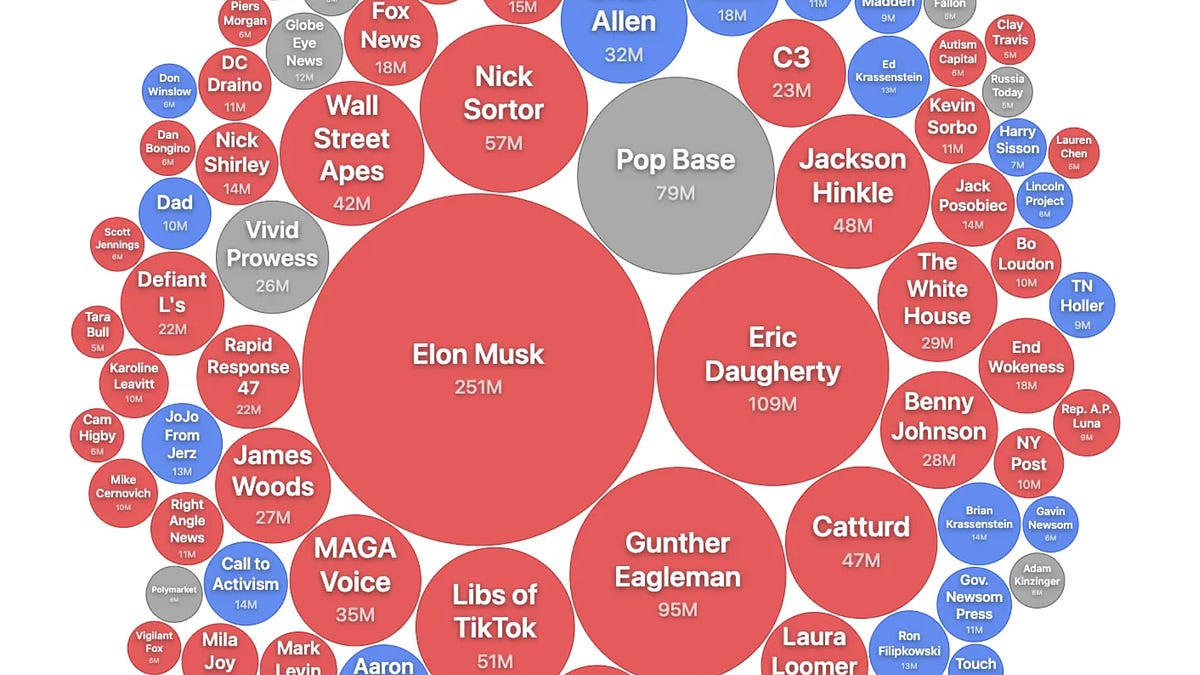
But what does that remaining traffic consist of? I recently came across a [bubble chart](https://x.com/kylewilsontharp/status/2037171182407999663) depicting the Twitter accounts that had received the most “engagement” in February 2026. It was depressing: most of the top accounts were extremely low-quality and highly partisan. I hadn’t even heard of many of them and only follow a handful of the top accounts. So I [tracked down the original data myself](https://dashboards.cluvio.com/dashboards/qxny-9e5q-k65v/shared?filters=%7B%22platform_filter%22%3A%5B%5D%2C%22political_content%22%3A%5B%5D%2C%22political_lean%22%3A%5B%5D%7D&reportId=k6zq-g911-3m2o&sharingToken=78eb1196-5766-429d-acf8-edcfd96b7067&timerange=1767225600~) and, with help from Claude, made my own improved version of the chart. Here, *voilà*, are the Twitter accounts with the most engagement so far in 2026:
s_!lsIC!,w_1456,c_limit,f_auto,q_auto:good,fl_progressive:steep/https%3A%2F%2Fsubstack-post-media.s3.amazonaws.com%2Fpublic%2Fimages%2F90360d93-50d0-484d-8cf1-ea4b8bd2695e_1440x1542.png) Data from Cluvio showing most engagements among X accounts from Jan. 1 to Apr. 4, 2026. Graphic by Claude Opus 4.6.
Data from Cluvio showing most engagements among X accounts from Jan. 1 to Apr. 4, 2026. Graphic by Claude Opus 4.6.
It’s not hard to notice that Twitter has become extremely right-leaning. But I’d argue there’s an equally important trend: the top accounts are of incredibly low quality. Elon, with the algorithmic boost he built in for himself, is at the eye of the storm, of course. But “Catturd” literally gets far more engagement than the New York Times, for instance. There are a lot of tweets like this one, from former hunky actor turned minor conservative media star Kevin Sorbo, which is approaching a million views:
Komodo dragons fighting. National Geographic
Thank you for reading Silver Bulletin, which is also an island unto itself — but on its best days, we hope, an island of sanity. Back to Trump and Iran tomorrow.
Yes, today is significantly better. Not even close.
Not that we bothered to run any dedicated advertisements on the forecast or monetize it in any tangible way.
And views have increased 6.5x relative to the first three months of 2024, though they don’t approach our election peak in late 2024.
In fact, everything is becoming increasingly uncorrelated. There is next to no correlation between the number of likes a Silver Bulletin post generates and the number of subscriptions it produces, for instance.
10 percent goes to Substack and roughly 4 percent goes to Stripe for financial processing fees.



Write a comment