The Economics of Smoot Hawley 2.0, Part II
Most of Donald Trump’s tariffs are clearly illegal. There is a special court, the Court of International Trade, which is supposed to have jurisdiction over these issues, and it ruled the tariffs illegal on May 28. However, the ruling was stayed while the administration appealed the decision to the Federal Circuit Court. Those following the deliberations mostly believe that this court will uphold the trade court’s ruling. But then the case will go to the Supreme Court, and almost everyone expects the Supremes to rule that Trump can do whatever he wants.
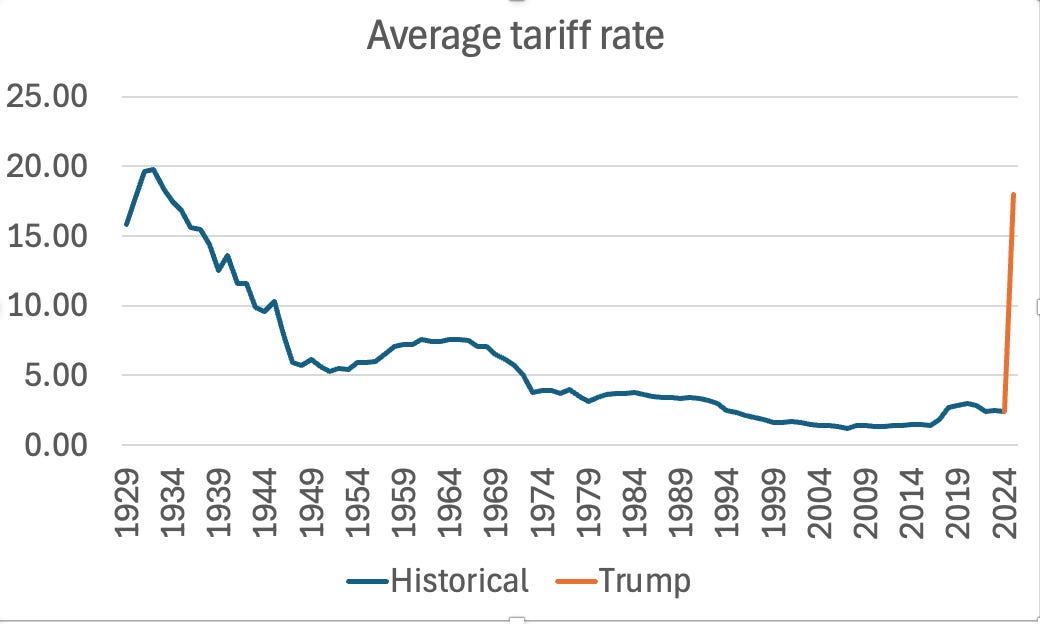
So high tariffs are probably here to stay. And I mean high tariffs. Trump has reversed 90 years of tariff reductions, achieved via reciprocal trade agreements — we’ll cut our tariffs if you cut yours. Here’s a chart of average U.S. tariffs since 1929, just before the infamous 1930 Smoot-Hawley tariff:

Source: Statista and Yale Budget Lab
How should we think about the economics of this huge policy reversal? In last week’s primer I focused on the macroeconomics of Smoot-Hawley 2.0 — its effects on trade flows and real GDP. But as I suggested at the end of that post, the real economic significance of the tariffs — even though they are ostensibly aimed at foreigners — is mainly how they will affect the distribution of income among Americans.
In 2020 Matthew Klein and Michael Pettis published a very good book titled Trade Wars Are Class Wars. They didn’t have Trumpian trade wars in mind, and their analysis was in important ways different from mine. But their meta point — trade policy is mostly about income distribution — was absolutely right, and I am going to steal their tagline.
Not to be coy about it, what I’ll argue in today’s post is that Trump’s trade war should be seen as part of a package of policies that amounts to class warfare — class warfare against middle and lower-income Americans in favor of the affluent, especially the top 10 percent of the income distribution.
Beyond the paywall I’ll discuss the following:
1. Tariffs as regressive tax increases that help pay for regressive tax cuts
2. The false promise of a revival in manufacturing jobs
3. The effects of tariffs on wages
Tariffs as regressive taxes
In a direct sense, tariffs are paid by the importing company. If Walmart brings a shipping container packed with, say, $300,000 worth of clothing from Bangladesh to the Port of Los Angeles, it will have to pay \(60,000 — 20 percent of the value — to U.S. customs. However, nobody believes that Walmart will eat that cost, at least on a sustained basis. It will, instead, pass the cost on in the form of higher prices. Tariffs, then, are basically sales taxes, albeit sales taxes that exempt goods produced domestically. Because sales taxes are a tax on consumers, most ordinary sales taxes also exempt significant categories of necessary goods in order to blunt their effect on families. For example, New York state’s sales tax doesn’t apply to [groceries, inexpensive clothing items and pharmaceuticals](https://taxcloud.com/sales-tax/new-york/). Trump, by the way, is threatening to impose [extremely high tariffs](https://www.cnbc.com/2025/08/05/trump-says-pharma-tariffs-could-eventually-reach-up-to-250percent.html) on pharmaceuticals. While all consumers pay sales tax whenever they purchase a taxable good, the *burden* of the tax is not equally distributed. Why? Because sales taxes impose a larger tax burden – cost of the tax as a percentage of income – on middle- and lower-income families than the affluent. That’s because high-income households typically spend less of their income and therefore pay less sales tax as a percentage of income, than families further down the scale. Economists call a policy *regressive* when it imposes higher costs on middle- and lower-income families. And sales taxes are regressive unless that regressivity is mitigated by other policies – policies such as exempting necessary goods or by re-distributing the tax revenue to those lower down the income scale. Overall, while state-imposed taxes (sales tax, property tax, and various fees) tend to be regressive, federal income taxes tend to be strongly *progressive* – that is, the burden, as a percentage of income, falls more heavily on more affluent families. In other words, while state taxes tend to redistribute income up the income scale, federal taxes tend to redistribute income down the income scale. That is, until now. Like a sales tax, Trump’s tariffs are regressive. Moreover, there are some technical reasons to suspect that they may be even more regressive than typical sales taxes (such as the fact that upper income Americans spend a larger share of their income on services, which don’t face tariffs). But what really turns Trump’s trade war into a class war, over and above your typical regressive sales tax, is how the administration plans to use the revenue from tariffs. For Trump has floated the idea of using tariffs to replace income taxes, and in practice the tariff revenue will be used to partially offset the tax revenue lost from the One Big Beautiful Bill Act’s big income tax cuts. And these income tax cuts strongly favor Americans with high incomes. The upshot is the Trump tariffs are not a standalone policy. They are part of a fundamental shift away from a progressive federal tax stance in which federal taxes fall more heavily on the rich and less on the middle class and pool. In other words, the Trump tariffs redistribute income upwards. Along with the OBBBA, tariffs are part of a radical transformation in federal tax policy that makes the well-off richer and the less well-off poorer. The Yale Budget Lab has estimated the combined effects of the Trump tariffs and the One Big Beautiful Bill Act — the legislation that cuts taxes at the top while slashing Medicaid and food stamps — on purchasing power at different levels of income. These estimates haven’t been updated for the latest tariff rates, but the general magnitude of the effects looks about right: s_!9rjR!,w_1456,c_limit,f_auto,q_auto:good,fl_progressive:steep/https%3A%2F%2Fsubstack-post-media.s3.amazonaws.com%2Fpublic%2Fimages%2F89cdcccb-b851-4181-b7e3-5e82b6043a5e_1764x1088.png)
Each bar represents a decile (a 10% tranche) of the US income distribution. Portions of a bar below the 0.0% horizontal line represent a loss of purchasing power; portions above represent a gain in purchasing power. The blue portion represents change in purchasing power due to the Trump tariffs; the red portion represents the change in purchasing due to the OBBBA.
As the graph shows, households in the bottom 30 percent of the income distribution (columns 1, 2 and 3) will take a huge hit, from both tariff hikes and benefit cuts. The poorest 10% of Americans will lose approximately 6.5% of their purchasing power due to the Administration’s policies. The next 50 percent (columns 4, 5, 6, 7, and 8) will pay slightly less in income taxes (the red portion above the 0.0% horizontal line), but these gains will be swamped by the tariff-driven rise in the cost of living (the blue portion below the 0.0% horizontal line). Households at the top, the top 20% of the income distribution (columns 9 and 10) are net winners from Trump policies: they, especially the top 10 percent, will get big tax cuts only partly offset by the cost of tariffs.
So as I’ve said, this supposed trade war is really a class war. Tariffs are part of a package of policies that will massively redistribute income from the have-nots to the haves.
Now, defenders of Trump’s tariffs will tell you to ignore all that and focus on workers. They claim is that the tariffs will bring manufacturing jobs back to America and raise working-class wages. Is there any validity to these claims?
The mirage of a manufacturing revival
In the 1950s more than 30 percent of nonfarm workers in the United States were employed in manufacturing. In popular memory these were good jobs, offering middle-class wages and extensive benefits. Today, however, only about 8 percent of workers are in the manufacturing sector. One of the main sources of the Trump tariffs’ appeal is the claim that the good industrial jobs of yore will return once tariffs have eliminated the American trade deficit in manufactured goods.
This claim is, however, false on multiple levels.
First, we tend to romanticize our manufacturing past. The good old days weren’t actually that good. Some manufacturing workers, like unionized auto workers in Michigan, were indeed well paid. Others, like textile workers in the Southeast, weren’t. In general, high wages for some industrial workers had more to do with strong unions than with the specific virtues of manufacturing employment.
Today, with unions in general far weaker than they once were, the “manufacturing premium” isn’t very large. Some analysts have argued that there is no longer any premium at all, although Larry Mishel of the Economic Policy Institute argues convincingly that workers in manufacturing are still, on average, paid more than other private-sector workers. But even he puts the premium at only 13 percent, which, as we’ll see, means that even if the tariffs lead to a rise in manufacturing employment they will do little to raise average wages.
Which brings me to my second point: it’s highly likely that Trump’s tariffs will have an insignificant or even negative effect on manufacturing jobs.
Trump officials claim that tariffs will induce consumers to shift away from imports to U.S.-produced goods, thereby reducing or eliminating our trade deficit and expanding U.S. manufacturing employment. But if you look at the specific tariffs Trump has levied, many of them will actually discourage U.S. manufacturing.
Consider the example of the auto industry. Cars imported from Japan now face a 15 percent tariff, while cars made in America don’t. But cars are largely made of steel and aluminum — and Trump has imposed 50 percent tariffs on both metals, sharply raising the domestic industry’s costs. Once you include tariffs on trade with Canada, whose auto industry is closely integrated with ours, it’s very likely that Trump tariffs will reduce American automotive employment.
Of course, some companies will benefit. In particular, the Washington Post reports that U.S. trade negotiators have tried to extract concessions on behalf of specific companies like Chevron and Starlink. But what’s good for Elon Musk is, to say the least, not necessarily good for America.
One unintended consequence of Trump policies might help U.S. manufacturing: the unexpected decline in the dollar. Before the Trump tariff regime was announced, many people — including Scott Bessent, the Treasury Secretary — expected tariffs to make the dollar stronger. Instead, the dollar has declined — probably because international investors are being repelled by our chaotic politics. The fall in the dollar makes U.S. manufacturing more competitive, although it also magnifies tariffs’ inflationary impact on consumers’ wallets.
Overall, Trump’s tariffs won’t do much to help manufacturing. Furthermore, policy chaos — nobody knows what tariff rates will be a year or two from now — discourages companies from making investments in onshoring manufacturing.
Finally, suppose that despite everything I’ve just said Trump were to preside over a large decline in the U.S. trade deficit. How much would this increase manufacturing employment and raise wages?
Not much. A few months ago I tried to estimate how much bigger the share of manufacturing in U.S. employment would be if we could somehow eliminate the manufacturing trade deficit. My answer was, not much. More recently Robert Lawrence, taking a similar approach but with better data, found similar but even smaller effects: completely eliminating the deficit would raise the share of manufacturing in employment from 7.9 to 9.7 percent, far below its levels in the 50s and 60s.
So how much would the return of “good jobs” in manufacturing raise average U.S. wages? Combining Lawrence’s estimate of employment gains with Mishel’s estimate of the manufacturing wage premium, the answer is roughly … 0.2 percent. Would raising average wages by a fifth of a percent make America great again?
So the idea that tariffs can help American workers by bringing good jobs back fails the math test. If there’s any effect at all, it would be tiny and completely swamped by the regressive effects on low and middle-income Americans.
One final point here: During the Biden years there was some revival of U.S. manufacturing, achieved not through tariffs but via industrial policy, especially subsidies for the expansion of green manufacturing. Manufacturing construction soared:

But the Trump administration has turned hard against renewable energy, and the Biden boom is rapidly fading away.
*Tariffs and wages*
**WONK WARNING: This final section is important but unavoidably technical. Some readers may want to skim to the conclusions, taking my word for their validity.**
There’s a popular perception that economists are rah-rah boosters of free trade, claiming that low or zero tariffs are good for everyone. In fact, however, economists have long recognized that tariffs can, under some conditions, benefit groups within a nation, even if they reduce real GDP.
In 1941 Wolfgang Stolper and Paul Samuelson made this point in one of the most influential papers on international trade ever published. “[Protection and real wages](https://academic.oup.com/restud/article-abstract/9/1/58/1588589)” envisaged an economy that exported capital-intensive goods — goods whose production requires a large amount of capital per worker — while importing labor-intensive goods.
In such an economy, tariffs would make the economy less efficient, reducing real GDP, but they would also shift the distribution of income in favor of workers. Stolper and Samuelson showed that in their model this distributional effect would swamp the efficiency effects: Tariffs would raise real wages.
During the 1980s and 1990s, which were marked both by increased globalization and rising inequality, the question of how much of the rise in inequality could be explained by Stolper-Samuelson effects was a major theme of research into international trade. The general conclusion — for example, in a [1995 survey](https://www.brookings.edu/wp-content/uploads/2016/07/1995a_bpea_krugman_cooper_srinivasan.pdf) I published on growing world trade — was that trade was *a* factor but not the main one. Others, like [Josh Bivens](https://www.epi.org/publication/standard-models-benchmark-costs-globalization/) of EPI, estimated bigger numbers for the trade effect, but the qualitative conclusion was the same.
So does this mean that the Trump tariffs can raise wages, or at least the wages of workers without a college degree? Probably not.
Why not? Tariffs can raise real wages — but only if they lead to an expansion in labor-intensive manufacturing. And here’s the thing: America in 2025 barely has any labor-intensive manufacturing left, and high as they are, the Trump tariffs won’t bring any significant amount of that manufacturing back.
Take the quintessential labor-intensive industry, apparel (garments.) In the early 1980s America still had more than a million garment workers, but at this point only a handful of workers, mainly producing high-end specialty items, are left:
s_!fktf!,w_1456,c_limit,f_auto,q_auto:good,fl_progressive:steep/https%3A%2F%2Fsubstack-post-media.s3.amazonaws.com%2Fpublic%2Fimages%2F8432e491-16fc-490d-a3f9-f9315d9513df_800x450.png)
Trump is imposing high tariffs on the nations that currently provide most of our clothing. Bangladesh, for example, will face a tariff on garments of 20 percent. But given low Bangladeshi wages, this tariff won’t be nearly high enough to get America producing pajamas again.
Suggestions that the tariffs will bring back other labor-intensive activities seem just as implausible. Howard Lutnick, the Commerce secretary, has been widely and appropriately ridiculed for claiming that
the army of millions and millions of human beings screwing in little screws to make iPhones, that kind of thing is going to come to America
That’s not going to happen. Industry experts say that a made-in-America iPhone might cost $3500.
I could go on, but the point seems clear. Bringing highly labor-intensive production back to the United States would require extremely high tariffs — much higher than even Trump has proposed — and would lead to devastating increases in consumer prices. So this won’t happen, and the tariffs won’t boost wages.
The trade war is a class war
The bottom line from this discussion is that Trump’s tariffs are being sold on false pretenses.
They look as if they’re targeted on foreigners, taking back the good jobs and raising American wages. But the real targets are middle- and lower-income Americans, who will pay higher prices to offset the revenue losses from tax cuts at the top. In many cases manufacturing, which the tariffs are supposed to promote, will actually be hurt by tariffs on inputs like steel and aluminum.
This trade war is really a class war. And roughly 80 percent of Americans will end up on the losing side.
Write a comment