The Beauty of Average-Looking Actors
Source: The Beauty of Average-Looking Actors Publisher: Cartoons Hate Her | Author: Cartoons Hate Her Published: January 22, 2026 | Archived: March 21, 2026
Of all the article topics people request, I never once suspected that the beauty differential between US-based and UK-based media would ever pop up, but alas, multiple subscribers have asked me to write about this. The request came after I briefly covered the fact that I found a relationship between British actors Olivia Colman and Benedict Cumberbatch in the recent comedy film Roses slightly implausible, because (IMO) he’s slightly better-looking than she is.

Not everyone agreed—they thought Benedict Cumberbatch looks like a ferret who got Handsome Squidward surgery, and perhaps to them Colman is the hotter one. For me, I think the disconnect came in part because he usually plays a bit younger than his age and she plays older (in real life, she’s only two years older than he is.) If a movie includes a dowdy, middle-aged British woman, she’s usually a top pick for the role, and she has been for a while. Meanwhile, Cumberbatch is only *now* entering his bumbling tweedy fuddy-duddy era. Otherwise known as “going unc mode.”
In part, this is because Hollywood sees men and women’s aging differently—not just that women are valued more for their youth (although they are) but we often see the same facial signs of aging on a woman and a man and conclude the woman is *aging worse*. In fact, we might come to this conclusion even when the man is older and objectively shows more signs of aging (Brad Pitt’s skin on a woman his age or even older would not be considered “aging well.”) And we are asked to believe, over and over again, that a male and female actor who are ten years apart are actually around the same age.
s_!0dZ5!,w_1456,c_limit,f_auto,q_auto:good,fl_progressive:steep/https%3A%2F%2Fsubstack-post-media.s3.amazonaws.com%2Fpublic%2Fimages%2F1bcbf59b-b6f7-449c-9b36-6f50ca600f33_2048x1536.jpeg)
But aging aside, one thing that struck me (and my subscribers, apparently) about Olivia Colman—and one of the many reasons I really enjoy watching her, along with her tremendous talent—is the fact that she does really look like a random British lady walking around at Tesco. Actors like Colman make TV and movies better—more realistic, more immersive, more engaging. And you see this a lot more with British media than with American. I will up the ante: even when movies are supposed to be sexy, “regular hot” actors are better than model-tier actors.
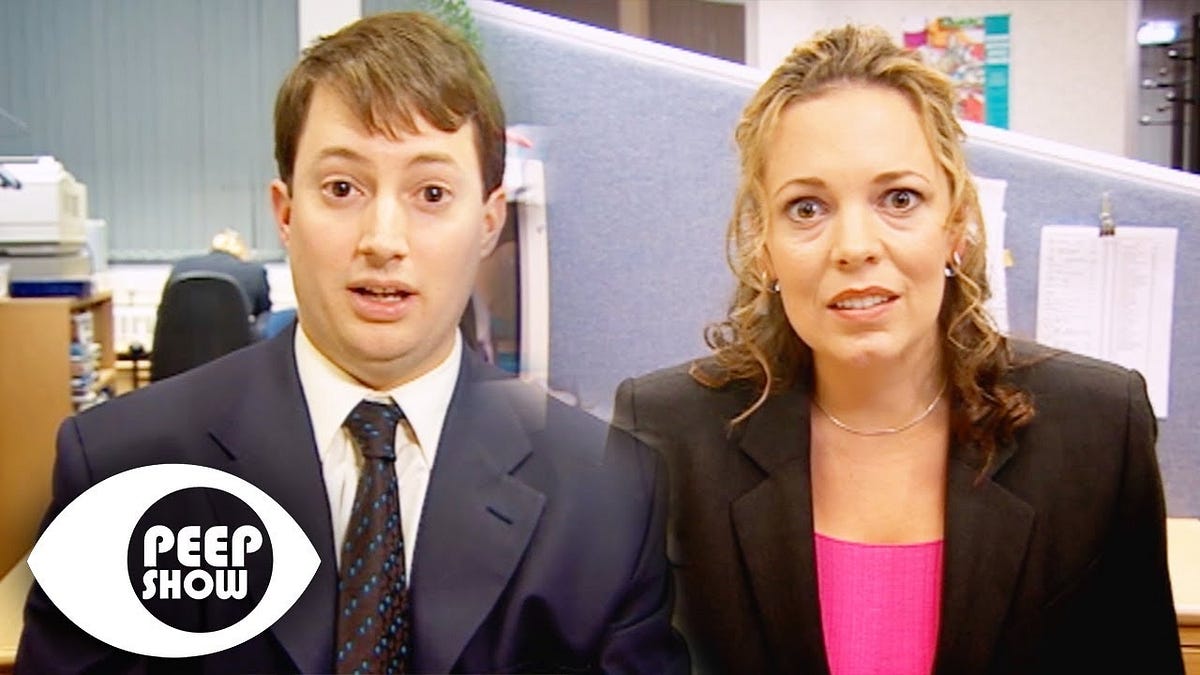
I actually first discovered Olivia Colman when she played the love interest on the amazing sitcom Peep Show. This show continued for eight seasons, and for about half of those seasons, we were following a love story between two people who looked like this:

Neither of these people are *ugly*, but that’s not the point. They’re completely…*normal-looking*. They look like people you’d see on the bus. Nearly every actor on *Peep Show* looked like this, and in a weird way, it elevates the entire show which is otherwise very low-budget.
Occasionally, they would bring in a hot love interest (usually a woman) who *looked* like an actress. It was incredibly uncanny and weird, and I never particularly liked those characters. Not because I can’t stand to see beautiful women, but it was almost like they broke a sort of…fifth wall. Potentially relevant is that *Peep Show* was filmed entirely from the perspective of different characters (hence the name) so you really feel like you’re *in it*. Once someone like *this* shows up, the illusion is broken.
s_!ZFe0!,w_1456,c_limit,f_auto,q_auto:good,fl_progressive:steep/https%3A%2F%2Fsubstack-post-media.s3.amazonaws.com%2Fpublic%2Fimages%2Ffc1242e7-07fa-4589-a587-d1571207f313_1280x720.jpeg)
No, you are NOT listening to a clammy-handed neurotic British loan manager’s innermost thoughts. YOU ARE WATCHING A TV SHOW.
I’ve noticed this with other British TV shows. Take, for example, the original iteration of The Office, which began in the UK. Like Peep Show, The Office was intended to resemble real life. That’s why the “Pam” character (named Dawn) looked like this:

And “Jim” (aka, Tim) looked like this:
s_!aQVg!,w_1456,c_limit,f_auto,q_auto:good,fl_progressive:steep/https%3A%2F%2Fsubstack-post-media.s3.amazonaws.com%2Fpublic%2Fimages%2F32c34be4-42f4-4d9d-8483-ce283452210f_1024x768.jpeg)
The difference is subtle when you look at how they casted these roles in the US. See, in The Office, America edition, they were still trying to cast “realistic” actors. But they made the deliberate choice to go…just a bit less realistic.

I really liked the American *Office*. I don’t think that Jim and Pam were too hot for the show to be good. But there was clearly a deliberate choice to cast a 6’3” quasi-hunk when the original Jim was a pallid, round-faced 5’7” guy. (To be clear, Martin Freeman, the guy who plays British Jim/Tim, was actually one of my earliest celebrity crushes…but this was in part because he *looked like a real guy*.)
Side note: guess who else was in the British Office? *Olivia Colman*.
s_!F_OJ!,w_1456,c_limit,f_auto,q_auto:good,fl_progressive:steep/https%3A%2F%2Fsubstack-post-media.s3.amazonaws.com%2Fpublic%2Fimages%2Ffcab048e-65ba-415b-8985-7f8d2b1e247c_658x549.webp)
British detective shows are another great example of this. Much like employees in an office, you don’t actually expect (or want) imaginary police officers to be dashingly handsome or stunningly gorgeous. An extremely experienced police officer is also probably going to be older—yes, even if she is a terrifying music OLDER WOMAN. I really love the show Happy Valley, which follows a female cop who is quite literally a grandmother. Not a full-blown GILF, but a regular, average-sized, grandmother:

Her average-ness isn’t why I like the show. It’s just a really good show. But there’s also something so enjoyable about watching people who you believe actually exist. Look, I completely buy that a supermodel would be hot. I would expect a supermodel to be hot. If I was watching a movie about supermodels, I want all of them to be extremely hot, to the point that they barely look humanoid. But if I’m watching a show about a detective in Northern England, it would be incredibly jarring if this person was played by Dua Lipa.
In fact, it had always been a bit of a gripe of mine that actresses cast to play relatively unglamorous roles—professors, scientists, cops, whatever—were always gorgeous, in a way that their male counterparts weren’t. Sure, it’s *possible* that a gorgeous woman might one day become a security guard, but how often does this happen, really? In fact, I can tell you that I saw a gorgeous young female security guard exactly once in my life, and it was memorable enough that it’s still seared in my brain. If I’m watching a show about cops, and the show is not specifically intended to be sexually arousing, I want everyone to look average. Fit, perhaps. Hideous, no. But I want them to look like cops, dammit!
In fact, speaking of cops, who other but OLIVIA COLMAN played a cop on a different British TV show (*Broadchurch)* looking like this:
s_!EOH4!,w_1456,c_limit,f_auto,q_auto:good,fl_progressive:steep/https%3A%2F%2Fsubstack-post-media.s3.amazonaws.com%2Fpublic%2Fimages%2F3dafda65-fb66-4f87-9cb0-e67ee3384e55_1000x666.avif)
Obviously, the presence of conventionally attractive actors doesn’t ruin a good murder mystery. But I feel that any looks above “pleasant” add nothing to a show that isn’t intended to turn you on. If I’m trying to figure out who dumped a beheaded body in the bogs of Yorkshire, why exactly do I need to see a snatched jawline and cat eyes?
Besides, when you’re really attractive, it reflects in the way people treat you. Ergo, it must become part of the overall character arc. If I’m going to watch a show that includes a total smokeshow, I expect that this person be treated like a total smokeshow, and have the confidence and life story of one. For example, Brad Pitt played an divorced single dad and general manager in Moneyball, looking like this:

Look, any guy who looks like this and has that job would be absolutely swimming in female attention. He would turn heads. He would be *known* as the hunky general manager. He would, perhaps against his will, be the subject of constant fancams and social media attention (*Moneyball* takes place before social media, but you get what I’m saying.) In fact, if this guy existed, people would stop him all the time to tell him he looks like Brad Pitt. It’s not that it’s *impossible* for someone like this to exist, but it is a bit implausible. Of course, this person really does exist, and his name is Billy Beane. But he looks like, well, a more normal-looking handsome guy:
s_!jLCc!,w_1456,c_limit,f_auto,q_auto:good,fl_progressive:steep/https%3A%2F%2Fsubstack-post-media.s3.amazonaws.com%2Fpublic%2Fimages%2F92b4296f-a298-454a-b038-23f5b0d22c6e_202x249.jpeg)
There is no British Moneyball. But I have a feeling that if there was, it would not star a guy who looks like Brad Pitt. I don’t mean to relegate Brad Pitt solely to sexy roles, but just as it’s not “fair” that average-looking actors tend not to win leading man roles in romances, it’s just a fact of life that inordinately hot people simply do not belong in roles where they are playing everyday people who are not constantly complimented on their looks.
Another example of a character who is far too good-looking for his storyline to be believable: Jonah Hauer-King in The Threesome.

Now, you might think his casting is totally plausible because the movie is about a guy who has a threesome, and it makes sense that an extremely good-looking guy like this would get to experience a menage a trois. But the problem is that the movie opens with him being insanely nervous to approach/flirt with a woman he’s *already hooked up with*. He is not suave or confident, and has an attitude around women befitting a guy who isn’t used to female attention. His being *extremely good-looking* is never really mentioned, and in fact, one of the lead actresses keeps rebuffing him at the beginning of the movie for no clear reason.
Yes, I’m sure good-looking men sometimes have social anxiety, or get rejected by women, but realistically speaking, men who look like this aren’t scared to lose their chance with one of the many women interested in them. Men like this do not beg women for a chance and nervously fumble their shots. Throughout the movie, he seems nearly *confused* by female attention like he’s never dated before, even though he’s canonically thirty years old and, well, looks like *that*.
This would make sense if he was played by someone who you could buy as a slightly awkward late bloomer, someone like Adam Driver or Pete Davidson—but he’s played by someone who is model-gorgeous. It’s still a decent movie, but I find this hump (no pun intended) hard to get over.
Now, you might be thinking that *sexy* movies, like *The Threesome*, aren’t sexy if the people in them aren’t top-tier attractive. But remember that most human beings *are attracted* to other normal-looking people. Granted, if the explicit purpose of a movie is to be sexy, it might make sense for the actors to be better-looking than your average shopper at Target, but a little realism goes a long way.
I will go a step further and say that actors who are slightly less attractive than model-tier actually make sexy movies *hotter*. Take James Spader and Maggie Gyllenhaal in *Secretary*. Granted, this movie might not be for everyone. It’s about a BDSM relationship between a lawyer and his secretary, to the point that when I read Reddit reviews of it, multiple people complained that it glorified a “toxic workplace” and sent the “wrong message” to middle-aged lawyers (Sheesh, legalize comedy.) But assuming you find the basic premise of the movie a little sexy, it helps that the actors look like this:
s_!hgbq!,w_1456,c_limit,f_auto,q_auto:good,fl_progressive:steep/https%3A%2F%2Fsubstack-post-media.s3.amazonaws.com%2Fpublic%2Fimages%2F1139aa1c-10bc-4e3b-b33a-5a4841ba6546_1024x576.jpeg)
These two people aren’t ugly, or even average-looking, but they are office hot, which is fitting because the movie takes place in an office. The fact that Spader and Gyllenhaal look like the best-looking people in your workplace means that you can feel really immersed in the storyline without pausing to remind yourself that you are, in fact, watching a movie. While Spader plays a lawyer in the movie, he doesn’t play a terribly impressive one in a Manhattan high rise, and while Gyllenhaal is his hot young secretary, she isn’t a rising influencer in Los Angeles, she’s a mentally ill young woman living with her parents. They look exactly the way these types of characters are supposed to look!
On the other hand, when I heard good things about the series Tell Me Lies, I tuned in, only to immediately nope the fuck out when the first scene of the lead actress showed incredibly obvious Instagram-tier lip filler. My first thought was actually, Wow, Shailene Woodley got some work done, only to realize that I was looking at some generic Standard Issue TV Face that might have been based on a ChatGPT prompt about Shailene Woodley.

Sorry, I do not mean to body-shame (face shame? Why is nobody ever talking about face shaming? Some of us are shamed for our FACES, not our bodies. Rant over!) But anyway, she looks lovely. I don’t mean to insult her. But I’m sorry, she’s just too pretty for me.
It’s not that I don’t buy that a woman who looks like this exist. Loads of them do. But immediately, I was reminded I was watching a *show*, not watching real people. Perhaps I was too quick to make this judgement, but it was actually my *husband* (famously not opposed to watching gorgeous women on TV) who turned it off because he felt it was “CW-adjacent.”
I’ve noticed this with Korean films and TV as well. Every time I’ve watched a really good, artful Korean film, I’ve noticed that the faces seem really natural-looking, unless there’s a specific character who is intended to look otherwise. Take *Parasite*, for example. The only woman in *Parasite* who looks like she’s had work done is the rich mom, and that’s very fitting because a filthy rich woman in South Korea may very well have had plastic surgery!
s_!KiXj!,w_1456,c_limit,f_auto,q_auto:good,fl_progressive:steep/https%3A%2F%2Fsubstack-post-media.s3.amazonaws.com%2Fpublic%2Fimages%2F709dadcc-12db-4cb2-9081-7d37eb66f0ef_880x586.jpeg)
That said, almost all the other characters (except for maybe her husband) look like they’ve never had anything done. While Parasite was obviously just a good movie in general, I think it would have been made worse if every character looked like an influencer.
Around the same time I saw Parasite, I attempted to watch a Korean TV show on Netflix (I’m forgetting the title, I’m so sorry) and out the gate, every single character (both male and female) had the same exact plastic surgery. They all looked like influencers. Of course, they were all extremely good-looking but in a very uncanny and weird way. It was impossible to believe them as regular, everyday people. I couldn’t deal with this show and ultimately didn’t last one episode. See also: the actors on low-quality soap operas tend to be extremely good-looking. In a way, if actors are too good-looking, the show is immediately coded as lower-quality before it has a chance to prove itself.
Sometimes, obvious plastic surgery and perfection is good. Nicole Kidman in Babygirl clearly had tons of work done, and it was part of her character. That’s fine. But I would not have bought Nicole Kidman, as she looked in Babygirl, playing a struggling grandmother trying to make ends meet by working at a Hannaford in Rochester.
I don’t think I’m the only one who feels this way. Sure, most of us enjoy looking at good-looking rather than hideous people, but aren’t TV shows and movies genuinely better if we can suspend disbelief that we are watching a bunch of highly-paid actors with faces insured for tens of thousands of dollars? It begs the question, Are the British doing this on purpose?
Well, yes and no.
I doubt that British television shows are purposefully discriminating against gorgeous actors. For example, The Fall starred Jamie Dornan as a handsome serial killer. Yes, Jamie Dornan of Fifty Shades of Grey stardom. A certified, perfect-looking, Hollywood-tier hunk.

But the answer lies in how British actors get their *start*, versus American actors. Let’s take one of America’s biggest stars and sex icons right now, Syndey Sweeney. She got her start in commercial acting and network TV like *90210* (the new one, obviously.) But Olivia Colman went to [drama school](https://en.wikipedia.org/wiki/Bristol_Old_Vic_Theatre_School) in England before starring in various sketch shows—neither of which requires good looks, let alone perfection. Many British actors are classically trained in theater, and then go on to get their start via live drama productions or sketch comedy. In the US, many A-list actors got their start in modeling, commercial acting or the good ol’ insipid Disney child star to sexy adult actor pipeline. All of these avenues are highly selective for conventional beauty.
All of this ties back to my all-time favorite British director/producer, Jesse Armstrong. You might know him because he created the American HBO hit, *Succession*. But he has quite the filmography, and was in fact the mind behind *Peep Show* as well as the fantastic British sitcom *The Thick of It*. Again, amazing show, not a conventional hottie in sight:
s_!uo07!,w_1456,c_limit,f_auto,q_auto:good,fl_progressive:steep/https%3A%2F%2Fsubstack-post-media.s3.amazonaws.com%2Fpublic%2Fimages%2F6528d9e9-11f2-401f-96f3-44ca7498863b_732x1000.jpeg)
Jesse Armstrong is amazingly talented. The man has created some of the best TV shows of all time. And as far as I know, he does not make a habit of casting model-attractive people. A Jesse Armstrong 10 is like a Michael Bay 6. And Armstrong’s strategy still worked in America, where Succession was wildly popular.

Yes, there were some decent-looking actors on *Succession*, but someone like, say, Glen Powell or Ariana Grande would have looked wildly out of place. Arguably, the only real aesthetic star of *Succession* was Sarah Snook’s ass:
s_!EYre!,w_1456,c_limit,f_auto,q_auto:good,fl_progressive:steep/https%3A%2F%2Fsubstack-post-media.s3.amazonaws.com%2Fpublic%2Fimages%2F4c6db22d-18ac-44c8-b292-00f37e488f0b_2048x2048.jpeg)
But Jesse Armstrong is proof that shows do not suffer for having regular-looking people. Not necessarily ugly people, not even necessarily plain people, but people who look like you might pass them on the street. And given his degree of talent and prestige, I find it hard to believe that he only cast the actors of Succession because he couldn’t find anyone hotter. Centering an entire show around a guy who looked like this was a deliberate choice:

So what should a frustrated, realism-loving viewer do? I guess watch more British TV. Or beg Jesse Armstrong never to retire.
Write a comment