A Wonkish Note on Trade with Canada and Mexico
To subscribers: There’s a lot of noodling around going on behind the scenes of this newsletter — that is, I spend considerable time chasing data and analyses that seem as if they might be relevant. Sometimes these chases lead to dead ends; sometimes they end up reflected in the discussion, but I don’t think readers will be interested in my seeing my homework.
Now and then, however, I’ll do some wonky homework that doesn’t feel like a hot button topic — and these days it’s hard to justify writing about anything that isn’t hot button — but that I think a limited set of readers might find interesting. This is one of those cases. I’m going to make it for paid subscribers only, because I should be offering something for your subscription dollar.
So we’re having a trade war — and even the Wall Street Journal, which normally finds a way to rationalize whatever Trump does, calls it “the dumbest trade war in history.” We have some real trade (and national security) issues with China, but China is getting off lightly; the brunt of Trump’s tariffs will fall instead on Canada and Mexico.
Why? The official rationale keeps changing. At this point it’s supposedly about fentanyl, but that’s a transparently concocted issue: Canada isn’t a major source of fentanyl, and while Mexico is, the Mexican government is trying fairly hard to crack down on the trade.
Anyway, until just the other day Trump was trying to make the confrontation about something completely different: the fact that Canada and Mexico run trade surpluses with the United States. Trump’s claim that this meant that we were subsidizing his neighbors was nonsense on stilts. But there’s an intellectually interesting question (at least for some of us): Why do we run bilateral deficits with our neighbors?
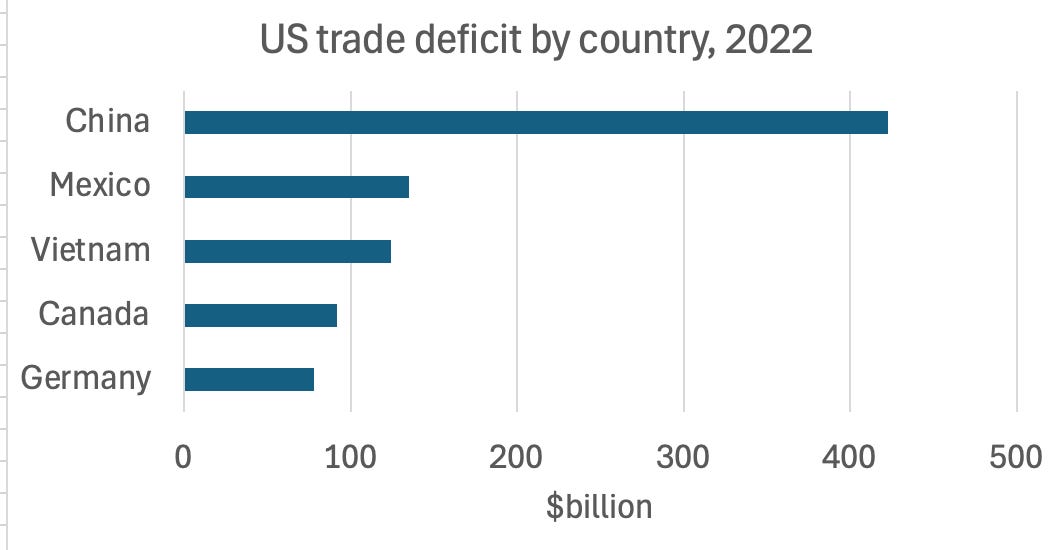
Here were America’s 5 biggest bilateral deficits in 2022:

Source: [World Bank](https://wits.worldbank.org/CountryProfile/en/Country/USA/Year/LTST/TradeFlow/EXPIMP/Partner/by-country)
Of these 5, China and Germany run surpluses with the United States because they run big trade surpluses overall. Vietnam is probably there because it’s a conduit for Chinese goods doing an end run around U.S. tariffs, often with a bit of Vietnamese value added so that it’s not pure transshipment.
Canada and Mexico, however, are more interesting. You see, neither is an overall surplus country. In fact, both run small deficits on current account (the trade balance broadly defined to include services and investment income):
s_!wBRB!,w_1456,c_limit,f_auto,q_auto:good,fl_progressive:steep/https%3A%2F%2Fsubstack-post-media.s3.amazonaws.com%2Fpublic%2Fimages%2Fbf253ed2-64fb-4a4a-bc05-2d69aedd00ce_1006x572.png)
Source: International Monetary Fund
Why, then, the bilateral surpluses?
The economics literature on bilateral trade imbalances is surprisingly thin, I guess because most economists considered it an unimportant issue until it began looming large in the mind of Donald Trump. The main starting point is a 2002 paper by Don Davis and David Weinstein; there have been subsequent elaborations, but they provide the framework I need.
D-W start with the “gravity model” of international trade, which says that the value of exports from country A to country B is proportional to B’s total imports but inversely related to the distance between the nations. The gravity model, which can be justified by several underlying models of international specialization, works spectacularly well empirically, so much so that economists often use deviations from its predictions to assess things like the impact of international trade agreements.
Can a gravity model explain bilateral imbalances? Yes, up to a point. D-W point to the possible role of “aggregate macroeconomic imbalances,” by which they mean that a country that runs a large overall trade surplus will tend to run bilateral trade surpluses with each of its trading partners, while a country that runs a large deficit will run bilateral trade deficits. In today’s world, China runs big surpluses because it has huge savings and is running out of domestic investment opportunities, while the U.S. runs big deficits, largely, I’d argue, because America’s surging productivity draws in a lot of foreign investment.
This suggests what I think of as the pushmi-pullyu model of North American trade imbalances (I read Dr. Dolittle as a child), which schematically looks like this:

China runs surpluses with everyone; America runs deficits with everyone; so our neighbors run deficits with China and surpluses with us.
But D-W found that macroeconomic imbalances weren’t enough to explain the bilateral imbalances we see, and my back-of-the-envelope calculations say that this is true for North American imbalances too. Instead, a lot of the imbalances surely reflect special factors related to the interaction between comparative advantage and geographical proximity.
In the case of Canada, this is mostly a story about energy: oil from Canada’s tar sands is shipped to the midwestern United States because it’s a nearby market that can be accessed by pipelines. I keep using this illuminating Bloomberg chart showing that Canada runs a bilateral deficit in everything except energy:
s_!KRu8!,w_1456,c_limit,f_auto,q_auto:good,fl_progressive:steep/https%3A%2F%2Fsubstack-post-media.s3.amazonaws.com%2Fpublic%2Fimages%2F1dd88364-c7b8-422a-8720-04182beca709_1396x774.png)
Mexico’s story is a bit subtler. As I and others keep pointing out, much of North American manufacturing, especially autos, reflects a highly integrated production system that sprawls across all three countries. This system relies on just-in-time production — that is, automotive factories have to be located close enough that their inputs and outputs can arrive quickly by road and rail, rather than taking several weeks to cross the Pacific.
Within this system Mexico, which has much lower wages than the U.S. or Canada, specializes in the more labor-intensive aspects of production. And while I don’t have the time to crunch all the numbers, I’m reasonably sure that Mexico’s exports of labor-intensive segments of the value chain play a similar role in bilateral imbalances to that played by Canada’s oil exports.
Pretty clearly, the Canadian and Mexican exports that account for our bilateral deficits make America richer than it would be without them. Canadian oil makes our energy cheaper; by handling the labor-intensive aspects of production, Mexico makes U.S. manufacturing more competitive.
Above all, bilateral imbalances are in no sense an indicator that Canada or Mexico are doing anything wrong. Trade within North America is working the way trade is supposed to work, and nobody is getting subsidized.
Write a comment