Tariff Policy by the Numbers
Will Section 122 give Donald Trump enough time to invoke Sections 232 and 301? If not, is Section 338 really a possibility? Do you have any idea what I’m talking about? I hope not.
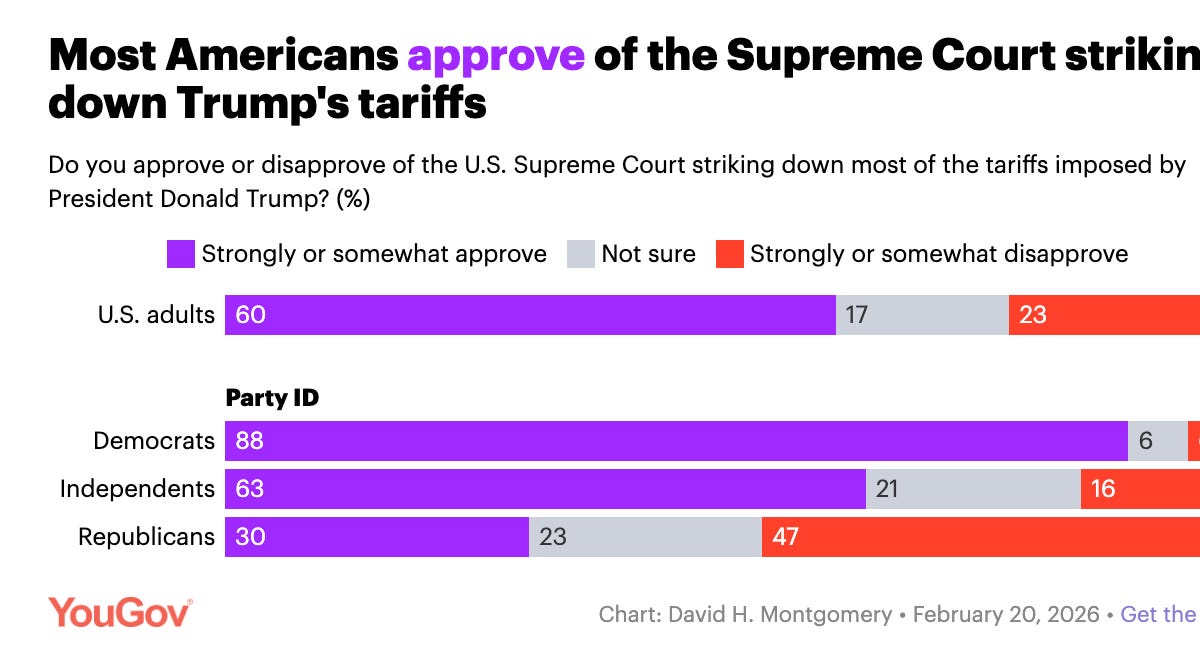
On Friday the Supreme Court delivered a body blow to Trump’s tariff policies, ruling that his promiscuous use of the International Emergency Economic Powers Act — the acronym IEEPA sounds like a yelp of pain, which is appropriate — is illegal. In principle Trump could reclaim authority to do whatever he wants on international trade by getting Congress to pass enabling legislation, which is how the federal government normally works. But his tariff policy is wildly unpopular, the most unpopular ever, unpopular like nobody has ever seen before:
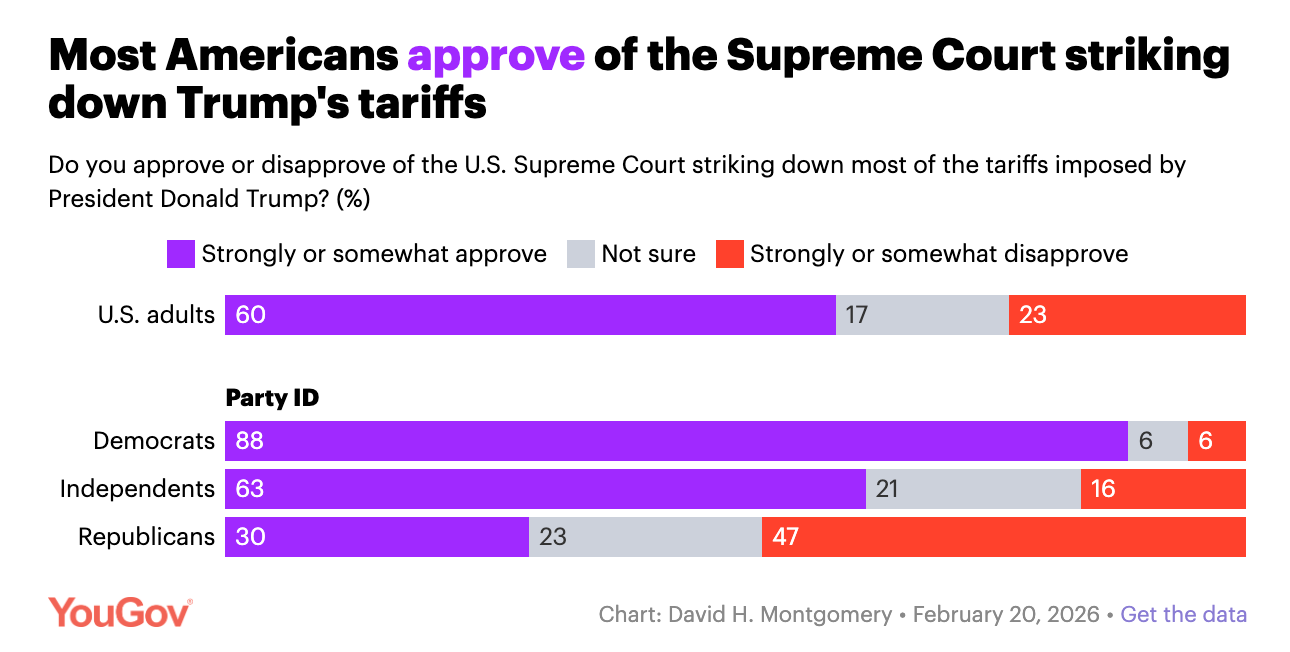

Members of Congress know this, and while Republicans will do almost anything for Trump, they won’t do that — that is, they wouldn’t have voted in the Trump tariffs as they were until Friday, and they won’t vote to restore them now. The Supreme Court struck down those tariffs because Trump tried to use IEEPA to impose tariffs without Congressional approval, and the Court said that was illegal.
But how was it ever possible to impose tariffs without a Congressional vote? Tariffs are taxes, and imposing taxes normally requires legislation. Why, then, has Trump been able to impose large tariffs without even consulting Congress? Why might he be able to keep tariffs high despite the Court’s ruling? And what’s with all the section numbers?
To understand what’s happening on tariffs, one needs to understand the history of U.S. international trade policy. And I do mean history: America has a system for tariff-setting whose roots go all the way back to the 1930s. That system was hammered together over decades by some very smart people who ingeniously harnessed self-interest in pursuit of their perception of the public good, cleverly created a synergy between domestic legislation and international diplomacy, and combined all of this with a keen sense of political realism. Unfortunately, that system was not designed to deal with a president like Trump.
Beyond the paywall I will address the following:
1. The long march to relatively free trade
2. The rules of the game, 1934-2025
3. Why presidents have so much discretion on tariffs
4. The Trump shock
The long march to relatively free trade
In the beginning there was Smoot-Hawley. The United States had maintained high tariffs since the 19th century, but the infamous 1930 tariff legislation sent them even higher.
And the deflation caused by the onset of the Great Depression sent average tariff rates into the stratosphere. Why? Because at the time many tariffs were “specific” rather than “ad valorem” — that is, tariff rates were set at, say, \(1.25 per ton of imported pig iron rather than 20 percent of the price. So when prices plunged, tariffs as a percentage of prices soared. When Franklin Roosevelt took office, his advisors believed that U.S. tariffs were much too high. They believed that tariffs at the rates then prevailing were economically counterproductive. Some of them, especially [Cordell Hull](https://www.cfr.org/sites/default/files/pdf/2008/07/CGS_WorkingPaper_4.pdf), FDR’s Secretary of State, also believed that international commerce was a force for peace. So they wanted to reduce tariff rates. However, the politics of trade liberalization were anything but easy. Tariff bills like Smoot-Hawley were Christmas trees full of giveaways to influential members of Congress — tariffs that protected manufacturers with factories in these politicians’ home districts, with little regard for the impacts of these tariffs on consumers or the economy as a whole. Getting rid of these special-interest giveaways would have required years of political trench warfare, if it was possible at all. But the Roosevelt administration had an answer: international negotiations. The [Reciprocal Trade Agreements Act of 1934](https://history.state.gov/milestones/1921-1936/export-import-bank) set up a process that, glossing over the details, worked as follows: U.S. officials would negotiate deals with other countries that involved tit-for-tat trade liberalization — we’ll reduce our tariffs on your products if you reduce your tariffs on our products. These deals would then be presented to Congress for up-or-down votes. That is, members of Congress would have to vote yes or no, with no opportunity for, say, Representative Bomfog from Widgetville to insert a provision maintaining high tariffs on widgets. Deals negotiated under the RTAA led to a substantial reduction in tariffs during the 1930s. And in 1947 the U.S. template established by the RTAA went global, with 123 nations signing the [General Agreement on Tariffs and Trade](https://en.wikipedia.org/wiki/General_Agreement_on_Tariffs_and_Trade), which established a US-style system for international trade around the world. Under the GATT, there were a series of multilateral trade negotiations — “rounds” — in which governments agreed on mutual tariff reductions. There were 8 such rounds in all, with the last, the Uruguay Round, concluding in 1994. Under the RTAA and then the GATT U.S. tariff rates came way down, not all the way to free trade but close: s_!DW1l!,w_1456,c_limit,f_auto,q_auto:good,fl_progressive:steep/https%3A%2F%2Fsubstack-post-media.s3.amazonaws.com%2Fpublic%2Fimages%2F57fb45a6-4250-46e4-b3da-7ab068cc0fef_1430x793.png)
Source: US International Trade Commission
Tariff rates in the rest of the world also came down, by comparable amounts.
When Trump announced his Liberation Day tariffs last April, those who knew this history were bemused — OK, pissed — that he described what he was doing as imposing “reciprocal” tariffs, as if the U.S. had opened its market unilaterally. The truth is that reciprocity has been the basis of U.S. tariff policy since 1934. We have never cut tariffs unilaterally. We have always reduced our tariffs in return for tariff cuts by our trading partners.
Why were reciprocal trade agreements successful? That is, why did the process that began in 1934 succeed in achieving large tariff reductions in a nation that had been highly protectionist for generations? Two reasons.
First, the process of international negotiation helped offset the power of special interests wanting tariffs with the countervailing power of other special interests: exporters. Some U.S. companies opposed tariff cuts because these cuts would expose them to foreign competition, but other U.S. companies, not to mention agricultural interests, wanted access to foreign markets and hence favored deals that led to lower foreign tariffs.
Second, as already mentioned, subjecting negotiated trade deals to up-or-down votes prevented interest groups from larding up trade legislation with giveaways.
There was also one more crucial feature of the pre-Trump 47 trade system: In addition to establishing a process of international tariff negotiations, it established rules of the game both for these negotiations and for what happened after deals were reached.
The rules of the game, 1934-2025
Until Trump knocked the table over last year, U.S. tariff policy was constrained by rules.
As I just explained, since 1934 we have set tariffs through international agreements. Such agreements weren’t exactly treaties, a somewhat technical legal distinction. Notably, unlike treaties, deals like the US-Korea Free Trade Agreement, signed in 2007, don’t have to pass the Senate by a two-thirds majority. Trade agreements do, however, have to be approved by Congress, and are supposed to be binding. Failure to honor such agreements is a violation of both U.S. and international law.
The fact that tariff rates, both in the United States and in other countries, have been set via international agreements means that nations aren’t supposed to be able to go back on past deals. That is, having negotiated lower tariffs on goods imported from, say, the European Union, we are not allowed to change our minds and put tariffs back up again. If we do, the EU can sue us and demand compensation, requiring that we reverse the tariff hikes or cut tariffs elsewhere.
You might be tempted to be cynical about these rules of the game, assuming that they didn’t really constrain policy. In fact, however, they mattered a lot, especially after the creation of the World Trade Organization in 1994 (part of what was achieved during the Uruguay Round.)
The WTO has or had a quasi-judicial “dispute settlement system” under which nations could and did bring complaints about policies that they said violated past agreements. What happened when the WTO ruled against a government? Obviously the WTO itself didn’t have any enforcement powers. However, a WTO ruling gave the plaintiff governments the right to retaliate against the nation that, according to its determination, broke the rules.
And even economic superpowers backed down in the face of adverse WTO rulings. For example, in 2003 the Bush administration lifted tariffs it had imposed on steel the previous year after the WTO ruled against them.
In addition to preventing nations from backtracking on past agreements, the pre-2025 system placed an important constraint on new agreements: the Most Favored Nation principle. This principle is right there at the beginning of the text of the GATT:
\[A\]ny advantage, favour, privilege or immunity granted by any contracting party to any product originating in or destined for any other country shall be accorded immediately and unconditionally to the like product originating in or destined for the territories of all other contracting parties.
That’s a mouthful, but what it means is that the U.S. isn’t allowed to discriminate among nations, say by imposing a lower tariff on imports of coffee from Colombia than it imposes on imports of coffee from Brazil.
Most Favored Nation has played an important role in keeping world markets open, especially for smaller nations with less bargaining power, because it prevents the big powers from, well, playing favorites.
The main exception to the principle of Most Favored Nation involves free trade areas, in which groups of countries drop all mutual tariff barriers. To continue with my coffee example, the U.S. can charge less on coffee imports from Honduras than it does on imports from either Brazil or Colombia, because Honduras and the U.S. are both members of the Dominican Republic — Central America Free Trade Agreement. I don’t want to go into the reasons for this exception, other than to note that free trade agreements continued to be signed, expanding global trade, even after the last global tariff round ended more than 30 years ago.
OK, that was the system that was. But some readers may have an objection. The way I have described the pre-Trump 47 system sounds as if the rules prevented America and everyone else from imposing any new tariffs on exports from nations with which they had existing trade agreements. Yet that wasn’t the case. Every modern president has imposed at least some tariffs, although nothing like what Trump is doing. For example, in 2009 President Obama imposed tariffs on imports of tires from China. What’s that about? The answer sets the stage for understanding what has been happening under Trump.
Why presidents have so much discretion on tariffs
Readers may already have figured out that I have immense respect for the people who put together the global trading system that Trump killed last year. What I find so admirable about the Greatest Generation of international economic policymakers is the way that they combined idealistic goals with political realism. The people guiding U.S. trade policy between 1934 and the 1960s or so believed that increasing global commerce would promote peace and prosperity, but they didn’t expect to get open world markets by lecturing people about the virtues of free trade. Instead, they crafted international agreements that established countervailing powers against special interests: exporters lobbied against protectionists and the threat of foreign retaliation discouraged backsliding.
Furthermore, being realists, U.S. international policymakers understood that the trading system should not be too rigid. There are times when even the most pro-trade leader must offer some relief from import competition. So the system included what I think of as pressure release valves: mechanisms that allowed the U.S. government (and other governments) to waive the rules under certain specified circumstances. Each of these pressure release valves is embedded in U.S. trade law and also permitted by the language of the General Agreement on Tariffs and Trade.
That’s where those mysterious numbers come from. Section 201, section 232, section 301 and so on refer to language in U.S. trade law that authorized tariffs under some circumstances. U.S. law is consistent with international agreements because the same criteria authorize tariffs under the text of the GATT.
In case you’re wondering which law these authorizations are sections of, they aren’t all from the same law! Section 201 and Section 301 are from the Trade Act of 1974, while Section 232 is from the Trade Expansion Act of 1962.
Until Trump blew up the whole system last year, I would have said that there were three main conditions under which presidents could impose tariffs:
· Section 201 tariffs — corresponding to Article XIX of the GATT — could be used to provide a breathing space to industries threatened by a sudden surge of imports.
· Section 232 tariffs — corresponding to Article XXI — could be used to protect industries vital to national security.
· Section 301 tariffs — corresponding to Article VI — could be used to offset unfair foreign practices such as export subsidies.
In none of these cases were tariffs supposed to be imposed by presidential whim. Instead, the president’s team was supposed to make an evidence-based case for tariffs, submit that case to a somewhat independent panel, then act only if the panel approved.
Nonetheless, the system gave presidents a great deal of power to set tariff rates without Congressional approval, which is required for any other kind of tax. Why deviate in this way from the normal separation of powers?
Part of the answer was the perceived need for quick action at certain times. For example, you don’t want an industry considered crucial, for national security or other reasons, to fail in the face of foreign competition while legislation to protect the industry is stuck in Congress.
Moreover, relying on Congress to provide relief from trade pressure would create an opening for the kind of special-interest, Christmas-tree politics the whole system of trade agreements was designed to avoid.
Finally, the system was predicated on the assumption that presidents act in the national interest, in contrast to members of Congress who are beholden to interests within their districts.
In retrospect, the delegation of some limited tariff-setting power to the executive branch to be used only in emergency situations worked well for many years. Granted, not all tariff decisions were wise. But the “section tariffs” did indeed serve as pressure release valves, and their economic impact never went beyond pinpricks.
That is, until Trump came along.
The Trump shock
Donald Trump returned to power in January 2025 determined to make a decisive break with America’s 90-year history of tariff reduction, but — as I said at the beginning of this post — clearly lacking the votes in Congress to do so through legislation. So he and his advisors repurposed presidential authority over tariffs, originally intended to relieve protectionist pressure, into a tool enabling protectionism by executive fiat.
Notably, Trump has freely used Section 232, the national security clause, to impose tariffs on goods few would associate with national security. For example, in September the White House announced that it was invoking Section 232 to impose tariffs on imports of upholstered furniture, kitchen cabinets and bathroom vanities.
In any previous administration, abusing presidential tariff authority in this way would have faced substantial pushback, not to mention incredulity. Seriously, invoking national security to protect us from the threat of foreign-made couches? Under another president these tariffs almost certainly wouldn’t have made it through the normal review process. Under Trump, however, there are no longer independent panels and no one in the executive branch dares to question the president’s judgments.
Despite Trump’s destruction of all existing norms for the use of presidential tariff authority, Section 232 and Section 301 weren’t sufficiently powerful for the Trump team. So they turned to the International Emergency Economic Powers Act, a 1977 law that was originally intended to limit presidential emergency powers rather than expand them. IEEPA was supposed to be invoked in response to declared national economic emergencies, yet Trump sought to use it even while boasting that the U.S. economy is in great shape. Also, IEEPA never even mentions tariffs as a tool for responding to such emergencies.
Yet Trump’s team chose to use IEEPA as the basis for around two-thirds of his tariffs, despite warnings that such tariffs might be ruled illegal — as they indeed were. They presumably went this route in the belief that IEEPA tariffs could be applied freely, for just about any purpose. Indeed, Trump has deployed these tariffs to advance many goals that have nothing to do with the normal objectives of tariff policy — for example, to punish Brazil for putting Jair Bolsonaro on trial, to punish European nations for putting troops into Greenland to forestall possible U.S. actions, and more.
Now the Supreme Court, after a bizarrely long delay, has ruled that IEEPA cannot be used to impose tariffs. Trump immediately pivoted to using yet another clause in old trade legislation to impose tariffs — Section 122, which, to be honest, I had never heard of until it suddenly surged into prominence a few days ago. On Friday, Trump announced that he would invoke Section 122 to impose 10 percent tariffs on everyone. On Saturday he raised that to 15 percent, the maximum allowed.
Section 122 allows the president to impose up to 15 percent tariffs for up to 150 days to deal with balance of payments emergencies. Why hadn’t I heard of it? Because it’s half-century old zombie legislation, designed to deal with a problem that no longer exists.
Nations used to worry about the balance of payments back when they tried to keep exchange rates fixed by buying and selling foreign currency. If a country ran persistent balance of payment deficits, there was a legitimate worry that it might run out of foreign exchange reserves. But that era ended with the collapse of the fixed-exchange rate system in 1973 and no one talks about the balance of payments anymore. However, this relic legislation is still on the books, and Trump is invoking it in an attempt to restore some of the unilateral power that the Supreme Court quashed.
Oh, and there’s even some possibility that Trump might invoke Section 338, a provision of the 1930 Trade Act — that is, Smoot-Hawley. (!)
So what will happen next? Trump may be able to maintain high tariffs even after Section 122 expires by declaring almost everything to be a national security issue (232) and claiming that everything foreign governments do is an unfair trading practice (301). But these actions won’t give him as much flexibility to issue fresh threats every night as he had over the past year. Also, might his 232s and 301s face legal challenges? That has never happened in the past, because few wanted to challenge presidents who said that the U.S. was facing national security and economic threats. But a president who declares that couches are vital to our security might be treated differently. We’re very much in uncharted territory.
In any case, while Trump has suffered a severe setback in his tariff push, the old rules-based tariff system isn’t coming back. That system depended on presidential discretion to provide crucial pressure release valves, and this in turn depended on the assumption that presidents would act reasonably and in good faith.
I can’t see why any trading partner will make that assumption going forward, even after Trump is gone from the scene.
Write a comment