People Can’t Even Tolerate "Cute" Mental Illness
Source: People Can’t Even Tolerate “Cute” Mental Illness Publisher: Cartoons Hate Her | Author: Cartoons Hate Her Published: January 28, 2026 | Archived: March 21, 2026

*Reddit personified*
In case you missed it, “Ye” (aka Kanye West) has [apologized](https://www.nytimes.com/2026/01/26/arts/music/ye-kanye-west-apology-antisemitism.html) for his years-long spell of antisemitism and love of Hitler, which he attributes to his untreated bipolar disorder. He published this apology in the Wall Street Journal, where he reiterated that he loves the Jewish people and is sorry for the pain he has caused to the Jewish community.
As someone of partly Jewish extraction, I am not really thinking about whether or not I “forgive” Ye. First of all, I don’t think he is thinking about whether Cartoons Hate Her forgives him, even if I *am* the greatest liberal intellectual of our time, (painfully underrated as many people are saying). Moreover, there is no way to know if he’s truly antisemitic or not, although I think most of us can agree he’s obviously mentally ill. These two things can coexist, but also, mental illness can predispose someone to antisemitic beliefs. In fact, antisemitism maps on *tremendously well* to mental illness, given that it involves a shadowy secret force of people behind all the ills in the world—perfect for anyone already vulnerable to paranoid or conspiratorial thinking. Such as in the case of famous chess player [Bobby Fischer](https://en.wikipedia.org/wiki/Bobby_Fischer), sometimes this happens even when the mentally ill person *is* Jewish.
[Freddie deBoer](https://open.substack.com/users/12666725-freddie-deboer?utm_source=mentions) wrote an amazing [piece](https://freddiedeboer.substack.com/p/its-mental-illness-doesnt-do-that) this week refuting the idea that mental illness could never possibly make someone say bigoted things. As he asserts, it can do *much* worse than that. He is, of course, correct. It would be odd for mental illness to be [capable](https://postpartumva.org/press-release-lindsay-clancy-death-of-her-children/) of driving a woman to kill her three children and jump out the window, paralyzing herself for life, but magically draw the line at inspiring racist comments.
Freddie already covered the fact that people are uncomfortable with mental illness that goes beyond the “cute” forms—things like anxiety or depression, ADHD, or basically anything that could be shown in an episode of *Degrassi.* These people often claim to be mental health advocates who want to “erase the stigma” because in their mind, the stigma is having a Betterhealth subscription or taking Lexapro. And if Freddie will allow me to yes-and him, I would like to say this: it takes a *lot less* than Ye’s form of mental illness to make people uncomfortable.
Even many of the “cute” forms of mental illness—something as pedestrian as anxiety—will inspire outrage, ire and judgment from people who consider themselves advocates for mental health awareness. They care about imaginary people with anxiety, but are repulsed and weirded out by seeing it in real life.
Freddie deBoer has written [openly](https://freddiedeboer.substack.com/p/how-do-you-know-if-youre-bipolar) about his experience living with bipolar disorder. For me, it’s OCD. I write a lot about my OCD, mostly so other people with OCD feel less alone. But if I am “lucky” in any way, it’s that my OCD is actually considered mild. I have been diagnosed as having “high insight,” so I can discuss my OCD very rationally and am usually aware when my OCD is acting up or when I’m having an intrusive thought.
I am also considered “high functioning,” in the sense that I am able to maintain employment (well, okay, I got fired [constantly](https://www.cartoonshateher.com/p/i-keep-getting-fired) when I worked in tech but it was mostly because I was a bottom 40th percentile employee. I was still able to keep jobs for multiple years.) I am also able to maintain relationships, leave my house, run errands, and do approximately 97% of the things other people can do. I can’t drive, which is at least partially related to my OCD but also because I was convinced that self-driving cars would be the norm by now and I put all my eggs in that basket, plus the fact that I went to boarding school and exclusively lived in cities. But OCD doesn’t stop me from taking care of myself or my children, let alone finding gainful employment on Substack where I publish five times a week. OCD doesn’t stop me from sewing, cooking, staying on top of my older child’s school schedule, or spending time with friends. Even with my OCD, I am able to maintain a happy marriage and have been with my husband for seventeen years. My OCD has never required inpatient treatment or medication more intense than SSRIs (which I actually found remarkably [unhelpful](https://www.cartoonshateher.com/p/how-ssris-became-the-female-fedora) anyway, and haven’t taken in over ten years.)
Of course, I still *have* OCD. I probably always will. Right now, it focuses on my family’s [health and safety](https://www.cartoonshateher.com/p/when-hypochondria-is-ocd), so it manifests in a very socially acceptable way, or at least you would think. I don’t have many taboo fears— I just worry a lot about every rash, scratch or bruise on my kids. Sometimes I Google rare diseases after noticing some minor symptom that might really be nothing. If I take them into the doctor for a routine appointment, I’m terrified some horrible disease will be uncovered. Sometimes, I worry that my kids will get seriously hurt in an accident. Also, sometimes I worry they will experience a relatively minor injury on the playground which gets screened into a CPS investigation, and nobody will believe me that the injury was accidental. I have enough insight into my OCD that this worrying just manifests as loads of Googling and ChatGPT [queries](https://www.cartoonshateher.com/p/my-ocd-was-in-recovery-then-chatgpt) but never actually results in any unnecessary medical appointments or tests. Although my husband has OCD, his manifests very differently, so he is able to act as a “check” on me.
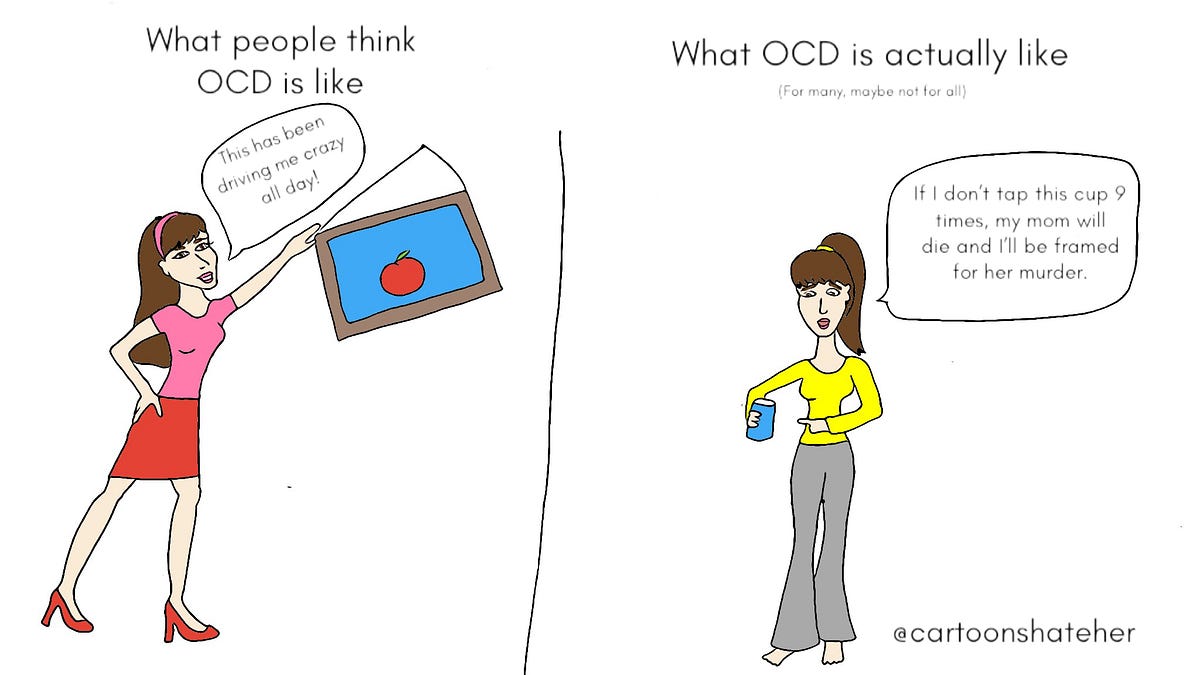
Generally, the OCD stereotype is that of a germophobe or a neat-freak. At one point in my late teens, I actually had this type of OCD. In fact, this textbook-obvious case of OCD was what helped me get [diagnosed](https://www.cartoonshateher.com/p/all-the-things-i-didnt-know-were). In particular, I was terrified of catching genital herpes or HIV from non-sexual means. After losing my virginity on the young side, I became voluntarily celibate for two years, specifically to avoid STIs. I did a lot of “typical” OCD things, like washing my hands nine times every time I washed them, returning home to check to make sure I had turned off appliances, counting my steps from one place to another, and engaging various in magical thinking rituals. I would try to guess if someone was promiscuous—even a family member or friend’s parent—before I used their bathroom. When I saw an older relative cutting sausages for a charcuterie board, I peppered him with random questions to figure out if he might have hepatitis C given its prevalence in the baby boomer generation (my concern was that a if I ate the sausage, it might have some of his blood on it.) And for some reason I still can’t explain, I was convinced the underpants I chose to wear on any given day would determine the fate of my loved ones. If a pair of underpants just gave me “bad vibes” I wouldn’t wear it, so getting dressed would take forever.
s_!dIFp!,w_1456,c_limit,f_auto,q_auto:good,fl_progressive:steep/https%3A%2F%2Fsubstack-post-media.s3.amazonaws.com%2Fpublic%2Fimages%2Fae9b14fc-355a-4f55-bfcb-b783948e591d_2048x1202.jpeg)
This was also the worst my OCD ever was. Even at its worst, I was able to do most things. I was never a danger to myself or others. I never self-harmed, unless you count excessive hand-washing leading to cracked skin. I didn’t abuse hard drugs. I still got decent grades in school, graduated high school, and then went to college. I still dated. I still had friends. Even at its worst, my OCD was not in the category of severe mental illness.
You might be reading all this and saying, “Oh, none of this is that bad. This is an example of those cute mental illnesses that the online mental health advocates find comfortable and acceptable!” But actually….you’re wrong. Even my relatively tame, non-taboo OCD has made people incredibly uncomfortable—not because I was involving them in some ritual or compulsion, but just because I was speaking openly about it to them, or because they witnessed an obsession in action.
First of all, I learned a while ago that I shouldn’t talk in detail about my OCD to anyone who is not already a close friend (or a subscriber of this Substack, I guess.) I have lost countless budding friendships after opening up in slightly more detail about my anxiety, after believing the other person to be on the same page. In particular, I remember having a woman and her children over for a playdate (our sons were the same age.) She confessed to me that she was a “major hypochondriac” and struggled with anxiety about her children’s health and safety. Figuring we had this in common, I reassured her that she wasn’t alone. Everything was going well—in fact, we seemed like kindred spirits with the exact same form of anxiety. But then, out of the corner of my eye, I saw my 5-year-old son cover my 2-year-old daughter with a heavy blanket and attempt to jump on her—something he had tried to do before, and which I already told him not to do because it scares her. Immediately, my mind flashed to suffocation, or broken arms and legs leading to police and CPS involvement. I jumped out of my chair and ran over to make sure my toddler was okay, while shouting, “How many times have I told you not to do that?” to my son. As it turned out, my son and his playdate-mate were just playing peek-a-boo with his little sister (or at least they said that was the plan.) I apologized, and turned to the other mom to explain to her that my son had previously used the blanket to tackle and scare his sister, so I thought that’s what was happening. I also clarified I wasn’t talking to her child, only my own.
I could see her finding it a bit jarring when I had that “big” reaction. But who hasn’t raised their voice to stop their kid from doing something dangerous? Besides, hadn’t she just told me that she had anxiety about her kids’ health and safety? Anyway, I never heard from her again, and that one moment seemed to be the tipping point.
I’m not arguing that my reaction was reasonable or good, only that it falls into the category of everyday, non-psychotic, high-functioning mental illness. What did you think mental illness meant? Vibes? Papers? Essays? Losers.
Back in my early twenties, my OCD manifested as intrusive thoughts that I had done or said something horrible while drunk. It didn’t help that at the time, I was using alcohol (through socially acceptable nightlife activities) to quell my intrusive thoughts in the first place. I would often ask my friends or acquaintances to let me know if I said or did anything bad when I was drunk. One time, I was terrified that I had cheated on my husband, not even with any man in particular. I had vague memories of having sex that night, which I were 99% sure were with my husband, but I couldn’t be 100% sure. Even after friends reassured me that I was with him all night, I looked back at photos from that night to see if there was any evidence of me socializing with another man. Again, is this normal or mentally healthy behavior? Of course not. But it’s boilerplate OCD behavior. It’s not dangerous or self-harming. And people did not take kindly to it! People stopped hanging out with me because it was just too weird for them, even after I explained this was likely an OCD obsession and that I knew it was weird.
Unsurprisingly, OCD affected me in the workplace. In the most egregious example, I worked briefly at a company that prided itself on “mental health awareness.” Almost all their company mission statements were about loving their people, taking care of their people, and wanting us to bring our authentic selves to work. Like some kind of imbecile, I believed them. But before I took the role, I made sure that it was “0% travel” because traveling away from my husband was my #1 OCD trigger at the time. I even got this in writing to be extra sure. As soon as I began working there, they surprised me with an update that I would be traveling multiple times per month. I didn’t want to be ostracized for my OCD, so I gave a bunch of other, more socially acceptable reasons for why I didn’t feel comfortable traveling. Finally, I decided honesty was the best policy, and I told them the truth about my OCD. I also offered solutions, such as a reduction in travel without complete elimination, or assigning me only to local clients (we had plenty!) They assured me that OCD was covered under the ADA and they would find a solution to provide reasonable accommodations. Then, they fired me the next day. They said I was a “bad culture fit.” They also asked me not to litigate, and for this they would reward me with Dr. Evil voice seven hundred dollars.
The easy answer here was that this company was just lying about caring about mental health. But I don’t think they saw it that way. They “cared” about mental health insofar as the company health insurance policy would partially cover therapy, and presumably, the people who used this therapy would never need any accommodations or show any signs of mental illness. Realistically, a lot of “mental health stigma-busting” is really just about making it more acceptable for people who have vague low self esteem or residual anger about their parents’ divorce to get a therapist. Their bar for which mental illnesses are actually acceptable is incredibly low.
My OCD has also attached to body image (well, face/skin image). I was very anxious about my appearance as a teenager, and even today I sometime get stuck on the idea that my husband isn’t attracted to me, or at least not as attracted to me as I am to him. These days, I reference this insecurity with tongue-in-cheek humor, but it still freaks people out to see a mother in her thirties who is concerned with something as immature as physical leagues and looksmatching. As long as I’ve had this obsession, I’ve been maligned by other people was an immature, vapid, shallow loser. It almost feels like people are more empathetic toward an imaginary bulimic person than someone with a perfectly healthy lifestyle who just has open insecurities about her pre-jowls. It’s a lot easier to manifest empathy for mentally ill people when they exist in the abstract. Consider that most of us would say we feel intensely for the struggles of people with eating disorders, but are quick to skewer and ridicule “almond moms.”
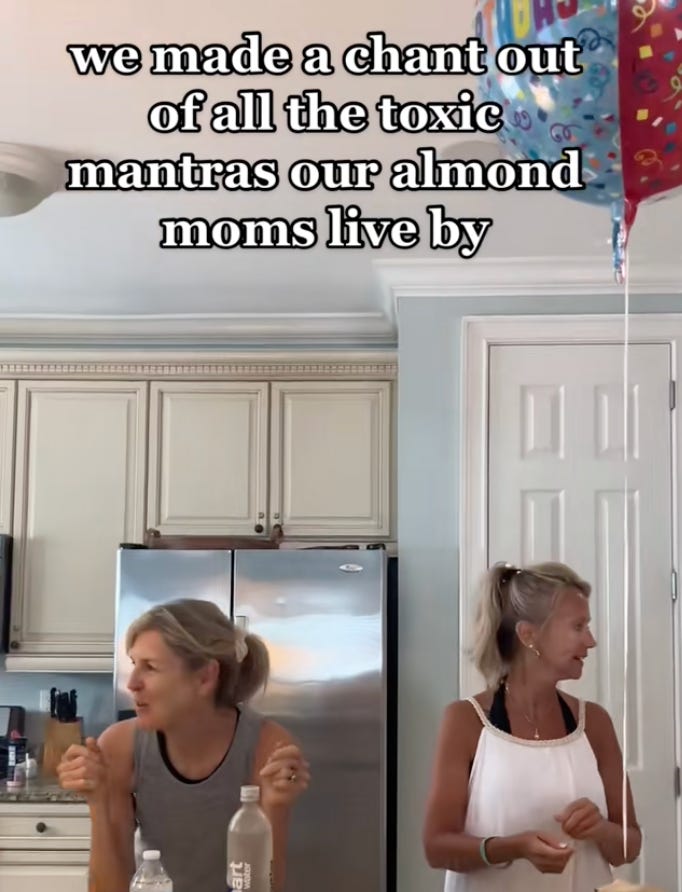 Your annoying almond mom has an eating disorder.
None of this is to excuse the behavior of “almond moms” or any other mental illness, if it causes real harm. For that matter, I don’t think being antisemitic is okay just because you have bipolar disorder. But instead of ridiculing and ostracizing people with mental illness because they did something weird or offensive, we should probably try to examine how their mental illness contributed instead of blithely arguing that mental illness would never make someone do something that bothered us, ergo, they must just be inherently bad people. Dare I say: almost everything that any mental illness does will bother someone.
People will say they struggle with mental health themselves, and that they support other people who struggle with mental health, but they really can’t deal with seeing mental illness in action, even if it’s relatively mild. I have plenty of other examples, both from my own experience and things I’ve witnessed. In particular, subreddits for interpersonal advice are almost always guaranteed to dogpile on anyone who posts anything related to their mental illness. I’m reminded of a woman who posted, with plenty of self-awareness, that her anxiety gave her intrusive thoughts about her fiance not being faithful to her. She posted asking for advice on how to deal with this, not accusing him of cheating on her. But the response was that with such an “extreme” degree of mental illness, she shouldn’t be getting married at all—she should postpone her wedding until she had “gone to intensive therapy, gotten on meds” and essentially gotten cured.
They do not think you’re worthy of love, marriage or parenthood until you are “cured.” They won’t use that word, but it’s what they mean. And I know this because if you tell these people that you’re already in therapy, or already on medication, or even give them details about all the progress you’ve made, they will insist you need more. More therapy, higher doses of medications, more medications. They aren’t satisfied until your mental illness is a blip in the history of your life, a dark period that you eventually moved past, with zero relapses or recurring hiccups. They are intensely uncomfortable with the idea of someone living with mental illness forever, even if they have insight into it, and even if they’re actively treating it and managing it. To these people, “managing” your mental illness means you never experience symptoms, so really, they see it as a cure. And many mental illnesses cannot be cured.
Another Reddit post, which later went viral on Twitter, was from a man who experienced lots of intrusive thoughts about not really finding his partner attractive. This man had a very obvious case of OCD. I’m not going to say I’m a doctor, or that I can diagnose someone from a Reddit post, but assuming the post was real, I would be shocked if he didn’t have OCD. But the comments were mostly just mocking him or calling him shallow and misogynistic. Very few people were able to see his intrusive thoughts for what they were, even as he explained they were unwanted and distressing—the very definition of an intrusive thought.
Several years ago, a woman posted to TikTok about how her OCD treatment involved labeling her “racist intrusive thoughts” as OCD. She didn’t clarify what the thoughts were, only that she had repeated intrusive thoughts that she was secretly racist. This is actually a well-established subtype of OCD! Those who suffer with this subtype are often not racist, and in fact, the reason racism distresses them so much is because being a racist is about the worst thing they can imagine (OCD will always hijack your worst fears, never something you find low-stakes.) This woman was bullied relentlessly for being “proud” of her racism and was told by countless people that “there are some things that shouldn’t be shared.” And remember: this was a woman with a high degree of insight, openly labeling her intrusive thoughts as OCD and raising awareness of the disorder, not shouting obscenities in public. And people still couldn’t tolerate it.
When the TikTok racist OCD controversy happened, the first thing I considered was that it’s a good thing these people were apparently unaware of the existence of POCD—a subtype of OCD where the sufferer is plagued by disturbing, intrusive thoughts of them secretly being a pedophile. Again, they worry about this because being a pedophile is the worst thing they can imagine. They are not pedophiles. In fact, sometimes as a way to quiet these thoughts, they will avoid children entirely, even their own kids. Because mothers of young children spend a lot of time doing care work involving diaper changes and baths, POCD is fairly common in this population—even though it’s statistically extremely rare for a woman to be a pedophile, and moreover, to be the type of subtype of pedophile attracted to infants.
POCD isn’t rare! It’s not a weird, niche subtype—it’s a common subtype you will see frequently if you are part of any OCD support group or forum. In fact, when I was active on r/OCD, I saw so many POCD posts that I actually began to find them boring and repetitive. But people already can’t tolerate hearing about intrusive thoughts about mundane, everyday things like jealousy and hypochondria, let alone intrusive thoughts about molesting children. And at the end of the day, all of this a the “cute” or “acceptable” mental illness. OCD is generally a neurotic disorder, not a psychotic one. Is it any wonder that people can’t tolerate bipolar disorder (also fairly common) when even OCD is beyond the pale?
People will assume that because OCD is one of the “acceptable” mental illnesses, that there must be something darker at play if an OCD sufferer says or does something that’s intolerably weird or taboo, aka, anything at all. Once, I posted on Reddit about my own struggles with health OCD regarding my children, and was immediately armchair-diagnosed as having Munchausen’s by proxy (MBP) a rare and serious mental disorder where parents purposefully harm or sicken their own children to get attention and sympathy. Keep in mind their only evidence that I had this disorder was that I was very scared of my children getting sick, not that I was actively making them sick. If anything, I have the opposite of MBP! But it was shocking that a group of Redditors—a population extremely likely to have OCD themselves—couldn’t stand to see a mother worry about something as “normal” as her kids’ health.
OCD can also be misdiagnosed, not only by the armchair psychologists of Reddit (who have also been kind enough to diagnose me with multiple personality disorders because my OCD was just too insane to be “just” OCD.) Some OCD sufferers are so attached to their intrusive thoughts, and with low enough insight ot be misdiagnosed as schizophrenic. When I had an anxiety attack at the pediatrician’s office as a child, my pediatrician suggested to my mother that I might have bipolar disorder (I don’t.) A viral Reddit post (which I hope isn’t real) detailed a man who forbade his wife to have contact with her POCD-suffering brother, convinced that he didn’t really have OCD and was actually just a pedophile.
Beyond the fact that plenty of OCD manifestations are just too taboo for public consumption, I think one thing that really irks people is when someone has a high degree of insight into their OCD, but still frequently falls victim to it and is unable to be cured. In their minds, mental illness always has an endpoint. It becomes a weird prior chapter of your life, you can turn the page, and look back on it to say, “Ahh, those terrible times, before I discovered therapy.” They are extremely uncomfortable with the idea that you will be like this forever.
I don’t know anything about Ye’s mental illness journey or whether or not he will ever find a treatment that makes his bipolar disorder an “issue of the past.” I don’t know if he was an antisemite before he started struggling with his mental health. But I do know there are many people like Ye—even people who have done far less taboo things, had far less embarrassing obsessions, and caused far less harm—who are still persona non grata within the “mental health awareness” community.


Write a comment