No, Trump Can’t Make Manufacturing Great Again
Weekday posts will be free forever. When I have something not too urgent that I have an itch to publish on a weekend, I may put it behind the paywall. This is an experiment; we’ll see how it works.
This post is about how Donald Trump’s policies couldn’t “make us a manufacturing nation again” even if they succeeded in greatly reducing trade deficits. They won’t, which makes it something of a moot point, but people should understand both that we are going to be a service economy no matter what, and that that’s OK: a fixation on manufacturing as the only source of good jobs is generations out of date.
In the summer of 1992 I flew to Little Rock, Arkansas for an audition. Officially, of course, that wasn’t what it was; then-governor Bill Clinton had invited a number of Democratic-leaning economists to talk about policy issues. But everyone understood that our performance would help determine whether we would be offered jobs if he won the presidential election.
At one point Clinton asked how we could get employment in U.S. manufacturing back up to historical levels as a share of total employment. Heads turned to me, since this was clearly my lane, and I answered something like this: “Well, Governor, that really isn’t possible. Even if we could eliminate our trade deficit, the manufacturing share would still be much lower than it was in the 50s and 60s.”
Needless to say, I didn’t get a job in the Clinton administration. I’ve been thankful ever since.
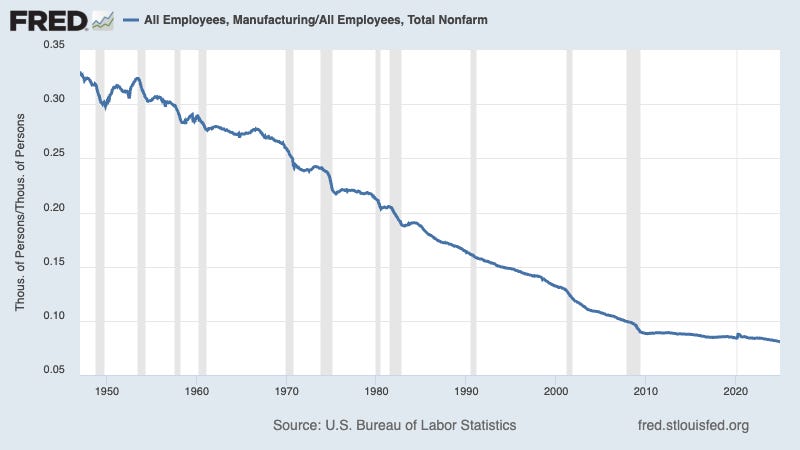
But I was right, and what I said then is still true. Donald Trump declared in his inaugural speech that “America will be a manufacturing nation once again.” No, it won’t. As I’ll explain shortly, Trump’s policies are actually likely to shrink manufacturing, but even if they weren’t, we aren’t going back to the days when manufacturing employed a quarter of the work force rather than its current 8 percent.
To be clear, there is a case for promoting U.S. manufacturing in sectors of strategic importance. Between Putin and Xi, the national security case for tariffs or subsidies looks stronger now than it has for generations. But such policies won’t change the fact that these days we are overwhelmingly a service economy.
And that’s OK. The popular belief that only manufacturing can offer good jobs to ordinary workers is wrong; in fact, at this point manufacturing doesn’t offer especially good jobs. We can make things better for American workers, but a fixation on manufacturing gets in the way of real solutions.
Let’s look at some numbers.
For a generation or so after World War II, America really was a manufacturing nation. Industry employed more than a quarter of the nonfarm work force:

And it accounted for a comparable share of GDP:
s_!2-km!,w_1456,c_limit,f_auto,q_auto:good,fl_progressive:steep/https%3A%2F%2Fsubstack-post-media.s3.amazonaws.com%2Fpublic%2Fimages%2F3a075c50-2c07-4c86-a8f9-cc63c447c4e1_958x580.png)
Source: BEA
But manufacturing’s relative importance has steadily declined. At this point substantially more Americans work in health care than in factories:

The question is, what caused this decline, and can it be reversed?
Trump obviously blames foreign competition and believes that we can make manufacturing great again if we force foreigners to stop running trade surpluses. And to be fair, America’s move into persistent trade deficits, which [really began under Ronald Reagan](https://paulkrugman.substack.com/p/the-dollar-and-the-trade-deficit), has been a contributing factor to manufacturing’s decline.
But trade deficits weren’t the main reason for manufacturing’s relative decline. What was? Basically, it’s the same story as the relative decline of farming as an occupation, even though America is a big agricultural exporter. We got so good at farming that we no longer needed many farmers; similarly, rising productivity in manufacturing has reduced the need for industrial workers.
Uh-oh, you may think, doesn’t that mean that rising productivity will eventually lead to mass unemployment everywhere? No, that’s a fallacy of composition; read my old Slate article “[The accidental theorist,](https://slate.com/business/1997/01/the-accidental-theorist.html)” which explains it all in terms of hot dogs and buns.
And while trade deficits have also been a factor, even eliminating our trade deficit would still leave us much less of a manufacturing nation than we were in, say, the 1960s.
Consider the comparison between the United States and Germany. We import more manufactured goods than we export; Germany does the reverse, running a huge trade surplus in manufactured goods relative to the size of its economy. (Like [China’s trade surplus](https://paulkrugman.substack.com/p/chinas-very-bad-no-good-trillion), this is a symptom of economic weakness rather than strength.)
So does Germany have a bigger manufacturing sector, in relative terms, than the United States? Yes, but even so it has declined over time, and it’s nowhere near as big as American manufacturing used to be:
s_!Mdvk!,w_1456,c_limit,f_auto,q_auto:good,fl_progressive:steep/https%3A%2F%2Fsubstack-post-media.s3.amazonaws.com%2Fpublic%2Fimages%2Fe8017ee1-945a-4d53-9321-b8c4294e12fc_1016x630.png)
Source: BEA, World Bank
And America is not going to run Germany-sized trade surpluses. For one thing, the world couldn’t and wouldn’t absorb US exports on that scale. Germany only manages to avoid a severe backlash partly because it’s a much smaller economy than America or China, partly because people tend to think of it as just part of the euro area.
No, we’d be lucky simply to eliminate our manufactures trade deficit, which would bring us roughly a third of the way toward a German-sized manufacturing sector, i.e. around 13 percent of GDP — far below its level in the 1960s, and in fact smaller than it was when I gave Bill Clinton the wrong answer.
In any case, Trump’s policies won’t eliminate our manufacturing trade deficit. If anything, they’ll make it bigger. Tariffs will lead to both foreign retaliation and a stronger dollar, hurting U.S. exports even as they reduce imports. Tax cuts will cause a potentially inflationary rise in the budget deficit; combined with the inflationary impact of tax cuts, this will cause the Fed to stop cutting rates and possibly increase them, driving the dollar and the trade deficit even higher.
True, Trump may try to force the Fed to cut rates despite the risks of inflation. If so, hello stagflation.
Anyway, the bottom line is that we are never ever getting back together to being the manufacturing nation of yore. But why should we want to go back?
Many people seem to believe that manufacturing is where the good jobs are. But that isn’t true and hasn’t been true for a long time. As of December, according to the BLS, the average production or nonsupervisory job in America’s private sector paid $30.62 an hour. In manufacturing the number was $28.34 — less than the all-industry average.
Why do people imagine that manufacturing offers ordinary workers good jobs? In part because it used to — not because there’s something inherent about working on an assembly line that leads to good wages, but because once upon a time many manufacturing workers were represented by strong unions. Now they aren’t, and manufacturing jobs are nothing special.
Also, I can’t help noting than even now many people think of working in a factory as something real men do, while, say, nursing is female-coded.
The bottom line is that Trump is (surprise!) selling a fantasy rather than an actual solution to workers’ problems. If we really wanted to bring back the days when workers without college degrees could afford a middle-class standard of living, the answer isn’t pipe dreams about bringing back manufacturing; it’s unionizing service sector giants like Amazon and Walmart.
MUSICAL CODA
Write a comment