A Conversation with Jim Chanos
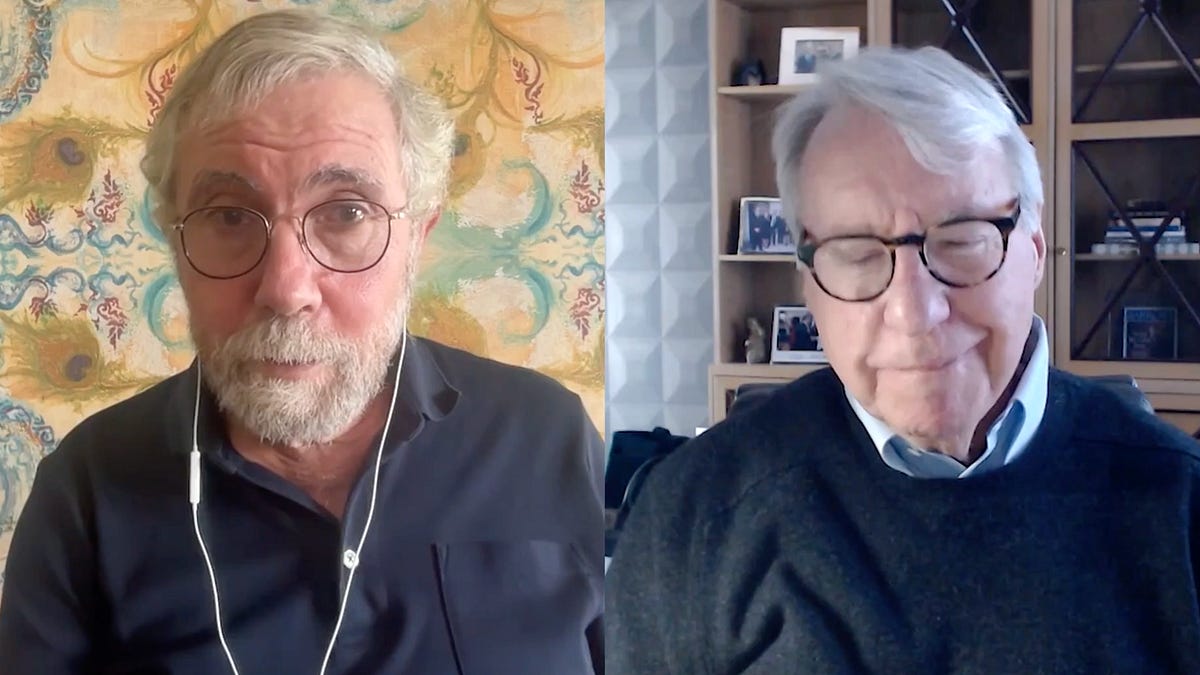

For me, one great thing about this digital era is that I can converse with interesting people without all the rigamarole associated with studio recording. It’s not just that you don’t have to be in the same place; if you’ve never done it, you have no idea just how much of your time gets wasted to do even a few minutes of live TV.
Recently I talked to Kim Scheppele about the death of democracy in Hungary (and we’ll record around 10 more minutes about the U.S. situation soon.) Now for something completely different: a talk with Jim Chanos, the legendary short-seller, about the state of the markets and the world.
I knew Chanos through the “dinners” he refers to in the conversation. Every couple of months some civilized Wall Streeters, media people and economists get together for a dinner where we plot global domination carefully analyze global trends drink wine and tell bad jokes. Chanos has come to some of those dinners, and despite his fearsome reputation is charming, completely approachable and something of a historical scholar (he’s been teaching courses at Yale and Wisconsin.)
I hope you find this conversation as interesting and as much fun as I did. Video past the paywall, followed by a cleaned-up transcript.
TRANSCRIPT:
KRUGMAN: Hi everyone, I’m Paul Krugman. This is actually the second in my series of videos, though something else may appear before we get this one out. And I am talking with, for the most part interviewing, Jim Chanos, who is a Wall Street legend, legendary investor, famously someone who specialized in short selling..
The most famous one was he caught on to Enron before pretty much anyone else. And I suspect, Jim, that you feel a little, probably a little peeved that that’s all anyone remembers — a little bit like all anyone remembers George Soros for is breaking the pound. But there’s a lot of stuff in there. And when we were talking, texting back and forth to set this up, Jim, you suggested Golden Age of Fraud as a kind of headline.
So let me just ask, just before we get into some more specifics, is there anything that you would like to say about where you think markets and the economy are right now? I mean, you’ve been through the wars over many decades. What do you think of where we are now?
CHANOS: Yeah, so the one thing I’ve learned after 40 years of running money is that my idea of where the markets are going is pretty much worthless. So it really, what you can do at any given time in market cycles is look at things like sentiment and valuation and give you an idea of what kind of risk you’re taking. It’s not necessarily timing mechanism, but should anything go right or anything go wrong, more importantly what type of risk are you incurring? And right now, I believe pretty strongly that risks are pretty elevated for lots of reasons. We can get into them. But valuations are very, very high. And they’re very, very high on what are basically all-time high corporate profit margins, which used to mean revert, but don’t apparently do that anymore, as you know better than I do.
And then you’ve overlaid on this now a really, really set of new political economic risks that could really take things in all kinds of different directions with unintended consequences. There’s elevated valuations on elevated profitability with a dynamic that is somewhat new in the political sphere.
Does that mean the market cap keep going up 20 % a year for another few years? I have no idea. I’ve learned long ago, starting about 1996, 10 years into my investing career, I just began to hedge our short picks and just take the market out of them and say, okay, well, I can hopefully find flawed businesses, but I really can’t predict where the market’s going short term.
KRUGMAN: Yeah, mean, what really struck me, and I have to admit I was not fully aware of until I started doing my homework, was that your specialty is not outguessing the market, not saying, I know where things are going, or even that I know that this business isn’t as good a business as people think. It’s more there are clear forensic signs of fraud here.
Your specialty has been finding companies that you think are legally or not cooking the books. Is that a fair description?
CHANOS: Mostly legally! One of the five models i teach in my history of financial fraud classes for my mutual friend Bethany McClean is this wonderful concept called legal fraud whereby everything a company does is technically legal by the book about the regs but yet there’s an intent to deceive and today virtually almost all public markets fraud fits under that umbrella.
You do get the very rare thing where someone just makes stuff up. For the most part, the lawyers and the accountants sign off on things that are intended to deceive you. Enron was the classic example. Enron was prosecuted for lying to shareholders, not cooking the books. And the books were cooked.
KRUGMAN: Yeah, actually, can you tell me about that? what did they lie to shareholders about that was illegal in a way that the book cooking was not?
CHANOS: A lot of it was the nexus of the off balance sheet entities where they hid material facts from investors that only the people who invested in the off balance sheet entities knew about but the shareholders didn’t and a variety of other things that flowed from the special purpose entities that were off the balance sheet.
The prosecutors, as is often the case, find it far easier to catch management in a lie on a conference call or in a statement than to explain the use of mark to model accounting on energy derivatives that were just as egregious, but juries don’t understand. And then when you get an accountant to come up and say, yes, under certain circumstances, this is accurate. Under certain circumstances, it’s not.
It’s hard to really go beyond the shadow of a doubt in a criminal case. Whereas if you can point to a false statement, it’s much easier for juries to understand that.
It’s easier to convince people that some verbal statement was a lie than convince them that the numbers were cooked. I find that all the time.
KRUGMAN: One of your other more recent really famous calls was Wirecard. Was what they were doing illegal? The German company that imploded seems to have had no real business there.
CHANOS: Right. So we did not do the original work on Wirecard. Like a lot of short sellers, we saw a series of reports that had come out of Europe and the UK in 2016 and 2017. So we kept an eye on it. But it wasn’t until the FT and Dan McCrum did a series of articles in 2019 that really, for the first time, pointed exactly where the fraud was occurring.in the Gulf States and in the Philippines and possibly Singapore. And then the bombshell for us and the reason we got short in the fall of 2019 in a big way was a follow-up set of articles in the FT with documents. And that was a smoking gun. And what was amazing about that, Paul, was that once you saw the actual documentary evidence, the supervisory board basically resigned a few months later.
They hired a third party auditor to audit the claims of the journalists and the short sellers. And that firm, KPMG, basically said the company wasn’t cooperating with them. And the stock still traded for another two months at an insane valuation until the company came out in June of 2020 and admitted the money wasn’t there and everything collapsed in three days.
It was a wonderful example of financial cognitive dissonance. From October 2019 to June 2020 you actually had real evidence of fraud and the market still didn’t care until the company admitted to it.
KRUGMAN: I’m going to be still very nonlinear here. Do you think that that sort of thing where it, um, markets just keep on believing even though the numbers tell them that they shouldn’t believe, is that more prevalent now than it used to be?
CHANOS: I think so. one of the things that again, one of the other themes I teach in my class, Paul, is that the longer the financial and economic cycle goes on, the more people suspend their sense of disbelief. So after people lose a lot of money, they’re very skeptical about things that are too good to be true. But once you go 15 years into a cycle or 20 years into a cycle, you basically get a whole new generation of investors, which is certainly the case now.
And people believe things that are too good to be true because there’s fear of missing out. Nobody really gets upset until they start losing money, including prosecutors and regulators. And so the longer this goes on, the more kind of egregious it gets until something pops the bubble. And since most frauds need to constantly raise capital to finance themselves, once the capital markets dry up, the bodies begin floating to the surface.
This goes back to, you know, hundreds of years.
KRUGMAN: Okay, this is kind of your version of Minsky, That long swings in which when markets are rising, everybody becomes very credulous and goes on for a long time.
CHANOS: I actually teach that macro model. We teach Kindleberger/Minsky as our macro model for fraud where you get it. You get a displacement. You get a big idea. Typically AI or the internet, the dot com era or, you know, radio and all the wonderful things in the 1920s, a railroads in the 19th century, the new world going back to our friend, John law and the and Mississippi company and, and, and, and the South sea bubble. So there’s always a big idea in the big waves of fraud where people begin to believe things that are too good to be true and what I’ve often said is that in bull markets people put a premium on promises and in a bear market they put a discount on reality and right now we’re putting a premium on promises.
KRUGMAN: Let me talk about some of the historical examples for a minute. How much of this is that big new ideas only come along every once in while? How much of it is just generational that the people who remember that bad things can happen have left?
CHANOS: Well, I saw a wonderful statistic a number of years ago, and it seems right, but I’ve never verified it. We had a wonderful bull market after World War II from 40, 45 to 68, basically. And then from 68 to 82 in real terms, the stock market went down as much as it did in the Depression. And I came into Wall Street in 1980. People thought I was crazy.
But I remember reading something that between the peak in Wall Street employment in 1968 to 1981 or 82, the actual amount of high paying professional jobs in Wall Street dropped something like 60 or 70%. So literally people not only lost money, but they lost their jobs. And nobody wanted stocks in 1980, 81. We had the famous death of equities cover on Business Week in 79.
People thought I was crazy to go to work on Wall Street in 1981 and so then where the bull market started you literally had a whole new generation of investors who had forgotten about the horrible seventies and you know we’re off and running. And we certainly have that today particularly the after the two bear markets dot com bear market and then the global financial bear market.
But you we have a whole new class of investors today who are buying zero dated options and buying crypto meme coins and we see in the volume numbers we just had at the big brokers, Coinbase and Robinhood report I mean the amount of trading volume their clients are doing a speculative items is just off the charts.
KRUGMAN: There was a discussion some years back on one on an economics blog from Ireland — an influential one — where they asked, what does the market want? And the best answer was that the market wants hookers and cocaine because the market is a bunch of 20 somethings who don’t know anything else.
That’s who they are. So yeah, let’s talk about some of these things. So crypto, like, mean, I have some pretty strong views about that and, and that’s the thoughts, but where’s your view on that? And I have a follow up question.
CHANOS: I’ve never owned a cryptocurrency. I don’t see the need for it. I’m puzzled a little bit by the use case. It seems to keep changing. It originally was going to be a stateless replacement currency for the dollar or what have you. Why the US would give up that hegemony is beyond me, but there you have it. And then it morphed into inflation hedge.
And then it morphed into store of value. And yet if you just look at the data on whether it’s Bitcoin or some of the secondary or tertiary coins, they pretty much track the NASDAQ almost day to day. I mean, they’re speculative assets. And so I don’t know that there’s still a valid use case.
People are trying hard to get sovereign wealth funds to buy them and okay I mean if you want to buy gold buy gold if you want to buy diamonds buy diamonds, well buy bitcoin buy bitcoin but as a security analyst I don’t think it’s a currency, as a security i don’t really think it has the attributes of the security that I would like to see so I don’t know
KRUGMAN: So I put in a fair bit of time on this and actually I made money off crypto by being invited to conferences as the designated enemy and being paid a fee in dollars. But the thing that puzzles me is not, I agree, can’t, the only use case I’ve been able to identify is money laundering.
CHANOS: Illegal uses
KRUGMAN: But what has amazed me about crypto is that it’s not new. Bitcoin was introduced in 2009. Bitcoin is barely newer than the smartphone. And yet it manages to keep this aura of the coming thing. I don’t know if you have any sense of why that is.
CHANOS: Well, again, I mean, it’s all part and parcel of kind of the zeitgeist of the market environment we’re in, right? It’s always about what something will be, not what it is. And I think that that really, so it fits very nicely with, you know, no profit Silicon Valley companies and all kinds of other things that are based on all the great riches that will accrue because of something that will happen 10 years from now. And predicting the future is hard. I’ve learned that the hard way.
KRUGMAN: Yeah, all predictions are hard, especially about the future. the question about since we’re on these things, so clearly AI has become a really big selling point. I mean, you’re no longer out there trying to short stuff, but do you have a sense of what’s going on there? there anything real? Obviously, this is not completely useless technology, but is it anything that justifies the kind of valuations we’re seeing?
CHANOS: Forget that. How about the capital being employed? There better be something new. I mean, we’re talking now for the just a top handful of companies doing $300 to $500 billion in capex \[capital expenditure\] annually. I mean, AI isn’t like the internet, which made things more capital efficient and raised returns on capital.
So far, AI is doing the opposite. It is a massively capital intensive business. Someone joked that the top tech companies are now looking like the oil frackers did in 2014, 2015, where more and more capital is chasing arguably a variable return. So I’m not a software expert. I’m sure AI will be embedded in all kinds of products.
And I’m sure new industries will come up and like the internet, it will destroy old business models. You know, I wouldn’t want to be an IBM right now, for example, or an Accenture or a lot of places that are basically consulting body shops because I suspect that those margins are going to be competed away. But will we see, will Microsoft and Google and Meta and Amazon see returns on the ever increasing hundreds of billions of dollars they’re now spending in this arms race? And will the economy benefit? So you’ll get a kick out of this. I went back and looked and I wanted to see what was US real GDP growth in the 10 years prior to the internet and 10 years after the internet’s broad introduction.
And I took 87 to 96 as the pre-internet because Netscape came out in 95. And then I took 97 to 06. I intentionally kept the global financial crisis out of that 10-year period to really make it as good a comparison. And there was, I think, one tenth of one percent higher GDP growth in the post internet age than in the pre internet age. It was a tool. It made a lot of big companies, but for overall economic activity, you would not have noticed it. And so I think AI, there’s a reasonable chance that we could see the same thing, that AI will bring forth all kinds of new businesses and possibly industries. It’ll also destroy some existing business models and whatever, and it’s creative destruction.
I just can’t tell you though the magnitude of the CapEx. And one other point about that as an economist and a finance guy we should talk about is that when you get these capital spending booms in technology, and remember in the internet age it was for the telecom build out, it wasn’t for the actual software, you get my capital, my CapEx dollars, my investment, which I do not expense, I depreciate over time, my capital investment becomes your revenues and profits.
So you get a turbocharged impact to the segment of corporate America during these booms where $500 billion of capital spending becomes $500 billion in revenues for a bunch of providers with big profit margins. And then the guys who are spending the money write it off over five years or seven years, whatever.
KRUGMAN: Maybe there’s a little bit of a difference between Nvidia and and the other guys in this. Nvidia is actually, you know, selling the chips. So they’re the guys selling shovels to the 49ers, the gold rush types.
For the others it almost looks like defensive investments. Google is spending hundreds of billions on AI for fear that somebody else will come up with an AI-based search engine that will take away their monopoly. But that doesn’t sort of justify a soaring valuation.
CHANOS: Nvidia is the Cisco of the last cycle.
We’ll see it and I think that the numbers are now getting so large from just even a couple years ago that the returns on invested capital are really now beginning to turn down pretty hard for these companies. And that was the one thing they really had. They had amazing, efficient capital models. And now they’re basically, as I said, like resource companies or steel mills. And so it remains to be seen.
You had this shock a few weeks ago when the Chinese announced a cheaper, you know, large language model, whether or not it exists or not. I don’t know, but what I highlighted to my clients at the time is that, you know, that’s the problem with investing in disruptive technology on the come. You might get disrupted before you yourself get an economic return by a better mousetrap.
KRUGMAN: Yeah, actually one question. The big capital spending during the 90s tech bubble was mostly by telecoms rather than the dot coms. And they left a lot of fiber that stayed dark for a long time. But it was at least there was something physical that came out of it. Does this boom produce anything like that?
CHANOS: Well, so I’ve been a bear on the data centers, the old data center companies, because now the new guys are building bigger and better and faster ones and the old ones are obsolete. But the problem is that it’s not so much the data centers that depreciate, they do because of the air conditioning and all the guts of them. It’s the chips that you’re paying $50,000 a piece for that are being leapfrogged by the same company, And so the question is how fast are you depreciating and are we gonna get into the realm of accounting chicanery? How fast are you depreciating these hundreds of billions of dollars if you have to keep re-upping newer and more expensive chips? So, you know, that’s where the rubber hits the road and the numbers are getting big enough, that in a couple of years, those are gonna be uncomfortable questions.
KRUGMAN: Kind of related, you mentioned fracking, which I thought was a, that’s a story that I think I remember you talking about. Bethany McLean, who broke the Enron story, talked about it a lot. And I don’t think enough has been made of it because it’s maybe not as sexy sounding a technology, but certainly there was a huge, huge enthusiasm. Why don’t you tell me what you think happened with the fracking business?
CHANOS: So it ended up being an accounting story. Like a lot of these things kind of turn out to be. And so I started talking to Bethany about it back in 2013, 2014, when we were looking at a company called Chesapeake Energy, which was run by a very charismatic guy, Aubrey McClendon. And he was kind of the the guy in fracking and selling it as a religion that the technology is now changing, that the integrated guys are dead, and I can do horizontal drilling and crack into all of these hydrocarbons for a fraction of the price. We started looking at it and then we began looking at the other companies. And what immediately jumped out at us of talking to people in the industry and looking at the numbers was that the technology was very real, like AI. I mean, it was a new technology. And the problem was that the fracked wells depleted very, very quickly. 60 % in your first year, and basically the economics were gone by three years. And then when you looked at the financial statements of the oil and gas companies that were moving into fracking, their average depreciable life on their capital base was still something like 12 to 14 years. And so the cap ex was massively more than depreciation.
And for a couple of years, people kind of ignored that and just said, well, look at the productions going up and the few spreadsheet guys like me pointing, wait a minute, your cap X is going through the roof and your marginal return on capital is below your cost of capital. And you better hope oil prices stay up because if they don’t, you’re going to crash and burn. And sure enough, 2015, OPEC put the screws on and you know, the rout was on and a lot of these guys had to restructure in 2016 and 2017 and a lot of them went broke. The industry now has gotten religion, by the way. If you look at the numbers now, they’re much more rational. But at that time, they weren’t. And all this capital was going into it and Wall Street got enamored. Private equity guys were throwing money at it. And it was just simply an accounting scam for about three, four or five years.
KRUGMAN: Accounting scam because, roughly speaking, people were valuing these as if they were conventional oil wells, which kept on moving for quite a while.
CHANOS: Somewhere in between. A traditional deep field like in Alaska or offshore might last 30 years. And the frackers lasted three years. And the depreciation schedules were sort of in the middle. And it really made no sense if you were a fracker to be depreciating over 14 years.
KRUGMAN: Okay, and it’s interesting because I think most people even people who follow this stuff don’t kind of know that story. People know about the dot coms, and they know about the housing bubble, but somehow the whole fracking thing, which was a lot of money, sort of got lost in the shuffle, isn’t part of the narrative. I kind of wish it were because it would be more of a cautionary tale for people now.
You and I both are old enough to remember dot com and all of that and the power of narratives, but it seems that the power of happy narratives about investment opportunities has grown. Is that your sense as well?
CHANOS: We see it in the behavior. It started really kind of kicking into overdrive right before COVID in 2019. We began to see an explosion in option trading volume and sort of retail coming back into the market. They kind of, from 09 to 19, basically they were buying mutual funds and S &P index funds and whatever. But 2019, something changed.
Some people say it was going to zero commissions that year, which happened, or the Fed reversing itself, it was tightening in 2018, and then it panicked at Christmas of 2018 and began easing again, a little bit like what Greenspan did after LTCM in 98, you remember. And that kicked in the speculative mania in 99 in 2000.
And in any case, with the exception of one month of COVID, March of 2020, I mean, basically we’ve seen nothing but just an increase in speculative activity and zero dated options, crypto, NFTs. had the SPAC mania in 2021. At one point, SPACs were raising about two and a half to three billion a night in February of 2021 which was roughly equal to the entire US savings rate at that point.
KRUGMAN: Since some of my listeners won’t know, tell us, what is a SPAC.
CHANOS: SPACs were something that’s been around for a long time, a special purpose acquisition corp. And it really was, a backdoor way to go public in a very kind of interesting way. You set up a shell company, you raise money, and you tell your investors that if you don’t find an acquisition candidate within a couple of years, you’ll get your money back. And so the reason promoters like it is they can take a big cut of the deal, typically 20, 25%. But the best thing of all, is that SPACs have a carve out from the registration rules under the SEC, and they enable you to put projections out there before the deal closes. So instead of putting out a prospectus, you put out a deck. And guess what? They’re often a little too optimistic.
KRUGMAN: So it’s basically hand me your money, trust me, I’ll find something good to do with it.
CHANOS: And then when I find it, I’m going to show you how it’s going to be a home run. We’re going to do space flights, we’re going to mine asteroids, and we’re going to, you know, what have you. So really, some crazy, crazy stuff came public in the first half of 2021. As I often said, Wall Street has a printing press too. And when you get the speculative juices going, you know, people will find pieces of paper for you to buy.
KRUGMAN: What really struck me was that back in the day, pre-COVID, we had near zero interest rates (for some very good reasons). But one of the things that people who were opposed to that policy kept on saying was, it just feeds speculative mania. It just leads to all this crazy stuff. And now, of course, we’re a long way from zero rates and mortgage rates around seven and speculative fever seems to be completely unbroken. But you’re saying you think it’s basically just that the people who are now trading have never really seen bad stuff happen.
CHANOS: It’s animal spirits. I’ll give you a wonderful anecdote from my world that kind of was an eye-opener for me. So we were short in 2021, we were short of a company called DraftKings, which is one of the big public traded gambling sites. And we know that there’s a gambling boom going on in the states have all begun to legalize it. And we couldn’t make the numbers work out.
Because historically, we had a long set of data series on sports gambling, legal sports gambling in Vegas. And then for years and years, decades, the sports books in Vegas casinos made about 5 to 6 % of the amount wager. And that makes sense because I put up $10, you put up $10, the loser has to pay $11, and the bookie gets the one extra dollar. Then we swap the $10.
$21 is at risk to win 20. And then with parlays and bells and whistles, they were able to get that 5 % or so up to about 6 % for years. And so we ran DraftKings sort of forecasts out using very robust assumptions, but using a 5 to 6 % win rate. And we couldn’t really get them to be very profitable, even 10 years down the road.
The reason I covered the short was it became very obvious a few years in that for the new guys, the online gambling companies, the win rate is not five to 6%. It’s running double that, at 10 to 12%. And the reason for that is that people are not betting Philadelphia versus Kansas City in the Super Bowl. They’re betting, will Jalen Hurts run a touchdown in in the first quarter? — and pay me 50 to one. And so the parlay bets are massively much more profitable. And now this is a project for one of your PhD students, think. Because at what point does that get competed away or are we going to see permanently higher margins because people make stupid bets? And it’s a head scratcher.
But it was enough for us to cover our short because we realized that our model was wrong.
KRUGMAN: Yeah, sports gambling, basically online, has exploded kind of alarmingly. And at some level, it’s probably part of this whole phenomenon.
CHANOS: It’s all right here on your phone, right? You can buy options, you can speculate on the Super Bowl, you can buy crypto. It’s gotten easier. we can argue societal impacts about that separately, but it certainly has gotten easier and it’s introduced a whole level of new risk taking to younger and younger investors getting back to one of our original points.
KRUGMAN: Yeah, it’s kind of digital opiates. One thing I’m sure must be related to this, I don’t remember, and maybe it’s just because I wasn’t paying attention or didn’t have enough money to be an investor, but I don’t remember anything like the meme stock phenomenon in the past. Did it really happen?
CHANOS: It did. mean, so it takes different guises. In the dot com bull market, which is the closest analog I have in my career to what’s happening now, you had IPOs. You had very aggressive IPOs. You had the Internet message boards on Yahoo, which was the social media of the day. You had very small stocks going public at $10 and trading at $40 their first day before they went back to $5. And now we don’t see that as much in the pure IPO market, but where you are seeing it is in things like the meme coins, the meme stocks, and much more aggressive use of leverage on traditional stocks. So leverage on Tesla and Nvidia and these things where people are buying options to speculate, not the actual underlying equity.
KRUGMAN: What struck me about it, someone who really, doesn’t do markets much, is the, know, these soaring prices for sort of very ordinary companies where there isn’t even really a new idea. that I don’t remember happening. Again, I wasn’t paying attention.
CHANOS: Yeah. We have a number of companies we still follow that are trading forty and fifty times earnings that haven’t grown in the last five years and and you know again a bit of a head scratcher but yes the that they are out there the median stock is a lot more expensive today that it was in 1999 back in 1999 you had kind of a real bifurcated market you have the dot com and telecom guys. And then you had a lot of things that were relatively cheap at 12 times earnings, 10 times earnings, whatever. Today, very hard pressed to find things at 10 or 12 times earnings, even the sort of stodgy, no growth companies often are trading at 20 times or more. it’s an expensive equity market, there’s no doubt about it.
KRUGMAN: Yeah. I was writing something, know, parallels between AI and the dot com era. I said that, some, were companies where the idea made sense, but it just never became a big business. And I used the example of Pets.com and mentioned that, look, I actually order food for Jack our cat on Chewy.com. I hadn’t never even thought to look at what’s happening to the stock price. But Chewy apparently has gone up some enormous amount in the past year for no obvious reason.
CHANOS: Yeah, I mean, again, there’s all kinds of businesses, you never knew you needed. And then there’s some that, you know, are valued that may never make money. And, I mean, take a look at DoorDash. We, you know, who knew we needed to pay 3X for our fast food to be delivered to us? But there we have it. And so this happens in all cycles. But what does worry me is, I think there’s a lot more leverage in the system that retail investors are incurring, like the 20s when everybody was on margin and it was much greater than people thought. And it makes me worry that the risks of dislocating markets is getting bigger and bigger, meaning a 10 % decline becomes a 20 % decline very fast because of just risk models and people suddenly are seeing their equity wiped out on a 10% to 15 % move in prices and that scares me.
KRUGMAN: I probably should focus on that. A lot of my academic colleagues are kind of relaxed about things. They say, oh, yeah, it’s probably a stock market bubble, AI is probably way overvalued. But this is not like 2007, when everything was really leveraged. But you’re saying that there’s actually a lot more leverage out there than people realize.
CHANOS: Well, I think that it’s in the equity, not the debt instruments, right? So that we had a banking problem in 07 to 09 because there was transmission and the banks didn’t believe each other’s balance sheets for good reason. so consequently, had a multiplier effect through the banking system as equity values evaporated. And suddenly people realized, oh, well, he’s in solvent, he’s in solvent, he’s in solvent. And today, it’s personal balance sheets, I believe. I think it’s consumers are speculating in the markets to a much greater extent than people think. Theymight not be large amounts, but it might be a $50,000, you know, portfolio for someone that suddenly goes to zero because they’re on triple leverage, you know, out of the money call or call options. and, and so.
In that respect, it’s sort of like the dot com era on steroids or 1929 where really wasn’t in the banking system at first, it was retail equity holdings. I think that that is where the risk is. If you want to talk about a systemic risk, the systemic risk is, I think, sitting on household balance sheets where people think they’re worth X and they’re worth six figures and they’re really worth five figures. with whatever commensurate drop in spending that might engender or whatever. And that’s where I worry. I don’t worry about the banking system. I don’t see the stresses like I did in 89 in commercial or 2006 in residential. We just don’t see it.
KRUGMAN: Okay, it’s not a systemic breakdown thing, but it could still be a pretty big hit too.
CHANOS: Yeah, it could be a 2002 kind of problem.
KRUGMAN: Okay, which was, yeah, which we’ve kind of written off as if it was nothing, but it didn’t feel like nothing at the time.
CHANOS: Well, NASDAQ went down 80 % and the S &P went down 40%.
KRUGMAN: Yeah, and there was a recession. It felt like a recession at the time. Now I know that obviously one of your bets that went wrong, and I don’t really want to dwell on it too much, was Tesla. I think you were trying to do forensic accounting, and I was just saying, gosh, Elon Musk looks like an asshole.
I guess my question here is, we seem to have gone massively into crony capitalism in just a matter of a few weeks. How much of that are you seeing and how much do you think is distorting things?
CHANOS: So we’ve had in my investing career 40 years, we had two 10X, two 10 times against us stocks. One was America Online in the late 90s. And I covered right at the top, right before Time Warner bought them. I should have shorted Time Warner, but I didn’t. Tesla in 2019 to 2023. And most in 2019, 2020.
And again, we’ll see where that plays out in the future. But we didn’t have the guys at America Online running the White House, like we now may have Elon Musk. And actually, apropos of getting ready for our conversation, I want you to remember that at one of our dinners, I came down and I plopped down a giant book, the new biography of John Law, give it to Bethany McLean, because she was thinking about writing about John.
And you immediately said, my God, there’s a new biography of John Law, one of the great economic thinkers. I said, if you remember, also the greatest financial criminal maybe in modern history. And if you think about it, Elon Musk may be our equivalent of the 21st century’s John Law, because John Law was a big thinker who came from abroad and had all these wonderful ideas about businesses in the future in the new world that France could be doing how could pay off its deficit and basically the king was I think 12 years old so the Regent was running France and and John LAW befriended the Regent and basically became literally the Prime Minister the Treasury Secretary and the head of the Mint and was the richest man in the world AND for a few years, it was amazing, right? We had the Mississippi bubble, the stock went up 10X. People were gonna trade in their French bonds for shares. So the higher the stock went, the more they could pay it off the debt. And it was this wonderful perpetual money machine based on a big idea. And then of course the whole thing collapsed. And so I’m just wondering if Elon Musk is this century’s John Law. We’ll have to see.
KRUGMAN: Yeah, I can easily see Musk using his position to basically rip off the American taxpayer for very large amounts of money. It’s not clear to me how or why that money actually gets to Tesla shareholders as opposed to him personally.
CHANOS: Yeah, well, remember he’s trying to get that big pay package that Delaware denied, reinstated. well, I’ll just give you an interesting little anecdote because I just looked it up. So from 2012 to 2024, Tesla reported profits in the United States, only domestic profits of 7.9 billion pre-tax cumulative. Over that time frame they got back four point four billion tax credits from the US, so rather than pay one or two billion uh… they got back four and half. So you know there’s no one that has played the government trough and tax credits and benefits better. So there’s a little irony there of DOGE looking for fraud and wastein various different agencies that are woke. And meanwhile, his companies are getting value of tens of billions of dollars in credits and tax credits and incentive payments for his customers and rocket contracts. Anyway, you know, my view on DOGE is sort of bifurcated. It’s either going to be wildly successful and it’s going to be basically the way in which this group of political leaders takes away the power of the purse practically from Congress in ways we just couldn’t imagine in the past. And because of that, it’s going to have unintended consequences on the level of spending. you know, your dollar of waste and fraud is my dollar of revenue to get back to one of our earlier concepts.
So cutting all that spending dramatically could be an external shock that none of us are kind of thinking about, number one. Number two is that this is political theater. And it’s really going after just the political stuff I don’t like, like transgender rights and DEI and wokeness and this. And that really the impact on cutting the deficit would be minimal. And then…
Trump will point to that and say, hey, I thought they were smart guys. I hired them. They didn’t do the job. I’m sorry. It’s their fault, not mine. Because there’s one thing we know, the president can fall out of love with people just as fast as he falls in love with them. The first administration is good evidence of that. I think it’s going to be one of those two outcomes. It’s going to be very interesting.
KRUGMAN: Okay, it’s it’s I’ll give you a third outcome, which is something that I’m worried about which is that you’re parachuting all these young guys who really don’t know anything into these agencies and they can actually wreck the functioning of the government. Just before we had this conversation it turned out that they inadvertently laid off a large part of the staff that keeps our nuclear weapons secure, right?
Pretty amazing stuff. Any final words?
CHANOS: I think it’s going to be a very, very interesting juxtaposition in next couple of years because of the elevated risks in overall markets and then now these sort of wild torpedoes in the waters politically that I think we’re all kind of guessing as to where they’re going to go. And so the chance for exogenous shocks is now higher than it’s been for a while. You’ve got the youngsters in charge, as you just said.with all the fun and games that means, both youngsters in charge of the government and in the markets. That’s kind of a theme of our discussion today. the old guys like us just sort of scratching our heads. But I think it’s going to be pretty interesting for the next handful of years.
KRUGMAN: Wow. Okay. So thank you. Maybe we’ll have another conversation after things really fall apart.
CHANOS: Well, I hope we have a conversation whether that happens or not and before that, but this is a lot of fun.
Write a comment